TLDR: Reflections on craving, virtue, and coming home… from someone who watches maybe two movies a year.
I rarely watch movies. Maybe two a year, if a friend drags me. So when I grabbed the ‘normal’ non-IMAX for Christopher Nolan’s The Odyssey, it was a genuine treat. I expected three hours of spectacle. What I did not expect was to walk out feeling like I had just attended a Dhamma talk.
Homer never met the Buddha. Homer’s poem, Odyssey, predates the Buddha by centuries. And yet a story about a man trying to get home kept pointing, again and again, at the same truths the suttas point at. Perhaps that is what happens when a story survives 3,000 years: only the parts that are true about the human condition make it through.
Don’t worry, I will keep this spoiler-light for a plot that is 3,000 years old (a bit of old news).
Here is what I saw as parallels between the Dhamma & Homer’s poem.
The sirens, and the river no one crosses
A quick primer for those who did not grow up with Greek myths. In the old lore, the Sirens are creatures who sit among the rocks and sing to passing sailors. The song is so irresistible that men steer their ships straight into the rocks to get closer to it. No one who hears it survives. The sirens do not attack anyone. They simply sing, and the sailors destroy themselves by drowning.
Let that sink in. The danger was never the sirens but rather the wanting.
And what do they sing about? Not treasure. As I understood from the film, the Sirens sing to you about all the things you wanted to be, and all the things you wish you had never wished for.
“That what you most want is what you most cannot have. And that what you most cannot have… is what you already had, and lost.” Odysseus
I sat there in the dark feeling thoroughly blown away.
Because that is taṇhā (craving): the thirst that runs beneath everything we chase. The Dhammapada puts it plainly: “There is no river like craving” (Dhp 251). Rivers at least reach the sea. Craving reaches nothing. It just keeps flowing, from the thing we want, to the next thing, to grief over the thing we lost.
Reflecting deeper on this part of the movie, Sirens are not out there on some rock. They sing every time I open my phone, every time I replay an old memory of who I used to be. The song is always the same song of transient praise that makes us feel pleased for the moment, but it never lasts. And just like in the lore, no one is steering our ship into the rocks except us.
Tie yourself to the mast
Here is what struck me most about Odysseus. He does not believe he can out-willpower the song. He knows that in the moment of temptation, he will fail. So he prepares before the moment: he has himself bound to the mast.
That, to me, is sīla (virtue, which includes keeping the moral precepts and a wholesome mind). We do not keep precepts because we are strong. We keep them because we know exactly how weak we are when craving strikes. The ropes are not a punishment. The ropes are not punishment. Tying them is what you do once you know that about yourself.
A climber’s rope is a restriction too. It stops you going where gravity wants to take you. But no climber resents it, because the rope is what lets them get up on the rock in the first place. Without it you stay on the ground, or you climb so carefully you never find out what you can do.
Sīla works on me the same way. The precepts let me go near the things that used to wreck me: desire, anger, other people. And other people get the safety too. When I do not lie or take or harm, they do not have to brace for me.
And the mast itself? For me, the mast is kalyāṇamitta (spiritual friendship): the wise friends and teachers we bind ourselves to. The Buddha went as far as telling Ānanda that admirable friendship is not half of the holy life but the whole of it (SN 45.2, Upaḍḍha Sutta).
I have felt those ropes hold. Ajahn Anan, one of my wise teachers, in Q&A sessions, has a way of pointing out your flaws so gently and so precisely that you cannot wriggle away from them.
And Ajahn Sumedho once reminded me not to be so willful in the practice… to smile more, to be gentle with myself. To build the path not with strictness but with softness held in khantī (patient endurance), which the Buddha called the highest austerity (Dhp 184).
I used to think discipline meant tightening my grip. Now I think it means choosing a good mast, and letting the ropes do their work.
Polished armour, soft body
Then there is Agamemnon. In his armour he looks magnificent. (Some viewers joked he looks like Batman, and honestly, fair.) He won the war. He wears victory like a second skin.
But remember what the lore says his victory cost. To win the gods’ favour for the war, Agamemnon sacrificed his own daughter. He traded his child for glory. And after surviving ten years of battle, the great king was not felled by any enemy spear. He died in his own bedroom, at home, where no armour could help him.
Look closer at that armour; it is polished. Gleaming. It has clearly not seen battle in a long time. It represents a king that does not fight his own wars. And underneath all that bronze is the same soft, ageing, vulnerable body every one of us carries.
Two reflections hit me at once here.
The first is anatta (not-self). We build a solid-looking self out of victories, titles and reputation, and it is brittle precisely because it looks so solid. We build a strong self-image (just like Agamemnon’s armour) and go out and present it to the world. The world is suitably impressed, cowed, and responds in fear or praise to that image; but the inner work remains undone. When the self-image is shed, we are laid low by our kamma, past misdeeds and hindrances.
The shinier the armour, the more we forget the body inside it. Agamemnon armoured everything except the one place life actually reached him.
The second is more uncomfortable, because it is about people like me. Polished, unused armour is also what Dhamma knowledge looks like when we collect it but never apply it. The Dhammapada compares someone who recites many teachings but does not practise them to a cowherd counting other people’s cattle (Dhp 19). I have shelves of Dhamma books. Some of them are… very well polished.
Armour only protects you if it gets used and not kept for ceremonies. The same is true of the teachings.
Athena, the voice that will not let you forget
In Greek lore, Athena is the goddess of wisdom, and Odysseus has always been her favourite. In the film, she is less a rescuer and more a conscience. She appears at the moments when Odysseus is closest to losing himself: when pride swells, when he drifts from the man he is supposed to be, when the cost of his choices lands on the people around him.
She does not fight his battles for him. She reminds him of who he is, holds his failures up to him without flinching, and points him back towards home.
Watching this, I kept thinking of hiri (moral shame) and ottappa (fear of wrongdoing). The Buddha called these two qualities the guardians of the world (AN 2.9), because without them, he said, humanity would fall into chaos.
We tend to hear “shame” as something toxic. But hiri is not self-hatred. It is the small and quiet inner voice that says this is beneath you, the way a goddess might say it: with dignity, expecting better of you. Ottappa is its partner, the wise wariness about consequences. Together they are not there to crush us. They are there to guide us back, every single time we drift. Athena never abandons Odysseus, no matter how far he strays. Neither do these guardians abandon us.
The guardians of the world do not scream or shout. They whisper, and then they wait for you to turn around. Or in Zendaya’s (actress who plays Athena) case, she just sulks.
The bow only you can string
You probably know the fable’s most famous test, so this gives nothing away: there is a great bow, and suitor after suitor tries to bend it to string it. None of them can. It answers to one person alone. Odysseus loses everything (wealth, fame, people, time) except this quality of his, a skill & a defining practice of his, that he returns to and honour.
It reminds me that one is heir to one’s kamma, owns it and is borne of it. Another person (the various suitors) cannot take your place and bear it for you, for it is “yours” alone.
I keep returning to that image as a question for the practice. The sutta this website is named after reminds us that the Buddha taught only a handful of leaves out of an entire forest (SN 56.31): a small set of essentials, because that is all we truly need. But even within that handful, each of us seems to have one leaf that fits our hand differently than anyone else’s. For one person it is mettā (loving-kindness) that comes naturally. For another, khanti (patient endurance). For another, cāga (generosity) that flows without effort.
I rarely watch movies. I am glad I watched this one, because it sent me home… in more ways than one… with a single question I now pass to you:
What is the one wholesome quality in your practice that you are familiar with, return to naturally, and perhaps you, and only you, can bring it out to the fullest extent for yourself?
TLDR: Becoming a Buddhist is not just about peace and calm. It often begins with discomfort, honesty and the loss of old certainties.
People often imagine that becoming a Buddhist is about learning to stay calm. Sit quietly. Breathe slowly. Light a candle. Feel peaceful. Those moments do come. They are lovely when they do. But anyone who has walked even a little way into practice knows that the real beginning feels very different.
When you sincerely try to understand your mind, certain inner “costs” appear. They are not punishments or signs that something has gone wrong. They are simply the price of wanting a clearer heart and a wiser way of living.
Here are eight costs that show up again and again.
Cost of imposter syndrome for the freedom of honesty
There was a stretch of time when every meditation session left me feeling useless. My thoughts stampeded. My legs ached. I watched the person in front of me sitting perfectly still and heard a voice whispering that I did not belong here.
I wanted the calm others seemed to carry (They sit so still!). But the price of entry was meeting that voice of self-doubt without looking away.
What surprised me was the relief that arrived the moment I stopped pretending. I told my teacher I felt like a fraud and I was trying so hard I felt tired. He nodded as though it was the most ordinary thing in the world. Many people feel this, he said. The shame of being not good enough loosened immediately.
Honesty makes the practice easier rather than a performance of the person I wish I already was.
Cost of uncertainty for the peace of accepting impermanence
I assumed that spiritual practice would hand me certainty. I imagined that sufficient mindfulness would stabilise life with little or no drama. The more I practised, the more clearly I saw the opposite.
Everything moved and twisted. Thoughts changed. Emotions rose and dissolved. Jobs ended. Friendships deepened or drifted. Bodies aged. There was no certainty to be found
The Buddha taught impermanence not as a gloomy verdict on existence, but as an accurate description of how life actually unfolds. When I stopped fighting this movement, uncertainty stopped feeling like a personal failing. It felt natural that there was nothing ‘personal’ about changes happening to you.
Cost of loneliness for the growth that comes from solitude
A particular kind of loneliness arrives when your values begin to change. I felt it when I started wanting quieter evenings. When I began declining things that drained me and old patterns lost their pull.
Some friends understood. Others grew distant. What had once bonded us no longer did. We grow differently.
At first, the isolation felt like rejection. Later, I recognised it as space. Space to breathe. Space to listen and watch my own mind without constant background noise.
In solitude, I saw how frequently I had been reacting out of pure habit. I found wounds or mental burdens I had been carrying for years without examining them.
Cost of routine for the transformation that comes from steady practice
People love the idea of wisdom. The reality of it tends to look like the same small choices made over and over. Sit. Breathe. Notice. Let go. Get irritated. Begin again.
There were mornings when I genuinely questioned whether any of it was doing anything. It felt so unremarkable. Just a person sitting on a cushion facing a stone statue.
But the mind changes through familiarity, not through spectacle. I noticed I became slightly more patient with strangers. Slightly kinder to myself and less reactive when things did not go as planned. When metta takes root in your heart, you are less quick to anger and instead see the cycles of conditioning a person is trapped in.
Cost of criticism for the integrity of walking your own path
The moment you begin making choices from your actual values rather than from convenience or social pressure, someone will question you. Someone will misunderstand you. Someone will decide you have become strange.
When I began adjusting my lifestyle, people made jokes. When I became more reflective and less immediately reactive, a few said I had changed too much.
My first instinct was to defend myself. Then I understood that approval had stopped being a reliable compass. The teachings describe praise and blame as winds that blow in and blow out. They are not verdicts or final. Integrity grows when you stop trying to curate them for instagram or social media.
Conclusion
These costs do not make the path harsh. Instead, we recognise them for what they are, they are the price of entry onto the path.
We stop thinking that suffering means we are doing it wrong. We begin to understand that these very costs are shaping the qualities we hoped to grow.
If you notice any of these costs appearing in your own practice, you are not alone. You may simply be stepping into the real beginning of the path.
Wise Steps:
Admit honestly when you feel like a fraud in practice, because as the article shows, naming imposter syndrome to a teacher or to yourself often loosens shame and makes the path less performative.
Notice subtle signs of progress rather than chasing spiritual highs, because becoming slightly more patient, less reactive and kinder to yourself is often how the Dhamma first takes root. Reframe discomfort in practice as part of the training, because seeing these costs as the price of entry rather than proof of failure helps you stay steady when the path feels hard.
TLDR: Hate does not disappear when we reject or suppress it. When we guard against hate without understanding it, it often reappears as judgment, righteousness, or fear. Through befriending ourselves and understanding suffering through the Four Noble Truths, hate can be transformed into wisdom and unconditional love.
The title must seem controversial. Why would anyone want to love anything that is unpleasant?
As Buddhists, we are told to guard our minds against the three roots of unwholesome qualities: greed, hatred, and delusion. It makes sense to guard against greed since greed causes us to become more insatiable. But guarding against hate might also increase hate.
You must be thinking: “WHAT?!”
First, let us explore what happens when we guard our minds against hate.
The Cost of Rejecting Hate
In guarding against hate, we may naturally repress or suppress this unpleasant quality inside our hearts. Just because we bury hate deep inside our hearts does not mean we are free from it. It is still very much present in us.
Instead of consciously working with hate, which is the real meaning of guarding, we may repress the feeling when it arises, thinking that it is bad and should be rejected. As a result, it may manifest in various ways. One of these is an increased feeling of righteousness, which we then use to judge others.
Being judgmental and divisive towards others whom we view as different, including those of other religions or different Buddhist sects, is still an expression of hate. It is fine to discuss points of difference, but to tell another that other doctrines are wrong, while preventing them from finding out on their own and doing so with indignation, requires an investigation of our hearts.
When Hate Is Truly Absent
I remember reading somewhere that says if we truly are free from unskilful emotions, we would no longer recognise them in ourselves or in others.
Sounds strange?
Well, not really. In the Dhammapada, the Buddha said, “Hatred does not cease by hatred, but only by love.”
In the second aspect of the Noble Eightfold Path, right thought, which encompasses the brahmavihāras, the four facets of unconditional or unbiased love, is presented as the antidote to hate. Hate can be replaced by love. Another way to see it is this: hate is also love, but distorted or one-sided. Hate really means we love something other than what we have now. But love’s true nature is all-encompassing, uniting, and not divisive.
How Hate Arises in Our Minds
There is a saying, “The grass is always greener on the other side.” It is true. When we experience illness, health looks better, and with loss, gain looks better. In whatever position we have in life, if we were to make comparisons, the other person, place, or circumstance always looks better.
I personally experienced this when I was gravely ill in my mid-thirties. I am grateful to have lived. But at the time, I wished I could be healthy in my youth like all those who came to see me in the hospital.
I wondered why I had to suffer while everyone in my age group was healthy and robust. But the pandemic, and the recent death of one of my friends, younger than I am, who had visited me in the hospital, made me realise how unpredictable everything is. So many have died, when I thought my life was more vulnerable than others’.
There is really no point in wishing or hoping to be other than what we have, because we do not really know anything. Wishing or hoping to be otherwise creates further stress, such as fear.
Fear as the Hidden Face of Hate
Fear is the root of envy, jealousy, anxiety, panic, and all stress. We fear, or hate, something, and wish for something else. “Fear is the main emotion that causes all suffering,” my online American dharma teacher said. He often asked us to share with one another how we could apply compassion to our fears.
When I first began Buddhist meditation seriously, I had pain in my legs within twenty minutes of sitting. But I came upon Lama Yeshe’s book on meditation. He said to send love to painful feelings in our legs during sitting meditation. I did what he said, and when I opened my eyes, I had sat for nearly an hour without pain.
I related this story to a friend who was marginally interested in sitting meditation. She asked, “How do you send love to the painful feelings in your legs?” It was intuitive to me then. It did not occur to me that it would be difficult, or that it would require thinking to send love to a painful part of the body. The pain was not so excruciating that love could not reach it.
Befriending Ourselves First
At that point in my life, I had sufficiently befriended myself. It is not possible to love ourselves, or to send love to painful feelings in our motionless legs during meditation, if we have not made friends with ourselves.
Being friends with ourselves means being at ease with ourselves. This is different from feeling confident because of the status, wealth, or position we have accumulated. I understood then, through the law of attraction, that whatever we think creates situations that can bring us pain and suffering or happiness.
Although I had that insight, I still did not have the deeper insight of the Four Noble Truths. Though others’ opinions about me did not bother me at all, including my station in life based on career, education, wealth, and power, I was unable to think positively when suffering struck, such as during an anxiety disorder.
How impossible it is to think positive thoughts when fear strikes.
Searching for the Truth Beneath Suffering
My life has been a long journey of discovering the truth within, through the suffering of illness, the lack of love and understanding from others, loss of loved ones, and anxiety disorders. Thus, it is impossible to unpack it all in one post.
But first, what is this truth that I am seeking? I wanted to know why suffering seems inevitable in life. What are we here for? To live with some happy moments, and then to die from pain and stress? Is that all there is to life?
In one of my posts, I expressed that through my search, I discovered that we all do have a spiritual life. It is not a belief, and it is not an opinion. The Buddha provided a vast number of discourses and ways to help us discover our inner selves, and not to merely live from this material outer self of what we call life. This inner life reveals our capacity to love unconditionally. It is free, and it is wise.
Unconditional love is love that already exists in us, without the need for any conditions to arise. This makes loving ourselves and others at the same time possible.
How to Learn to Love Ourselves
It can be hard to send love to ourselves if we have difficult relationships with our families, or if we never really felt loved or secure. How can we learn to love or be compassionate towards ourselves, especially if we grew up in families that were unloving or had high expectations?
To learn to do that is to cultivate wisdom, which is to understand suffering through The Four Noble Truths.
The Four Noble Truths look simple on the surface, but their profundity is immense, and thus they cannot be fully explored in one post. To summarise, the Four Noble Truths encourage us to see the first two truths in our experience: what causes us stress, such as not getting what we want, being separated from what we like, and being with what we dislike, and realising that this is due to our wanting to control our experience. Then, we experiment with abandoning control and experiencing well-being through acceptance and compassion towards our predicament.
This abandonment of control does not come with the snap of a finger, but from developing the mind through the Noble Eightfold Path, which is akin to psychological training to investigate one’s own mind.
Seeing Our Own Role in Suffering
It is only by looking at our suffering through the lens of the Four Noble Truths that we can truly see that we are the cause of our own unhappiness.
For instance, I long had communication problems with my late father. He did not know how to show concern and had expressed in numerous episodes that I was not his favourite child. For many years, I wished I had some parental love like others did. It was through sitting meditation one day that I looked at the suffering I held in my heart, the longing to be loved and understood by my father, the only living parent I had.
I realised it was this wanting, and not getting what I wanted, that had caused the anguish in my heart. This dissatisfaction was behind the actions I took, such as retorting in anger and doing certain things in the hope of gaining appreciation. I also saw that my father was suffering, and he did not know how to take care of his own suffering, thus allowing it to flow to me.
Understanding our suffering is the very first step towards wanting to make changes in our inner world, because we have finally seen the truth. Compassion, not blame, arises in our hearts for having caused our own selfish misery.
Since I saw how I caused myself suffering, I stopped hoping for something different and felt freed. I was able to communicate with more compassion towards my father, which was the result of having applied compassion to my pain. Our pains are all the same, the result of our own selfish wants that cause misery.
Opening the Door to the Inner Life
Having the breakthrough of seeing my suffering, and being kind to myself by no longer hoping for something other than what is, and by not having expectations of others, was not the end of this spiritual search. It was only the opening of a door.
As Saint Teresa of Avila shared, there are seven mansions and many doors to the interior castle, which is the spirit or consciousness. The innermost mansion is where the king, our heart, not the physical heart, sits. The further we can step into this inner castle, which she likened to a diamond or a crystal, the safer we are from the predators, which are discursive thoughts and negative feelings that bind our psyche to fabrications or illusions. The king does not receive anyone casually, thus we need to show our sincerity through devotion, meditation and the development of virtue.
The purpose of this life is truly to discover what we really are, beyond this limited material self that is prone to selfishness for survival’s sake.
Choosing Compassion in an Uncertain World
With anxieties and uncertainties increasing in an uncertain world shaped by climate change, vulnerable economies, and geopolitics, we may feel there is very little we can do to change our outer circumstances. We cannot even reverse old age, sickness, and death.
But we all have an inner life of boundless compassion that can offer peace to ourselves and to those around us. Instead of spending our time scrolling social media feeds, engaging endlessly in social activities, or being absorbed in work, there are opportunities now, between life and death, to step into this inner castle of our lives and to learn to live from love and wisdom, which is what our world badly needs.
Wise Steps:
1. Notice hate without rejecting it When feelings of aversion, judgment, or irritation arise, pause and observe them rather than pushing them away. Guarding the mind means working with these emotions gently, not suppressing them.
2. Look for fear beneath hate Explore what fear or longing may be present beneath feelings of hate or resistance. Ask what you are wishing to avoid, or what you are hoping would be different.
3. Practise sending kindness to discomfort Whether emotional or physical, meet discomfort with kindness rather than aversion. Even a small gesture of goodwill towards pain can soften resistance and create space.
4. Cultivate friendship with yourself Learn to be at ease with yourself beyond status, roles, or achievements. Befriending hate begins with befriending oneself, especially the parts that feel vulnerable or afraid.
5. Reflect on suffering through the Four Noble Truths Use moments of stress and dissatisfaction to see how craving and control create suffering. From this understanding, compassion arises naturally, for yourself and for others.
TLDR: Running felt awful at first where I was breathless, messy and discouraging. Sticking with a beginner’s mindset turned pain into something workable and even calming.
When I talk to my friends, some of them often say, “I don’t like running” or “I really hate running.” When I ask why, the answers are usually the same: “I feel breathless” or “I can’t maintain a consistent pace.”
Deep down, I resonate with them. I used to, and occasionally still do, experience that same unpleasant sensation while running. Yet, over time, I realised that the lessons running teaches my mind bring far greater satisfaction to my overall mental and physical well-being than the temporary discomfort it creates.
So, let me share what I’ve learned along the way:
1. It’s Hard At First, But It Gets Better
I started my running journey in mid-2024, largely because of friends. With a goal to complete a race in September 2024, we trained once a week. Back then, running just 3km felt like torture. Running was never my forte (and honestly, still isn’t), so I struggled with my breathing, my form, and my confidence.
But you never know unless you try.
I entered running with a beginner’s mindset: accepting that pain exists, that improvement takes time, and that small adjustments to breathing and technique matter.
Slowly, I realised something important: the pain is temporary. Once you pass that phase, running can become therapeutic. With the wind brushing past and the rhythm of my steps, I felt a sense of freedom. No overthinking, no monkey mind. Just breath, movement, and the present moment.
Looking back, this reminds me of something the Buddha often emphasised: training is gradual. The body learns in stages, and so does the mind. Discomfort does not mean something is wrong. It often means something is being learnt. When I stopped fighting the unpleasantness and simply stayed with it, the struggle softened on its own.
2. Do It Scared
After crossing the 5km mark, I decided to join a running club. I joined alone because the friend who recommended it couldn’t make it that day. It was intimidating, stepping outside my comfort zone, surrounded by experienced runners.
Thankfully, there were other first-timers, and we ran together.
However, midway through the run, I couldn’t hold my pace. From the middle of the pack, I slowly drifted to the back until the sweeper pacer stayed by my side. She shared tips with me, though I barely absorbed them as I struggled to breathe. Near the end, I decided to walk for a bit. She understood, it was a beginner’s struggle, and I returned among the last few runners.
What made me come back was curiosity. I wanted to try the advice she gave me. With a sense of ehipassiko, “come and see for yourself”, I continued running, joining other clubs and experiencing different group vibes. As an extrovert, I found this surprisingly fun!
It was scary at first. But fear fades when you show up, again and again.
Over time, I made new friends. From running in silence to training and running together with marathon buddies. It was a meaningful connection I found through joining running clubs. I’m grateful to meet supportive camaraderie who share the same hobby.
3. Start Everything with Intention
As I went deeper into the running “realm,” I learned that there are different training types and zones. Some runs push speed; others require slowing down to build long-term strength.
Once I understood this, I began setting intentions before every run. The temptation to compare myself, to look left and right, is always there. But the grass is always greener on the other side. Your own grass grows when you water it consistently.
So my intention became simple: show up, water my own grass, and trust that results will come in their own time. I push myself to a level that still feels okay, without pushing my body to the point of burnout. Somemore it’s fun to switch various training in a week too!
4. You Don’t Always Get What You Want… And That’s Okay
Every training plan comes with goals. But life gives lemons often times…
I once aimed for a 6:30/km pace in a 10km race and finished at 6:33/km, ending the race feeling nauseous. That experience taught me to start steady instead of getting swept up by the crowd (I had run the first 2km at a 5:00 pace). There was also a time on my first ever half-marathon where my watch malfunctioned at the 9km mark and restarted from zero. So I didn’t get any PB (personal best) recorded on stats for both races that I was looking forward to.
When my watch restarted from zero, I was reminded that suffering often comes not from what happens, but from what we cling to.
It’s actually a reminder to let go of the desire for validation and proof. The frustration tells me to enjoy the process, and going back to the reason why I run in the first place: to experience a little bit of “freedom” and to have fun enjoying different moments in life.
I take heart too in Ajahn Brahm’s, a famous Australian meditation master, saying that:
“Your job is not to ask for things the world can’t give you. Your job is to observe. Your job is not to try to prod and push this world to make it just the way you would like it to be. Your job is to understand, accept, and let it go.”
5. Surround Yourself with People Who are Better Than You
Or in other words, it’s okay to be the “dumbest” in the room.
When I wanted to improve my speed, I joined interval training sessions. Puma Run Club became my choice because of its structured coaching. Yes, the pressure was there, but I learned to embrace my pace and enjoy the companionship.
It also teaches me to loosen my attachment to the sense of “self.” Insecurity still arises, thoughts like “I don’t fit in” or “I’m so slow compared to them.” Instead of getting caught in them, I observe these thoughts like floating clouds. I recall the idea of “self” is shaped by conditions and is constantly changing. Hence, with this understanding, I can come with an objective intention to learn, without feeding my insecurities.
It turns out by running with people more experienced than me, I learned practical tips through shared stories. My pace and endurance slowly improved and I gained friendships along the way.
6. Cherish the Companions
One of the most beautiful things about running communities is their positivity. I’ve never felt discouraged by seasoned runners. They don’t judge you for running slowly, because they understand it’s part of the process. Any fear or negativity I felt initially came from my own mind. Once I let go of the negative mindset, I come to run with a lighter heart.
Happy people celebrate effort. And that energy matters to keep going, improving in running or just striving in ‘life’ in general. Most of the runners are very supportive! Some of us also ran 21KM and came on both days to cheer for other runners too!
Beyond Running
I’m grateful to meet friends from the running community with whom we can talk about other aspects of life! From helping a friend get her race bib, work life, to travel, family, even I found my neighbour whose house in Jakarta is just 2-3 units away from mine! XD
It was really fun getting to know new friends and broadening my perspective, too!
Also, other areas of my life have improved. I gained clarity during my quarter-life crisis, and yes, as a side effect, I finally reached a weight I had been aiming for since upper primary school 😂.
More importantly, running taught me lessons beyond exercise. It reshaped how I face challenges, helped me reframe difficulties, and reminded me to keep going, even when life feels uncomfortable. Last but not least, having supportive friends is really important in the journey – they are your fuel to keep going when you feel unmotivated!
I hope I continue to have the right conditions to maintain a beginner’s mindset, one that allows me to keep learning and experimenting (taking in the essence of ehipassiko) in many forms: exercise, meditation, creativity, leadership, and beyond, with a single intention: to be a better person every day.
Thanks for reading! Hope this sharing also inspired you to be better for your own physical and mental well-being!
Cheers, Ditt
Wise Steps
Start with a beginner’s plan and accept early discomfort, because training is gradual for body and mind, like running 3km easy while noticing breath without judgement.
Join a group even if you’re anxious, since fear shrinks with exposure and support, like turning up alone to a club run and sticking with the sweeper.
Set a clear intention before each session to curb comparison, such as deciding today is a slow zone-2 run and ignoring faster packs on the park loop.
TLDR: Discovered the Dhamma and can’t stop quoting it at baby showers, dinners, and funerals? This tongue-in-cheek guide reveals how spiritual ego sneaks in and how to stay kind, grounded, and relatable while practising sincerely.
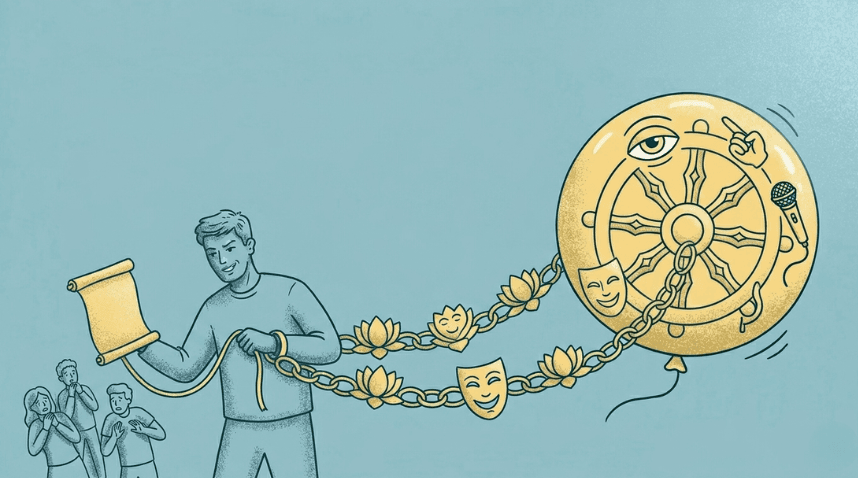
Congratulations on your spiritual growth in the Dhamma! Now that you’ve discovered the Dhamma, it’s time to make sure everyone else knows about it….especially at the worst possible moments. Here’s your guide to becoming that person nobody wants to invite anywhere anymore. (April Fools special)
The Birth Announcement Buzzkill
Your friend just had a baby. They’re glowing with joy, exhausted but happy, holding their newborn like it’s the most precious thing in the world. This is your moment.
What to say: “Well, birth is the cause of death, isn’t it? The First Noble Truth tells us life is suffering. Now you’ve brought another sentient being into samsara. Have you considered the karmic implications?”
The awkward aftermath: The room goes quiet. Aunty drops her phone. Someone coughs nervously. Your friend’s spouse suggests that maybe you have somewhere else to be.
The actual lesson: Yes, the Buddha taught about suffering and impermanence, but he also spoke about loving-kindness (metta). Understanding life’s challenges doesn’t mean ruining happy moments. True practice means holding both the reality of impermanence and the beauty of precious moments. Just say “Congratulations!” first. The deep conversations can wait.
The Attachment Free Dinner Guest
You’ve been invited to a dinner party where your friend spent six hours preparing their grandmother’s secret recipe. They’re beaming with pride.
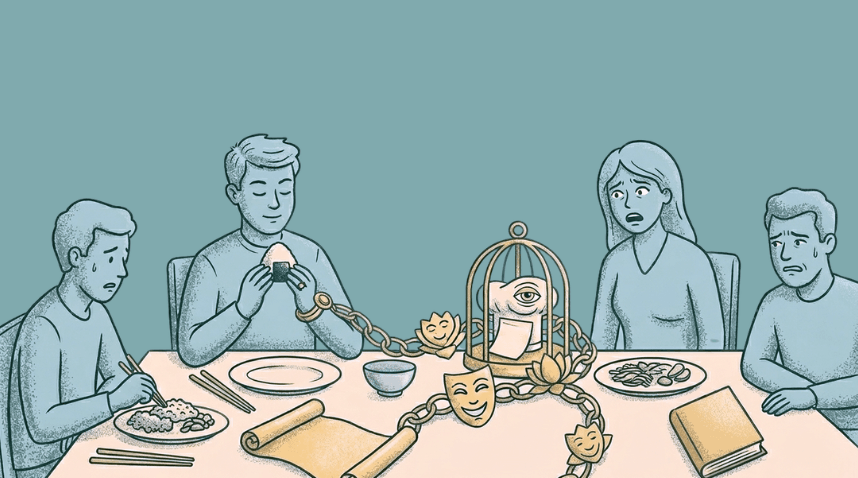
What to say: “I’ve probably transcended attachment to taste. Everything is just fuel for this temporary body. There’s a monk who eats blindfolded to avoid sensory attachment, you know?”
The awkward aftermath: Your host stares at their lovingly prepared meal. Another guest quietly eats your portion. You’re somehow both sanctimonious and still helping yourself to seconds.
The actual lesson: The Middle Way isn’t about rejecting all pleasure. It’s about not being enslaved by it. The Buddha rejected extreme asceticism for a reason. Appreciating good food mindfully, acknowledging the effort and connection it represents, is perfectly fine. Try: “This is delicious, thank you for preparing it.”
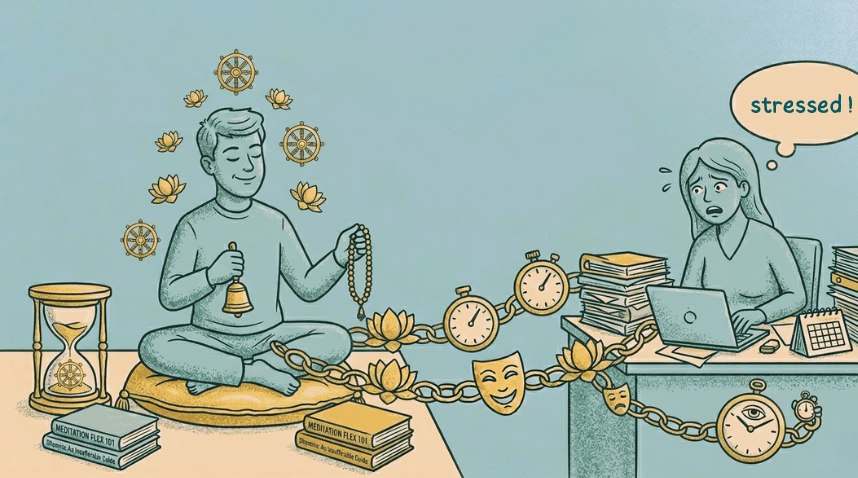
The Meditation Flex
Someone mentions they’re stressed about work deadlines.
What to say: “I wouldn’t know about stress anymore. I meditate two hours daily….one hour in the morning, one at night. Working toward three hours now. My teacher says I’m progressing quite rapidly. Have you tried just… not being attached to outcomes?”
The awkward aftermath: Your friend now feels both stressed and inadequate. They’re definitely not calling you next time they need support.
The actual lesson: Meditation is a tool for growth, not a competitive sport. The Buddha’s teaching on Right Speech includes being helpful and timely. If someone’s drowning, you don’t lecture them about your swimming achievements, you help them. Share techniques if asked, but spiritual one-upmanship is just ego in different packaging.
The Impermanence Party Pooper
Your friend just got promoted or bought their first flat, or got engaged.
What to say: “That’s nice, but you know it won’t last. Everything is impermanent. Companies downsize, relationships end,and houses deteriorate. Clinging to these temporary conditions will only bring suffering.”
The awkward aftermath: The celebration ends abruptly. Your friend wonders if you were ever really their friend.
The actual lesson: Understanding impermanence should make us more present and grateful, not less. When we know flowers will fade, we treasure them more deeply while they bloom. The teaching on impermanence is meant to free us from anxiety, not to weaponise against joy. Rejoice in others’ happiness (mudita) while it’s here. That’s also part of practice.
The Kamma Accountant
Someone shares they’re going through a difficult time, like illness, job loss, or relationship trouble.
What to say: “Well, everything is kamma. You must have done something in a past life to deserve this. Have you reflected on what negative actions you might be reaping the consequences of?”
The awkward aftermath: You’ve just blamed someone who’s suffering for their suffering. They’re hurt, and rightly so. Congratulations, you’ve also created some questionable kamma yourself.
The actual lesson: Kamma is complex and not meant to be wielded as a judgment stick. The Buddha consistently emphasised compassion over cosmic scorekeeping. When people suffer, they need support, not blame. Even the Buddha didn’t always explain suffering through past actions. He cared for the sick monk nobody else would help. Practice compassion first, philosophical discussions later (or never).
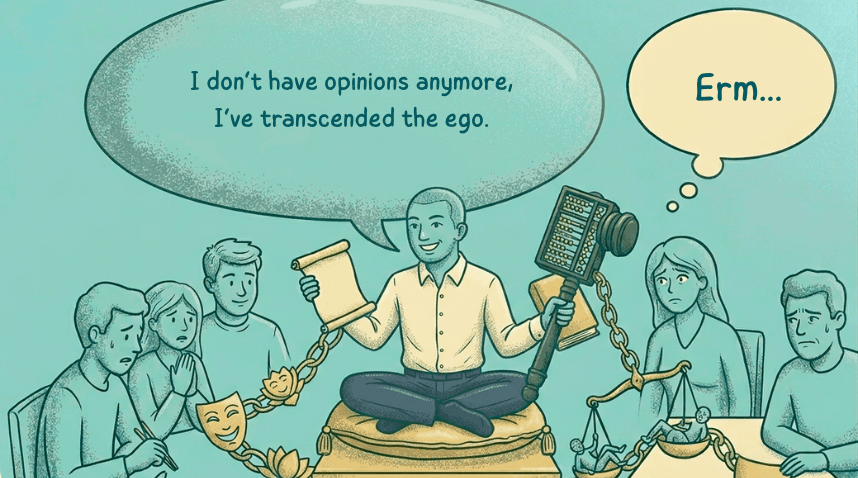
The Ego Free Ego Trip
In any group discussion:
What to say: “I don’t have opinions anymore, I’ve transcended the ego. I simply observe without judgment, unlike you all who are trapped in your conceptual frameworks and dualistic thinking.”
The awkward aftermath: Everyone notices you seem awfully attached to being unattached. Your “egolessness” is the most egotistical thing in the room.
The actual lesson:Spiritual bypassing (using teachings to avoid genuine engagement or feel superior) is a trap. Real non-attachment includes not being attached to appearing enlightened. The most profound practitioners are often the most humble and ordinary. If you’re constantly announcing your transcendence, you haven’t transcended anything.
The Way Forward
Here’s what nobody tells you: being Buddhist (or practising Buddhism) shouldn’t make you insufferable. If it does, you’re doing something wrong.
The Buddha’s teaching was always practical and rooted in reducing suffering for yourself and others. If your practice makes you less kind, less present, less able to connect with people in their joy and sorrow, then somewhere along the way you’ve lost the plot.
Real practice looks like showing up for your friends. It looks like appropriate responses to situations. It means genuine warmth, not performative detachment. It means understanding when to share teachings and when to simply be human together.
So next time you’re tempted to drop a Dhamma bomb at a baby celebration, ask yourself: “Will this reduce suffering, or am I just trying to look enlightened?”
The answer might be the most important teaching of all.
Now go forth and be less annoying. Your friends will thank you.