
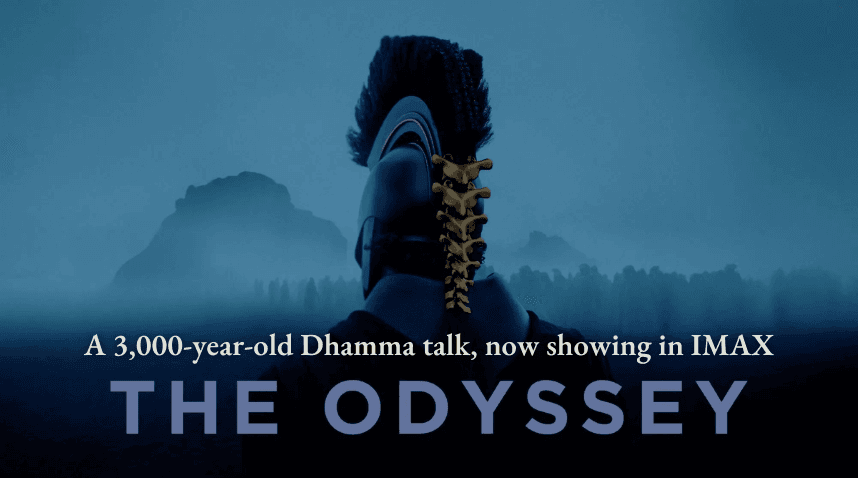
TLDR: Reflections on craving, virtue, and coming home… from someone who watches maybe two movies a year.
I rarely watch movies. Maybe two a year, if a friend drags me. So when I grabbed the ‘normal’ non-IMAX for Christopher Nolan’s The Odyssey, it was a genuine treat. I expected three hours of spectacle. What I did not expect was to walk out feeling like I had just attended a Dhamma talk.
Homer never met the Buddha. Homer’s poem, Odyssey, predates the Buddha by centuries. And yet a story about a man trying to get home kept pointing, again and again, at the same truths the suttas point at. Perhaps that is what happens when a story survives 3,000 years: only the parts that are true about the human condition make it through.
Don’t worry, I will keep this spoiler-light for a plot that is 3,000 years old (a bit of old news).
Here is what I saw as parallels between the Dhamma & Homer’s poem.
The sirens, and the river no one crosses
A quick primer for those who did not grow up with Greek myths. In the old lore, the Sirens are creatures who sit among the rocks and sing to passing sailors. The song is so irresistible that men steer their ships straight into the rocks to get closer to it. No one who hears it survives. The sirens do not attack anyone. They simply sing, and the sailors destroy themselves by drowning.
Let that sink in. The danger was never the sirens but rather the wanting.
And what do they sing about? Not treasure. As I understood from the film, the Sirens sing to you about all the things you wanted to be, and all the things you wish you had never wished for.
“That what you most want is what you most cannot have. And that what you most cannot have… is what you already had, and lost.” Odysseus
I sat there in the dark feeling thoroughly blown away.
Because that is taṇhā (craving): the thirst that runs beneath everything we chase. The Dhammapada puts it plainly: “There is no river like craving” (Dhp 251). Rivers at least reach the sea. Craving reaches nothing. It just keeps flowing, from the thing we want, to the next thing, to grief over the thing we lost.
Reflecting deeper on this part of the movie, Sirens are not out there on some rock. They sing every time I open my phone, every time I replay an old memory of who I used to be. The song is always the same song of transient praise that makes us feel pleased for the moment, but it never lasts. And just like in the lore, no one is steering our ship into the rocks except us.
Tie yourself to the mast
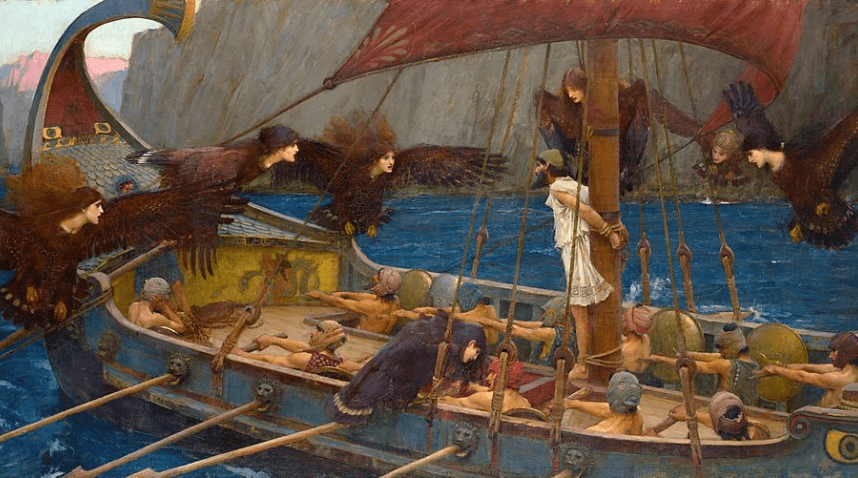
Here is what struck me most about Odysseus. He does not believe he can out-willpower the song. He knows that in the moment of temptation, he will fail. So he prepares before the moment: he has himself bound to the mast.
That, to me, is sīla (virtue, which includes keeping the moral precepts and a wholesome mind). We do not keep precepts because we are strong. We keep them because we know exactly how weak we are when craving strikes. The ropes are not a punishment. The ropes are not punishment. Tying them is what you do once you know that about yourself.
A climber’s rope is a restriction too. It stops you going where gravity wants to take you. But no climber resents it, because the rope is what lets them get up on the rock in the first place. Without it you stay on the ground, or you climb so carefully you never find out what you can do.
Sīla works on me the same way. The precepts let me go near the things that used to wreck me: desire, anger, other people. And other people get the safety too. When I do not lie or take or harm, they do not have to brace for me.
And the mast itself? For me, the mast is kalyāṇamitta (spiritual friendship): the wise friends and teachers we bind ourselves to. The Buddha went as far as telling Ānanda that admirable friendship is not half of the holy life but the whole of it (SN 45.2, Upaḍḍha Sutta).
I have felt those ropes hold. Ajahn Anan, one of my wise teachers, in Q&A sessions, has a way of pointing out your flaws so gently and so precisely that you cannot wriggle away from them.
And Ajahn Sumedho once reminded me not to be so willful in the practice… to smile more, to be gentle with myself. To build the path not with strictness but with softness held in khantī (patient endurance), which the Buddha called the highest austerity (Dhp 184).
I used to think discipline meant tightening my grip. Now I think it means choosing a good mast, and letting the ropes do their work.
Polished armour, soft body
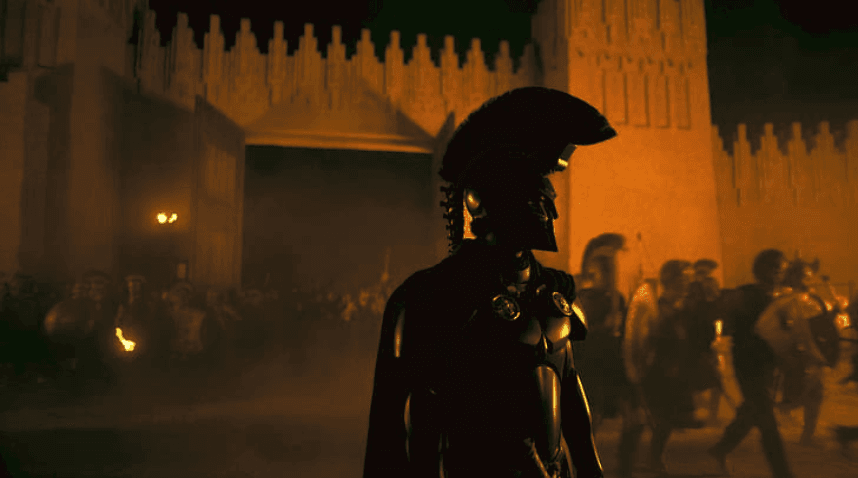
Then there is Agamemnon. In his armour he looks magnificent. (Some viewers joked he looks like Batman, and honestly, fair.) He won the war. He wears victory like a second skin.
But remember what the lore says his victory cost. To win the gods’ favour for the war, Agamemnon sacrificed his own daughter. He traded his child for glory. And after surviving ten years of battle, the great king was not felled by any enemy spear. He died in his own bedroom, at home, where no armour could help him.
Look closer at that armour; it is polished. Gleaming. It has clearly not seen battle in a long time. It represents a king that does not fight his own wars. And underneath all that bronze is the same soft, ageing, vulnerable body every one of us carries.
Two reflections hit me at once here.
The first is anatta (not-self). We build a solid-looking self out of victories, titles and reputation, and it is brittle precisely because it looks so solid. We build a strong self-image (just like Agamemnon’s armour) and go out and present it to the world. The world is suitably impressed, cowed, and responds in fear or praise to that image; but the inner work remains undone. When the self-image is shed, we are laid low by our kamma, past misdeeds and hindrances.
The shinier the armour, the more we forget the body inside it. Agamemnon armoured everything except the one place life actually reached him.
The second is more uncomfortable, because it is about people like me. Polished, unused armour is also what Dhamma knowledge looks like when we collect it but never apply it. The Dhammapada compares someone who recites many teachings but does not practise them to a cowherd counting other people’s cattle (Dhp 19). I have shelves of Dhamma books. Some of them are… very well polished.
Armour only protects you if it gets used and not kept for ceremonies. The same is true of the teachings.
Athena, the voice that will not let you forget
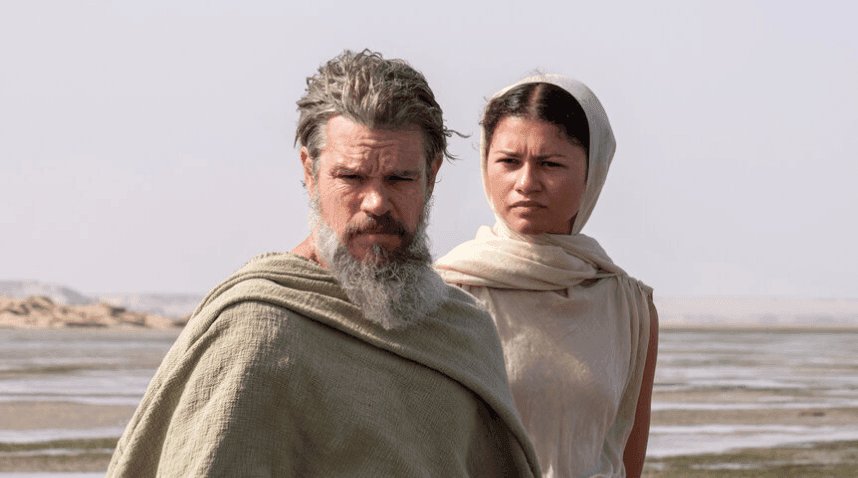
In Greek lore, Athena is the goddess of wisdom, and Odysseus has always been her favourite. In the film, she is less a rescuer and more a conscience. She appears at the moments when Odysseus is closest to losing himself: when pride swells, when he drifts from the man he is supposed to be, when the cost of his choices lands on the people around him.
She does not fight his battles for him. She reminds him of who he is, holds his failures up to him without flinching, and points him back towards home.
Watching this, I kept thinking of hiri (moral shame) and ottappa (fear of wrongdoing). The Buddha called these two qualities the guardians of the world (AN 2.9), because without them, he said, humanity would fall into chaos.
We tend to hear “shame” as something toxic. But hiri is not self-hatred. It is the small and quiet inner voice that says this is beneath you, the way a goddess might say it: with dignity, expecting better of you. Ottappa is its partner, the wise wariness about consequences. Together they are not there to crush us. They are there to guide us back, every single time we drift. Athena never abandons Odysseus, no matter how far he strays. Neither do these guardians abandon us.
The guardians of the world do not scream or shout. They whisper, and then they wait for you to turn around. Or in Zendaya’s (actress who plays Athena) case, she just sulks.
The bow only you can string
You probably know the fable’s most famous test, so this gives nothing away: there is a great bow, and suitor after suitor tries to bend it to string it. None of them can. It answers to one person alone. Odysseus loses everything (wealth, fame, people, time) except this quality of his, a skill & a defining practice of his, that he returns to and honour.
It reminds me that one is heir to one’s kamma, owns it and is borne of it. Another person (the various suitors) cannot take your place and bear it for you, for it is “yours” alone.
I keep returning to that image as a question for the practice. The sutta this website is named after reminds us that the Buddha taught only a handful of leaves out of an entire forest (SN 56.31): a small set of essentials, because that is all we truly need. But even within that handful, each of us seems to have one leaf that fits our hand differently than anyone else’s. For one person it is mettā (loving-kindness) that comes naturally. For another, khanti (patient endurance). For another, cāga (generosity) that flows without effort.
I rarely watch movies. I am glad I watched this one, because it sent me home… in more ways than one… with a single question I now pass to you:
What is the one wholesome quality in your practice that you are familiar with, return to naturally, and perhaps you, and only you, can bring it out to the fullest extent for yourself?