
TLDR: The Five Precepts support ethical daily living, while the Eight Precepts create temporary conditions for deeper practice. One helps you live well in the world, the other helps you step back and study the mind.
Most Buddhists are familiar with the Five Precepts. They form the basic ground for living well with others. Do not harm. Do not steal. Be honest in speech. No sexual misconduct. Avoid intoxicants.
These rules support a life where trust, respect and peace can grow. It also enables a mind that settles easily into meditation and stillness.
“So, Ānanda, the purpose and benefit of skillful ethics is not having regrets. Joy is the purpose and benefit of not having regrets. Rapture is the purpose and benefit of joy. Tranquility is the purpose and benefit of rapture….. “ Excerpt from AN 11.18
The Eight Precepts feel less familiar. People usually encounter them during retreats or full-moon observance days.
On first glance they look demanding. No dinner. No entertainment. No perfumes or adornments. No sexual activity. A simple place to sleep. For someone juggling work, family and commitments, the list can feel unrealistic.
But the Eight Precepts were never meant to be long-term burdens for the average lay person. They create a temporary environment where the mind stops running after stimulation. The body settles. The day slows down.
Patterns that are usually hidden become clear. They are not stricter versions of the Five. They serve a different function altogether. They give practitioners a chance to live like Arahants (enlightened beings)!
To see the difference, it helps to understand what each set is designed for.
The Five Precepts: Support for everyday life
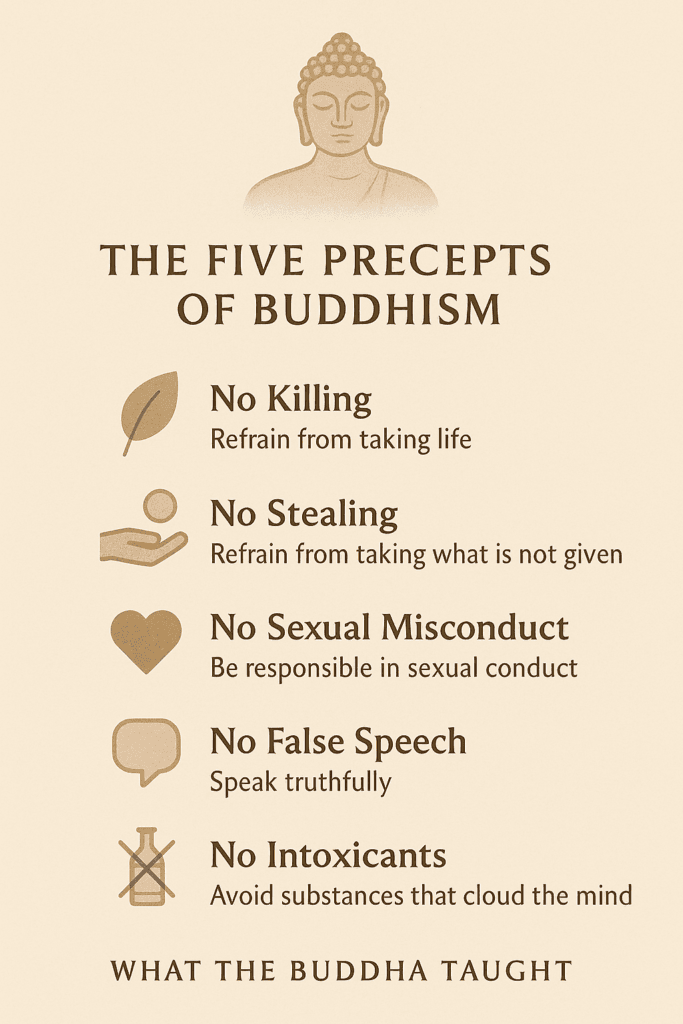
The Buddha gave the Five Precepts as a foundation for lay life. They keep daily interactions clean and prevent the kind of harm that creates guilt or conflict. Someone who keeps them steadily usually feels fewer complications in relationships and fewer moments where they have to repair the consequences of their actions.
The Five are practical. They help a person move through the world without leaving a trail of regret.
A well-known teaching from the Aṅguttara Nikāya reminds practitioners of how precepts support the mind. The Buddha says that when a person reflects on their ethical restraint and sees no transgression, “joy arises, and from joy, rapture arises” (AN 11.1). This is not theory but a reality. Ethical living makes the mind lighter.
Try meditating after scolding or insulting someone, the chances of a good meditation will be very slim.
Let’s Talk About Sex Before Diving Into The Eight Precepts
The Eight Precepts remove the usual noise that surrounds us. They simplify the body, the senses and the environment. This frees up mental energy for observation, stillness, and insight.
Each precept plays a role.
Under the Eight precepts, the 3rd precept changes from avoiding sexual misconduct to avoiding sexual activities. I funnily recalled a Dhamma friend erroneously saying she can’t take the five precepts as her husband will not be happy because of the third precept.
The third precept, in the context of the five precepts, pushes practitioners to keep loyal relationships and never use sexuality as a weapon. The eight precepts changes that to be chaste for that period of practice.
The Eight Precepts: A change in lifestyle, even if only for a day
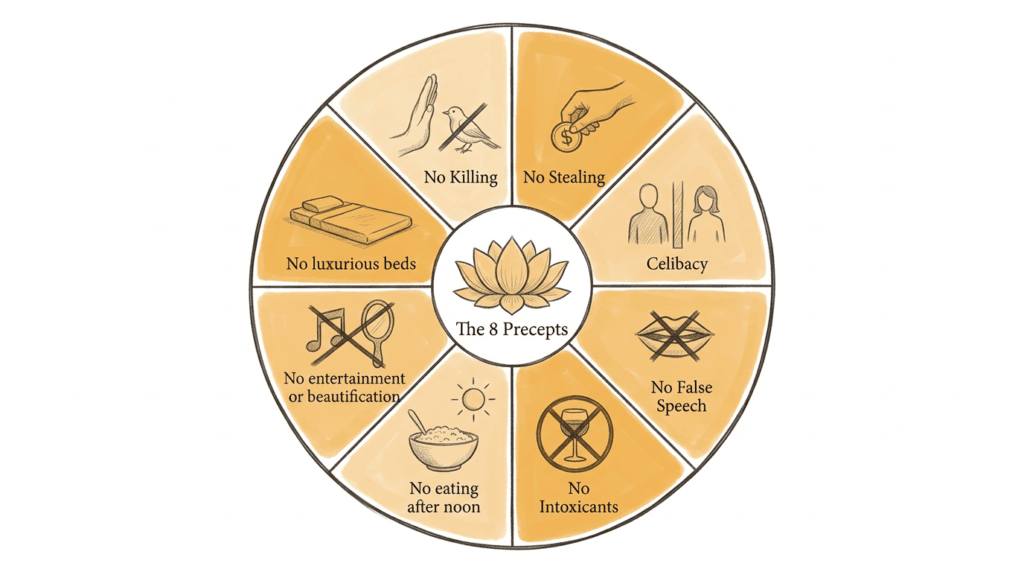
Avoiding sexual activities brings the mind away from lust and heavy craving.
Avoiding dinner rests the body (no food coma for evening practice too!)
Avoiding entertainment keeps attention from scattering.
Avoiding adornments removes the pressure to present an image.
Sleeping simply makes waking up easier and steadier.
The Buddha spoke about this kind of simplicity often. In MN 39, he describes the lifestyle of one who trains to reduce excess: modest clothing, simple food, and a mind that moves away from indulgence. The Eight Precepts follow the same logic. They narrow the stream of stimulation so the mind can see itself without interference.
They are not permanent rules for us, the typical layperson. They are short-term conditions for deeper practice.
Why do people take the Eight at all?
People choose the Eight Precepts for many reasons.
Some want a break from constant activity.
Some want to observe their habits without distraction.
Some take them during stressful periods to regain balance.
Others take them simply because the heart asks for more space than usual.
Ajahn Chah, the famous meditation master, explained this shift well. In No Ajahn Chah, he said, “If you let go a little, you will have a little peace. If you let go a lot, you will have a lot of peace. If you let go completely, you will have complete peace.”
Reducing stimulation is one way of letting go a little. The Eight Precepts provide a structure for that release.
What actually happens when people try the Eight
Before taking them, most people worry about the rules. No dinner sounds intimidating. No entertainment sounds dull. Yet when they try it, the experience tends to be different from what they expected.
Hunger rises, then fades.
The mind stops jumping from distraction to distraction.
Sleep becomes lighter and more restful. The morning feels clean.
Without entertainment, the mind’s restlessness becomes obvious. Without adornments or performance, the pressure to impress evaporates. What remains is a quieter form of attention.
The Eight Precepts are about seeing what drives us. They reveal our impatience, vanity, cravings and habits not to shame us, but to help us recognise them. The suttas often describe this as the beginning of insight. In MN 19, the Buddha explains how observing the mind’s movements allows unwholesome thoughts to fade and wholesome ones to grow.
People are often surprised by how quickly this happens. A day of the Eight Precepts can feel longer, fuller, and strangely spacious, even though nothing big happens.
How the Five and Eight Precepts relate to each other
The Five Precepts steady the way we behave with others.
The Eight help us understand the way we behave with ourselves.
The Five are about restraint in the middle of daily life.
The Eight are about stepping back from daily life so we can watch the mind work.
They simply serve different seasons of practice. A person may keep the Five throughout their life and take the Eight once a month, or during retreats, or during challenging periods. Another person may take the Eight only occasionally. Someone else may take them regularly to remind themselves of how simple life can be when cravings ease.
The point is not discipline for its own sake. It is freedom from habits that weigh the mind down.
The Buddha calls the precepts “training rules” (sikkhāpada), not commandments. They are tools. They help us notice and work when taken up willingly.
A way of living more deliberately
For anyone curious about the Eight Precepts, the question is not whether you can do them perfectly. It is whether you want to spend a day living more deliberately than usual. If the answer is yes, the practice will show its benefit.
The Five Precepts make daily life stable. The Eight Precepts show you what the mind does when the world becomes simple.
Both lead toward the same destination described throughout the Nikāyas: the gradual fading of confusion, agitation and regret. When those fall away, the heart becomes light enough to understand the Buddha’s path from the inside.
Wise Steps:
- Set aside time to try the Eight Precepts for just one day, because treating them as a temporary training rather than a lifelong burden makes the practice realistic for working adults with family and responsibilities.
- Eat simply and stop after the permitted time. Avoiding dinner is not about punishment but about resting the body and seeing how quickly hunger rises and fades.
- Cut out entertainment for the day, because once the usual distractions are removed, you can observe just how restless the mind becomes and begin to understand what usually keeps it scattered.