TLDR: In this post, we share insights on loving-kindness meditation, where we learn that within us, lies the mother who loves her child unconditionally.
Like many beginner Buddhists, I started my meditation training by paying attention to the breath.
At the time, I had no idea how to meditate. I was just watching the breath, and over-focusing on it brought on both tension and calm. Tension arose when I was unable to focus my attention on the breath and calm arose when I was able to pay attention to the breath.
It was after a very long time that I noticed I was meditating unskillfully because I did not want tension but I wanted calm (wanting and not wanting are causes of suffering in the second noble truth).
While training my mind, I learnt the loving-kindness chant, and also loving-kindness meditation. This meditation practice was a lot easier than focusing on the breath. It is very pleasant to practice and seldom did I feel the tension in loving-kindness meditation.
But when there is a narrow focus on loving-kindness as an object of attention for a sustained period of time, I clung to the pleasantness of this meditation and felt dissatisfied when I could not escape the tensions of daily life into this beautiful experience of inner conditioned love.1
An external understanding of loving-kindness
The entire loving-kindness chant is worth reading over again and again for reflection. When we become familiar with meaningful chants such as the loving-kindness chant, we may find ourselves experiencing some of the verses in daily life.
For instance, the verse: “Unburdened with duties and frugal in their ways”, made me realise that I need to not surround myself with so many tasks or hobbies that I can’t practice mindfulness in my life.
There is also a portion of the chant that inspires me:
“Even as a mother protects with her life
Her child, her only child,
So with a boundless heart
Should one cherish all living beings”
Love and wisdom are aspects of the Dhamma that are inseparable.
Love without wisdom is foolishness while wisdom without love is cold and selfish. I was inspired by the verse and wondered how I could cherish all living beings with a boundless heart as a mother who loves her child.
But I was blinded by arrogance as I was still very identified with my personality – my name, and my background – essentially thoughts I could not let go of. While clinging onto the thoughts of ‘I’, ‘me’, and ‘mine’, I thought about wanting to spread boundless, or unconditional love to all beings. But how could it be possible, when the type of love I understood, is a thought that has no permanence? Since thoughts are fleeting.
An internal understanding of loving-kindness
Whenever a habitual thought/feeling is solidified (seems real to the mind), we take ownership of it and defend it. The experience of a solidified thought/feeling or feeling/thought is tension in the body. There is a contraction which is a feeling of tightness somewhere in the body.
When we notice how tension (suffering) is caused by holding onto thoughts, and how one thought causes a chain of thoughts (psychological rebirth), we can drop thoughts as if we are dropping a lump of hot burning coal we have been holding onto all our lives.
Our society prize thinking as the gift of humanity, as shown in our knowledge economy, and so we cannot bear to part with it. Thinking has contributed to a better way of life for individuals but has also destroyed much of Mother Earth.
The result of dropping thoughts habitually causes an almost immediate letting go of tension in the mind and body. Upon letting go of the tension, there is deep relaxation and opening of the mind (which embodies the whole body).
Thoughts start to part like clouds in the sky, and the sky is the experience of a widened awareness, resembling the mother in the loving-kindness sutta, who loves her child (the fleeting thoughts and feelings) without being attached.
The child here can be unwholesome thoughts or feelings, as well as wholesome ones. There is that embrace of the mother with love and wisdom. She knows the child comes from her womb, but it isn’t her, and therefore she can soothe its pains and pleasures.2
Loving-Kindness in every object of meditation
Loving-kindness is a precious spiritual practice in our world where most minds are absorbed into the digital domain of endless thoughts – on social media, news apps and video streaming. Although most meditators begin their meditation journey with the breath, and practice loving-kindness separately, in reality, they aren’t separate.
We can see loving-kindness as the mother, that embraces the child, which is the breath. Every meditation object we use to train our attention is embraced by the mother, a spacious awareness that embraces the child. Within all of us, lies this mother who loves her child unconditionally, within or without.
Footer:
1 Conditioned love involves a person thinking about love. Unconditioned love is an experience without needing someone to think about love for it to arise.
2 We normally identify pain as suffering. But pleasures cause suffering too, when we don’t get what we want, or get what we don’t want.
Wise Steps:
Loving-kindness is an unconditional aspect of the dhamma. But to practice it, we need to condition our minds with regular guided practice.
Reflect on the loving-kindness chant, so that you can notice the verses become a reality in your life.
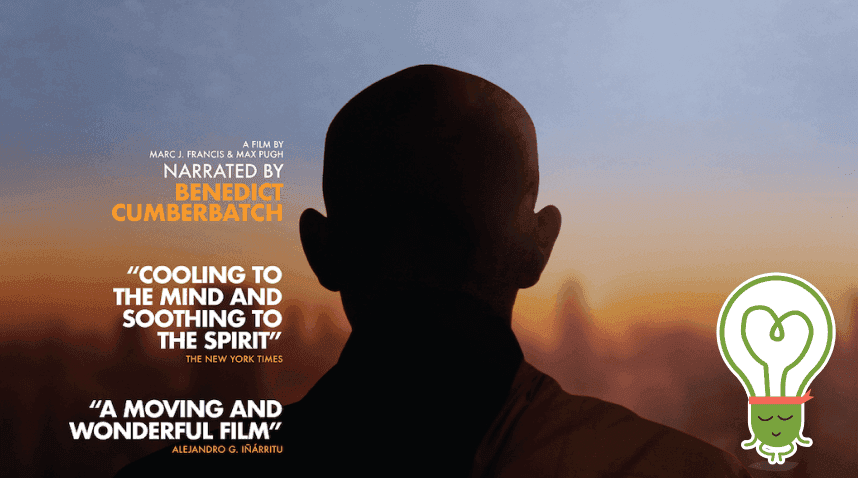
TL;DR: This a reflection of a short movie about Thich Nhat Hanh, his teachings and community. Let’s walk together.
I had the chance to join the DAYWA (Dhamma Assembly for Young Working Adults) group for the Walk with Me movie screening some weeks ago. It’s a documentary showing a glimpse of activities in Plum Village, the community founded by Thich Nhat Hanh in France after he was exiled from Vietnam during Vietnam war time. It is a space for practitioners to immerse themselves in Zen Buddhism and the art of mindful living.
The directors perhaps wanted to appeal to a wider population, accompanying it with narration by Benedict Cumberbatch – with his deep voice and strong British accent. And I believe it may have worked when he read several lines from Thich Nhat Hanh’s journal throughout the movie.
There isn’t much dialogue or scripted lines like we’re used to in movies. It contains snapshots of activities, short conversations, moving images or sounds of nature.
What may seem like random scenes strung together, turns out to be a strangely beautiful flow of the story for me.
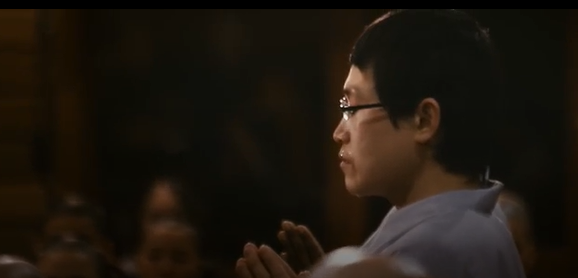
Cr: Scenes from the film
Captivating scenes
One of the earlier scenes left a deep impression on me: a group of laypeople on their knees, waiting in line for ordination. What’s striking isn’t so much the act of joining the ordained ones, but the deep sense of relief I see in their faces. Tears flooded down their faces, not from grief, but as if a huge rock had been lifted off their chests.
Cr: Scenes from the film
Witnessing such an intimate emotion, I can’t help but tear up and wonder to myself: when was the last time I experienced such a huge relief? What is weighing us down in life?
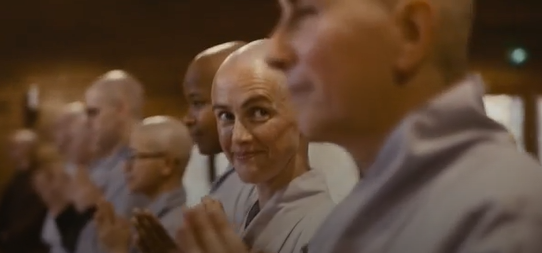
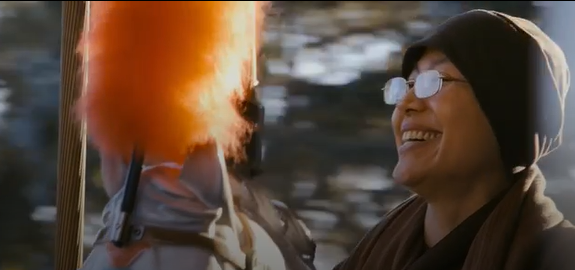
Cr: Scenes from the film. I love the knowing smile of “welcome to the group”
The bell chime every 15 minutes was cited by many of us as a good reminder for mindfulness – stop whatever it is and catch our breaths intentionally while listening to the bell for a few seconds. The resumption of the activities seems as if nothing has disrupted the motion; if not with the attitude of new experience.
Perish
“Friends want you to appear in the familiar form they know. But that is impossible. How could we continue to live if we were changeless? To live we must die every instance. We must perish again and again in the storms that make life possible.”
A few sentences with an immense reminder to the ever-changing nature of life: we’re not truly living if we try to fix part of us from others’ memory of us and we can’t fix others based on our memory of them.
It also reminds me of one poem in Yung Pueblo’s book Clarity & Connection:
How can we have a real conversation if every time we speak I can see in your eyes that my words are not reaching you? They stop at a narrative you have created about me based on who I was many years ago.
A reminder to let go of the past – image and belief of something and someone. So we could be fully present with what is in front of us, even if it’s a version that we’re unfamiliar with or dislike about.
The movie wasn’t only filmed within the compound of Plum Village, but also journeys to the outside world to share Buddha’s teaching. It was interesting how the monks’ and nuns’ encounters in the U.S. (prison visit, park meditation, monk’s and nun’s visit of family) shine light on the many who don’t understand Buddhism.
The scenes showed how these monks and nuns patiently shared with those who’d like to listen, in a way relatable to them. It was almost funny how the prisoners seemed to be frightened or perhaps showing pity when the monk said monks/nuns do not hold possessions and don’t even hold their own money – as if to ask: who is the one living in jail? But who is the freer person – the one who chooses to drop things or who yearns for things being denied?
Final words
I’ve watched the piece for the second time to write this article and a third time to find meaningful scenes to include alongside and realise that I can ‘watch’ it with my eyes closed. The directors have inserted beautiful sounds of nature, chanting and singing, familiar yet unfamiliar words and melodies. This is the first time I’ve heard Namo Avalokistesvara being chanted alongside violin accompaniment – a new way to appreciate the words and embrace what it stands for.
Cr: Scenes from the film: A smile can be a beautiful sound
One may expect to see more scenes with the Master himself. While Thich Nhat Hanh does make a couple of appearances in answering a question from a little girl (she’s feeling sad because her dog has passed away) and scenes covering his presence in the hall, there are limited scenes of him. His teachings and messages are cleverly transmitted through the actions and energies of his students; even in mundane activities like (mindfully) sipping a small cup of tea.
In summary, this may not be the typical movie or documentary.
One needs to appreciate and trust the flow enfolding every new second, as our self-held expectations and mind search for particular meaning or story, which is the result of a mind habitually trained at grasping. We can probably practise what Thich Nhat Hanh himself taught and come home.
Key Reflections:
Keeping ourselves open to new activities with a new group of people could result in a positive experience
The group may be watching the same film, but the message that strikes us individually may be different depending on our internal world
Lengthy script isn’t necessary to transmit a message that is well-woven in the visual, audio and tone of the piece
Editor’s note: This is an abridged version of Roberta’s Vipassana experience post on her blog. There are many different ways to approach meditation and start learning. Some are more hardcore than others. Ultimately, it is about finding the techniques that suit your temperament and strengths. Roberta’s retreat experience represents one of the diverse Buddhist meditation techniques that one can try! Do check some out here
TLDR: The opportunity to sit in silence for 10 days was equally the hardest and most gratifying experience I’ve had so far. I decided to write about my Vipassana experience and try to distil my observations and reflections. Whether you one day embark on a similar retreat, or even if you don’t, I hope it encourages everyone to introspect on their mental thought patterns in a beneficial way. May we all break free from the thoughts that hold us back.
Ten days, a vow of silence, no interpersonal communication and absolutely no external distractions. Alcohol, tobacco, drugs, books, writing materials and any type of electronic device are all out of the question. Heck, you aren’t even allowed to bring your own snacks. Ten days with you, your mind and your body, separated from the material possessions that define you.
In this contained environment with nothing to escape to, would I be able to sit with the unwelcome visits of Madame Ego and Mr Monkey Mind with a compassionate lens?
What would consume me to attend a course like Vipassana? How has it impacted me, if at all. Where is my head after the experience and will I continue the practice? Let’s process.
Reflection
It was liberating to know that I could push my mind to sit through at times very gruelling sessions.
The course was a powerful practice of discipline, and a real humbling reminder that we don’t need to act on the critical, and often dominant, voice inside. It brought to the forefront the complexities of what we consider our identities, and how we have a say in how we define our experiences.
I was able to reflect on the many roles I play in my own life (partner, daughter, sister, friend…). I’ve rewritten this post a few times, in the hope of avoiding sounding like a generic Vipassana informational. I’ve landed on sharing the points that defined my Vipassana experience…
Grounding in nature
For those of us that live in cities, our daily lives are often dominated by being indoors and sheltered from the elements.
The opportunity to be in Blackheath, one of the highest points in the Blue Mountains surrounded by lush greenery, Australian rich red soils and rolling hills was a blessing.
It was a true lesson of living in the moment, as the weather would change in the blink of an eye. Sunshine and wispy white clouds would shift into ominous grey balls pissing down with showers. Howling winds would break into stillness.
Being lucky enough to attend in Spring, we became witness to flowers blossoming, majestic sunsets, and titillating thunderstorms (nature’s Dolby surround sound).
By day 3, there was an observable grounding in the cohort, people less on a mission, and more in the moment…
Remaining equanimous
The course requires meditators to follow a schedule from 4am-9:30pm daily, with up to 11 hours of seated Vipassana meditation each day.
Those hour-long sits with no movement, could easily make you think that time itself had cruelly and permanently stopped. Your body would scream and every cell in your body would be begging you to move. Yet, as physically or mentally excruciating as the sessions could be, each meditation block would come… and go.
Food times were a reminder of the same. The course schedule had two fixed meal times (6:30am and 11am), where we’d feel the short-lived exhilaration of receiving sustenance, a natural dopamine-lifting activity.
We’d happily receive a dollop of vegetarian food with some rice or bread and a simple side salad. We’d relish the warmth, or the spices, the crunch or smooth textures of the meal.
One perfect bite and all the memories of the painful hour before would all but dissipate. And as quickly as we’d lined up at the start, mealtime would be over and we’d be in another gruelling meditation session.
It was a true lesson of the impermanent nature of everything, good or bad.
Introspection
As the days progressed, it became more intuitive to observe the inner voices and mental thought patterns without being carried away by them.
By creating the intention of breathing and objectively noticing, it allowed space to question the patterns and impulses that sway us like ships in a storm.
Some meditations, I’d feel like walking out early and running away. Other’s I’d feel the competitive urge to stick it out. Slowly, the meditation time blocks became sacred and immovable, and it would only be my mind running away rolling through it’s dialogue.
It was particularly interesting to observe my mild human addiction to catastrophizing, assuming situations will result in the worst possible outcome (cut to scenes of when my clients would tell me they needed a word and I would agonise thinking I did something wrong when in actual fact, it was a kudos for a job well done). The whole experience became an exercise of observing sensations, acknowledging its existence and letting it pass or shift into something different.
Boredom
With none of the usual external objects of distraction handy, it was inevitable that I’d misconstrue the silence as boredom. However, surrounded by the crisp mountain air, allowing myself to do nothing allowed space for my most creative ideas and for old forgotten memories to surface.
New connections formed by linking new and old experiences resulted in new perspectives and questions to ponder. I remain evermore in awe of the brain and human spirit as it is a constant vault of activity that is never completely knowable to us.
I realised that my interpretation of boredom slowly shifted into enjoyment for the quiet space where these bouts of inspiration could appear.
Taking things less seriously
With no one to talk to and hours of often intense isolating meditation experiences, it was easy to get into an existential or philosophical mindset (Why did that memory come up? Why does it hurt so much? Who is that voice in my head? I feel restless, I should be at home writing…).
During a recess on Day 5, halfway through the course with a throbbing lower back and tight hips, I was reflecting on the morning Vipassana session, where the theme was a heavy reflection of my future.
Looking out at the deep green tree tops and rolling clouds, my mind swirled with thoughts of life after Vipassana and I felt a fire ignite in my gut about the changes I’d need to make.
Sitting on a log bench overlooking the valley, my eyes were glued to a particularly tall and striking gum tree, rooted by a thick speckled trunk with peeling strands of dark brown bark that looked to have weathered many storms.
As I sat in wordless oneness with the tree, an Australian wedge-tailed Eagle (I kid you not) landed on one of the branches, directly in my foreground.
For a moment, it looked like a scene from Aztecan folklore – a premonition of the greatness to come. The Eagle sat majestically in profile view for a postcard shot in my brain. Suddenly, it turned as if facing me beak-on, and… dropped a huge shit before flying away.
That broke my trance and made me laugh. Not everything has to have a meaning. It just is.
The experience this time was very different to my first stint 7+ years ago. Beyond being obviously younger, and more immature, my young adult mind was riddled with anxiety and concerns about the uncertain future.
This time around, despite the pending uncertainty, I approached the experience with far more curiosity, openness and acceptance of myself. I could observe my reactions and mental jerks (sudden movements, not the nasty voices) with a sense of understanding. I have faith in my ability to weather any storm.
Will I continue the practice?
Now the golden question is, will I continue the practice? At this point, the answer is yes, until it is no. I am living moment to moment. While not all aspects of the theory agree with me (or rather, I with it), I value the practice for helping to create space and awareness of my own internal dialogue and impulses.
It empowers us to make conscious choices and to be the Master of our Present – the only true way to try to influence the future.
I’m a strong believer in the benefits of meditation and have long incorporated different techniques into my own daily life. I’ve spent years facilitating mindfulness courses (for corporate groups), and guiding meditations and I continue to foster a mindfulness community that I am lucky to learn from regularly.
I see meditation and mindfulness practices as a cornerstone to good mental health and resilience. So I naturally get a little uncomfortable when the course links meditation to something as obscure as spiritual liberation. I choose to take this part with a grain of salt, as the technique itself is practical and a helpful observation of one’s internal self. I hope it doesn’t scare people off, who could actually benefit from any sort of meditation practice.
Wise Steps:
Take time to observe your thought processes through a reflective activity, whether that be meditation, journaling, or talking to a therapist or friend. It will help to clarify your blocks.
Take things less seriously. Everything passes with time. Everything.
Wholesome Wednesdays (WW): Bringing you curated positive content on Wednesdays to uplift your hump day.
Trying to meditate and struggling to make it consistent? We know meditation is important but we often miss a few days or two and then…. it becomes a month without meditation. We explore two ways to go beyond ‘loving the idea’ of meditation and doing it consistently.
1. Tips for Lazy Meditators
2. A challenge to make your meditation habit stick
Tips for Lazy Meditators
Cr: Unsplash
What’s going on here & Why we like it
Ajahn Brahm, a Buddhist monk from Australia, shares on spirituality and our occasional obsession with dogma. The notion that we take on labels (e.g. I am a Buddhist from Singapore/Malaysia who follows xxx teacher) prevents us from being expansive in our hearts.
Ajahn Brahm then also shares a unique moment where a reporter scolded Dalai Lama on receiving a skirt from a poor lady. A pretty fascinating response from Dalai Lama that embodies the spirit of Christmas. We have time-stamped the story in the video below.
“You build a circle that grows, grows, and grows. And all those things you have fear of in the past. It vanishes.”
Wise Steps
What views are you holding on to that prevent you from embracing the differences in others?
Heavy Commitments are hard to stick with. Cr: Unsplash
What’s going on here & why we like it
The team at HOL has crafted a HOL 30-day challenge which you can check out and try to kickstart the year with consistency. Do give it a shot with short meditation videos you can follow daily!
“What you are is what you have been. What you’ll be is what you do now.”
Wise Steps
When was the latest time you tried something new for 30 days? The sign you have been waiting for is here 😉
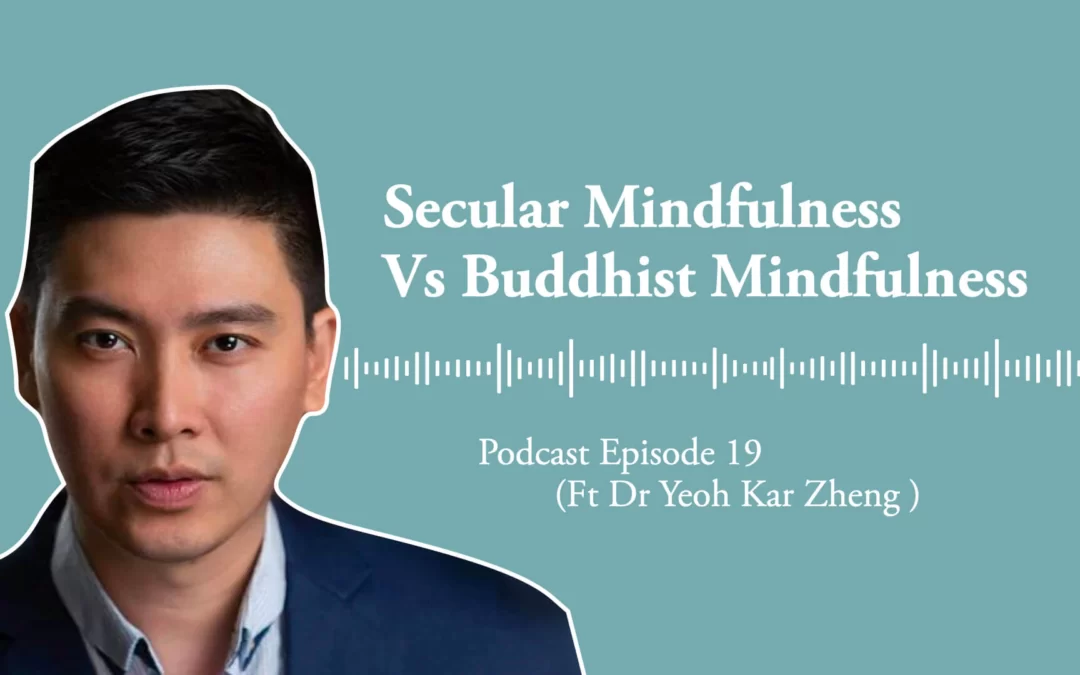
Dr. Yeoh Kar Kheng has over 15 years of experience in practising and teaching Mindfulness and is a certified trainer under the Search Inside Yourself Leadership Institute, teaching scientific-based mindfulness and emotional intelligence curriculum developed and tested at Google.
Welcome to another episode of Handful Of Leaves. Today we are very privileged to have Dr. Yeoh Kar Kheng. Fun fact, this is our third time recording the episode because of so many technical issues. And I think the very fact that Dr. Yeoh you are here with us, again, is testimony that you’re very, very mindful as well as stable and equanimous. I think this is because of your meditation practice, I suppose. Lots of love from you today. And for our guests who do not know you, even though you’re very prominent meditation teacher, could you start by sharing with us? How do you get to where you are today? Why do you stop practising mindfulness?
Yeoh Kar Kheng (00:41)
Thank you, Kai Xin and hello, everyone. So actually let’s bring us back about more than 20 years ago, when I was a university student, at the age of 20 years old, I suffered from mild depression and insomnia. So I was eagerly looking for a way how to cure my monkey mind. I was introduced to Buddha’s mindfulness meditation, you can call it a Satipattana meditation. During university, I know meditation from Brother Lim Bon Cheng – he recently just got elected as member of Parliament in Australia. So, he brought me or introduced me to Buddhism, and Vipassana meditation, and this is how I get started. And then I started to attend many different retreats in Malaysia, in Burma and Thailand, and learn from different Buddhist traditions.
And then, in year 2008, I went to Oxford, to study for my PhD in organic chemistry. And because I’m a scientist, okay, I’m now a university lecturer in Penang. So I study chemistry, and I teach chemistry. And it’s always my intention to introduce mindfulness or meditation in a more approachable way, by using a layman term, and perhaps to connect it with science.
So when I was in UK, in Oxford, at that time, there was a very famous Oxford Mindfulness Centre, so I was able to attend an 8-week mindfulness-based cognitive therapy (MBCT) cause and that was my first encounter with contemporary mindfulness, or sometimes we call it secular mindfulness. And I admire the way that they teach mindfulness without using very complicated Buddhism. And also the course is very structured and combined different meditation techniques. You can see the formula from the Mahasi method, from the Goenka method like body scan, and they also have some mindful stretching, and yoga activities in the 8-week course. And they also bring in some modern psychology concepts, the MBCT, cause the main purpose is actually to prevent recurrent depression. There are many books that have been published on this topic. And then when I returned to Malaysia, “I thought, Oh, this is quite good. Especially this is well suitable for the Malaysian context. And I think it’s the same for Singapore as well.” Because we have multi-racial and multi religious, people around. So I thought, oh, in this way, if we can bring mindfulness to the university, to the hospitals, and to the kids, that will be very nice, without, you know, having the Buddhism label.
I started to conduct mindfulness courses in my university, for the university lecturers and staff and some students as well. And this is how I started. And then slowly, eventually, I started to offer a mindfulness course, a secular mindfulness course but I do not call it MBCT because I’m not an MBCT-certified teacher. That time I call it EQ, mindfulness, and how to use mindfulness to develop emotional intelligence. Actually, I got this idea from Meng, a Singaporean, as someone passed me his book Search Inside Yourself. And that is how it’s about how to develop emotional intelligence using mindfulness, I thought that will be fantastic. Because this is emotional intelligence is something that is very much needed by everyone. Almost everyone. So I thought that there will be very, very brilliant ideas to bring this to the public. And of course, there are some requests as well, when people know about them, I’m running my class in the US, and some reporters did some interviews with me. So it gets some attention from the public. Therefore, I started to offer mindfulness courses to the public, in English and also in Mandarin.
Eventually, I also set up a Malaysia Mindfulness Association. I’m the founder, and also the chairman with the intention to bring mindfulness or to create the awareness, you know, of mindfulness to the public. Of course, this is what I mentioned is about secular mindfulness, without using any Buddhist terminologies. So this is how I started and I have been doing this. And also now, one last thing, I eventually received a scholarship from Meng, to be trained as a certified teacher to teach the Search Inside Yourself or SIY programme, so I also have been teaching this for a number of years in Malaysia, and China’s Hong Kong and different countries.
Kai Xin (06:34)
Wow, that’s fantastic. When you say, keep it secular, it reminds me of this particular saying, by I believe, Goenka, “the breath knows no religion.” So regardless of whether you’re Christian, Muslim or Buddhist whatsoever, you have this breath, you can be mindful. And that’s something we’re going to dive deeper into. Because mindfulness as a word has been quite popular these days. I think people use it as a practice for various reasons. I’m particularly curious about your own experience, what got you saying that this is something that you want to dive deeper into? And this is something beneficial to me? Is there a trigger point in your life?
Yeoh Kar Kheng (07:17)
Yeah, definitely. Because the retreat experience that I got, you know, really helped me a lot, as I mentioned earlier, so I got into mindfulness because I suffered from some emotional issues. You know, like, I didn’t know how to work with my emotions, for example, sometimes it’s weariness, sadness, and stress, and so on and I couldn’t sleep. So, mindfulness meditation offered me a way how to work with this emotion. So, from then on, of course, my retreat experience was very long, it was not easy at all at the beginning.
But somehow after my second retreat, I start to get a deeper understanding and have what we call practical experience, on how we can bring our mind back to the present moment, and how to calm the mind. And through understanding the nature of the mind, with no doubt, you know, I am very confident that it can help a lot of people because it has helped me a lot. The mind was very messy, worrying about the future or thinking about the past, you know. After I learned about mindfulness and became more mindful, which means in simple terms, I was able to stay in the present moment, and my mind became quite peaceful. And then when, for example, anger and weariness arise, I was able to notice it, you know, and then just observe it without following the thoughts or emotions. So, this is something that when you have got the experience, it gives you a lot of confidence.
I would say that secular mindfulness is a very good introduction to bring you to the door or maybe to have a taste of mindfulness and then from then on, you know after you have gained the technique, then we will want to go deeper and you are a Buddhist then, of course, we are most welcome to do so. But at the same time, when we are able to offer secular mindfulness, it opened doors for more people. In fact, I read a report, I think a number of years ago, in more than 20% of the population in America, actually practice meditation or mindfulness in some way, but I’m not sure how true this is. In the history of humanity, this is something that never happened before. Because in the old time, of course, we have, we do have a lot of meditators, but I think, at this time that our time is in, more people start to be aware of mindfulness and meditation. And this is something that can help them, you know, in various ways.
Kai Xin (10:58)
Definitely, I also agree, I didn’t know that meditation can be taught. So, when my friend first asked me for my very first retreat, it was a weekend retreat. My first thought is, I thought, is it so difficult to just breathe? Don’t you just close your eyes, right? Then when I started my very first retreat, it was in the Buddhist context. And wow, it was really like my eyes opened, the doors also opened, and then I went closer to the Dhamma. Of course, we are not saying that meditation or getting people to learn mindfulness is a way to convert, because it is, in a very secular sense, a good way to manage our emotions, as you mentioned. However, also, I think, sometimes we run into the danger of saying that Buddhist mindfulness is also like secular mindfulness, because clearly there is a distinction and I believe not a lot of people know about that. So can you shed some light on this? Because you have gone through both, the secular and the Buddhist context. What’s the difference between mindfulness in both?
Yeoh Kar Kheng (11:53)
There are actually similarities and also differences. Okay. So, in so-called Modern mindfulness, the definition I normally use is this: Mindfulness is about how to pay attention to your body, mind and also sometimes including the environment, with an attitude of curiosity and kindness. The attitude is about how you pay attention to your physical and emotional experience. Why do we include the environment sometimes, for example, a lot of times I was also not very mindful when I went to the shopping mall and park my car, every time I took pictures so that I can remember where I parked my car.
Kai Xin (12:52)
That’s very smart! Because I always forget.
Yeoh Kar Kheng (12:57)
So you see, mindfulness in a way in the Buddhist terminology is called Sati. Sati actually means not forgetful or remembrance. So for example, after you parked your car, you were so excited to go to the shopping mall, and you totally forgot where you parked your car, that is what we call absent-minded. Again, absent-mindedness, so, your mind is not fully present. Because your mind isn’t fully present, or you are not very mindful, you couldn’t remember where you parked your car.
So, we need this (mindfulness), in this way, when we define mindfulness this way as the ability to remember and sometimes we use the term present moment and mindfulness, these two are not the same, but they are interrelated because your mind is not present.
For example, when you step down from the train and then get up on the train, we say, be mindful of the step, which means you need to be careful. It also has the meanings of carefulness and also mindfulness. So this is how we use the term mindfulness actually. Sometimes we cannot call it Buddhist mindfulness because mindfulness does not belong to Buddhists.
If you read the sutta, you will know that even the Buddha agrees that mindfulness is a very important ability. For example, if you need to become a very successful person, like a businessman or the king, mindfulness is a very important cultivation and you need to have it. I can remember the Buddha mentioned how to become a successful person, and one of the qualities is mindfulness. Because we need mindfulness for almost everything. Now parking the car, if you do not have mindfulness and you become absent-minded again, then you have to spend enough time you know, looking for your car. So, that is the meaning of mindfulness.
Let me remind, and repeat again, it’s not forgetfulness, and then sometimes we call it, or some teachers also say it’s present moment mindfulness, present moment awareness. How these two are connected, let me give you another example, similar to the parking example.
When you get home, you simply just put your handphone or mobile phone somewhere, okay, because at that time you are not fully present. So, you couldn’t remember where you have put your handphone. So if you remember, for example, now I have my mobile with me here, when I put my handphone down, I was fully present. Okay, that is called present moment awareness, I’m clearly aware of where I put my handphone. So, after that, I can easily recall and remember where I put my handphone. So the first thing is present moment awareness, for you to be able to recall where you have put your handphone and that ability to recall is what Sati means. Okay, because in the Buddhist context, Sati actually doesn’t mean present-moment awareness.
One of my teachers defined mindfulness in four ways:
The first is to remember. So for us to be able to remember, we need present-moment mindfulness. If you’re absent-minded, you are not able to remember, so remembering is like happening at the present moment. But when we’re talking about the present moment, the present moment has passed, because time is like this way. So the first R, is to remember.
The second is to remind. In the practice of mindfulness, we always have a meditation object, like the breath, like the whole body awareness. So at first when we started to meditate, okay, we’re bringing our attention to the breath, or to our body, okay, after that our mind starts to wander. So, we have to remind ourselves to come back to the present moment to remember your object, which is your breath or your whole body awareness. And then a lot of time, we become forgetful in daily life. Although we know we want to live a mindful life, we want to be mindful on the possible everything that we do, brushing, drinking tea, or walking or whatever daily activity you do, that needs a lot of reminder, which means we need to keep on reminding ourselves to bring our attention back to our body back to observe the mind. So, the second R of mindfulness is to remind.
The third R is to recollect. Recollection is something that we use to refer or something in the past, which is true when we have mindfulness. We will be able to recollect for example, to recollect “Where did you park your car?” That is a recollection.
And the last R is to retrospect. Retro means to look back,-spect means to inspect. Why do we call it as retrospect? Retrospect as I mentioned, when we observe the thoughts, thoughts have already arisen. Now, we are aware there is something in the past so we actually look back, but this is the immediate past. Of course, this has gone into very technical, but mindfulness does have this four meanings very closely interrelated meaning. I repeat the 4 Rs, remember, remind, recollect and retrospect. These are the four so this gives the meanings of Mindfulness.
These 4Rs have nothing to do with Buddhism. This has nothing to do with any religion because this is the ability that you can say that we need this mindfulness for our daily activities that we do, you know, we need this.
Yeoh Kar Kheng (20:27)
But what makes Buddhist mindfulness different from secular mindfulness is what we call the Right Mindfulness. In Pali term, we call it Samma Sati. Okay, so there is a right in front there. Of course, in the Buddhist texts, there is also Wrong Mindfulness. This is called Miccha Sati. So we may dive more into that, what is the difference between mindfulness and right mindfulness, and what qualifies us to call it Right Mindfulness?
We cannot just talk about Right Mindfulness alone, because Right Mindfulness has to be supported by the other seven Noble Path factors. Note: The noble path consists of eight elements, not eight different paths.
So, we have
Right View,
Right Thought (sometimes we call the Right Intention)
Right Speech,
Right Action,
Right Livelihood,
Right Effort, right mindfulness, and right concentration, okay? These are the eight elements of the Noble Eightfold Path, therefore we call it Eightfold. Eight(fold) path is one path, not eight paths. So the path consists of eightfold. Okay?
So when we’re talking about right mindfulness, right mindfulness is Buddhist mindfulness, okay. So, the Right Mindfulness needs to have the base of Right View. So, what is Right View? Right View is to understand the Four Noble Truths okay. This will become a Buddhist Crash Course *jokes*.
In short,
what is suffering,
what causes suffering,
the end of the suffering, there is a possibility to end the suffering,
and the path that leads to the end of suffering, which is the Noble Eightfold Path.
So, Right View means we see things in a simple way based on these three characteristics.
The first one is Dukkha – suffering or unsatisfactoriness. Dukkha doesn’t deny happiness. It just tells us that even happiness itself is impermanent. Again, we cannot have full control over what is happening because whatever things are happening are all based on causes and conditions. So, that is what we call the Right Understanding. So, for example, if we like to distinguish between so-called Modern mindfulness and Buddhist mindfulness, to enable you to practice Buddhist mindfulness, you need to have very deep or very good knowledge, not only theoretically. The theory is the starting point, but when you have that very deep knowledge or Right Understanding, you truly understand (what the Buddha calls direct understanding).
(The second) is about how you look at things as impermanent: everything has an impermanent nature (Anicca).
(The third): everything has a non-self nature, we call it Anatta. What is not self or non-self? Self or Atta in Buddhism means you have full control, Anatta means you do not have full control. Why do you not have complete control? Because things, the body and mind experience arise due to causes and conditions. I’ll give you a very simple example. We know that we grow older day by day. So, the Buddha said that illness is sickness, old age is sickness, and death is sickness. Even birth is sickness. We can’t help but face impermanence. So, when you get old and when you get sick, you get very frustrated and you cannot accept the so-called reality of getting sick. That is what we call without Right Understanding. When we have Right Understanding, we are already mentally prepared for it, we already know the body will get old, the body will get ill, the body will die.
Yeoh Kar Kheng (25:44)
So, mindfulness means to remember. We define mindfulness as to remember, to remind yourself this is the reality of life. So, when we are faced with this, we recall or remind. So, we need mindfulness to strengthen our right understanding. After we have this Right Understanding, then only possible we have Right Thoughts, which is the second noble path factor or sometimes we call it right intention so that you do not reject, you do not fight with what is happening. Just now I mentioned the four physical aspects of the dukkha and then we have another aspect, which is the mental aspect. Not getting what you want, then facing something that you don’t want.
Yeoh Kar Kheng (26:39)
Departed from your loved one. So, you bet we can remember we learn all this from the Dharma class, but how does this understanding, get rooted in our mind with this learning, we can even recite, we can memorise very well.
Kai Xin (27:02)
But whether we internalise it is a different story.
The first is sutamayā paññā, we’re reading from books or we listen to the teachings of great teachers.
The second, cintāmayā paññā, by reflection.
The last, bhāvanāmayā paññā, is by meditation, so we internalise it.
Yeoh Kar Kheng (27:31)
When we practice Buddhist meditation or Buddhist mindfulness meditation, one of the ways is to remind and remember when we are facing pain or thoughts, we are not chasing it away. We develop this understanding that thoughts arise because of cause and condition. So that once we have understood it, we bring in Right Understanding, Right View (Samma Ditthi). When we have Right Understanding then Right Thoughts (arise) as a result.
Right Thought means Ahimsa (non-violence), okay, which mean in simple term the thoughts of loving kindness, the thoughts of acceptance, we do not reject, we are not afraid, we do not create enmity with what is happening, which means in simple terms, we do not reject. So, which means we need kindness and curiosity, we need acceptance, and we need non-judgmental awareness.
Although in secular mindfulness, we do not explicitly use the term Right Thoughts, in fact, what we are trying to develop is the quality of Right Thought because, in a secular context, we cannot bring in the Buddhist concept of right mindfulness like Anicca, Dukkha and Anatta.
So, if you are a Buddhist practitioner and at the same time you are a mindfulness teacher, of course, they are very skilful means, we can introduce this concept in a non-Buddhist way. So, I always tell my students, so, when they observe emotion, they just know that emotions are temporary phenomena, emotions are changing, and they are not permanent. And then you cannot control emotion, because emotion arises due to cause and condition. So, you know, even though they are non-Buddhist, you know, they can understand this basic concept.
Kai Xin (29:38)
Sometimes when we package things in a religious context, people are less receptive, even though it’s beneficial to them, I think, without getting into too many technicalities of the Noble Eightfold Path, because I’m pretty sure that’s another lecture altogether. Please attend Dr. Yeoh Kar Kheng’s, Dhamma talks as well as our lesson if you want a full course, but if I were to understand to simplify, I think the importance of understanding the difference between secular and Buddhist mindfulness is really the motivation and the intention, you brought up Noble Eightfold Path, right, that is the path to enlightenment, which is freedom from suffering. And I suppose not everyone wants to meditate to gain enlightenment, but they want to meditate to be free from some kind of affliction, to be more peaceful, to have less anger, and to be able to concentrate. So I guess that’s where packaging it in a more secular form would make it more palatable.
For listeners who are interested to go beyond that, to say, “Okay, now I’m, I have the right concentration already. I have Right Mindfulness, I can do the four Rs, then what is next?” Of course, we always say what’s next. We want to become – that’s also part of the learning, right? How do we have the Right Intention to renounce, let go of becoming or non-becoming which is a separate lecture altogether.
So am I right to say if we were to put it in brief, Buddhist mindfulness even though we call it as right mindfulness, doesn’t mean that secular mindfulness is wrong, but it’s really because it stems from like you say, the foundation of morality. So can we have our virtue because it will affect our meditation, right? Whether our mind is calm, or we do bad things, then you will, you know, keep repeating in our head. Then also with the right mindfulness, it would help to allow us to see things clearer with wisdom. So it fits, which is a very beautiful cycle. I think Buddha was a genius. And in this context, it’s really about practising Right Mindfulness to be completely free from suffering. Is there a right way to understand?
Yeoh Kar Kheng (31:46)
Yes, yes, it’s true as you say, what is the major difference between Buddhist mindfulness and secular mindfulness? One of these is motivation. Of course, the highest aim for Buddhists is the final liberation or Nibbana, but as you said, the highest aim doesn’t mean that you know, the lower aim, which is like stress reduction to be happier is wrong. Because the Buddhist, the Buddha, in fact, in the Sutta also mentioned one of the fruits or benefits of mindfulness and clear comprehension, Sati and Sampajanna is the present life happiness.
We actually do not need to go beyond the present life if we do not believe in rebirth. For example, you can feel the benefit itself right here and right now, which is the reduction, of suffering, okay? So it may not lead to the end of the suffering, but it’s a temporary end of suffering. So, in this in this way, even in secular mindfulness, we have this motivation and intention, to want to be happier, to want to be calm, and then want to be more peaceful. So there is nothing wrong with the way. As you have pointed out, although we say there is a right mindfulness and Wrong Mindfulness, which is Miccha Sati, it doesn’t mean it’s morally wrong, is just that this is not the right mindfulness, not the right mindfulness that will lead you to the final aim. When we practice secular mindfulness for stress reduction, preventing recurrent depression, or developing emotional intelligence or enable leadership, this is not wrong.
Kai Xin (33:48)
I hear this analogy before it will be wrong if you practice mindfulness and you use it to do something unwholesome because even burglars are very mindful, right? Like, well, they have to walk very slowly, they have to pay attention, remember, okay, which passcode, where to enter the door, etc. But precisely when we say right mindfulness, it stems from ethics and morality. So I suppose it’s okay if it’s wholesome because it’s stress reduction. Pretty wholesome.
Yeoh Kar Kheng (34:15)
Yes, yes, you are, right. Yeah, definitely. If we are doing some unwholesome thing with mindfulness, that is definitely called Wrong Mindfulness. But even when we just do it to become happier, you know, to develop our skill, then that is wholesome mindfulness. It required of course mindfulness to relax because it is related to some wholesome quality of the mind. Okay, so that is the difference to your point.
Kai Xin (34:49)
It’s interesting. So I’m wondering, some people tell me that, hey, you know, cooking is meditation for me, or eating, singing and swimming. So they have all these different activities which they define as meditative. So, can you actually practice mindfulness without formally meditating?
Yeoh Kar Kheng (35:08)
Yes, definitely whether in the Buddhist way or in a secular way, we always encourage people, especially mindfulness practitioners to bring in or to integrate mindfulness into their daily life, as you say, when you are cooking, when you are walking, when you are eating. So, you bring the present moment awareness. Some peace also includes some mental focus, which will become more focused, focus in a way is that one point in this focus, okay, but you are fully aware of what is happening, while we are cooking, you are fully present, you know, you’re aware that your whole body is standing, your whole body is sitting. So there is in the Satipattana Sutta. Yeah, you can say in a flow, is more to Dynamic Meditation or dynamic concentration, which means your mind is fully focused. But that actually doesn’t mean mindfulness. It is a result of mindfulness. There is a difference between mindfulness and mental focus, okay, mental focus is the result of mindfulness.
Kai Xin (36:27)
So there needs to be some form of effort, like I will deliberately be mindful and aware of my cooking, rather than Oh, you know, I’m just so absorbed in the cooking itself.
Yeoh Kar Kheng (36:37)
Right. Deliberate awareness. So for it to be called mindfulness, most of the time, we need this deliberate attention. Okay? So mindfulness needs to be cultivated and developed, it is not something you are born with that. well, we are born not mindful, because we always forget and are distracted.
Kai Xin (36:57)
Yeah, people’s attention span nowadays is very, very short. Also. And I’m wondering, then, if you say, all this can be meditative, right, and we can cultivate, you know, in daily life. Is there a benefit to just sit (in formal meditation, close your eyes) on a cushion?
Yeoh Kar Kheng ( 37:15)
Of course, before you can actually integrate your mindfulness very effectively, in your daily life, I will say the form of practice is the foundation because in formal practice, when we do sitting meditation, or standing meditation, or walking meditation, we are in a protected environment, which is more conducive and you are sitting still, okay? So you will be able to be more mindful, you know, your mindfulness has shorter gaps, okay, so after we have developed this, and then after we open our eyes, and then continue with our daily activities, so that will be easier, rather than you say, Oh, I just do daily mindfulness is enough. But when you see them, you are not able to sit still. Okay, which means your foundation is not strong. So we need actually both, formal practice and informal practice, and the best thing is to combine both, if you can do formal practice, like 10 to 15 minutes or even longer per day, then you can see the differences compared to just doing daily mindfulness. Okay, so both support each other.
Kai Xin (38:38)
I completely agree based on personal experience, as well, when I started going for longer retreats, then I really got the opportunity to get to a point where my mind is still because sometimes, you know when I tried to be mindful in day-to-day life with no foundation, it was very easy to get agitated. But once I get past that stage, I think it’s also faith and confidence, right? Well, it’s possible whatever the Buddha said, is true. And that’s when I experienced it by myself, then, you know, move beyond, go closer and closer to something that is more integrated into day-to-day life. I think that’s a lot more practical, rather than just jumping straight into the battlefield.
Yeoh Kar Kheng (39:17)
Yes, and also one of the qualities of the Dhamma, you know, as we recite Veditabbo, is to experience individually by oneself.
Kai Xin (39:30)
Yeah, people can already tell on your behalf. Yeah.
Yeoh Kar Kheng (39:32)
And then it makes you more confident, it is not only about a book knowledge or about something that we read It is about something that we can truly experience. For example, when we read the Satipatthana sutta, which is the discourse on the establishment of mindfulness, the Buddha give various instruction on how to develop mindfulness. One of these will be being mindful when you are standing, being mindful when you are sitting, being mindful when you’re walking, you know, and being mindful when you’re lying down. It is specifically mentioned in the Sutta itself. And then we have a session on clear awareness or clear comprehension, which is about mindfulness in daily activities. You know, be mindful or be fully aware, when you’re attending to your head, and be fully aware when you’re putting on your robe. For laypeople, when we’re putting on our T-shirts, in everything that we do, even when we speak, when we go to the toilet. So these are actually mentioned in the Sutta. So when you practice it, and you feel that, oh, it’s true. Previously, I always do this activity without mindfulness. Now, I do it with mindfulness – doesn’t mean you have to do it very slowly to get it right. You just have to remind and remember how when you walk, and you can feel that your mind is more stable, okay?
That is the quality of the Samadhi, the quality of composure, your mind becomes more composed and more stable, and you feel it. When you feel it and can explain it, then you want to do it more. Because you in a way like this experience, and that is not wrong to like this experience, because you’ll find that your mind becomes more peaceful, you know, you become more aware, you become less agitated, you know, and then this is what prompted you to practice more. There is what we call to practice the Dharma in daily life. Yeah.
Kai Xin (41:39)
Yeah, definitely. And I think sometimes the litmus test is just when you walk into the kitchen, do you remember why you go into the kitchen? I know sometimes also, when I open a fridge and forget what I want to take out. Why am I here? So then that means no, no mindfulness already.
Yeoh Kar Kheng (41:51)
Yes. So when we are aware we are not mindful, that is mindfulness. So we keep on you know, notice how our mind gets into absent-mindedness, then that is awareness. So do not be afraid to be not mindful. The more that you are aware that you are not mindful, that is mindfulness. That is a way to keep on our practice.
Kai Xin (42:14)
Yeah, wow, that is so powerful, because I know sometimes when like I say I’m absent-minded I keep telling myself, ” Why am I so absent-minded” and it can be quite demoralising. And I would kind of throw in the towel. Right. You reminded me of a saying by Sharon Salzberg. So she’s also a very prominent meditation teacher. She said the moment that you’re aware that your mind has drifted. She called that the magic moment. Because at that moment, you have a choice whether to bring the mind back, or whether to continue wandering and having that choice is so powerful. So I thought I actually wanted to ask you the question, you know, how to sustain a practice, but I thought this is something really interesting to keep reminding ourselves, hey, you know, it’s part of a journey, the fact that I’m aware, I’m progressing, I’m progressing and progressing.
Yeah, I would like to kind of summarise or end this session, or episode with you by asking you if there is any way to know where we are progressing besides what you’ve just mentioned. So that we can feel a little bit more encouraged and find some yardsticks or milestones along the way.
Yeoh Kar Kheng (43:25)
Yeah, this is a very good question. In fact, the yardstick that we should measure our progress on mindfulness meditation is not how long you’re able to sit, or how much fantastic experience you are able to experience okay. It’s not about them. Because these are all temporary, momentary. After you had that experience feels so blissful, and so mindful and then you are looking for more with it and then there is greed in there.
The real yardstick is to see how much our greed, hatred and delusion are getting. If it’s getting less and less and replaced with more wisdom more compassion, more peaceful and calm, then, you are okay. You can ask the people around you or your family member they will tell you usually quite accurately as well. So, this is how we can measure our progress. When we encounter problems, where previously we will get mad, we will get very worried, now, because we are more mindful, we are more mentally ready and we have this Right View and Right Thought. So our defilement getting less and less now which means you become less greedy. Less anxious. And then yeah, and so on. Okay, that is the yardstick that you can measure your progress.
Kai Xin (44:56)
And I suppose that’s also the Buddhist way, right? Because I’ve seen so many secular mindfulness meditation centres or teachers, I’m not going to name names. But sometimes the draw is that oh, you will be able to get these magical experiences or perhaps it will be you can become more successful, etc. It’s not wrong, I think we need all of these to function in our very conventional material life to succeed, etc. But if we can understand that all these are fleeting and transient, then we can move past that. So we still have our corporate success or our worldly success, but we can also sustain the real happiness within which I thought it’s very powerful. So thanks for clarifying that misconception that it’s not just clocking the hours because I used to be that person, like, How long can I sit, then a lot of willpower, but more and more hatred towards myself, like, Hey, how come the mind is not still, etc. So when I also first heard lesser greed, hatred and delusion and wah it was such a big mind-shift moment, because I realised I’d been doing it wrong all this time. So I guess that very, very nicely wraps up.
I hope that’s also a good takeaway for our listeners who are just beginning or even advanced meditators a good reminder. So practice the 4Rs in our day-to-day life. Now it’s my test, Remember, remind, recollect, and retrospect. Yes, I have a little bit of mindfulness through our podcast. Thank you so much, Dr. Kar Kheng, is there any other things you’d like to say to our listeners before we wrap up?
Yeoh Kar Kheng (46:37)
Yeah, I think whether you practice secular mindfulness, or Buddhist mindfulness, please continue. Again, please don’t give it up. Okay. Because I can see mindfulness can really be very helpful and useful in any context. Okay. So when you need to give a public speech, you need to give a corporate presentation, you need to be very calm and mindful as well in everything that you do. So please, continue and I hope to see you again in future.
Kai Xin (47:12)
Yes, definitely. And do search Dr. Kar Kheng if you want to find out more about the Noble Eightfold Path or how to get started with the techniques of meditation. Today is really just a teaser. There’s so much more. So more links in the show notes as well as resources. Thank you for listening. Meanwhile, stay happy and wise. Thank you.
Thank you to our sponsors for this episode:
Alvin Chan, Tan Jia Yee, Siau Yan Chen, Tan Key Seng, Ven You Guang, Soh Hwee hoon, Wilson Tan.