#WW: 🤭 Simplified meditation for the busy one

#WW: 🤭 Simplified meditation for the busy one

Wholesome Wednesdays (WW): Bringing you curated positive content on Wednesdays to uplift your hump day.

With the plethora of wellness trends, from Tibetan bowl meditations to dynamic meditations, peace and calm seems to come with many things. You need to book a class, wear yoga outfits, go through different rituals or have a teacher…. 

 Are we overcomplicating mindfulness and meditation?

Here are two short videos that brings us back to the simple foundations of mindfulness practices. 

1. 1 Minute to be present
2. 2 minutes video dispelling meditation myths

1 minute to be present

brown wooden analog wall clock
cr: Unsplashed

Summary

Dzongsar Khyentse Rinpoche, a Bhutanese monk from the Tibetan tradition shares a very simple practice for people who only have a minute, and want something accessible and effective. We found this useful because he goes straight to the point and removes all fluff. He keeps the practice unbelievably minimalist, suitable for the folks who are running from one meeting to another and have an exploding inbox to clear. Give it a try! 

You never know how much you needed this!

“I’m not even going to tell you to do positive thinking, sunrise, rainbow or stuff like that”

Wise Steps

  • Identify opportunities in your day where you can take a moment to be present, ie walking, taking the lift, sitting in the bus/MRT.

Check out the video here or below!

2 minutes video dispelling meditation myths

Cr: myths in Unsplash

Summary

Yongey Mingyur Rinpoche, a monk also from the Tibetan tradition breaks down the myths that many people have about meditation. Is it about emptying the mind? Do I need to create any special states? Am I wasting time? 

He also helps us to experience a simple sound awareness meditation and encourages us to try that for today! 

“Meditation can be done anywhere and at any time”

Wise Steps

  • Contemplate: Am I holding on to any expectations about meditation?
  • Practice makes progress! Try these short videos out!

Watch it here or below

Ep 35: Altered States: A Drug Addict’s Journey to Dhamma

Ep 35: Altered States: A Drug Addict’s Journey to Dhamma

Transcript

[00:00:00] Cheryl:

Welcome to the Handful of Leaves podcast. My name is Cheryl, and today we are back with another episode. I am here with Alvin, a friend who has experienced and struggled with drug addictions in the past. He’s here today to share a little bit more about his learnings, and his journey. He wanted to give back to society after seeing how the Dhamma really helped him in his journey.

[00:00:27] Alvin:

Hi, Cheryl. Hi, guys.

[00:00:29] Cheryl:

I’m very curious about how you started getting into drugs.

[00:00:34] Alvin:

So, an ex-friend actually introduced me to drugs. When we were in primary school, they told us to stay away from drugs, right? They told us we’d get hooked easily. I guess at that point, I was just curious. Oh, is it really true that a few puffs will really get us hooked? So I went ahead and tried it, which is a very bad idea.

[00:00:51] Cheryl:

Right. Curiosity killed the cat, but in this case, curiosity got you hooked. I see. And what happened after that?

[00:00:59] Alvin:

Your work, your health, your relationships friends, actually everything got affected. Because almost every moment I was thinking about drugs. In a way, deep down a part of me also feels guilty. I know this is wrong but, I just can’t help it. The addiction basically just takes over. To be honest, I broke all the precepts except for the first one, the killing of another human being.

Because I was using crystal meth, the whole time I was feeling like I was no different from an animal or maybe a ghost? Basically, I was always craving for drugs. It increases your sexual desire, you are impulsive, and you have frequent mood swings. Because I have a bit of anxiety, it actually increases the anxiety attacks.

[00:01:44] Cheryl:

I see. What was the turning point to get out of your addiction?

[00:01:48] Alvin:

I mean, I feel like I’m a being from the lower realm. When I look at my friends, I basically feel that something is actually wrong with me and I need to change. That is when I started to do my own research on the Dhamma and modern psychology to help myself get out of the addiction. Basically, abusers will glorify the highs you can get from the substance, and they don’t look at the negative effects on your mind and body.

I watched videos on human anatomy created by healthcare professionals, to watch what it does to your organs, your brain, everything. In that process, I listened to Dhamma teachings. I make the effort to go for meditation, sign up for retreats, speak to Bhantes, and share my problems with them. Going through all these Dhamma activities, I also made Dhamma friends. I also share my problems with them. All of them gave me advice and helped me.

And because of meditation, I looked inwards, and I realized that being in addiction, my behaviour, my thinking, everything was distorted. It’s really like beings from a lower realm.  I must just keep making the effort to replace negative habits with refined habits and negative thoughts with refined thoughts.

[00:03:00] Cheryl:

That is actually very similar to what the Buddha said of Right Effort and Right Intention. The Buddha shared that essentially when you have wholesome, skillful states of mind, you make the effort to make it more abundant. If it has not yet arisen, you also plant the seeds so that it will arise. Then on the other side if it’s unwholesome things, if it has not arisen, you try to make sure that it doesn’t arise. But if it has already arisen, you make the effort to cut it, abandon it, and don’t indulge too much in it. That sounded very similar to what you shared as well.

Just in reference to what you said about feeling like a being from the hungry ghost realm, I think it’s a perfect simile because they are usually depicted as creatures with scrawny necks, and small mouths, and their limbs are very thin and very emaciated. At the same time, they have very large, bloated, empty bellies. In the domain of addiction, when we constantly seek something outside ourselves to curb that insatiable yearning for happiness, relief, or fulfillment, we will always feel empty inside because these substances, these objects, these pursuits, we hope that it will help us to be happy, but it will never give us the happiness that we need. And we will haunt our lives without ever being fully present.

[00:04:27] Alvin:

Like beings of the lower realm, there’s no way we can create merits because our views are distorted. Even though we think that we are doing something virtuous, actually it’s not.

[00:04:37] Cheryl:

Can you share an example?

[00:04:38] Alvin:

I have a friend who introduced me to drugs. After every session, he will share some so-called TCM with fellow drug users to help them to relieve the symptoms. He thinks that he is actually doing something virtuous to help people, but actually, he’s not.

You can’t blame him, but indirectly he’s actually giving people the wrong idea that you can actually remove the toxins from drugs using TCM after you use them. But they didn’t know actually crystal meth affects your brain immediately when you take them. So what he’s doing is actually relieving the symptoms after the drugs which actually doesn’t help to remove the damage to the brain.

[00:05:13] Cheryl:

Interesting. So he himself probably has that wrong belief as well, that it’s the right thing. And he goes on to perpetuate that. And I think that is the danger of not having Right View, right? When you don’t have Right View, you firmly believe that what you’re doing is actually going to give you happiness and you follow it. The result of that is obviously suffering to yourself and suffering to others as well. These are very painful consequences. Were there any relapses in your journey to recovery?

[00:05:44] Alvin:

If let’s say after you stopped using for three months, you suddenly go and take a puff, it’s considered a lapse and not a relapse. A lapse is just a slip. I have a few lapses here and there. If I remember it’s around maybe three. After every lapse, I will feel extremely guilty. Oh no, I actually took a puff. I’m such a terrible person. I thought I made the motivation to stay clean. How could I do something like that? After feeling guilty, I have to maybe look back and see what causes the slip. Is there anything I missed out? Maybe some context I didn’t delete or maybe the triggers. So after every lapse, if you make the effort to learn from it, it will prevent the next lapse from happening. It’s basically like riding a bicycle. If you fall, you get up and then you continue riding. If you fall and you just give up, then you won’t be able to ride a bicycle.

[00:06:33] Cheryl:

But what gave you the motivation to come back up again? It’s so tiring, right? You are literally fighting a battle that is very hard to win because it has already affected your neural connections. So what gave you that strong drive?

[00:06:46] Alvin:

I relate to beings of the lower realm, right? If I don’t want to get out of the addiction, I’ll always be a being of a lower realm. I’ll always be stuck there and the worst thing is in this life and in my future life. So yeah, that gave me the motivation. Also because I did some meditation, I have to be mindful that actually I’m fighting the defilements. It’s the defilement that keeps pulling me back. I stick a note on my wall to remind myself that thoughts are thoughts, memories are memories. Just come back to your breath. So whenever thoughts try to trigger me to pick up the substance. I just remind myself that, that’s not me. That’s just my past habit. So after a while, usually after a few minutes, the thought will go away. So you just have to keep fighting it.

[00:07:32] Cheryl:

You have to endure it within the few minutes when it comes on strongly. Alvin, I must really say that I really admire how much wisdom you have. This wisdom of seeing things clearly in the sense of seeing the drawbacks of being in this lower realm. First, you compare yourself with your friends, you’re lagging behind because of this addiction. Second, realizing the drawbacks of how rare this human birth is, but at the same time being stuck in the lower realm, traps you into not being able to do any goodness, any merits. With that wisdom, that really pushes you through all the difficulties, even though there were lapses in your process of learning how to ride the bike.

The Buddha shared the second of the Eightfold Path, which is the idea of Right Intention. Being firm on this idea of renunciation, letting go of ill-will, keeping yourself in goodwill, keeping yourselves in loving kindness. Being firm and resolved on the idea of harmlessness to yourself as well as harmlessness to other people. This is called right resolve or right intention in which you set your mind firmly to move on into more wholesome activities, more wholesome bodily actions as well.

[00:08:50] Alvin:

I’d also like to add that every time I go for Dhamma activities, the Bhante or the Luang Por will make us retake the Five Precepts. So every time I retake the five precepts, it reinforces the motivation to stay away from all these substances. Every time I go to these Dhamma events, I see my Dhamma friends there. I shared with them my addiction and they are like my safety net. So every time I meet up with them, they will ask me, how are you? Indirectly, they will check in on me. I also made promises to Ajahn and Luang Por. Every time they see me, they’ll also ask me. It gives you the additional protection. It’s quite helpful. Maybe those who are actually struggling with addiction can apply it to themselves.

[00:09:29] Cheryl:

Thank you so much for sharing. You’re very, very lucky to have this supportive community of spiritual friends and more importantly, spiritual teachers that you respect. When you make aspirations in front of people that you respect highly, I think you’ll take that more seriously as well. Your defilements will be a bit scared of it as well. And what are the biggest changes in your Dhamma practice in these two and a half years?

[00:09:55] Alvin:

I will say that my mindfulness has increased. I have more opportunities to create merits, go on retreat, and do things that truly benefit myself and other sentient beings. It’s a big gain. I will use a simile right now, I feel like I’m a human being. And I’d kind of go further into maybe Deva?

[00:10:13] Cheryl:

For all our listeners who have not heard of this term, Deva usually refers to the higher beings. It could be something like deities, angels, or beings of the higher realm that are in a way superior to the human realm. And I guess that is also the path, right? In a way, we start off as puthujjanas, which means that we are not really wise, we break the precepts, and we are a bit heedless here and there. And then as we do more goodness, we start to practice generosity, then that’s where we become kalyanajanas, meaning good people or good beings. Then as we continue on the path and practice, cultivate, and purify our minds, hopefully, we can be Ariya-puggalas, which basically refers to noble beings where our minds are purified as far as possible from the grasping of greed, hatred, and delusions. And Alvin, I just wonder, are you happy now?

[00:11:10] Alvin:

Basically, in the past, every weekend, long weekend was the time when I met my friends for drugs. But right now, I have the time to listen to teachings and really spend time with my loved ones. I feel that really benefits myself and other sentient beings. The happiness is different from the happiness you get from drugs. Drug-induced pleasure is basically short-lived, just for that few hours you feel good, but after that when the effect wears off, everything starts crashing down. Whereas the happiness I feel from creating merits, listening to teachings could last for up to a few days. So every time I do something good on Sunday, I listen to a teaching, and attend Dhamma activities, every time I recollect that memory, it actually brings out happiness.

[00:11:51] Cheryl:  

It’s actually referring to merit arising. It’s the idea that when you perform meritorious deeds, you can constantly recollect to bring up joy in your mind as well. You can also recollect your merits in times of sadness or depression. You remember the good that you did and that joy can continue to sustain you. And this kind of joy is very different from the pleasures of drugs or even the pleasures of shopping. You go and shop or you’re going to eat good food after a while you’re like, I’m hungry again. I need the newest bag. I need another car. It’s unsustainable.

It’s very interesting because a lot of people don’t understand that this kind of craving is not sustainable and if you just look into material society, everyone is running around for the bigger paycheck, the next big thing to buy, the next thing to own. “Encircled by craving, people just hop around and around like a rabbit caught in a snare. Tied with all these fetters, all this attachment, you go on to suffer again and again for a long, long time.” (Dhammapada 342) And this is actually in one of the Suttas as well. Then the Buddha says, don’t be like that rabbit. “Anyone on the path should dispel that craving and should aspire to dispassion for this endless craving for oneself”. (Dhammapada 343)

What Buddhist teachings inspire you the most these days?

[00:13:17] Alvin:

I’d say the Four Noble Truths. From my own experience, I find the suffering of being addicted actually gives me the motivation to seek a path out of that suffering. In the process, when you look inward, you realize that the problem is not from the outside, but from the inside. So once we are able to fulfill our internal needs by looking inward and also relating to our own experience, then we realize that actually, the pleasures of the material world can only give us temporary happiness. It isn’t sustainable. Nowadays, I find that doing my meditation, it’s actually able to give me that happiness that material pleasures can’t fulfill.

[00:13:56] Cheryl:

I’m wondering what was it that you were craving that you hoped drugs were able to give you.

[00:14:03] Alvin:

It was the loneliness inside and also trying to find the quick and easy way out to fulfill the internal needs. Unfortunately, it could only make things worse.

[00:14:16] Cheryl:

Yeah, unfortunately, it just worsens and perpetuates your suffering, the very suffering that you wanted to run away from initially. Wow. That’s powerful. I’m very glad, that you also have the right conditions to go back to the Buddhist teachings. A lot of people, once they go into drugs as strong as crystal meth, it’s a one-way road down to deterioration and you’re able to still turn back.

[00:14:40] Alvin:

Yeah. Basically, that is also what I told myself because I keep asking myself, I have the condition, my life is actually good, and I don’t have any problems with my family, or my friends at work. Why am I doing this to destroy my own life? This gives me the motivation to want to stop the addiction. If you don’t have any meditation background, you can look for a teacher and learn meditation. When you start looking inward, you realize that we have the choice to change our future. So it’s actually really up to us. We can’t rely on external things to make us feel better.

[00:15:14] Cheryl:

You have to only rely on your own efforts, to persevere through and then you’re able to find inner happiness, but we’re also very lucky at the same time that we have the Buddha who taught the Dhamma and have a wonderful community of Sangha to show us how to practice well this path so that we only have to put in the effort to go through this practice.

And as you wrap up that chapter of your life, there were definitely some things that you have remorse for. How do you deal with that remorse and regrets of the past, the people that you’ve hurt, and perhaps even your loved ones?

[00:16:00] Alvin:

I just use the simile, it’s something that I did in my so-called past life. I can’t go back and change the past, but what I can do is I can change the present. So I just do well right now and I can create a better future for myself and the people around me.

[00:16:17] Cheryl:

Just focusing on the present. With the faith that what you’re doing in the present is good, the future will ripen with good seeds as well. In the Buddha’s time, there was this serial murderer, Angulimala who killed 99 people to get their fingers. Then the last one he wanted to kill was his mother. But the Buddha, out of his compassion, saw that Angulimala was going to do a very, very big offense. So he went there to try to stop Angulimala and Angulimala wanted to kill the Buddha instead. He’s like, huh? Okay. I don’t kill my mother. I kill the Buddha. But then of course the Buddha cannot be killed. So using his psychic powers he kind of floated away while Angulimala was trying to chase after him. Then after a while, Angulimala got really tired and he was like, Stop running, Buddha, please. I’m tired. Then the Buddha said, Oh, I have stopped for a long time.

In that passage, what he’s referring to is actually not about the running, it’s about the craving. He has stopped all these cravings for a very, very long time. Then of course, with the Buddha’s amazing ability to teach the Dhamma according to everyone’s conditionings, Angulimala became one of the Buddha’s disciples and eventually became an Arahant as well. He even made the blessing chant that after becoming the Buddha’s disciple, I had not killed anybody before. By the power of that truth, may this protect anyone who’s going through difficulties in giving birth or in labor. So it speaks to the potential of all of us regardless of what bad deeds we’ve done or whatever foolishness that we have committed in our past that there is hope to change ourselves as long as we put in the effort. As long as we are able to find the Dhamma which corrects our Right View and to walk on diligently, then we can attain to the Path.

And I guess addiction, there’s a lot of forms, right? Eating disorders, sexual addiction, porn, even video games, gambling, social media. What advice would you give to someone who is struggling with any form of addiction?

[00:18:30] Alvin:

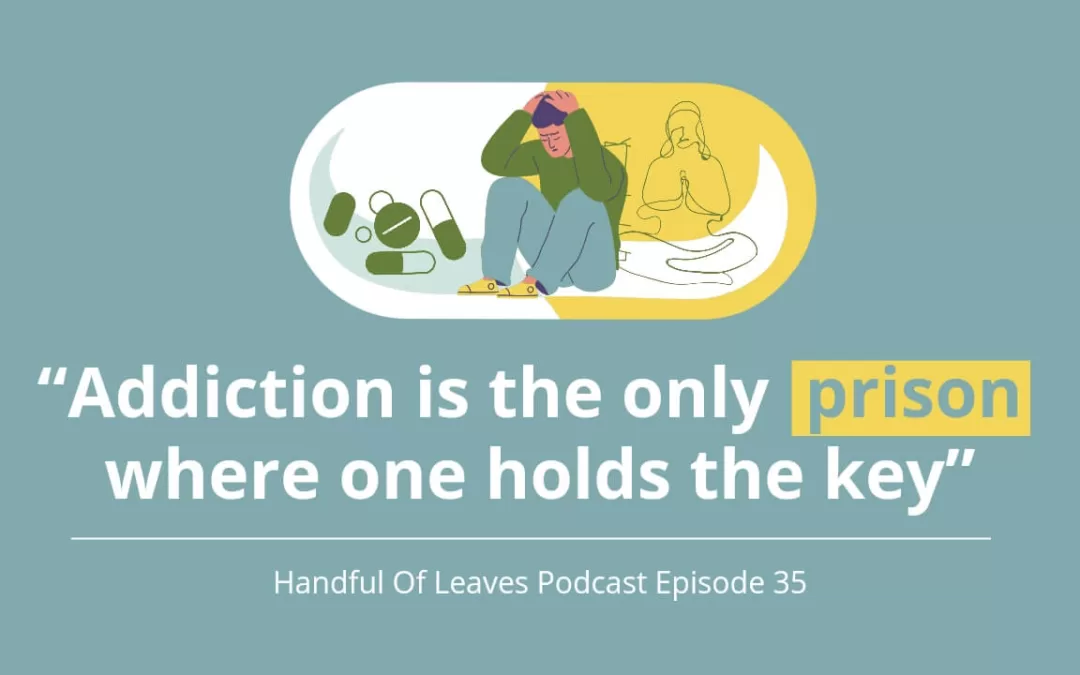
I came across this quote that actually motivates me. Addiction is the only prison in the world where one holds the key. For someone who is in deep addiction, who wants to get out they might feel a bit helpless, it’s like, what do you mean I hold the key? It’s very difficult for me right now. Yeah. So actually I would encourage people to just get professional help if they really need it. It’s okay, it takes courage to admit that you have a problem. Get help if you really need it.

[00:18:56] Cheryl:

And I find it very interesting because, in your own journey of recovery, you actually didn’t seek professional help, right? You were kind of DIY, do it yourself. So it’s interesting that you gave the advice that it’s okay to look for help. Why do you give this advice?

[00:19:13] Alvin:

Although I didn’t get professional help, I did talk to Ajahn. It took me quite a while to get out of that remorse state. We can expect everybody to use the Dhamma to help them. Some people might need professional help. So there’s no one-size-fits-all method for everybody.

[00:19:29] Cheryl:

You have to find what is suitable for you at that point in time. And at different times, you will require different things as well. Yes. You were saying it took you quite a while to get out of that remorse state. But eventually, in retrospect, what you realize is that… There’s no point in clinging to the past and the present and the future is more important. Okay. What was the turning point, which gave you that aha moment?

[00:19:58] Alvin:

I heard this teaching from Luang Por. Every time we recollect something virtuous, it’s like we are doing that virtuous action again. Similarly, if we keep thinking about the negative things we do, we are actually indirectly doing that negative action again. So I have to tell myself whatever is done is done, just move on. If I really want to benefit myself and all sentient beings, I have to move on.

[00:20:21] Cheryl:

That is very powerful. I really love that. Thanks for sharing. Amazing. Is there any last thing that you want to share from your experience with struggling with drug addiction?

[00:20:32] Alvin:

There’s this method which I find quite helpful. Perhaps you can use something of higher value to overcome the addiction. So something that fits your principles and your personal values. In the past, I’ve always wanted to be a fitness instructor. So actually I also make use of fitness, like going to the gym, taking out new sports to overcome the addiction, and using that drive to help me get out of the addiction and also to pursue my dreams.

[00:20:59] Cheryl:

What if someone doesn’t have any other value and the value is just seeking happiness? Drugs give me the highest happiness, they can say.

[00:21:07] Alvin:

It’s still a form of wanting to seek happiness. To me, it’s still a value. You could actually replace that addiction with something positive. Get a friend to help you to try something different, learn a new hobby, et cetera. Then you can compare and contrast. To see that actually, there’s something that could be even a higher form of happiness compared to the substance I’m attached to. Just try to take the first step.

[00:21:31] Cheryl:

Yes. The first step might sound extremely scary, and difficult. But always know that there are alternatives to the drugs that you’re taking which harm your body in very severe ways and there are other ways to obtain happiness that actually continues to contribute to your long-term happiness as well. That could be a better option as well. And I’m actually very curious. You say that you have already cut off the friends who did drugs with you, I guess the dealer as well. Have you forgiven them?

[00:22:04] Alvin:

To be frank, for a period of time, I was blaming them. But I realized that actually I also have a part to play. So just see everything as due to causes and conditions. So just move on. Cause if you keep dwelling, having anger towards them, then you’re actually still trapping yourself in the past. Just have compassion for them as well, because they don’t have the Right View. They don’t have the merits to encounter the Buddha’s teaching. That’s why they are actually doing something that they think is right, but actually it’s wrong. In the future, they have to bear the consequences of their actions as well. So they deserve compassion and empathy more than anger.

[00:22:43] Cheryl:

That’s very wise words as well, because at the end of the day, no matter how people manifest in their actions, no matter how evil, how selfish, or how unpleasant it is, everyone is really just seeking happiness in the ways that they know how. It’s unfortunate that people sometimes seek this happiness through ways that cause them more harm because Kamma is the action and intention and the results of this action and intention will always be by your side. You will always be related to this Kamma. You always be associated with this Kamma. You always be with this Kamma. Whether it’s good or bad, you have to bear its results. So in a way, you’re right, they deserve compassion a lot more than they deserve anger. It’s very, very wise of you and very compassionate of you to be able to notice that, and I rejoice with your wisdom.

We’ve come to the end of this episode. Thank you so much for sharing on a topic that not many have experienced, but yet also relating to. I guess that’s the humanness of all of us, the suffering that all of us share together in wanting to be happy, and trying to find the best ways to be happy as well.

To our listeners, I hope you’ve learned a thing or two and you’re able to apply some of these gems of wisdom and compassion in your own lives. If you enjoyed this episode, please give us a five-star rating on Spotify and share this with your friends. Until the next episode, stay happy and wise.

Resources:

Special thanks to our sponsors:

Buddhist Youth Network, Lim Soon Kiat, Alvin Chan, Tan Key Seng, Soh Hwee Hoon, Geraldine Tay, Venerable You Guang, Wilson Ng, Diga, Joyce, Tan Jia Yee, Joanne, Suñña, Shuo Mei, Arif, Bernice, Wee Teck, Andrew Yam, Kan Rong Hui, Wei Li Quek, Shirley Shen, Ezra, Joanne Chan, Hsien Li Siaw, Gillian Ang, Wang Shiow Mei.

Editor and transcriber of this episode: Cheryl Cheah, Susara Ng, Ke Hui Tee

2 life lessons we glimpsed from the meditator Ng Kok Song

2 life lessons we glimpsed from the meditator Ng Kok Song

Editor’s note: During this Presidential Election, HOL is dedicated to fostering understanding and learning from a variety of interactions, rather than endorsing a particular political figure. We maintain an impartial stance and do not advocate for any candidate. Quotations have been abridged for clarity and grammar.

Ng Kok Song, one of the presidential hopefuls, is an advocate for meditation – a practice not often mentioned openly in the Singapore context.

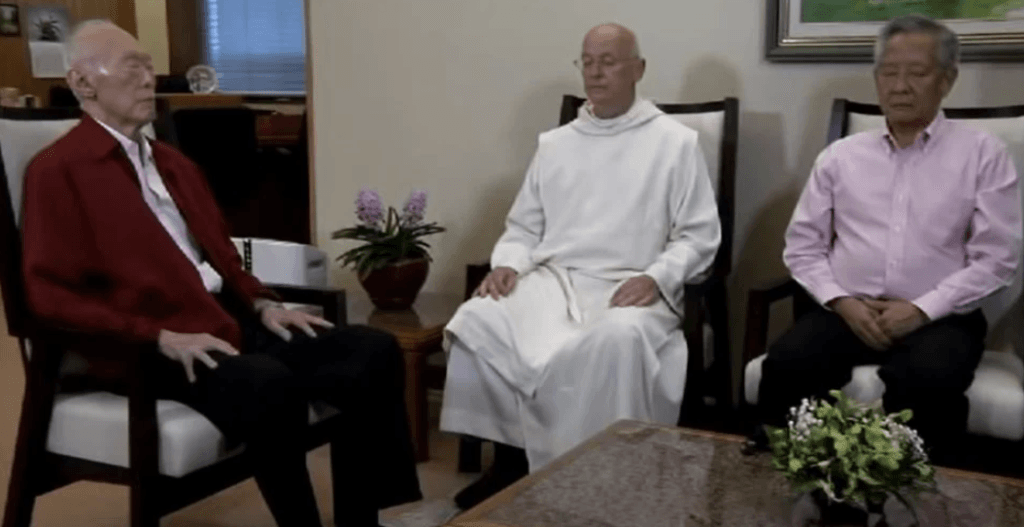
Mr Ng meditating with the Late Lee Kuan Yew
CR: https://mustsharenews.com/ng-kok-song/

Here are 2 life lessons we have taken away from Mr Ng’s life journey.

1. Bring mindfulness to work & life

Photo Credit: Shin Min Daily

Mr Ng believes that youths can benefit from practising meditation, which he said can give them “inner peace” and address mental health issues. 

Mr Ng credits meditation as one of his greatest supports during challenging times at work. Mr Ng, a Christian meditator for over 30 years, meditates twice daily and has openly encouraged colleagues to take up the practice. As part of his priorities if elected as President, he also hopes “to raise the consciousness of mental health, and to encourage as many people as possible to come together.”

As Mr Ng shared, “Most of us tend to perceive reality distorted by our perceptions and egos. We tend to confirm our own biases. By transcending the ego, we are better able to receive reality as it is.”

This ability to move beyond entitlement was evident to our writer PJ Teh, a young GIC officer who met Mr Ng. Despite his seniority, Mr Ng took time to ask how PJ was and thank him – an uncommon humility in the high office of the corporate world.

Even the famously driven Mr Lee Kuan Yew wanted to learn meditation after seeing Mr Ng’s serenity, asking him to teach “meditation for the final stage of life and serenity of mind.

Sustaining and walking the talk of meditation is a high bar; being able to teach your boss mindfulness (Mr Lee was on the board of GIC previously), is at a new level.

2. Approaching death with equanimity

Mr Ng cared for his wife in her final 19 months, calling it “the happiest time of our lives together because we knew time was short.” This echoes Ajahn Brahm’s teaching to smile at life’s impermanence like the end of a beautiful concert.

When a concert is over, we do not cry but rather smile at how lovely the concert was. Our role as caregivers is not to cure but to care and be present.

Having meditated together daily, Mr Ng said his late wife faced terminal cancer with equanimity. As he put it, “I cannot suffer for her but I can be by her side.” This points to meditation as training to let go of attachments and relax into impermanence, and respecting every moment as the most important moment.

Learning to meditate is like learning to die. The idea of dropping all possessions, views, and desires because you cannot take them along. Through that daily practice, we cling less to our views of how things should and should not be.

Mr Ng also shared that being loved helps overcome the fear of death. This connects strongly to the Buddhist principle of metta or loving-kindness – for ourselves and others – as support even at life’s end. 

It was amazing to connect the dots between meditation, death, and love in a person’s life story.

Conclusion

Mr Ng’s life lessons showcase how daily mindfulness can imbue work and equip us to face life’s hardest times with grace. To weather life’s storms, we must build our roof beams strong through regular practice.

‘It’s just like this’: 3 Takeaways from my forest retreat

‘It’s just like this’: 3 Takeaways from my forest retreat

TLDR: Cheryl shares her experience in attending a meditation retreat. She explores how she sought refuge from unsatisfactoriness, learned to understand and accept suffering as natural, and reduced conceit through mudita and gratitude.

From the 18th to 25th of February, I had the great opportunity to attend Ajahn Anan’s ( a renowned teacher from the Thai forest tradition) meditation retreat in person in Wat Marp Jan, Rayong, Thailand. Thankfully, the right conditions were present, such as having supportive health, work, and family conditions. Therefore, I was able to attend and complete the retreat as planned.

It is not uncommon that people full of faith in their hearts sign up, and make payments, but due to unexpected illnesses or personal matters, are unable to make it. Thus, I cherished the rare opportunity and sought to try my best in absorbing as much as I could from a teacher I respect and admire. 

The routine and living conditions in the retreat were basic but were adequately comfortable. As a lay female devotee, you live in a shared two-floor dormitory with 50 other female retreatants, with no air-conditioning or private toilets. You rest on a thin mattress and a small block of cushion as a pillow to lay your head on.

The environment was void of any luxuries or excesses, providing a conducive environment to sustain and live simple lives as we spent 8 days practising the path of virtue, concentration, and wisdom.

The programme begins at 4:30 am, and consists of many hours of sitting and walking meditation, chanting sessions, 2 to 3 Dhamma talks and QnAs every day, communal chores, and the best part, one vegetarian meal a day.  

As city-dwellers used to the 3Cs of Comfort, Convenience, and air-Conditioning, many of my colleagues and friends couldn’t hide their surprise. “Why put yourself through such ‘torture’?” is one of the many questions I got.

I guess what the question is really pointing to is: What are you searching for so desperately?

I was seeking refuge, to escape the chaos and hotness of the mind, swirling and spinning with the worldly winds of gain and loss, pain and pleasure, praise and blame, and fame and disrepute.

Here are 3 things I can only hope to summarise:

  1. Understanding unsatisfactoriness is not the same as having unsatisfactoriness
  2. There’s no “I” in total control over “my” body and mind. 
  3. Reduce conceit through mudita and gratitude

Understanding unsatisfactoriness and looking it in the eye

Before the retreat, I was a total wreck. I was extremely anxious over the possibility of losing my job, my mental state and physical health were all out of whack due to personal matters.

One may say, with all of this chaos, that I am well acquainted with the Buddha’s first noble truth of suffering, and I thought so too. I was self-proclaimed to be an expert on suffering. “Life sucks, life is so painful,” I would lament to anyone who would care to listen.

I experienced immense suffering, but I was ignorant of the truth that suffering is an inevitable part of life—and a large part of my suffering accumulated because I did not want to suffer.

I did not want to be separated from what I loved, I did not want to be associated with what I disliked. By fighting the experience of dukkha, unknowingly, I was just deepening my suffering and creating conditions for more suffering to arise.  

As the Buddha said in SN 56.11,

“Birth is suffering, aging is suffering, death is suffering; sorrow, lamentation, pain, distress, & despair are suffering; association with what is not loved is suffering, separation from what is loved is suffering, not getting what is wanted is suffering. In short, the five clinging aggregates are dukkha. Stress should be known.

The cause by which stress comes into play should be known. The diversity in stress should be known. The result of stress should be known. The cessation of stress should be known. The path of practice for the cessation of stress should be known.”

Learning this noble truth helped me soften my attitude towards suffering. As many wise monks often say, “When one experiences happiness, it’s just like this; When one experiences sadness, it’s just like this.”

Instead of grasping tightly to the experience of suffering as mine and as something that “I should deal with” or “I should not have”, I observe the experience as something that arises, stays for a little while, and ceases. Just as fire needs the conditions of heat, oxygen, and fuel to arise, as long as the mind is still conditioned by greed, hatred, and delusion, suffering will still arise.

And the practice was to accept that the experience of a constricted mind wanting freedom is just like this, the pain of clinging is just like this, the unreasonable demands of craving are just like this, and to patiently endure till the experience ceases accordingly.

Thankfully, nothing ever stays forever and the longest a sensation lasted was 6 breaths, before the suffering ceased on its own. 

In accepting suffering as something natural, and an experience that arises due to causes and conditions, I also learn to have more compassion towards myself.

Just as how one would sympathise and care for a toddler who is learning to walk and keeps falling over many times, I am reminded by the wise words of Ajahn Achalo to not underestimate the power of our negative habitual tendencies and mental afflictions, and be forgiving to ourselves as we stumble and falter in the journey.

You would not berate the toddler for falling down as he learns to walk, so do not berate yourself as you make mistakes or have unwholesome thoughts. 

And lastly, understanding that Dukkha is an inevitable experience of the human condition also expands the compassion to all beings.

Regardless of whether one is clothed in Gucci or in tattered rags, living in a huge mansion or a tiny hut, everyone will have to experience the same burdens of birth, ageing, and death; of sorrow, lamentation, pain, distress, and despair; of association with what is not loved, of separation from what is loved, and of not getting what is wanted.

Thus, let’s be unconditional in our compassion for fellow compatriots in old age and sickness. 

There’s no “I” in  total control over “my” body and mind

Anatta is the concept of non-self, which teaches that there is no permanent, unchanging entity within an individual. In the Anatta-lakhana Sutta, Buddha addressed the group of five and shared: 

“Monks, form is not-self. Were form self, then this form would not lead to affliction, and one could have it of form: ‘Let my form be thus, let my form be not thus.’ And since form is not-self, so it leads to affliction, and none can have it of form: ‘Let my form be thus, let my form be not thus.’

The process of contemplating my mind and body was truly humbling as I had to surrender to the fact that there is a complete lack of control in shielding my body from afflictions no matter how much I tried. As much as I try to keep healthy and maintain hygiene, my body still falls ill and deteriorates and experience pain/sickness in almost every part.

Think of the hair of the head, hair of the body, nails, skin, teeth. Have you not experienced blisters, cuts, itches and aches, falling off and bleeding in these areas? 

And if the body was truly mine, why was I not able to avoid feeling painful sensations? If the body was truly self, wouldn’t I be able to stop a cough or sneeze and be less disruptive in the Dhamma talks?

But alas, the body is not mine to control, not something I own, and is merely a machine just reacting to causes and conditions, deteriorating every day till it ceases to function anymore.

Likewise, if the mind was truly mine to control, shouldn’t I be able to control my thoughts and feelings and not be distracted when I didn’t want to?

My life has always been geared towards creating a stronger sense of control by getting what I want. With this delusion, the mind was constantly in this agitated state of wanting more and more pleasure, excitement, and enjoyment, but the craving is never ever satisfied. Oddly, the more I had, the more I wanted. Craving is not fulfilled through satisfying it.

Letting go of the sense that I had to be in full control for even just a tiny moment felt so liberating because I can just rest in a content mind, and be at ease with the present moment. The mind can finally stop chasing, and this letting go leads to the heart feeling full. Thus, contemplating on how little control one has over your mind and body can be a skillful means to bring the restless mind to stillness. 

Furthermore, understanding how little control I have has also enlightened me about my own mortality. Perhaps I could die by mid-morning, perhaps I could die in the afternoon, perhaps I could die at night. Life is uncertain, and we will never know when or how we will die, but death will certainly reach us.

As one who may be intoxicated by our youth, health, and life, the idea of a near-death may seem improbable, but no one can confidently say for a fact that it is impossible.

This reflection on death also brings about energy when the mind is slacking in sloth and torpor, distracted in restless thoughts, anxiety, or sensual desires. It can therefore be also used as a skilful means for contemplation. 

Practice Mudita and gratitude to reduce conceit

In the Sona Sutta, the Buddha speaks to the householder Sona regarding conceit.

“If one regards himself superior or equal or inferior because of the body, [likewise ‘feeling,’ ‘perception,’ ‘mental formations,’ ‘consciousness’] that is impermanent, painful and subject to change, what else is it than not seeing things as they really are? But, Sona, whatever recluses and Brahmans do not hold such views… What else are they but those who see things as they really are?

Due to the conditioning of ignorance present in my mind, and the mind still clinging firmly to my five aggregates, the proliferation of conceit always arose in my mind.

As I walk, thoughts screaming for attention will go “Look at me, look at me! I’m better than them!” and then in the same vein, it will swing to the far end.  “Oh my god,but I am worse than xxx!” and then sometimes “Ok lah, at least we same same!”

It was fascinating to observe how the mind see-saws endlessly between feeling pretty good about itself, to becoming awfully self-loathing and stricken with anxiety. It is painful, yet almost absurdly comedic. Ajahn Anan describes this sense of self as the “us-them” or “me-you” narrative that goes on and on and on, creating so much Dukkha along the way if left unchecked. 

What I found helpful was to bring up the wholesome mindstates of appreciative joy. As Buddhists, we often use the term “Sadhu”, which means to rejoice or say “well done!” But how many of us actually take the time to truly appreciate how rare it is for another person to be walking on the Noble Eightfold Path, or appreciate how much goodness may arise from one seeing the importance of doing good, practising virtue, and purifying the mind? 

Sadhu for me has always been a ritual, something you do because everyone around you says it. However, the teachers kindly reminded us to not underestimate it but to bring it up to the forefront of our mind constantly.

In practising appreciative joy, I find that rejoicing in the good deeds and success of others not only uplifts and lightens the mind, but it also reduces the unwholesome qualities of greed in the mind. I stop needing to put others down to feel better about myself, and simply feel better in the happiness others experience from getting what they want or enjoying the fruits of their labour.

Ajahn Achalo half-jokingly puts it, “It’s the easiest way to gain merit without putting in all the hard work!”

Similarly, practising gratitude is also immensely helpful to move the mind from a place of conceit to humility. Whenever thoughts of conceit arise, such as “my wisdom is superior,” “my body is equal”, “my meditation is inferior”, I recall all the people I am thankful for.

This reminds me that what I perceive to be mine are merely the byproducts of the generosity, wisdom, and compassion of so many people around me, as well as the Buddha, the Dhamma, and the Sangha.

Without all these, what I proudly claim to be “mine” would have never even existed. What is experienced as “mine” is merely a ripening of kamma stitched together by various causes and conditions. Thus, this serves as a reminder for me to be heedful of speech, thoughts, and actions, as I will be the owner and heir of the kamma ripening, be it wholesome or unwholesome. 

In conclusion

The retreat was a deeply challenging yet transformative one, and the end of it is only the start of a commitment to a life-long practice. As the bus journeys from the monastery compound into the “real world”, it is important to recollect that time also does not pause as we journey one second at a time into old age, sickness, and death. So, make the best use of our limited time here to do good, avoid evil, and purify the mind.


Wise Steps:

  • Whenever you are suffering, take a deep breath and use the mantra “It’s just like this.” to remind you to stop resisting the experience.
  • Contemplate the body as not a “self” I can control, not a “mine” I own. 
  • Keep a gratitude log and genuinely rejoice in another person’s virtue and success. 
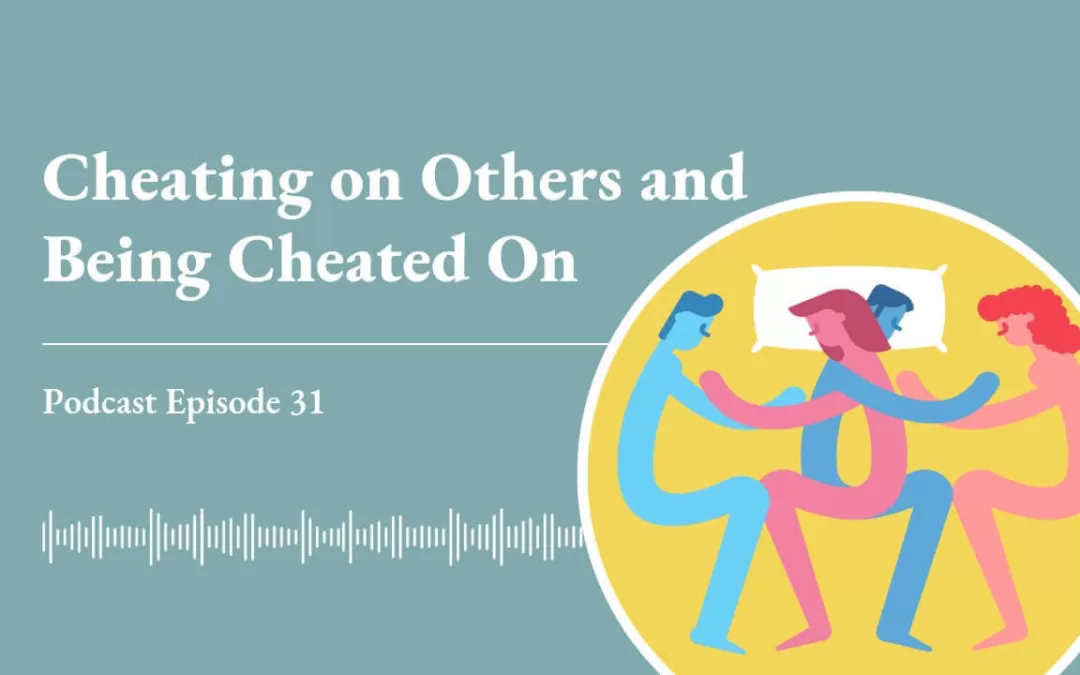
Ep 31: Cheating on others and being cheated on

Ep 31: Cheating on others and being cheated on

About Our Guest

Jason* is a pseudonym as this topic is very sensitive and involves many other people’s stories. Jason wants to be mindful and avoid implicating the people involved in the past relationships, and thus an altered voice and pseudonym are used.

Transcript

[00:00:00] Cheryl:

Welcome to the Handful of Leaves podcast. My name is Cheryl, and I’m your host today. We will be talking about the topic of cheating and can leopards ever change their spots? We have a very interesting guest who has courageously come up to share his experiences of being cheated on as well as cheating on his partners.

So I invite you to listen with an open mind as we delve into his past, to understand why people cheat, as well as to explore the question of whether someone who has cheated should be forgiven.

Can they be forgiven? Can they ever change? This episode will be enjoyed best with earphones because we will be altering the voice of this person and using a pseudonym*. So with that, let’s get started.

Hi Jason*, thanks for coming to this episode to speak to us today on the condition of anonymity. So I think first off, I would love to understand what’s your definition of cheating.

[00:01:06] Jason:

I think generally most people talk about cheating in two forms, emotional cheating, and physical cheating. Physical cheating would be engaging in sexual behaviour with someone else apart from my partner. To make it clear, in this case, it’s not just sexual behaviour, but nonconsensual sexual behaviour.

[00:01:25] Cheryl:

Thanks for clarifying that for us. And maybe you can also share with us your experiences of cheating.

[00:01:32] Jason:

For my experience of being cheated on, it’s very interesting. I think till today, I have no clarity on whether it actually happened. Before the time of smartphones and dating apps, we had to use IRC Chats to get to know people. I, later on, found out that even though we were together, he went out to the IRC channels to meet other people with the intent of dating. So that to me felt like it should be cheating already. But that was my first relationship. I went through many years trying to think whether that counts as cheating or not.

[00:02:07] Cheryl:

Well, it must have been very confusing for you because it’s also your first experience and what did you feel?

[00:02:14] Jason:

The initial reaction was shock, then came, is it true? Could it be someone else impersonating my boyfriend? So when I actually tried to clarify he gave many reasons. I was just like, am I being cheated on? What’s happening? What am I supposed to do? It’s just very overwhelming.

[00:02:35] Cheryl:

I see. And I think that is really inflicting a lot of pain inside you as well, where you have to doubt yourself, doubt whether your partner is lying to you or not, or are they actually telling the truth.

Putting into the context of Buddhism. So Buddhism doesn’t really have the connotation of sin or whether things are right or wrong, but rather, sexual misconduct where cheating is actually viewed as unskillful and unwholesome because it causes a lot of pain to other people. It harms other people. In the context of cause and effect, when you do something bad, you’re really planting the seeds for something bad to happen in the future whenever that ripens. I think you really brought out the point that it just causes a lot of unwholesome states of mind to arise within yourself as well.

[00:03:30] Jason:

Cheating as a behaviour itself causes a lot of harm. At the same time, I feel that it indicates that generally there’s a deeper issue at hand. This might be a precursor to even more unskillful behaviour that may happen later down the road. So some people may think that it seems like a very small, innocuous action but the effects are quite severe.

[00:03:53] Cheryl:

And tell us a little bit more. So how did that manifest in yourself? And in a way, how did that experience of cheating kind of lead you down this vicious cycle of hurt where you eventually then became someone who cheated on others at some point in your life?

[00:04:09] Jason:

My ex-partner and I, we both hurt each other a lot. At one point, I was threatened with suicide and a lot of emotional manipulation. It’s not unfair to say that I was traumatised by the first relationship, and I didn’t know how to recover from it. So I started dating very serially, rebound partner after partner. Even if I didn’t feel like I was in love with the person, I just kinda crave another person.

Eventually when I realised that I wanted to end the relationship, but I didn’t know how, subconsciously what happened was, I cheated in order to get out of the relationship. Yeah, in hindsight it’s really horrible, but I look back and I realised that at that point in time, I had no idea what I was doing. That sounds like I’m probably trying to find excuses for the cheating but that felt like what was happening.

[00:05:01] Cheryl:

And how do you come to that realisation then?

[00:04:57] Jason:

It took many years. It took a few relationships and very unfortunately, that was not the only time I cheated. After the death of a loved one, I decided that I wanted to see a therapist. With the therapist, I worked through a lot of different issues about grief, about relationships, about the cheating behaviour. At one point, there was a question that was always on my mind. Since I have cheated before, does that mean that I’m a cheater and I will always be a cheater? It took me many years of therapy and a lot of work on myself to discover that I cannot define myself by my behaviours.

[00:05:31] Cheryl:

Yeah, I think that’s a tricky one, right? I know people who have been cheated on before, and they will be in that dilemma where, can I trust my partner again? Or am I just being stupid? Because in a way, a leopard never changes its spots. Right? What can I do once this trust is broken?

But as you mentioned, a lot of things, the actions, the behaviours are really just the superficial layer and there are always underlying reasons or root causes behind them. Not to say that the behaviour is correct. I mean it causes harm, causes hurt. You can’t deny that. But if we go deeper, we can really see that there are a lot of root causes there.

I’m just curious, for yourself it was because you experienced a hurt very deep from all the trauma from your first relationship, and it was kind of like your defense mechanism to then hurt your future partners, is it?

[00:06:33] Jason:

Yes. I think you put it very well. It was a defense mechanism, to hurt before I get hurt. It’s quite sad and looking back the amount of hurt I inflicted on my ex-partner was very unfortunate. The person had no hand in whatever trauma I received. But looking back, this behaviour caused so much hurt to my ex-partner, an innocent party, for no good reason.

[00:06:55] Cheryl:

I see. Because it’s very complicated, right? When you were in the moment, you really didn’t know what you want. I guess all you felt was just a desire to go on the app to find someone else, but you can’t really pinpoint what’s happening as well. So how can we avoid even putting ourselves in these situations where we may lose control? How can we better create conditions to not hurt other people so much?

[00:07:21] Jason:

That’s a difficult question and I’m glad I’ve gone through sufficient therapy and worked on myself and I have my spiritual practice to support me on that. How to stop? Should I not put myself in situations where it is likely that this behaviour will happen? If it’s subconscious, are you sure that you can stop it? Cheating is never just that one spur-of-the-moment decision. What we see is that action. What we don’t see is what happens behind that led to that action. Maybe there’s some unhappiness in the relationship or there is something that the person doesn’t want to handle within themselves.

So for me, I didn’t want to handle the hurt from the previous relationship. So, I just diverted my attention outwards. And when some additional trauma comes in internally, then I think it spills over, and whatever external measures I put in, it’ll all be pointless. So what I realized is that we must always work on ourselves. Whether you’re in a relationship or not, make sure that you’re a person who can live a wholesome life so that you don’t bring your personal problems into a relationship, or you don’t cause the relationship problems to be unable to be resolved because your own personal issues are standing in the way.

[00:08:37] Cheryl:

Yeah, it does make sense and it really gives me a different light because a lot of times people are very quick to judge or condemn people who cheat, and straight away criticize and judge and put a lot of labels. But then as you share, I realize that there’s so much suffering within one person to bring them to that action of cheating and of course all the steps that it takes to reach that behavior. They cannot contain it anymore and then it just spills over. Sadly, with this spilling over, it burns them as well.

Any practical tips that you think could be helpful? Maybe stop using the apps when you’re in a relationship or don’t look at people who walk around with blinders.

[00:09:12] Jason:

Practical tips? My response to what you said about not installing the apps. I thought that would work. I honestly tell you, I’ve tried it. But the horrifying thing is that, when the intention is there, whatever you want to make happen, you probably can. So, a practical tip I would say is to get in touch with your inner self whether it’s through meditation, or through other means available for you. Find out what are the areas of your life that may cause you problems when you’re in a relationship. A lot of people like to use this term, oh I’ve already found my better half, or my other half. My own personal belief is that we need to be whole before we go and meet another person so that we are two people who are whole that come together in a relationship that is healthy and they both grow.

[00:09:55] Cheryl:

You’ve brought up a very important point that the mind is the forerunner of all things. If you don’t take care of your mind, you don’t prioritize mental hygiene, then you know that uncleanliness will spill out one form or the other, and no external thing, no people will be able to fix you for you, you gotta fix you for yourself. But of course, we can always lean on others but not a hundred percent, and throw our problems at them.

[00:10:22] Jason:

To allow my mind to be less likely to tend towards such things, the Buddhist principle of morality is very important. And it’s something for us to practice on a daily basis. Tend your mind towards wholesome thoughts, wholesome behaviours, and actions, so that the imprint on your mind will be more wholesome and that it slowly grows with time, and we let go of the more unwholesome behaviour, which goes back to the Noble Eightfold Path, Right Effort in this case.

[00:10:50] Cheryl:

Indeed. Really plus one to that because I feel like the undercurrents of greed, hatred, ill-will or delusion is very, very strong. And for me, sometimes I find it very fascinating that it can come out so strongly. Generally, I’m a normal person. I don’t have very crazy thoughts. I don’t indulge too much in violence, but when I feel either very hurt or I feel betrayed or if I don’t get something that I really want, the thoughts of anger, of wanting to hurt people can come up very strongly. As you said, if we practice inclining our minds towards wholesome states, towards skillfulness, then that restraint really helps to protect us to actually turn all of those thoughts into action.

I think we can also segue into moving beyond the identity of both being cheated on and all the connotations that you may hold about that, as well as someone who has done these actions. What was your journey in forgiving others and forgiving yourself?

[00:11:54] Jason:

Forgiving others turns out to be easier than forgiving myself.

[00:11:57] Cheryl:

Oh, interesting.

[00:11:59] Jason:

I think what helped was realizing that this person was very hurt and therefore might have acted without being fully conscious about what he was doing.

It feels like cheating is like trauma and like how intergenerational trauma works. If a person has been hurt so much and is unable to process that hurt and let go of that hurt, that person will go on to hurt other people.

I think forgiving that person came a lot easier when I realised to have compassion for the other person, knowing that this person doesn’t have the intent to hurt. And to be fair, I think nobody on Earth has a true intention to hurt. I believe that. But if somebody is hurting, there must be some reason that the person is unaware of.

But forgiving myself, that was a whole different ball game. The question about, will I always be a cheater? haunted my mind so much. I had a friend who told me, my principle is I’ll never make friends with cheaters. But you, Jason, you’re my good friend and I understand what happened. Her forgiveness might have helped me to also see that she hates the behaviour, but she doesn’t hate the person. That made me realize that at some point, I need to separate the behaviour from the sense of me. I cannot keep latching on to that behaviour, identifying with that behaviour.

[00:13:24] Cheryl:

Where you’re able to see the entirety of yourself as bigger than the acts that you have committed.

[00:13:34] Jason:

I think that was why the first time I encountered a teaching by Ajahn Brahm, one of his famous stories, it’s about the two bad bricks in the wall. He misaligned two bricks and all he could see was that these two bricks were just so horrible that they ruin the whole wall. Until one day he realized that there are so many other beautiful bricks there.

He used that story to explain that when he went to a prison to teach, he didn’t see prisoners, he didn’t see rapists. He saw people who murdered, people who raped. But apart from looking at just this behaviour, there’re so many other aspects of this person that we can look at. That teaching touched me deeply. It made me realize that there are so many other aspects of myself. Even though, yes, I made a mistake, it’s a really horrible mistake, I made it more than once. But that doesn’t mean that I’m a person who is incorrigible.

[00:14:23] Cheryl:

Yeah, Sadhu. Very good to see that you’ve come around to this. I think it’s important to not let yourself be burdened by all of this guilt as well because if you keep carrying that burden of I’m not a good person and berating yourself, it just causes you to be in a very unwholesome mindset state. When you’re in an unwholesome mindset state, when you’re not thinking clearly, habitual tendencies can arise more quickly. So when you are moving away into a lighter mind state where you are at least abiding in forgiveness, in self-love, in mettā, unconditional loving kindness, then the clarity of mind is there to inform you to make wiser decisions the next time you’re in difficult situations as well.

[00:15:08] Jason:

Yeah, and it feels like common sense but it actually took me a while to grasp the fact that I need metta for myself, so that once I can sort out all the hurt from the past, then I can have the capacity to go and stop harming others, be kind to others. If I want to be kind to others, I must first start with myself. By being kind to myself, I stop holding on to the past and let the past hold me back.

[00:15:36] Cheryl:

Very beautiful. I’m just curious, I don’t know if you have had any closure with that person. But if he were to listen in and you were able to share with him something, what would you say?

[00:15:45] Jason:

I would say, thank you for the good times we had. As much as we’ve both hurt each other a lot, I think now looking back, I’ve tried to find things I’m thankful for, things that I’ve learned in the relationship. And I forgive you because it’s what is not easy to do. Made me realize that we all are hurting in this world. I hope that you’re having a good life and that all of us can take good care of ourselves and stop hurting others.

That’s a great question. I feel like I’m in some therapy session. That was an amazing question.

[00:16:24] Cheryl:

I’m sure a lot of our listeners will feel deeply touched by you really acknowledging the suffering and the capacity for us to continue to love, and continue to be kind. And what would you say to Jason in the past?

[00:16:38] Jason:

I would say, you tried your best. There were times when you didn’t know what you were doing. You were hurt so deeply, by so many things in life. Maybe you hope that you could have done better, that you shouldn’t have done all this and you’re probably scolding yourself for being such a messed up person, for hurting other people and everything.

I just wanna tell you, it’s okay. Let go of all these. Don’t have to hold on to it. It really hurts a lot to hold on to all these. It may cause you to hurt even more people later on. If you can just let that go, I assure you that you’ll become a really beautiful person down the road.

[00:17:16] Cheryl:

Wow. I think that was not just for Jason. It really goes into all of our hearts because we’ve all done things that we’re not very proud of, big or small. I’m sure there are some things that we still hold against ourselves, but allowing ourselves to let go and forgive. That’s a very, very beautiful way to end our episode today.

We covered a little bit about cheating, the experiences of Jason being cheated on, and how that hurt propelled him into a really dark place in life, where hurting others and cheating multiple times was almost his only way of finding happiness at that point. We talked about how we forgive ourselves and not define ourselves as just the bad acts that we do, but also look into all the 98 other beautiful bricks that we have within ourselves. That gives us more confidence, gives us more strength to love others, love ourselves, and create less harm in this world.

[00:18:18] Jason:

Wow. What a beautiful way to end this and I just want to say thank you for making this podcast a lot less difficult than I thought. I’m very thankful to you for all the really great questions. Going through this podcast has helped me to learn a lot and to reinforce the message for me to be even kinder to myself.

[00:18:35] Cheryl:

Sadhu Sadhu. I hope all of our listeners will also take away something and continue to stay happy and wise and see you in the next episode.

Special thanks to our sponsors:

Buddhist Youth Network, Lim Soon Kiat, Alvin Chan, Tan Key Seng, Soh Hwee Hoon, Geraldine Tay, Venerable You Guang, Wilson Ng, Diga, Joyce, Tan Jia Yee, Joanne, Suñña, Shuo Mei, Arif, Bernice, Wee Teck, Andrew Yam, Kan Rong Hui, Wei Li Quek, Shirley Shen, Ezra, Joanne Chan, Hsien Li Siaw, Gillian Ang, Loo Tiong Ngee

Editor and transcriber of this episode: Tee Ke Hui, Cheryl Cheah, Koh Kai Xin