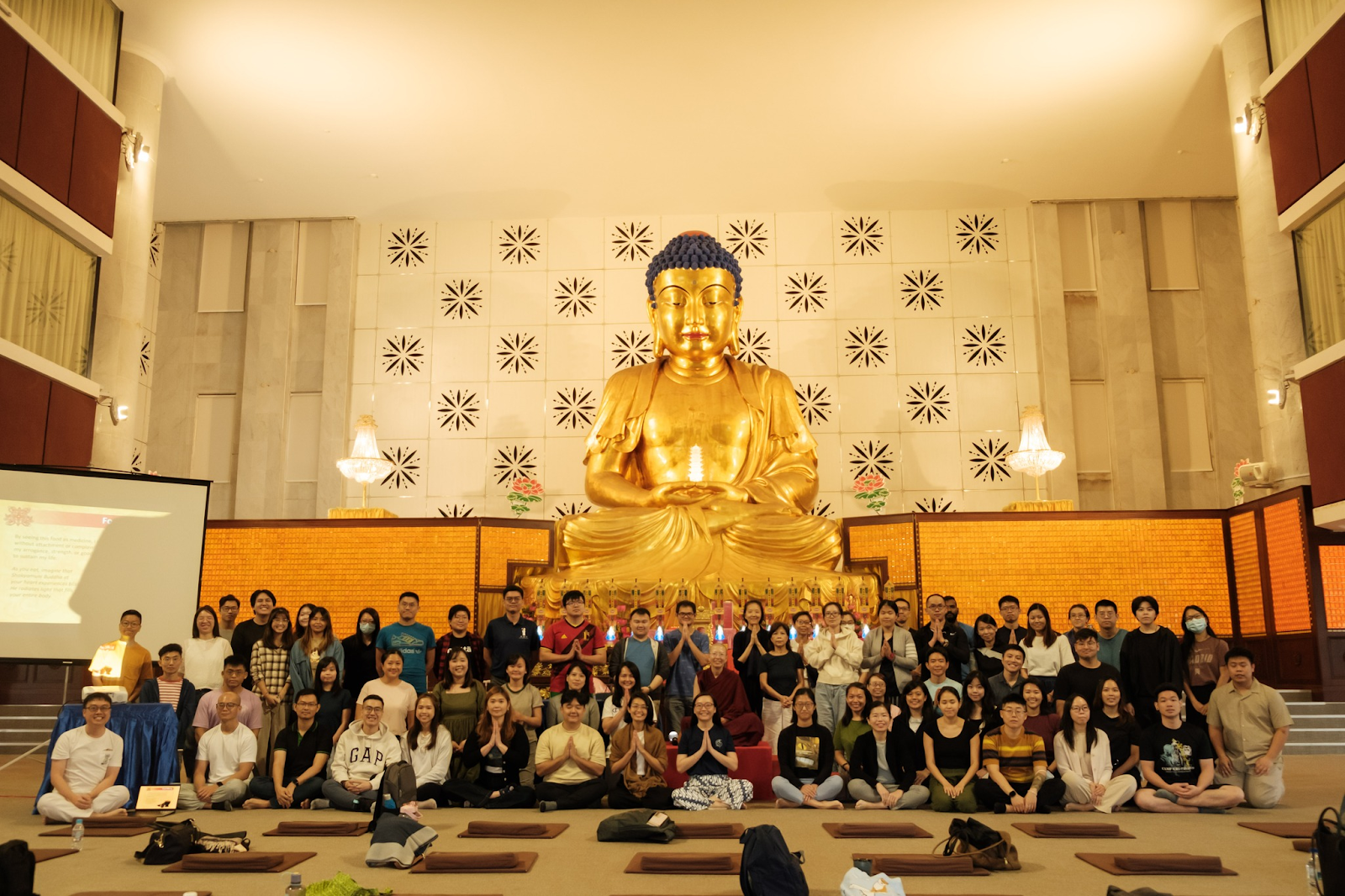
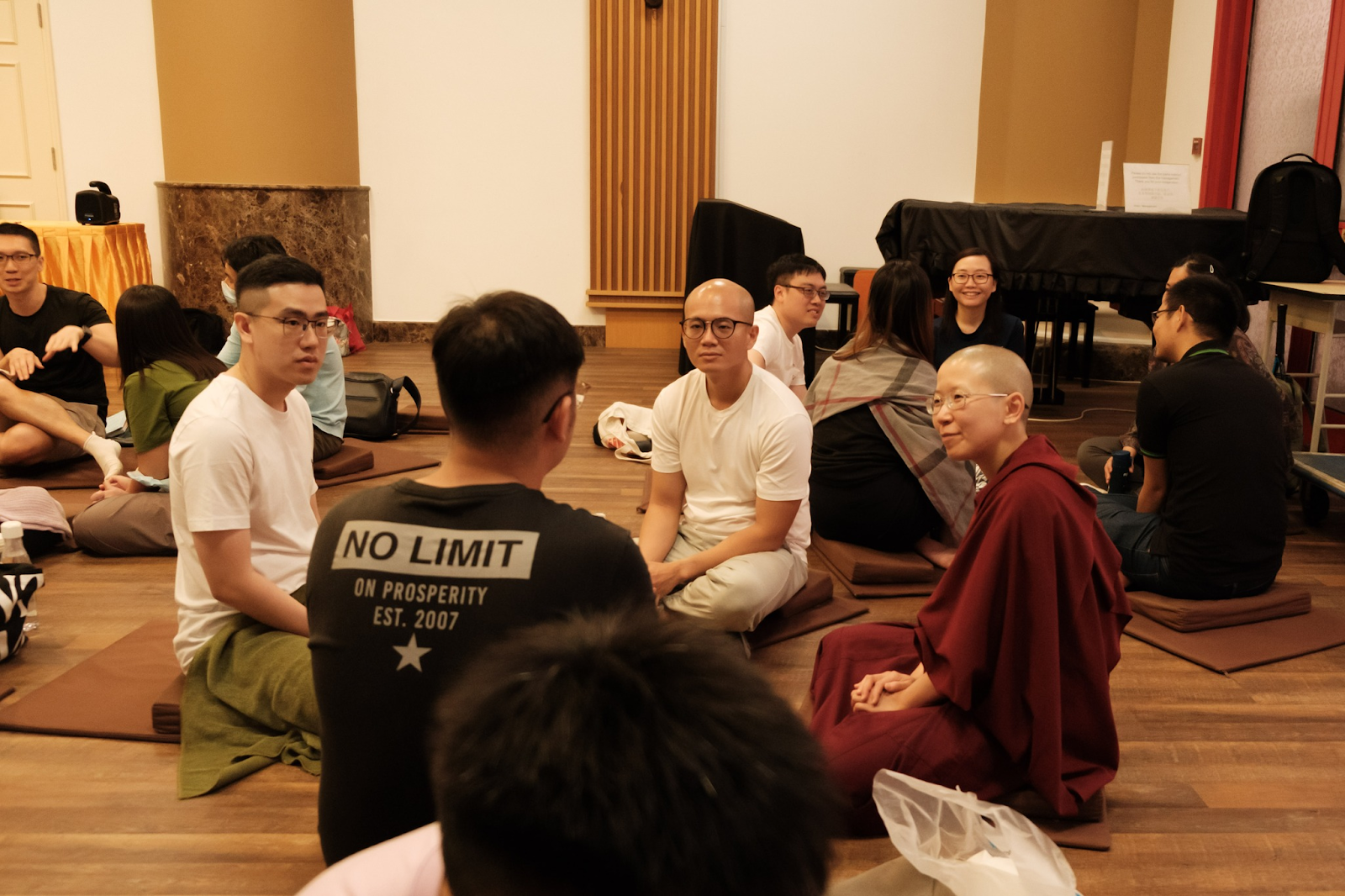
TLDR: Brace yourself for a wild ride as I dive into a thrilling graveyard meditation adventure. From serene sunset surroundings to nerve-wracking encounters, follow my rollercoaster journey as I explore fear, arming myself with the Three Jewels while battling the terror with breath meditation and metta.
A while back, I impulsively signed up for a cemetery meditation session with Palelai Buddhist Temple, promptly forgetting about it until just a week before the event. With no preconceived expectations, I approached the experience with a carefree mindset, blissfully unaware that it would be a departure from the usual temple retreat.
Mindfulness of death (maranasati) is one of the many meditation methods that we can practise when we sit. It is an awareness exercise to contemplate deeply about death and the impermanence of this body. Its purpose is to serve as a reminder that death can strike us at any moment, developing a sense of spiritual urgency so that we would practise with diligence.
As the date approached, a sense of excitement began to build. This was no ordinary meditation; it was a venture into the serene realms of Bukit Brown Cemetery.
With the anticipation rising, I started making a mental checklist of items to ensure maximum comfort – because let’s face it, who wants to deal with mosquitoes during a spiritual journey?
True to form, I found myself fashionably late for the briefing at Palelai, hastily scribbling my signature on the indemnity form before dashing for the transport bus.
As I shamefully took the last spot in line, I settled into my seat and peered out at the city’s iconic Singapore’s Flyer and MBS skyline, watching it blur pass as the bus sped towards our destination.
The drive into the woods
Upon our entry into Bukit Brown Cemetery, the bus navigated through tight and narrow paths, slowing down as we delved deeper into the forest. The sun was gracefully setting, casting a warm glow that painted the sky in hues of orange and pink.
Entrance to Bukit Brown Cemetery Cr: The Travel Intern
Through the tall trees, the enchanting sunset peeked through, setting the stage for an evening of unique and deep introspection.
As I marvelled at the captivating canvas of colours stretching across the sky, my daydreaming was abruptly interrupted. Instructions echoed in my ears, “if you see anything, hear anything, smell anything, don’t react ah. Just go back to your usual meditation object ok” the volunteers urged us. Well-acquainted with anapanasati as my primary meditation object, the prospect of focusing on my breath seemed like a familiar journey.
The volunteers reassured us with the promise of three triumphant “sadhu” calls heralding the end of our two-hour meditation.
Venturing deeper into the woods under the guidance of the volunteers, we each received our own “individual tombstone” to set out our mats right in front of the tombstone and assumed our meditation postures.
Maintaining a respectful distance of at least two arm lengths (perhaps three for someone of my vertically challenged stature), I found myself positioned in the furthest reaches of the woods, I wasn’t sure whether to count myself lucky or the opposite.. :’)
The mental and physical preparation before the long sitting
Before departing, the volunteers reiterated the crucial instruction: “Hear, see, smell anything don’t react ok! Try not to open your eyes!” It suddenly dawned on me that this was no mere child’s play; my eagerness for a novel experience failed to prepare me for what lay ahead.
Was this about to be a friendly visitation from the resident friends, a thought that humorously crossed my mind?
Settling into the two-hour meditation session, an uncharted territory for someone accustomed to a maximum of 45-minute sits, I questioned my ability to endure this prolonged stillness.
Cross-legged and five minutes into the session, the uncle beside me made himself at home and comfortable by initiating a “ceremonial mosquito repellent ritual” by spraying his and my surroundings.
Shifting his position to face me instead of his designated tombstone, he playfully quipped, “Better to open my eyes to a human than a tombstone la, hor?” he joked. I chuckled, and we both assumed our individual meditation postures. Adjusting to the pervasive fragrance of insect repellent, generously applied by my fellow meditators, I took some time as we delved further into the sit, now approximately 15 minutes in.
..at this point I am aware that this sounds like an O-level English composition paper sia.
During the sit —disturbed peace.
Amidst the occasional insect crawls and bites, I choose to adopt a laissez-faire attitude, whispering to myself, “Juuust let it be; may they be well,” while sending metta to my tiny, buzzing companions. Settling into the unfamiliar environment proved challenging, aggravated by the “free perfume”—courtesy of the mosquito repellent—that filled the air.
As I sat there for another 10 minutes or so, my peace was abruptly s.h.a.t.t.e.r.e.d.
Suddenly, footsteps, unmistakably human, began to circulate the perimeter of my mat. From the right, behind me, to the left. The rhythmic pacing continued, devoid of any verbal interaction. Convinced that I wasn’t conjuring this in my imagination, and equally certain that no volunteer was wandering at this hour, my heart raced, and my mind spun narratives of the mysterious intruder.
My imagination wove enough tales to send shivers down my spine. Panic set in, tempting me to open my eyes and confront the unknown, but fear held me back.
I clamped my eyes shut, becoming as still as a skeleton; a skeleton buried in fear. The footsteps prolonged and intensified; I could swear they were on my mat! My heart was palpitating so rapidly I thought I felt it right in my mouth.
The stomping got more frequent and much louder.
Amid this nerve-shattering circumstance, I recalled the two-syllable mantra: “Bud-dho” as taught by the revered late Ajahn Chah. “Observe, don’t react” I desperately repeated in my mind. Channelling my focus back to my breath in between my upper lip and nostrils, I grappled with the mounting numbness in my legs.
The familiar urge to change posture arrived, as per my “biological clock” at the 35-minute mark, but fear paralysed me. I endured the discomfort, viewing it as an opportunity to push my mental and physical boundaries, contemplating the impermanence (anicca) of the sensation. I tried my best to observe the rise and fall of this phenomenon.
Cr: TimeOut Singapore
The deafening silence became almost unbearable, compounded by the chaotic narratives playing out in my mind about the bizarre stomping. I recalled Ajahn Brahm’s words, assuring that harm would not befall us as long as our moral conduct (sila) remained pure.
Yet, doubt crept in—was I truly leading a blameless life, worthy of the devas’ protection? Questioning my self-worth, I pondered whether I upheld the five precepts well enough. In that vulnerable moment, I found solace in the only certainty I could grasp: trust that I was okay.. I mean, what else could I do at that very moment? I was scared shitless.
In the course of my unnerving existential ordeal, a profound realisation dawned on me: if the Buddha had triumphed over challenges, then I, too, could navigate through this turbulent moment.
“What the Buddha overcame, we too can overcome. What the Buddha attained, I, too, can attain”; a phrase that I chanted frequently in reverence to the Three Jewels entered my mind. Desperate situations call for desperate measures.
In those moments of utter panic, my faith in the Buddha intensified, and I found solace in recollecting his sublime qualities (Buddha Vadana), as if invoking his divine presence would shield me from harm. If Buddha, the perfectly enlightened being, knower of the worlds, said I could do it, then I can.
Almost surrendering to a higher power (lol), I unabashedly entrusted my fate to the Buddha. The grip of fear had grown so potent that I willingly sought refuge in the Three Jewels, pondering what the Teacher of gods and men would advocate in such a predicament.
Embracing the practice of buddhanusati, a peculiar yet fascinating deviation from the intended maranasati session, I extended my focus to spreading metta. With each loving-kindness meditation, I directed metta to those I cherished, those who invoked neutrality, and even those I found myself frightened by at that very moment—whatever form they might take.
It was an act of admitting to the universal truth that, despite our diverse appearances (forms), we are all bound in the cyclical nature of birth and rebirth, tethered by ignorance.
Contemplating the interconnectedness of all sentient beings, seen or unseen, I found comfort in the shared struggle within samsara, the countless cycle of continuous existence. Reflecting on the Buddha’s teachings on metta, I acknowledged the universal pursuit of happiness, a shared aspiration that transcends the boundaries of form.
In that moment of terror, the realisation that we are all yearning for joy, regardless of our current forms, illuminated a path of empathy and understanding.
After all, who’s to say that in the next life, I won’t be reborn in a form similar to those I feared at that very moment?
In acknowledging our shared journey in dukkha through samsara, I discovered an intense sense of compassion that extended beyond the confines of my immediate experience.
The internal monologue persisted, stretching on for what felt like another 15 to 20 minutes, or perhaps even more—I couldn’t be certain, too petrified out of my wits to check the time. The mantra “Bud-dho” became my lifeline, a rhythm that echoed in my mind:
“Breathing in, I count 1. Breathing out, I count 1.
Breathing in, I count 2. Breathing out, I count 2.”
I repeated this sequence until the count of 5 before restarting the cycle. Gradually, my mind accepted this momentum of breathing in and out. In that unnerving silence, my sole companions were the rhythmic inhales and exhales—my breath, my best friend, my unwavering ally.
“Sadhu sadhu sadhu” signifying the end of meditation
With my eyes still tightly shut, a sudden beam of light penetrated the darkness. Simultaneously, footsteps approached my side, and a volunteer whispered, “Sadhu, sadhu, sadhu” in my ear. Alas! Relief washed over me; hope had arrived. As I slowly rose, my eyes finally opened, revealing the human faces of the volunteers.
The revelation
After sharing merits and engaging in post-meditation chatter, the uncle who had faced me during the session expressed his admiration for my ability to sit completely still for the entire two hours.
Feeling a mix of embarrassment and relief, I refrained from admitting that my motionlessness was fuelled by sheer fright. As he sat facing me instead of the tombstone, he recounted observing a rat scurrying around, as if “circumambulating” me throughout the meditation. Instantly, a sigh of relief escaped me, realising that my anxiety had been unwarranted.
Thinking back
That night, lying on my bed, I pondered the intriguing string of emotions during this unique experience. There were no supernatural entities on my meditation mat—just the tumultuous workings of my mind. It became clear that my ordeal was a testament to the potent influence of fear and the resilience discovered in surrendering to the simplicity of breath and the present moment.
Reflecting on the situation, I couldn’t help but feel a twinge of foolishness for concocting horror stories within my mind, wasting a good 30 minutes (or more!) in the process.
This experience served as a timely reminder of the impact of our mental constructions on perception. I undoubtedly fabricated unnecessary narratives, instilling fear within myself. Rather than noting the stomping footsteps with equanimity and continuing with my meditation, I allowed my mind to be engulfed in futile scenarios that sparked uneasiness.
In those moments of self-induced apprehension, the power of our cognitive processes became glaringly apparent.
There lies a fine line between understanding the nature of our thoughts and succumbing to the unnecessary panic that our minds can craft.
The entire encounter unfolded as a captivating rollercoaster of the mind. To my surprise, my smartwatch revealed that I had been in a state of sleep for 1 hour and 15 minutes out of the 2-hour meditation. Perhaps my heart wasn’t pounding as intensely as my vivid imagination had led me to believe. “Could it be that the rapid heart hammering was yet another creation of my mind?” I wondered to myself.
The revelation that the mysterious footsteps were nothing more than the movements of a rat brought an immediate dissolution of my fear. It was a vivid illustration of the concept of anicca, the impermanence inherent in all things.
Mental formations are unpredictable and unstable in nature- that was my main learning that evening. The agitation that had felt so concrete and real in my mind just moments ago, causing anxiety and distress, proved to be conditional—lacking any permanent, unchanging, independent core.
What is there to be called a “Self”? This heartfelt realisation left an indelible mark, emphasising the transient nature of our mental fabrications and the powerful influence of perception on our subjective reality.
There is nothing intrinsically scary in the dead of night. Fear is what our minds perceive. Fear is the mountain created out of a non-existent, empty molehill.
We can gain profound insights into the nature of existence, embracing the beauty of impermanence through maranasati. Let’s embark on this transformative journey together and unlock new depths of understanding. Mai tu liao!
Wise Steps:
Practise Loving-Kindness (Metta) Meditation. Recognise the similarity in all sentient beings that even the tiniest creature or the unseen deserve our kindness and friendliness. Metta is non-discriminatory and extends beyond the human realm.
Be consistent in your practice. Consistency in practice is key to call on a calm and steady mind whenever required. A mind that is unfamiliar with tranquility would not naturally turn to peace in uncomfortable situations.
Embrace the unknown with equanimity. Whether dealing with discomfort, distractions, or unexpected events, try to let go and accept the situation as it is. Channel a mindset of equanimity, acknowledging the impermanence of sensations and external disturbances.
TLDR: How can the suttas and teachings aid us in our meditation journey? Paul shares his initial struggles and how the Buddha’s discourse to Mahanama immensely helped him with his mindfulness and mental state.
My Past — An On-and-off Meditator With Wavering Interest in Buddhism:
Even since learning about Buddhism and trying to study and practice it, I used to think the only practices to cultivate the mind were sitting meditation with eyes closed and walking back and forth slowly.
Since my first attempts to practice meditation back in 2009, I found it a very peaceful experience but also often beset by drowsiness. Furthermore, not long after completing the sitting meditation, after getting on with the activities of the rest of the day, the peaceful state was quickly lost and I didn’t feel noticeably different than if I had not meditated.
Even after years of doing regular sitting meditation on and off and going on several multi-day meditation retreats, this problem persisted. It wasn’t hard to do sitting meditation, even for days at a time at a meditation retreat. I didn’t feel like it was having an effect for long after getting up off the meditation cushion.
Even though I found the Buddha’s teachings to be very wise and studied them in much depth, not seeing much benefit from the practices made me ambivalent and wavering about Buddhism as a whole.
Turning point: The Buddha’s Discourse to Mahanama the Sakyan
This problem persisted through many years until around the time I came to learn about one of the Buddha’s discourses with Mahanama the Sakyan, one of the Buddha’s foremost lay followers.
In AN 11.12, Mahanama asks the Buddha: “…we spend our life in various ways. Which of these should we practice?”
In addition to specifying the cultivation of the 5 spiritual powers that should be cultivated to support awakening, the Buddha gives Mahanama six topics that should be recollected: The Buddha, Dhamma, Sangha, ethics, generosity, and devas.
The Buddha then tells Mahanama he should develop these recollections “…while walking, standing, sitting, lying down, while working, and while at home with your children.”
This stood out to me. These things can be done not just while doing sitting meditation or walking slowly back-and-forth for walking meditation but at any time and anywhere.
What are the effects the Buddha lists of practising like this?
“When a noble disciple recollects the Realized One their mind is not full of greed, hate, and delusion. At that time their mind is unswerving, based on the Realized One. A noble disciple whose mind is unswerving finds inspiration in the meaning and the teaching and finds joy connected with the teaching. When they’re joyful, rapture springs up. When the mind is full of rapture, the body becomes tranquil. When the body is tranquil, they feel bliss. And when they’re blissful, the mind becomes immersed in samādhi.” – AN 11.12
Exploring The Practice More By Finding Modern Teachers Who Practise in This Way
As I was learning more about his practice, I began to discover Thai Forest Teachers who practice using ‘Buddho’, ‘Dhammo’, ‘Sangho’, or similar phrases anytime and anywhere they could. For example, Venerable Ajahn Maha Boowa practised using ‘Buddho’ even while doing chores. Venerable Ajahn Anan Akiñcano teaches us to “always keep ‘Buddho’ in the heart, whether standing, sitting, walking, lying down, or whatever else we might be doing.” Ch’an Master Sheng Yen teaches the practice of reciting the Buddha’s name at any time and in any place to purify the mind.
The most common method in the Thai Forest Tradition seems to be “Buddho”. However, I usually prefer “Buddho, Dhammo, Sangho” because the longer phrase is easier for me to focus on.
How It Helped
Following the practice:
Walking anywhere: “Buddho, Dhammo, Sangho”.
Sitting on the bus or MRT: “Buddho, Dhammo, Sangho”.
Eating alone: “Buddho, Dhammo, Sangho”.
Working at a task that doesn’t require full concentration: “Buddho, Dhammo, Sangho”.
While talking break at work: “Buddho, Dhammo, Sangho”.
Doing walking meditation back and forth: “Buddho, Dhammo, Sangho”.
Pretty much any activity becomes an opportunity to practice and purify the mind.
Practising as such now for over a year, my mind has become so much more tranquil and clear than all the years in the past when just doing sitting or walking meditation based on breathing, mindfulness of the body, or metta. It is even better than when I went on several multi-day meditation retreats because it is so much more stable.
At night, I can fall asleep so much faster. During the day, I am more clear-headed, more aware of unhealthy thought patterns, and much more easily able to let go and be free of cravings for unhealthy food, unhealthy thought patterns, and other unwholesome activities. It’s been especially helpful in the moments and at the times of day when my mind is the most stressed and prone to greed, hatred, and delusion arising.
It also greatly strengthened my faith in Buddhism. Any time becomes a time when one can feel a connection to the Buddha, contemplate his positive qualities, and help cultivate a calm, clear mind, and compassionate mind.
Even if I don’t feel tranquil at some particular point while engaging in this practice, it is still helpful because it gives my mind something positive to focus on. This practice provides a refuge when feeling overwhelmed by negative emotional states.
Unexpectedly, I’m able to maintain a regular sitting meditation practice much better now than in all the years in the past because I’ve developed the habit of mindfulness much more strongly by practising throughout the day.
Wise Steps:
It may help to combine this practice with mindfulness of breathing, mala/prayer beads, or mindfulness of the body (for example, when feeling stress, tension, or strong emotions or doing an activity such as walking or eating).
Finding a rhythm such as one syllable per step or one syllable for the in-breath and one for the out-breath can make the practice simple and enjoyable.
See the Related Resources section below for more detailed teachings on practising in this way.
Related Resources on Mindfulness of the Buddha in Any Circumstance
TLDR: Learn from monastic life insights to navigate less-than-ideal conditions with acceptance, finding peace in life’s imperfections.
Writer’s Note: Hi Everyone,
Thank you for taking the time to read this article. It contains some things that I have found to be helpful for the practice. I hope that they will be as helpful for you as they were for me. 🙏 You may find Part I here.
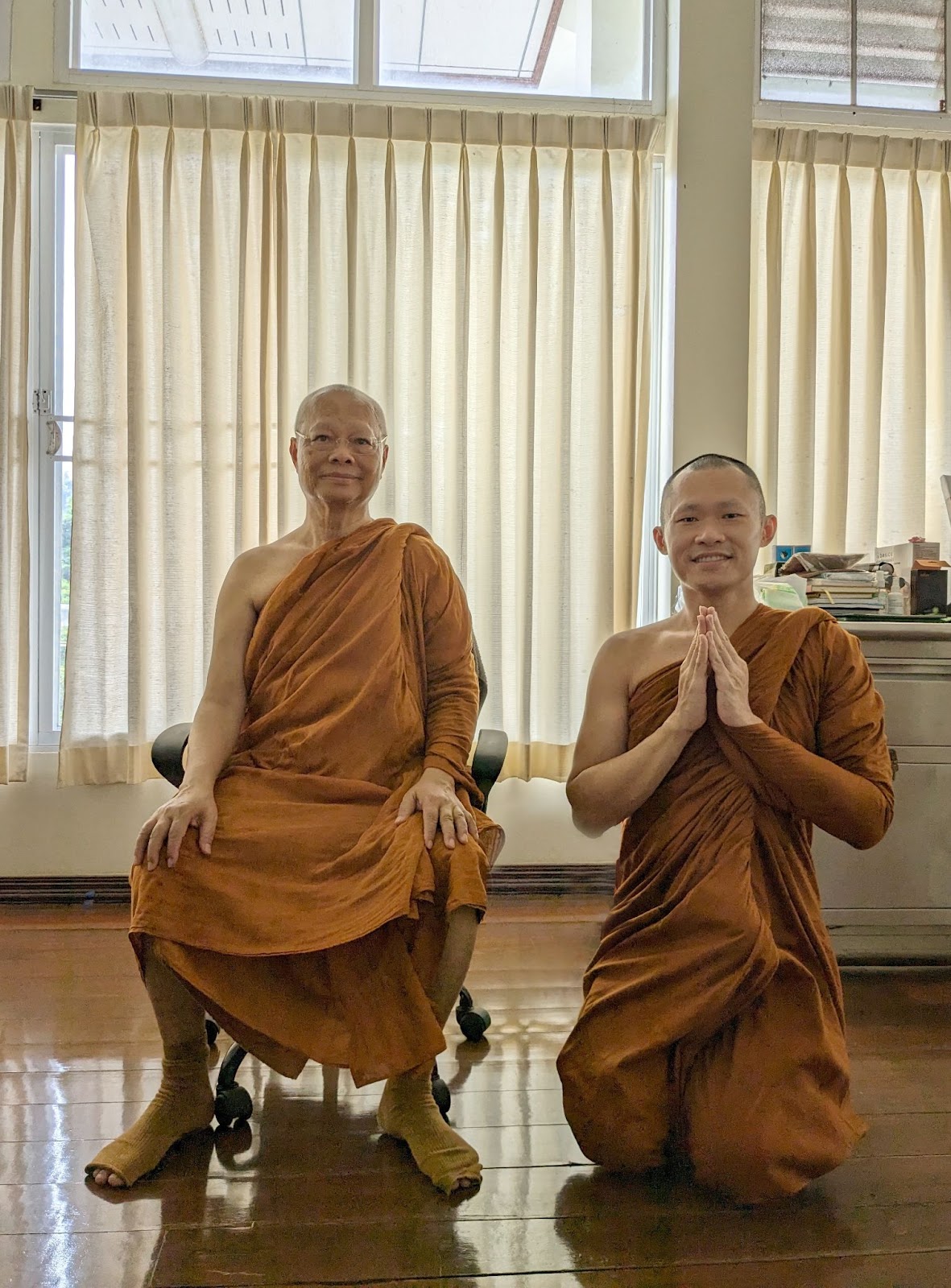
With Luang Por (Ajahn Anan) (Photo used with permission)
Pain is inevitable, but suffering is optional
One of my first realisations was that monastics are, like laypeople, not exempt from pain and suffering (surprise, surprise!).
As I was in Thailand during the hot season, the temperature was about 35 degrees Celsius in most afternoons.
My body became very inflamed (i.e. heaty) twice during that one month and resulted in large mouth ulcers.
While I was lucky that the monastery had some herbal cooling pills which helped with recovery, it was necessary to find ways to manage the pain. I found that complete acceptance of the body’s condition and strengthening mindfulness by continuously attending to breathing helped to lighten the mind substantially and the result is that one feels much less pain.
Alms round and painful walking
Alms round was also a very educational experience. It was painful walking barefoot on the road and the ball of my right foot cracked and bled after switching from a shorter route to a longer route.
There was a day when the pain became really intense. I knew I had to do something to continue as I was slowing down and my breathing was becoming very laboured.
I told myself “every step I take, I walk closer to Nibbāna” and a wave of release instantly rushed over me and brought tears.
These examples demonstrate that pain does not necessarily result in suffering if we make an effort to adjust our mind wisely.
Suppose it was the time of autumn, when the rain was falling heavily, and a bubble on the water forms and pops right away. And a person with clear eyes would see it and contemplate it, examining it carefully. And it would appear to them as completely void, hollow, and insubstantial. For what substance could there be in a water bubble?
In the same way, a mendicant sees and contemplates any kind of feeling at all … examining it carefully. And it appears to them as completely void, hollow, and insubstantial. For what substance could there be in feeling?
Why do we allow ourselves to be influenced by feelings when they are as transient and insubstantial as a bubble?
Pain is caused by conditions, but suffering is caused by the mind. If we simply rush to pleasure to numb pain, we will continue to suffer and bounce back and forth between pain and pleasure.
Conditions are just conditions
A mother cat gave birth to a litter of cute kittens at the monastery. Unfortunately, one of the kittens died (I’m not sure of the cause) and I happened to see it one morning.
When I saw it that morning near the eating hall, I took some time to observe it. Its body was still whole but its mouth was open with some blood vomited.
At that time I did not feel much as my mind was quite equanimous. Whilst I thought that it was an unfortunate situation, I shared merits and moved on.
The extent that we get caught up or blinded by worldly conditions is a matter of choice. While it does not mean that we cannot try to change our conditions, much is beyond our control, e.g. death.
As practitioners, we cannot simply blame our circumstances or environment and do nothing else. We have to process and contemplate wisely.
Whilst monastics usually have less distractions in life compared to laypeople and may have better conditions for the practice, it does not mean that laypeople are unable to practise as well as monastics.
The Buddha himself notes his lay disciples Citta and Hatthaka as role models and they were said to have awakened to the extent of Anāgāmi (Non-Returner).
When things are less than ideal
One may find it helpful for there to be a difference between what we choose to believe in internally and what we strive for externally, especially if there is a need to accept something that is less than ideal.
For example, “my job may not be ideal but it is good enough and I will continue until I find something else”. This technique helps to create acceptance and letting go.
Sometimes in life we just need to “suck it up” and accept conditions that are less than ideal in order to move on.
Try to “look on the bright side” as it is always a meritorious learning opportunity when we accept and deal with challenging conditions. Human life and society is not and will never be perfect.
While we can and may try to change certain conditions in life, not everything is within our control. We would be much happier if we develop patience and accept conditions that are beyond our control.
What is within our control is the condition of our mind. Change that instead.
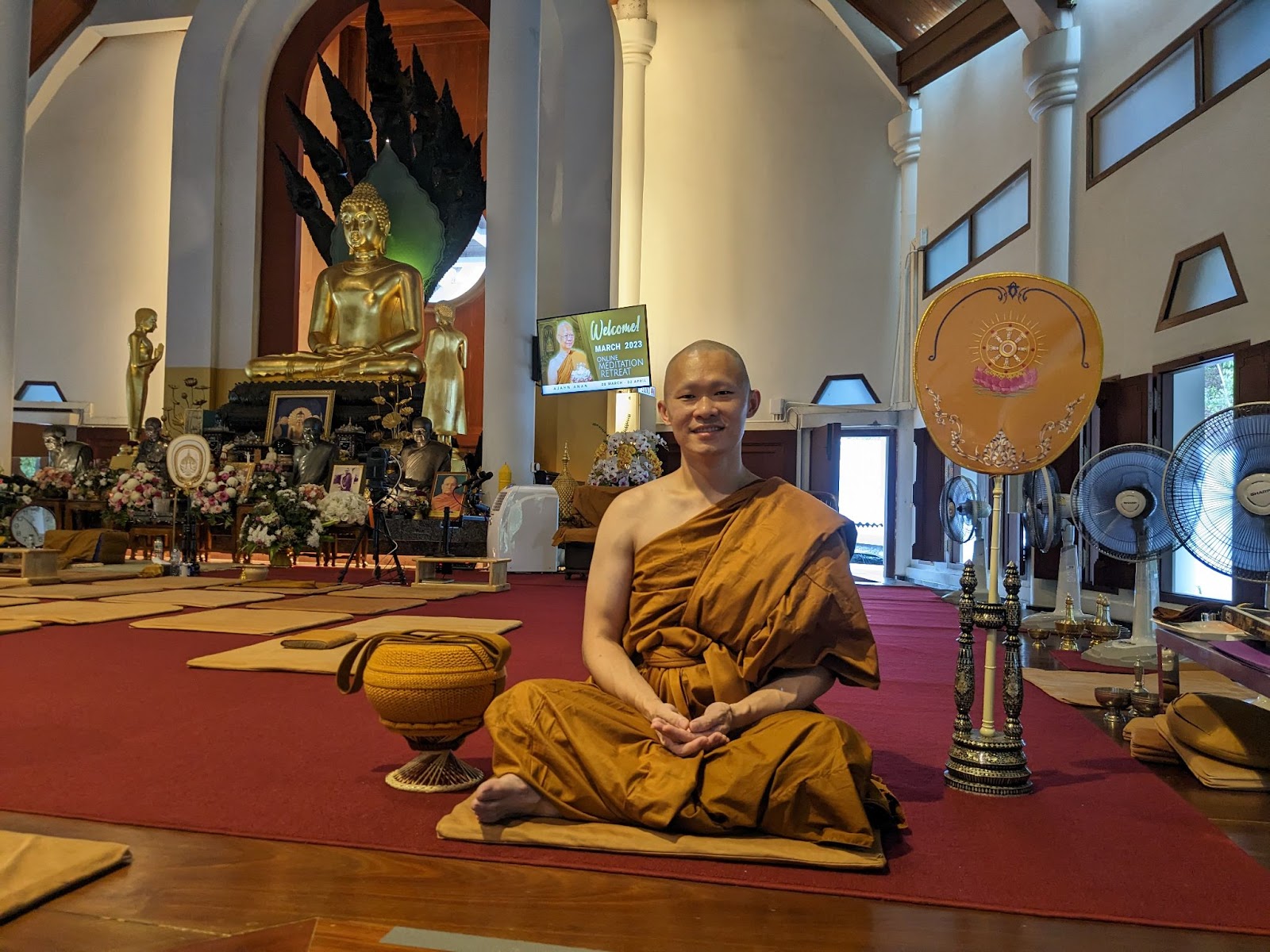
Obligatory post-ordination photo
How to practise better?
In order to suffer less, we need to uproot and release the causes of our suffering.
Firstly, it is crucial to reflect and understand ourselves better. We should contemplate and identify what are our main stressors in life.
It is beneficial to reflect honestly and sincerely on which of the five hindrances occur most prominently in our daily life.
The stronger any hindrance plays (or preys) upon the mind, the more suffering will occur whether or not one realises it.
Conversely, the more one acts skilfully to eradicate one’s hindrances and defilements, the less one suffers. I’ve suggested some tips at the end of this article which may be helpful.
It is beneficial to review why we want or think we need certain things, as well as the views we hold onto. A skilful practitioner will constantly investigate his/her desires and attachments and whether it is really necessary to have them.
One change I made was to stop judging whether I’ve had enough sleep based on the number of hours spent in bed and to make that determination based on how I feel instead.
That is because it became clear to me that one can sleep little and yet be full of energy if our mind is light and unencumbered, whereas one may not be refreshed even after spending many hours in bed if our mind is caught up or encumbered.
Peace and serenity come from our own minds. No one can give them to us.
Ajahn Stuart (Photo used with permission)
More mindfulness helps
The next step to self-improvement is to develop and maintain mindfulness as much as possible throughout our daily life.
Monastic life highlights the dangers of not being mindful. I’ve dropped my alms bowl (while waiting to get food), tripped on my toe a few times during alms round, forgot to wear my slippers, and forgot to take my stuff (e.g. bowl, lower robe, sitting cloth).
These situations occur in lay life as well but we tend to see them as normal and acceptable as we prioritise and value being caught up in our labours.
The truth is that when we are not mindful, we are much less effective and the likelihood of saying or doing something unwholesome is much higher.
If we reflect on incidents or choices we regret in life and consider how we could have acted more skilfully, with some mindfulness we are likely to behave in a much more wholesome manner the next time similar situations occur.
One of the best ways to develop mindfulness is to place some attention on our breathing whenever we can even while attending to daily tasks. The more often we do this, the freer our mind becomes!
Change our habits by skilful means
I was told off by another monk for stepping on the wet floor after it was mopped as well as not mopping the way he asked me to. While I recognised that I could have been more mindful, his attitude did cause some painful feelings to the extent that it required some contemplation to resolve.
I told myself that I should have patience and develop compassion for him. I also reminded myself that while living the holy life, my conduct has to be impeccable.
It helped that I had the advice of a senior monk who agreed with my approach and I was able to continue helping with chores without reacting.
After some time spent working with that monk, I realised that he was particular because he was trying to do the best for the monastery. That realisation helped me to see him in a different light and I was pleased that I did not allow myself to react negatively.
In my second week, I maintained noble silence for 5 days. I realised that noble silence has to include not talking to yourself as inner speech is also distracting. That being said, it is skillful to talk to ourselves wisely in order to encourage ourselves in the practice.
Identify phrases and teachings that inspire you and use them often, e.g. say “well done” / “sadhu” to yourself when you do a wholesome deed or refrain from doing something unwholesome.
Every time you sit to meditate, say “this is freedom from suffering” and/or “this is what the Buddha did” (credit to Bhikkhu Anālayo). If we often speak unwisely, transform the inner speech first and the outer speech will also be changed for the better.
“Intention, I tell you, is kamma. Intending, one does kamma by way of body, speech, and intellect.
It is important to investigate what aspects and habits of our daily lives are actually dissatisfactory or stressful. Do your acts and thoughts create more happiness or unhappiness for yourself as well as for others?
Break unskilful and unwholesome habits by intentionally replacing them with skilful and wholesome habits. Most of us start our day by immediately jumping into our mundane work.
However, it is actually more beneficial to start the day with meditation and being mindful as it makes us more equanimous and develops a more balanced mind (credit to Ajahn Achalo for this recommendation).
I have also found it helpful to make vows that improve the standard of our practice (e.g. I vow to meditate daily), but vows that are about results may not be as helpful (e.g. I vow to have jhāna) as we do not have control over the results of our practice.
A skilful practitioner would also evaluate the company they keep and actively choose to spend more time in the company of the wise. The Buddha said that spiritual friendship is the “whole of the spiritual life”.
This can help us to develop wisdom and slowly change the unskilful parts of our character into more skilful ones. I’ve found it very beneficial to join practice-focused organisations such as the Dhamma Assembly For Young Working Adults (DAYWA). Having wise spiritual friends to support one another can help us resolve issues faced in our lives, especially when we feel safe enough to be open about them.
Many of us practise hoping for a good rebirth. There’s nothing wrong with that, but actually our practice also makes life better right now, not just in the next life. Why? Because our desires, attachments, and suffering will reduce when our practice improves.
Balance is key
“But when your harp’s strings were tuned neither too tight nor too slack, but fixed at an even tension, was it resonant and playable?”
“Yes, sir.”
“In the same way, Soṇa, when energy is too forceful it leads to restlessness. When energy is too slack it leads to laziness. So, Soṇa, you should apply yourself to energy and serenity, find a balance of the faculties, and learn the pattern of this situation.”
In order to practise well, we need to know and understand ourselves well so that we can skilfully adjust the string of our practice into one that is neither too tight nor too loose.
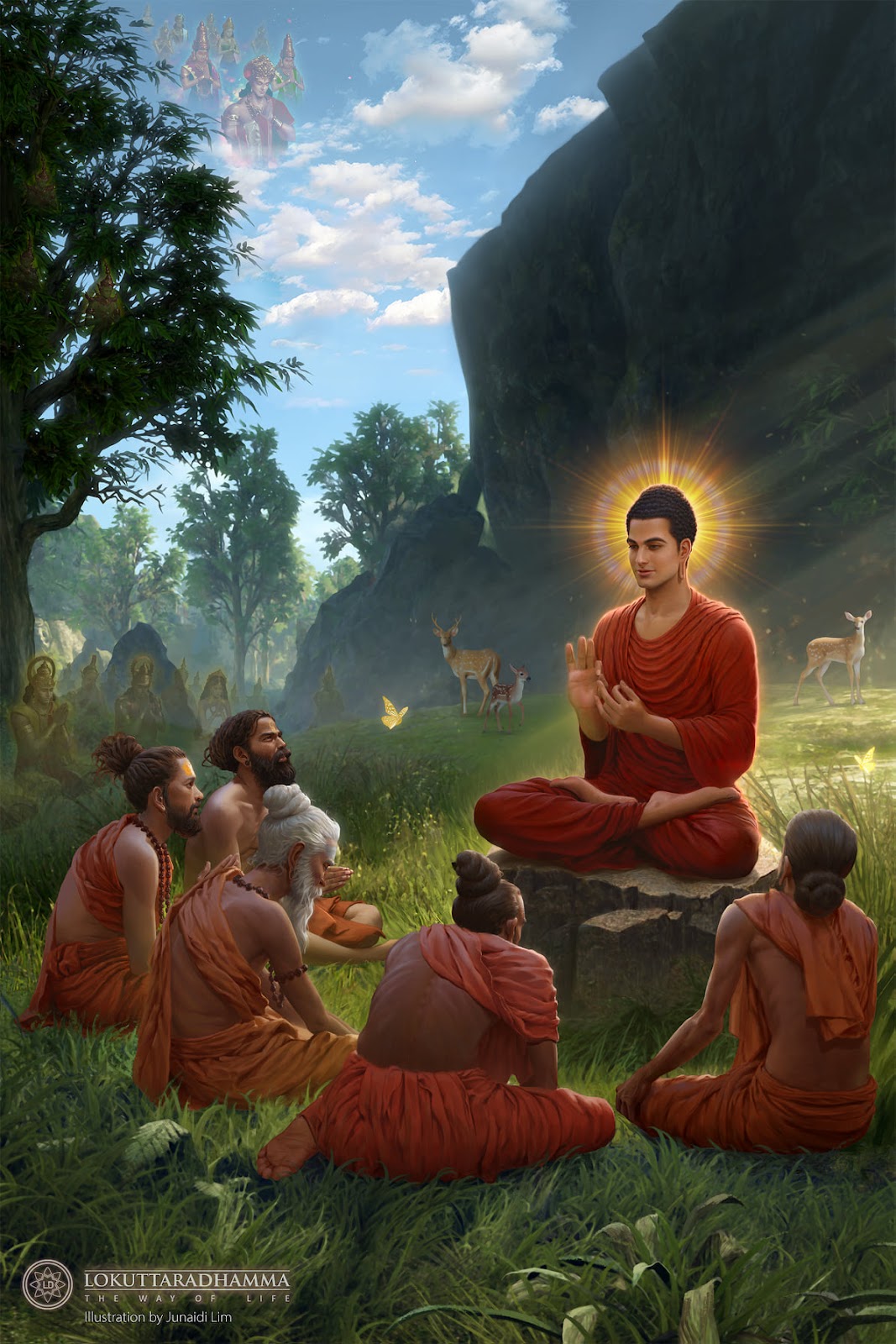
The Buddha’s first teaching, Dhammacakkappavattana Sutta (Illustration by Junaidi Lim, used with artist’s permission)
Explore more of the Buddha’s teachings
Every Buddhist tradition helps us to see the goodness that we all have within us. The historical Shakyamuni Buddha is part of every Buddhist tradition and he left an incredible wealth of wisdom for us.
Not to do any evil; to embrace the good; to purify one’s mind: this is the instruction of the Buddhas.
Patient acceptance is the ultimate fervor. Extinguishment is the ultimate, say the Buddhas.
Consider subscribing to ReadingFaithfully.org which emails you a new sutta every day. If suttas are not your thing, Ajahn Jayasaro provides wise and relatable Dhamma teachings in English, Chinese and Thai.
For a more structured course on the Buddha’s teachings, consider attending the Dhamma Foundation Course at Buddhist Fellowship (held yearly, starting early 2024).
May we all continue to practise well.
Here are some simple techniques that may be helpful to address the hindrances:
When being overcome by sense desire, reflect and visualise the true nature of whatever that is the source of your craving e.g. body is a carbon construct that ages and rots, food is just unprocessed excrement, luxury items are just marketing and are not actually worth their (mental) cost. It’s ok to have some enjoyment from time to time but it is not ok to overindulge as excessive greed harms yourself as well as others.
When having ill will, reflect that whoever you dislike is just a construct of their choices and karma, they are just illusions (like yourself) and there is actually no real person to like or dislike (teaching by Ajahn Anan). If that does not work, tell yourself that you are the only one suffering by allowing your aversion to continue existing in your mind, and that everyone is subject to their own karma. Try to develop compassion for yourself as well as others as we are all suffering in samsara together.
When feeling lazy, tell yourself that you might actually die today from a bad fall, an unknown physical condition or a traffic accident, or that you are heedlessly wasting the limited time that you have left in this world.
When feeling anxious and when the mind is unable to stop thinking, have a warm shower or bath and listen to soothing music to calm down. Try to meditate and see that your continuous thinking and worry is pointless and tiring as people and conditions are just things that are beyond our control.
When feeling doubtful of the teachings, consider the fact that no matter what you think or believe, you are still suffering. But there is a way out of suffering and we should try to keep an open mind and perhaps clarify with teachers that we respect. If you do not already have a teacher you respect, Ajahn Anan is one of the most well-practised monastics and would likely be able to address your doubts.
TLDR: Always scrolling whenever there is nothing to do? Doing a weekly one-day digital fast from one’s devices, and employing the methods of mindful living recommended by Zen Buddhist monk Thich Nhat Hanh may help in combating a digital addiction.
In the bustling city of Singapore, a one-day meditation retreat became the turning point in my mental health journey.
This retreat was an escape from the city’s chaos. It included guided meditation, moments of introspection, and times of quiet. During this, my racing thoughts began to calm down.
The retreat didn’t provide an instant fix, but it jump-started a positive change. I started to incorporate mindfulness into my daily life and also started a rewarding digital detox journey.
This one-day retreat unveiled the path to resetting my mental health. It taught me that, even amidst the chaos of life, there’s room for tranquillity. The journey continues, with mental detox as my guiding light towards a healthier and happier mind.
A quiet hall
It was a lovely morning on 22 July 2023 when eighty intrepid youths gathered at the Hall of Medicine Buddha on the sprawling grounds of Kong Meng San Phor Kark See Monastery.
Titled “Shoulda, Coulda, Woulda: Living a Life with No Regrets”, there was an air of anticipation as we sat patiently on the cushions provided, waiting for the morning session to begin.
Venerable Damcho led us in an opening puja, and then a morning meditation, ending with an intention for the day.
She then expounded on the topic of the day, which plagues many youths today – FOMO, or the fear of missing out.
A light bulb went off in my mind
Group Retreatants
Something she said caught my attention, and I paraphrase, “Isn’t it rather odd that we spend so much time ‘catching up’ with our friends by obsessively scrolling on Facebook, Instagram, or Tik Tok; when we could very well just ask them out for a cup of tea instead?”
During the question and answer session, I asked, “As a queer person of faith, and for many others who do not fit into the neat little boxes society tells us to conform to, I seek solace in online spaces to find ‘my tribe’ as it were, before I found queer affirming Buddhist communities like Rainbodhi Singapore…
… In Singapore, as an educator who has journeyed with students who have been diagnosed and are seeking treatment for digital addiction, I think that scrolling on Instagram is one way people deal with chronic loneliness. I think that there are some benefits to this…
… May I also ask, what would be some of your suggestions for encouraging people to ask their friends out for a cup of tea if they suffer from anxiety issues?”
Her answer was most compassionate. She acknowledged that certain online spaces were places of refuge for those who might be unable to find community in real life.
But encouraged us to still endeavour to interact with our friends in real life.
Group interactions with Venerable Damcho
Having reflected upon the talk in the past 2 months, I have some reflections.
Putting it bluntly, I think we suffer from a delusion when we doom-scroll on our platform of choice on social media, whether that be Instagram, Facebook, Twitter, TikTok, or others.
To me, obsessive scrolling on social media, out of the ‘five poisons’, is a toxic cocktail made up of both ignorance and attachment. The other three are aversion, pride, and envy.
You might be surprised to note that I don’t include envy in my consideration. You might differ from me, but to me, the main reason why I scroll Instagram to while away some time while waiting for the elevator to arrive is because I am ignorant that there are better things to do with my time.
I am also simultaneously attached to wanting to know what interesting things my friends are up to, the concept of FOMO that Venerable Damcho was targeting in her talk.
What I did after her talk
There were 3 things I implemented after her talk that have been helpful for me to combat this FOMO problem and the endless digital distraction that compels us each day to check our phones way too many times in a day.
I am not yet an expert in battling digital addiction*, but I thought it might be useful to share what’s helped me.
(*Note: I see digital addiction as being on a spectrum. While I might not get physically violent if my digital devices are removed from me, scrolling compulsively for 2 hours every night before I sleep instead of reading or chanting is to me, most certainly a problem, even if it might not qualify as being pathological in nature. Please consult a professional if you suffer from addictions of any sort, the following are but some humble suggestions that have worked for me.)
1. Digital Detox
I implemented a day where I would be offline for 24 hours, on an off day where I don’t have to work, and I would take care to inform the friends and family I text most often.
(This is crucial because I once caused them a lot of worry just going dark without telling them, for I am the consummate digital native, replying to messages at a ridiculously rapid rate.)
On the day of my digital fast, I’d intentionally put my phone, laptop and tablet at home, and either go for a morning walk at the nearby park or head to the beach to sink my feet into the sand.
Then I’d mindfully eat my breakfast of kaya toast and coffee, more mindful than usual instead of Instagramming it and pairing it with a witty caption for my followers.
Sometimes I’d head to my favourite temple, Bright Hill Temple, and pay my respects to my favourite bodhisattva, Guan Yin, then meditate in the Hall of No Form for a bit, before partaking in a delicious vegetarian lunch at their canteen.
Then I’d spend some time journalling, in pen and paper (crazy, yes I know, some of us haven’t touched a pen since graduation – at least according to a friend of mine), and write down some thoughts and reflections I’ve had for the week.
Finally, I’d spend the rest of the afternoon crocheting, chanting a meditative mantra silently in my mind with each stitch.
Then I’d wind down by doing some nighttime chanting to Guan Yin with my mala (prayer beads), then finally curl up to a good book to quieten my mind and body before falling asleep.
This is in contrast to staring at my phone, indulging in my usual bedtime procrastination of scrolling for 2 hours straight, and catching up with what my friends are doing, before collapsing in exhaustion past midnight.
I can see why retreats are useful, but since I cannot currently afford to go overseas to spend 7 days in silence regularly, I think being offline, away from the constant overwhelming digital noise, 1 day a week can be super helpful too.
2. Mindfully doing everything (as much as possible)
I have been a great fan of Thich Nhat Hanh’s methods, ever since I was recommended his books as a newcomer to Buddhism 5 years ago.
In his little series of books that I love, with them intentionally titled, “How to Sit”, “How to Walk”, “How to See”, and so on, I have learnt that we can be mindful of the little things.
As I began to eat more mindfully during mealtimes, setting aside my phone (after snapping a square photo, I know, forgive me, for I am still learning to be mindful), I began to better experience the flavours, the texture, and even noticing the temperature of the food I as I chew.
I felt grateful with each bite, for the many causes and conditions that brought the bowl of noodle soup to me, with the various ingredients sourced and harvested from all across the world. That is not to be taken for granted. This also reminds me of the concept that Thich Nhat Hanh likes to call “Interbeing” more commonly known as interdependence.
This means that no man exists as an island unto himself and that we all rely on one another, whether we realise it or not. And I began to see the universe in my little bowl of noodles. It is incredible indeed, what being mindful can do to one’s experience of a meal.
Then, while walking, even to the bus stop from my house, I noticed the feeling of my feet as I took each step. I see the trees, the breeze gently caressing each leaf and cradling each branch, the accompanying chirping of the birds, and the gentle early morning sunshine on my face, and I am grateful to be alive.
I must admit, this does not happen all the time, I am sometimes still engrossed in my phone, replying to an urgent text from a client or a friend, checking for the day’s movie timings or seeing what time the bus is arriving from my app.
But when I do, and I try to when I remember, the world slows down and everything becomes that much more meaningful as the digital world fades into the background that much more.
3. Digital decluttering the Marie Kondo way
Recently, I began to do a little digital decluttering.
I cleared my photo album of photos that I no longer needed, screenshots of receipts after meals I send to friends to split the bill, or posters to events that have long passed.
Then, I did some purging.
Often on social media, digital friends can over time become unwholesome to one’s practice if their views aren’t aligned with mine.
On Twitter, I unfollowed or muted some friends who posted things that were too violent, whether in imagery or speech, too sexual, or too angry.
My feed then magically became a more wholesome place to be in, where I converse with friends on important topics of the day, even as we partake in one another’s lives across continents, making plans to one day visit.
I think this can be sometimes controversial, for some might consider this a form of locking oneself in an echo chamber.
Well, my response to that is, that I’d rather be in a wholesome echo chamber than be in a town square full of angry and hateful people, bombarding my eyes with their violent speech and imagery, thank you very much.
My feed is mine to curate, and it’s like reading books or watching movies – we don’t read every single book or watch every single movie that comes into the market. Why? Each of us has a unique taste, cultivated over time, informed by our religious beliefs and practices. Similarly, I shouldn’t subject myself to reading every tweet, Instagram picture, or TikTok video that comes my way if it isn’t aligned with my practice.
That’s being mindless instead of being mindful.
My friends often wonder why my TikTok feed is so weird – my feed is filled with parenting advice from a mom who is also a professor and counsellor, fun chemistry videos from a real-life chemist, wholesome coming-out advice from a queer couple, and Book Tok videos of new books my favourite Book Tok celebrity, Jack Edwards, has laid his hands on.
These are things I enjoy learning about, and I am glad the TikTok algorithm is rather accurate in serving up the wholesome content that I enjoy. No shade on those who dance in skimpy clothing but it’s just really not my thing. But I most actively steer away from content that is overtly angry, rude, or discriminatory, which (un)surprisingly makes up a lot of content online these days.
Even if one cannot go offline completely, plugged into the digital world as we are in the 21st century, whatever one consumes directly affects your brain. There is a famous neuroscience saying that goes, “Neurons that fire together, wire together”, meaning that the more you consume, the more your brain wants you to consume.
The more sexual imagery one consumes digitally, the more they’d want the same hit of dopamine, and a vicious cycle continues.
Like my friends in recovery, instead of going cold turkey, many replace their addiction with a healthier form of coping.
Instead of smoking, they might chew gum instead (I know, we can’t buy chewing gum in Singapore, but you get my point).
Instead of feeding one’s mind with celebrity break-up news on Instagram, one could instead read the helpful posts on the Handful of Leaves Instagram page, and listen to their podcast too (My favourite one is the sex talk the two hosts did with Venerable Damcho).
Conclusion
I still struggle with and have a mild digital addiction. However, implementing the methods of mindful living as espoused by Thich Nhat Hanh, and doing a digital fast once a week, has been tremendously helpful for me. Curating my social media feed is something I’m currently still working on, even as I work on digital decluttering, removing apps and photos that I no longer use or are helpful to my practice.
I hope this little sharing has been helpful for you and I wish you all the best of luck with your digital journey.
Be kind to yourself, be curious about why you do the things you do, and be brave enough to make changes to your life when the need arises.
TLDR: ‘McMindfulness’ is a term for describing commercial mindfulness divorced from its Buddhist roots. You are missing a key ingredient of mindfulness if you are using the practice as another tool to get rid of unpleasant feelings such as fear.
Mindfulness is the key word for stress reduction in today’s world, so much so it has been given the term “McMindfulness” where the practice has become commercialised and departed from its roots. In its ancient form, mindfulness is for overcoming fear and getting to know ourselves deeply, and not just a wellness tool.
There are different types of fear such as financial loss, losing reputation and our lives.
The last fear is something that drives most of us – the need to make a name for ourselves before we die, or seek comfort for a long life. However, all fears are existential.
What underlies most fear is the fear of being rejected. The fear of rejection by society can lead to survival problems (not being in a herd means we are more easily attacked, or have less assistance from others when we need help), threatening our existence. Unfortunately, we seldom contemplate such matters until a serious challenge in life forces us to look within.
However, in our society, corporations have created an unnatural psychological fear in our pursuit of profits.
For instance, we fear not looking beautiful, not having enough and not being healthy. Do you see how all these fears are driven by beauty, investing, and get-fit personal training advertisements we see everywhere?
Different mindfulness techniques for working with fear
One of the powerful techniques in mindfulness for overcoming fear is to befriend fear. Befriending fear is a wonderful technique for overcoming fear. When we treat someone as a friend, that person cannot antagonise us and it is the same way with negative feelings.
However, the technique of befriending fear may not be useful for all situations, especially if one’s mind has no clarity or concentration.
Learning to be with fear is another way to get to know it deeply by watching fear arise and subside on its own. This takes a strong mindfulness practice because most times we react to fear as opposed to just observing and being with it.
Another powerful method for working with fear is to accept the situation (things we cannot change). To accept is to run towards the fear instead of avoiding it.
It is by running towards it, as opposed to turning away from it, that the energy of fear is able to flow.
Life itself is a constant flow. It is our resistance that causes stress, which blocks the energy flow of these different emotions in our bodies.
But isn’t mindfulness a technique to get rid of fear? This is the biggest misconception of mindfulness.
Unlike going for a massage to relieve pain, mindfulness is not about getting rid of feelings we dislike.
This misconception is significant because it highlights a fundamental misunderstanding of what mindfulness truly entails. Mindfulness isn’t a tool for erasing or suppressing uncomfortable emotions like fear. Instead, it encourages us to acknowledge and understand these emotions, fostering a healthier relationship with them.
By embracing our feelings, including those we dislike, mindfulness empowers us to navigate life’s challenges with greater resilience and inner peace. It offers a path to coexist with our emotions, ultimately leading to personal growth and emotional well-being.
Overcoming fear by letting go of control
Since fear is a natural biological instinct, we can learn to trust that it is there to help us. However, since we humans are also a part of nature, we need not fear the feeling of fear when we are facing possible death of the self because death is natural.
The key ingredient that is missing in secular mindfulness practice is confidence or faith.
This faith isn’t a blind belief but a trust in the process and the wisdom of the Buddha and those who developed these practices over centuries.
A lot of people reject negative emotions and use meditation as another tool to get rid of them.
For example, a practitioner who is feeling lonely may start to watch the breath so as to forget feeling lonely. However, this is just another form of distraction. True mindfulness encourages us to confront and understand our emotions, even the uncomfortable ones, rather than simply using it as a distraction tool.
Meditation is the deliberate act of training the mind to be collected and stable. When we place awareness on the breath in meditation, it can alleviate unpleasant feelings. However, the same unpleasant feeling may return when we come out of the meditation practice.
It is as if we have used a rock to cover the moss (unpleasant thing) instead of uprooting it. Once the rock is removed, the moss remains there.
Meditation is a support for mindfulness. Mindfulness is not a tool to distract ourselves from uncomfortable feelings. First, we learn to steady our minds with meditation. Then, we use this strength of the concentrated mind to observe and accompany unpleasant feelings.Why?
With mindfulness, we can become familiar with what comes after unpleasant feelings such as fear. Watching how the fear fades and the next emotion that arises strengthens our understanding of feelings and their nature to fluctuate. It cannot stay forever. Just like musical notes. Music is made of both high and low keys.
When we learn over and over again to be with fear, we realise there is no need to push away fear as it arises and passes away.
We can also gain confidence through the practice that fear or any painful feeling is also followed by different emotions which can be relief.
I leave you with some techniques you can apply to managing fear.
What are some techniques i can apply?
Here are 3 techniques for overcoming fear:
Befriend: When the feelings of fear arise, welcome the feeling by mentally noting “Hello my friend, there you are again.”
Being with: Stay with the feelings of fear means to feel its sensations (knowing the body temperature has risen, there are more sensitive vibrations in the body) in the body and not reject them by wanting to feel something else.
Run towards: When the fear comes, see it as an adrenalin rush, run towards it and tell yourself it is good to have more of this energy because you can use this excess energy to exercise or to dance your fears away.
Wise Steps:
When facing fear, stay present with the feeling in the body, don’t run – if you are a mindfulness practitioner.
Notice what comes at the end of fear when you stay present with it mindfully. Know the end of fear again and again, because the end of fear is the same gap between thoughts and all feelings.
Know the difference between meditation and mindfulness; find different ways we can incorporate them into day-to-day life.