TLDR: Reflections on craving, virtue, and coming home… from someone who watches maybe two movies a year.
I rarely watch movies. Maybe two a year, if a friend drags me. So when I grabbed the ‘normal’ non-IMAX for Christopher Nolan’s The Odyssey, it was a genuine treat. I expected three hours of spectacle. What I did not expect was to walk out feeling like I had just attended a Dhamma talk.
Homer never met the Buddha. Homer’s poem, Odyssey, predates the Buddha by centuries. And yet a story about a man trying to get home kept pointing, again and again, at the same truths the suttas point at. Perhaps that is what happens when a story survives 3,000 years: only the parts that are true about the human condition make it through.
Don’t worry, I will keep this spoiler-light for a plot that is 3,000 years old (a bit of old news).
Here is what I saw as parallels between the Dhamma & Homer’s poem.
The sirens, and the river no one crosses
A quick primer for those who did not grow up with Greek myths. In the old lore, the Sirens are creatures who sit among the rocks and sing to passing sailors. The song is so irresistible that men steer their ships straight into the rocks to get closer to it. No one who hears it survives. The sirens do not attack anyone. They simply sing, and the sailors destroy themselves by drowning.
Let that sink in. The danger was never the sirens but rather the wanting.
And what do they sing about? Not treasure. As I understood from the film, the Sirens sing to you about all the things you wanted to be, and all the things you wish you had never wished for.
“That what you most want is what you most cannot have. And that what you most cannot have… is what you already had, and lost.” Odysseus
I sat there in the dark feeling thoroughly blown away.
Because that is taṇhā (craving): the thirst that runs beneath everything we chase. The Dhammapada puts it plainly: “There is no river like craving” (Dhp 251). Rivers at least reach the sea. Craving reaches nothing. It just keeps flowing, from the thing we want, to the next thing, to grief over the thing we lost.
Reflecting deeper on this part of the movie, Sirens are not out there on some rock. They sing every time I open my phone, every time I replay an old memory of who I used to be. The song is always the same song of transient praise that makes us feel pleased for the moment, but it never lasts. And just like in the lore, no one is steering our ship into the rocks except us.
Tie yourself to the mast
Here is what struck me most about Odysseus. He does not believe he can out-willpower the song. He knows that in the moment of temptation, he will fail. So he prepares before the moment: he has himself bound to the mast.
That, to me, is sīla (virtue, which includes keeping the moral precepts and a wholesome mind). We do not keep precepts because we are strong. We keep them because we know exactly how weak we are when craving strikes. The ropes are not a punishment. The ropes are not punishment. Tying them is what you do once you know that about yourself.
A climber’s rope is a restriction too. It stops you going where gravity wants to take you. But no climber resents it, because the rope is what lets them get up on the rock in the first place. Without it you stay on the ground, or you climb so carefully you never find out what you can do.
Sīla works on me the same way. The precepts let me go near the things that used to wreck me: desire, anger, other people. And other people get the safety too. When I do not lie or take or harm, they do not have to brace for me.
And the mast itself? For me, the mast is kalyāṇamitta (spiritual friendship): the wise friends and teachers we bind ourselves to. The Buddha went as far as telling Ānanda that admirable friendship is not half of the holy life but the whole of it (SN 45.2, Upaḍḍha Sutta).
I have felt those ropes hold. Ajahn Anan, one of my wise teachers, in Q&A sessions, has a way of pointing out your flaws so gently and so precisely that you cannot wriggle away from them.
And Ajahn Sumedho once reminded me not to be so willful in the practice… to smile more, to be gentle with myself. To build the path not with strictness but with softness held in khantī (patient endurance), which the Buddha called the highest austerity (Dhp 184).
I used to think discipline meant tightening my grip. Now I think it means choosing a good mast, and letting the ropes do their work.
Polished armour, soft body
Then there is Agamemnon. In his armour he looks magnificent. (Some viewers joked he looks like Batman, and honestly, fair.) He won the war. He wears victory like a second skin.
But remember what the lore says his victory cost. To win the gods’ favour for the war, Agamemnon sacrificed his own daughter. He traded his child for glory. And after surviving ten years of battle, the great king was not felled by any enemy spear. He died in his own bedroom, at home, where no armour could help him.
Look closer at that armour; it is polished. Gleaming. It has clearly not seen battle in a long time. It represents a king that does not fight his own wars. And underneath all that bronze is the same soft, ageing, vulnerable body every one of us carries.
Two reflections hit me at once here.
The first is anatta (not-self). We build a solid-looking self out of victories, titles and reputation, and it is brittle precisely because it looks so solid. We build a strong self-image (just like Agamemnon’s armour) and go out and present it to the world. The world is suitably impressed, cowed, and responds in fear or praise to that image; but the inner work remains undone. When the self-image is shed, we are laid low by our kamma, past misdeeds and hindrances.
The shinier the armour, the more we forget the body inside it. Agamemnon armoured everything except the one place life actually reached him.
The second is more uncomfortable, because it is about people like me. Polished, unused armour is also what Dhamma knowledge looks like when we collect it but never apply it. The Dhammapada compares someone who recites many teachings but does not practise them to a cowherd counting other people’s cattle (Dhp 19). I have shelves of Dhamma books. Some of them are… very well polished.
Armour only protects you if it gets used and not kept for ceremonies. The same is true of the teachings.
Athena, the voice that will not let you forget
In Greek lore, Athena is the goddess of wisdom, and Odysseus has always been her favourite. In the film, she is less a rescuer and more a conscience. She appears at the moments when Odysseus is closest to losing himself: when pride swells, when he drifts from the man he is supposed to be, when the cost of his choices lands on the people around him.
She does not fight his battles for him. She reminds him of who he is, holds his failures up to him without flinching, and points him back towards home.
Watching this, I kept thinking of hiri (moral shame) and ottappa (fear of wrongdoing). The Buddha called these two qualities the guardians of the world (AN 2.9), because without them, he said, humanity would fall into chaos.
We tend to hear “shame” as something toxic. But hiri is not self-hatred. It is the small and quiet inner voice that says this is beneath you, the way a goddess might say it: with dignity, expecting better of you. Ottappa is its partner, the wise wariness about consequences. Together they are not there to crush us. They are there to guide us back, every single time we drift. Athena never abandons Odysseus, no matter how far he strays. Neither do these guardians abandon us.
The guardians of the world do not scream or shout. They whisper, and then they wait for you to turn around. Or in Zendaya’s (actress who plays Athena) case, she just sulks.
The bow only you can string
You probably know the fable’s most famous test, so this gives nothing away: there is a great bow, and suitor after suitor tries to bend it to string it. None of them can. It answers to one person alone. Odysseus loses everything (wealth, fame, people, time) except this quality of his, a skill & a defining practice of his, that he returns to and honour.
It reminds me that one is heir to one’s kamma, owns it and is borne of it. Another person (the various suitors) cannot take your place and bear it for you, for it is “yours” alone.
I keep returning to that image as a question for the practice. The sutta this website is named after reminds us that the Buddha taught only a handful of leaves out of an entire forest (SN 56.31): a small set of essentials, because that is all we truly need. But even within that handful, each of us seems to have one leaf that fits our hand differently than anyone else’s. For one person it is mettā (loving-kindness) that comes naturally. For another, khanti (patient endurance). For another, cāga (generosity) that flows without effort.
I rarely watch movies. I am glad I watched this one, because it sent me home… in more ways than one… with a single question I now pass to you:
What is the one wholesome quality in your practice that you are familiar with, return to naturally, and perhaps you, and only you, can bring it out to the fullest extent for yourself?
TLDR: Most lies are small and unplanned. But they still erode trust and self-respect. Buddha’s framework for Right Speech shows a better way.
Think about the last time you said you were busy when really you just didn’t want to meet someone. Or when you nodded along in a meeting, pretending you understood, just to avoid slowing things down. These aren’t dramatic fabrications, but they’re still untrue.
Because these lies feel small, we tell ourselves they don’t matter. But over time, they become the default, shaping how others see us and how we see ourselves. If we can practise honesty in these small moments, the big moments become less daunting.
Why We Default to Half-Truths
Most lies aren’t carefully plotted. They’re quick escapes from discomfort, judgment or vulnerability. We tell them to protect our privacy, like sidestepping a nosy colleague’s question about our salary.
We tell them to save face, like saying we’re almost done with a task that hasn’t even been started. We tell them to avoid conflict, like reassuring a parent we’re “still thinking” about marriage when we’ve already decided.
Sometimes we even do it to make ourselves look better, claiming we “led the project” when our role was much smaller.
Each time, we might feel the relief of avoiding an awkward moment. But underneath, trust wears thinner — both our trust in others and theirs in us.
Buddha’s Five Gates of Right Speech
The Buddha’s teaching on right speech is a core principle in Buddhist ethics, designed to help people communicate truthfully and skillfully while also minimising harm. Right speech, as outlined in the Noble Eightfold Path, includes abstaining from four kinds of speech: lying (false speech), slanderous or divisive speech, harsh speech, and idle chatter.
The Buddha offered a simple filter for our words: are they factual, timely, pleasant/gently spoken, beneficial, and spoken with goodwill?
Factual means we resist the temptation to add, twist or leave out details that change the truth. Timely means we choose the right moment to speak, because even true words can be harmful if badly timed. Beneficial means the words help rather than simply airing our feelings. And goodwill means they’re rooted in kindness, not in the desire to hurt or score points.
When our words pass through all four gates, they have the power to strengthen trust. When they don’t, even harmless-seeming lies chip away at it.
Navigating Truth Without Harming
Yet, the suttas recognises that speaking the truth can sometimes cause harm. The Buddha’s conduct gave guidance on navigating this ethical dilemma. If a question would put someone in danger or create unnecessary harm, outright lying is not condoned, but neither is unnecessary truth-telling that would cause suffering. In some stories, the Buddha remained silent when answering directly would have led to harm.
Silence is often preferred to lying. If the truth would harm, a practitioner may choose to stay silent or give a non-committal response.
Diversion in the form of changing the topic, answering with another question, or speaking about something else is not explicitly forbidden, as long as it does not cross into deception.
Right Speech Guidance
Types of Speech
Ai En’s elaboration
Lying
Always avoid, even for small gains; never deliberately mislead
Harmful Truth
Prefer silence or skillful, honest ambiguity over harmful truth
Diverting/Changing Topic
Acceptable if not deceptive and does not cause harm
Idle/Pointless Chatter
Avoid; speak only if it is meaningful and timely
Slandering/Harshness
Abstain; use speech to promote harmony and goodwill
The Buddha’s practical approach to right speech helps people stay committed to truth while recognising the complexity of human interactions.
Rather than offering rigid rules, he encouraged mindfulness, compassion, and discretion in navigating speech, always returning to the question of whether words are beneficial, kind, true, and timely.
How we apply it? Here are some scenarios
Practical applications: Buddha in the Workplace
Office life offers endless opportunities for half-truths. A report isn’t close to finished, but we say it’s “almost done” to buy time. A client’s email has been sitting in our inbox all morning, but we claim we “never saw it” because we didn’t want to deal with it yet. A team project gets praise and we quietly let people think we were the lead, when in fact we only handled a small portion. Even something as simple as being asked about our pay can nudge us toward a made-up figure instead of simply saying, “I prefer to keep that private.”
Your boss asks, “Is the report ready?” and your brain starts scrambling. You have not even opened the file. The easiest escape is to say “almost done” and hope to buy some breathing room. The problem is, that slips straight into lying, and in the Buddha’s guidance even a small gain like a few hours of peace is not worth the cost of bending the truth.
A better approach is to stay honest while keeping the tone calm and constructive. You could say, “It’s not done yet, but I’ll start this afternoon and send you an update by tomorrow.” This shows you are on top of it and gives them something specific to expect.
Or, “I have not started yet; other priorities came up, but here’s my plan to get it moving.” Here you are admitting the delay and focusing straight away on the solution.
Or, “It’s still at the starting stage, so I’d like to adjust the deadline to make sure it’s done well.” This frames you as someone who cares about quality, not just speed.
Each of these responses passes the Right Speech test: they are factual, given at the right time, beneficial to the person asking, and delivered with goodwill. When you practise answering like this often enough, honesty stops feeling like a nerve-racking leap and starts becoming your default way of speaking.
Buddha Meet Your Nosey Aunty
It’s the classic family reunion scene. You’re piling food onto your plate when an auntie leans in with that familiar smile: “So… are you seeing anyone?”
Your reflex might be to laugh it off with, “No, too busy with work,” even if that’s not the full truth. It’s the safe answer, but let’s be honest ,it’s still a lie. And if you pad it out with a story about how “work has you travelling non-stop,” you’ve drifted into idle chatter, giving them something to chew on that’s not actually real. So, what will the Buddha say in such a situation?
Right Speech offers a cleaner way through. You can tell the truth without handing over your entire love life. You might say, “I’m not dating anyone at the moment.” Clear and simple — no room for misinterpretation.
Or, “Ask me again in a couple of months.” This one’s gentle but firm, signalling you’re not inviting more questions. And most likely, they’ll forget all about it months later.
Or, “I’m seeing someone but I’d rather not share details yet.” This is what the Buddha would call skilful, honest ambiguity — truthful, but private. You protect your boundaries without misleading.
These answers pass the Right Speech filter because they’re factual, timely, and delivered with goodwill. You’re not shutting your relative down, but you’re also not handing them a story you’ll have to keep straight next year. And the best part? You leave the table feeling lighter, because you’ve told the truth in a way that still feels safe.
In Social Life: Outgrowing a Friend Group
You know that uni friend group that still invites you out? The ones you’ve quietly outgrown. You appreciate the history, but these days the connection feels forced. Every invite comes with a little knot in your stomach — and the go-to line, “Busy with work,” slides out almost automatically.
A more skilful way is to speak honestly without burning the bridge. You could say, “Thanks for the invite, but I’m not up for going out these days.” That’s simple, factual, and gives them a gentle clue that your priorities have shifted.
Or, “I’ve been spending my time differently lately — I’ll reach out if I’m free in the future.” This makes space for distance without closing the door entirely.
Or, “I’m not joining this time, and I think I’m stepping back from group outings for now.” It’s the clearest option, and sometimes the cleanest endings are the kindest.
The first few times will feel awkward. But the relief of no longer having to invent excuses is worth it and you leave the friendship on an honest note instead of letting it fade under a fog of small lies.
Building Truthfulness as a Habit
Like any habit, truthfulness takes practice. Studies suggest forming new behaviours often takes 30 to 60 days. One useful method is habit stacking, attaching a new action to an existing routine. For example, after your morning coffee, take 30 seconds to mentally rehearse a truthful response to one tricky question you often get.
Defining “go-to” phrases in advance removes hesitation. Instead of being caught off guard and defaulting to a lie, you’ve got a prepared, truthful answer ready. Over time, that becomes your reflex.
Lying takes more mental energy than telling the truth, especially when you need to remember past stories. Research shows that the more you practise truthful speech, the more instinctive it becomes. Even in pressured situations, honesty can become your default.
The key is repetition; choosing small moments to tell the truth builds the resilience to stay honest when the stakes are higher.
Closing Reflection
Every time you replace a half-truth with a clear, kind response, you reinforce the habit. Right Speech, backed by modern habit research, isn’t abstract philosophy. It’s a daily practice, and every truthful sentence is another step towards a lighter, freer way of living.
Not lying (truthfulness or sacca)is considered a vital perfection (pāramī) on the Buddhist path to Nibbāna (enlightenment).
The Buddha and enlightened disciples are described as never breaking the precept against lying throughout their long spiritual journeys. Truthfulness is both a sign and a cause of deep spiritual attainment. The “perfection of truthfulness” is explicitly cultivated to reach and safeguard the highest realisation.
Practical steps you can try this week:
Pause before answering to check if your reply passes the four gates.
If it doesn’t, reframe until it does.
Practise boundary-setting phrases that are honest but private.
TLDR: This article explores the struggle of growing up gay in a conservative society and the conflicting messages from different Buddhist traditions. It highlights the Buddha’s early teachings, which focus not on sexual orientation but on living ethically, with compassion and non-harming.
Growing Up Gay in a Conservative Society
At fourteen, I noticed something different about myself—something society deemed abnormal. I found myself attracted to the same sex. I attended an all-boys’ school where masculinity and heterosexual norms were paramount. Anything even remotely feminine was ridiculed, and being called “gay” meant mockery and marginalisation.
I began my long performance: a straight boy in disguise. It was the only way I felt safe.
There was no one I could trust. Friends, classmates, even my own parents—none offered support. I still remember the sting of hearing my parents comment on the news of a gay DJ who had murdered his ex-boyfriend. “See, gay people are crazy,” they said. “That’s why they end up like this.” Their words pierced deeper than they knew and I was scared of being found out.
With nowhere to turn, I sought solace in religion, exploring the complex realities of LGBTQ+ in Buddhism and hoping for compassion and understanding. My journey into Buddhism and homosexuality revealed both rejection and surprising insights that challenged conventional beliefs. In searching for Buddhist views on being gay, I encountered teachings that ranged from strict moral interpretations to deeply compassionate reflections — showing how differently the Dhamma can be understood across traditions.
In major faith traditions, homosexuality is often condemned. In certain sects of Traditional Chinese Buddhism, being gay is seen as morally deviant, a karmic transgression.
Renowned masters like Venerable Hsuan Hua had openly declared that homosexuality “plants the seeds that lead to rebirth in the lower realms.” In one of his teachings, he said:
大家要知道,同性戀是違背天地之理,忤逆人倫之惡行。在他們後面都由妖魔鬼怪所慫恿、煽風點火,叫人直奔地獄門。(Everyone must understand that homosexuality goes against the natural order of heaven and earth and is a vile act that defies human ethics. Behind them are demons and evil spirits inciting and fanning the flames, leading people straight to the gates of hell.)
Those words haunted me. (I thankfully found closure on his comments which I will cover at the end of the article).
I bore a heavy burden of guilt and self-doubt, questioning my worth, my sanity, and my right to exist. Finding self-acceptance felt impossible in a world that condemned my very identity. For years, I silently wrestled with feeling unworthy in the eyes of society and religion. How could I reconcile my faith with who I was? How could I accept myself when everything around me screamed that I was broken?
This is not just my story. It is the story of many others—gay Buddhists—who suffer quietly in the shadows, longing for acceptance, for love, for peace.
Encountering Ven. K. Sri Dhammananda
Perhaps this is exactly what the Buddhist concept of causes and conditions (因缘) is all about. One day, while in search of a Dharma-based perspective on sexual identity—still unconvinced by Venerable Hsuan Hua’s interpretation—I came across the writings of Venerable K. Sri Dhammananda an esteemed Theravāda Buddhist scholar-monk widely revered in Malaysia and Singapore.
His article, titled “A Buddhist View of Homosexuality”, immediately caught my attention, offering a perspective on Buddhism and homosexuality that is both compassionate and empowering. I felt drawn to it, hoping to find a voice of clarity and understanding. One bold line stood out to me:
“There is nothing intrinsically wrong with sex. What is wrong is attachment and slavery to it, on believing that indulgence in sex can bring ultimate happiness.” — Ven. Dr. K. Sri Dhammananda (1919–2006)
Reading that, I was overwhelmed. Finally, an affirmation that my sexuality was not something inherently wrong or abnormal. Tears of relief and quiet joy welled up inside me.
Ven. K. Sri Dhammananda offered an insight that was refreshingly non-condemnatory, providing a path toward self-acceptance and inner peace, regardless of sexual orientation. His writings reshaped many Buddhist views on being gay, showing that compassion, not condemnation, lies at the heart of the Dhamma. In essence, he explained that homosexuality—like heterosexuality—arises from ignorance, but it is not “sinful” in the Abrahamic religions’ sense. All forms of sexual desire, regardless of orientation, can increase lust, craving, and attachment to the body. Yet with wisdom, we gradually outgrow these attachments.
The goal of the spiritual path is not to single out or condemn homosexuality, but to transcend all forms of clinging, recognising that they all delay our liberation from Samsāra.
Initially comforting, this balanced and compassionate perspective soon gave way to confusion. I noticed stark divisions among contemporary Buddhist masters. Though some teachers of Traditional Chinese Buddhism take a critical stance on homosexuality, Buddhist scholar Ven. K. Sri Dhammananda emphasises inner transformation over external condemnation.
This left me with a burning question: How do we, as queer Buddhists, navigate such contradictory views within the same spiritual tradition?
Turning to The Historical Buddha
In the face of contradictions among contemporary Buddhist voices, what could be wiser than to return to the earliest sources—to take refuge in the Early Scriptures that contain the voice of the historical Buddha, Gautama, himself?
I embarked on a personal journey into the Early Suttas and Āgamas, with a focus on the Chinese Āgamas (《阿含經》), familiar to me through Chinese-language sources. My goal was to explore within the Chinese Buddhist tradition itself—not relying solely on later interpretive views but delving into the Buddhavacana, the words of the Buddha as preserved in scriptures Chinese Buddhists regard as authoritative.
I turned to the CBETA digital archive of the Taishō Tripiṭaka, accessing the Āgama texts to study what the Buddha had to say about topics like sexual misconduct. While there is a notable silence on LGBTQ-specific issues, what I discovered instead was wisdom and compassion from the Buddha who neither condemns nor excludes, but invites all beings onto the path. In Saṃyukta Āgama (SĀ) 10391:
行諸邪婬,若父母、兄弟、姊妹、夫主、親族,乃至授花鬘者,如是等護,以力強干,不離邪婬。[Engaging in sexual misconduct — if a woman is protected by her father, mother, brother, sister, husband, or relatives, or even one who has simply been offered a flower garland (signifying betrothal), and yet one forcibly violates her — this is not free from sexual misconduct.]
SImilarly, in Saṃyukta Āgama (SĀ) 10442:
我既不喜人侵我妻。他亦不喜。我今云何侵人妻婦。是故受持不他婬戒。(Just as I would not be pleased if someone violated my wife, so too others would not be pleased. How then could I violate another man’s wife? Therefore, I uphold the precept to refrain from sexual misconduct.)
Also, in Madhyama Āgama: The Upāsaka Sūtra (MA)3:
復次,舍梨子!白衣聖弟子離邪婬、斷邪婬,彼或有父所護,或母所護,或父母所護,或兄弟所護,或姊妹所護,或婦父母所護,或親親所護,或同姓所護,或為他婦女,有鞭罰恐怖,及有名雇債至華鬘親,不犯如是女。彼於邪淫淨除其心,白衣聖弟子善護行,此第三法。(Furthermore, Śāriputra, a noble white-clad [lay] disciple abstains from sexual misconduct, refrains from it. That means: he does not violate a woman who is protected by her father, or mother, or both parents; or protected by her brother or sister; or by her husband’s family; or by relatives; or of the same clan; or one who is married to another man; or who is subject to punishment, fear of punishment; or one who is in debt; or even one who is bounded by a garland as a sign of engagement or kinship. He does not violate such women. In this way, the noble white-clad [lay] disciple completely purifies his mind with regard to sexual misconduct, skillful in protecting his actions. This is the third practice.)
From various passages in the Āgamas above (the Chinese parallels of the Nikāyas in the Pāli Canon), it becomes evident that laypeople are advised to abstain from sexual relations with “unsuitable partners”—typically defined as underage girls, women who are betrothed or married, and those who have undertaken religious celibacy. This guidance is clear and grounded in harmlessness. It suggests that, in early Buddhism, sexual misconduct is not about sexual orientation, but rather concerns actions that would disrupt families, violate commitments, or cause harm.
Such an understanding aligns closely with the broader Buddhist ethical principle: that which causes suffering to oneself or others is considered unwholesome—or more precisely, unskillful (akauśalya). Viewed in this light, there is no strong doctrinal reason to assume that same-sex relationships, if consensual and non-harmful, should be treated any differently than heterosexual ones.
So, one must ask: why obsess over a layperson’s sexuality or sexual orientation at all? If the Buddha himself is silent on the matter, what does that say about contemporary attempts to moralize sexual orientation among lay followers?
Embracing Who You Are Now Without Harming Yourself Or Others
The early discourses of the historical Buddha make it abundantly clear: what truly matters is not one’s sexual orientation, but one’s commitment to the path.
Embrace self-acceptance fully: accept yourself as you are, now, in this lifetime, be it heterosexual or homosexual, and walk the path sincerely with diligence. The essence of the Buddha’s teaching is simple yet profound, as mentioned in the Ekottara Āgama (EA)4:
Commit no evil, do good abundantly, purify your mind — this is the teaching of all Buddhas.
The real obstacle is not who we love, but whether we are caught in craving (tṛ́ṣṇā) and clinging onto the delusion that sensual pleasures bring lasting happiness. Without dispassion and renunciation, whether gay or straight, we remain in saṃsāra—a central lesson in Buddhism on love and attachment.
We are all capable of walking the path to liberation—regardless of gender, sexuality, or background.
So why can’t gay Buddhists fully embrace the path? As long as one lives according to the principle of non-harming—causing no harm to oneself, to others, or to both through body, speech, and mind—then one is undeniably walking the noble path, the path that leads to happiness, peace, and ultimately, liberation. As the Buddha advised his son, Rāhula, in the Ambalaṭṭhikarāhulovāda Sutta (MN 61):
“Does this act with the body that I want to do lead to hurting myself, hurting others, or hurting both? Is it unskillful, with suffering as its outcome and result?’ If, while reflecting in this way, you know: ‘This act with the body that I want to do leads to hurting myself, hurting others, or hurting both. It’s unskillful, with suffering as its outcome and result.’
To the best of your ability, Rāhula, you should not do such a deed. But if, while reflecting in this way, you know: ‘This act with the body that I want to do doesn’t lead to hurting myself, hurting others, or hurting both. It’s skillful, with happiness as its outcome and result.’ Then, Rāhula, you should do such a deed.”
Sexual orientation does not determine one’s rebirth or afterlife destination, contrary to assertions made by figures such as Venerable Hsuan Hua. A close examination of the Buddha’s words as preserved in the Āgamas and Nikāyas reveals that it is unwholesome actions—committed through body, speech, or mind—that lead to unfortunate rebirths, such as in the hell realms, the animal realm, or the realm of hungry ghosts.
This is in theApāyasaṁvattanika Sutta (AN 8.40), where the Buddha identifies eight unwholesome courses of action that lead to rebirth in the lower realms: (1) killing, (2) stealing, (3) sexual misconduct, (4) false speech, (5) divisive speech, (6) harsh speech, (7) idle chatter, and (8) the consumption of intoxicants. Notably, none of these factors pertains to sexual orientation.
In contrast to certain moral frameworks that associate non-heteronormative identities with spiritual downfall, early Buddhist ethics does not regard sexual orientation—whether heterosexual, homosexual, or otherwise—as inherently unwholesome.
What matters is the volitional quality (cetanā) and ethical nature of one’s actions. Thus, whether one identifies as gay, straight, bisexual, or otherwise, it is not one’s orientation that leads to rebirth in heaven or hell, but one’s intentional conduct and adherence to ethical principles. This reflects the emphasis on personal responsibility, ethical intentionality, and liberation through mindful and compassionate living in the Buddha’s teachings—regardless of one’s sexual identity.
Returning to the Heart of the Path
How can a gay person be a good Buddhist?
If we live without harming ourselves or others—guided by mindfulness, kindness, and integrity, as emphasised in Theravāda Buddhist teachings—we are already walking the Noble Path. Through my journey, I realised that Buddhism and homosexuality are not inherently in conflict. The Buddha cares less about who we love and more about how we live. We, too, can care in the same manner.
For years, I sought acceptance from religion and society yet no acceptance is found. But the early teachings of Buddha Gautama reminded me: it’s not the sexual identity that defines a practitioner, but intention and action.
May we all—regardless of orientation—walk this path with courage, clarity, and compassion. As mentioned in Ārya Asaṅga’sAbhidharmasamuccaya:
sattvāḥ sukhena samprayujyeran
May all sentient beings be endowed with happiness, for there is no one who rejects joy and happiness in their life.
sattvā duḥkhena viyujyeran
May all sentient beings be separated from sufferings, for there is no one who takes delight in sufferings.
All sentient beings, be they straight or gay, are in constant search for love, joy and happiness. There is no one who rejoices in suffering. Grounded in compassion, may we all inflict no more, unnecessary sufferings, on any being regardless of gender and sexuality.
Wise Steps:
Return to Early Texts: Focus on the Buddha’s ancient teachings in the Pāli Canon or Āgamas.
Live by Non-Harming: Let compassion and harmlessness guide your actions.
Practice Self-Acceptance: Embrace who you are while walking the path with sincerity and mindfulness.
Editor’s notes: This article has been kindly contributed by Bhante Shravasti Dhammika who’s works can be found on Budblooms. In addition, he has launched a new book Footprints in the Dust, The Life of the Buddha from the Earliest Sources, now available on Amazon.
Disclaimer: This article was written in the early 2000s and some terms used here may have new cultural meanings. We encourage readers to read the book ‘Out of Ordinary’ to get better context and nuances of the time. Any potentially offensive terms used are not intentional.
TLDR: Beyond black and white views applied to gender, Bhante Dhammika explores the story of a transgender monk, the suttas on the topic of transgender people, and a possible explanation of why it happens.
We are used to thinking of the world in black and white terms, of things being either right or wrong, up or down, one thing or another. A good example of this would be the popular but mistaken understanding of kamma as either good or bad.
The Buddha, by contrast, said that kamma can be good, bad or a mixture of the two (vītimissā dhamma), which of course accords much more with reality. In fact, few things are either 100% good or 100% bad.
When it comes to gender, we commonly assume that people are either male or female whereas the categories are not always that clear, a truth that the Buddha recognized centuries ago.
Buddha & His Recognition of Transgender Individuals
So, what is Buddha’s view on non-binary genders?
He was aware that there were those who were of indeterminate or mixed gender (i.e. partly male and partly female); he called them “men-like women” (vepurisikā), “those with the characteristics of both [genders]” (ubhatovyañjanaka), and sometimes spoke of what he called “sexual indistinctness” (sambhianī).
He made a rule that such people were not to be ordained as monks or nuns, probably not because he considered them to be immoral or perverted, but simply because there were no positions within the Sangha which they could fit into.
In fact, it is remarkable that the Buddha made no moral judgments about those whose gender was mixed. Today, the condition that the Buddha recognized in the Suttas are people who identify as transgender.
It should be understood that being transgender is different from being homosexual – the first is having the strong feeling that one’s gender is the opposite of what one’s body indicates, whereas the second is being sexually attracted to those of one’s own gender.
The first is about identity whereas the second is about sexual attraction. There are several stories in Buddhist literature about people changing their gender.
The most well- known of these, from the Dhammapada commentary, tells of the man, Soreyya, who was transformed into a woman after being entranced by a young monk’s physical beauty.
Of course, this scenario is not possible, but the story indicated an awareness of transgender desire. However, today medical science has made it possible for transgender people to change their gender.
The Story of Michael Dillion
One of the first people to have done this was Laura Dillon. He was born into an aristocratic English family in 1915 – his brother was Sir Robert Dillon, the eighth Baronet of Lismullen.
Educated at the best girls’ schools and Oxford University and used to privilege, by the time he was 15, he started to feel he had been born into the wrong body, a female body. He started to cut his hair short and wear more masculine-looking clothes, which was thought of as eccentric but something he would grow out of.
He never did. When he was 24, he sought treatment for excessive menstrual bleeding and his doctor gave his the male hormone testosterone, thinking it would cure this condition. He also recommended that he consult a psychiatrist who eventually put his in contact with the pioneering plastic surgeon Dr. Harold Gillies.
Laura Dillion, before undergoing gender transition
The Transformation
Over a three year period, the doctor performed 13 operations on him which included removing his breasts, constructing male genitals and in effect transforming him into a man. Because of contacts in the records office, he managed to have his name changed to Michael and he officially became Michael Dillon.
He then embarked on medical studies and became a doctor, worked in the marine industry for some years, and published a book on being transgender without revealing that he himself was transgender.
The book attracted a great deal of attention from both doctors and psychologists as well as from the general public. This eventually led to Dillon being Michael Dillon when he worked as a ship’s doctor.
Michael Dillon
This led to Dillon being identified as transgender and him being hounded by the press wanting a bizarre and lurid story. So negative was the pressure that he decided to quietly disappear to India.
Journey to India
Long having an interest in Buddhism, he made his way to the Himalayas where he lived in a monastery for some years and later at the Mahabodhi Society in Sarnath learning Dhamma and meditation.
Michael as a monk
Later he settled in the Rezong Monastery in Ladakh where he ordained as a monk taking the name Jīvaka, after the Buddha’s doctor of that name.
For the first time in his life he felt comfortable and accepted, writing several books on Buddhism including a study of the Vinaya, and after a serious illness passed away in Darjeeling in 1962.
He also wrote an autobiography called Out of the Ordinary which Fordham University Press published in 2017, its delay in its seeing the light of day due mainly because his brother who tried to stop its publication.
Transgender: A Possible Buddhist Explanation
During Dillon’s youth as a female, he was often mocked and teased because of his distinct boyishness and after becoming a male, he was hounded by the press, thought of as a freak and rejected by his family and former friends.
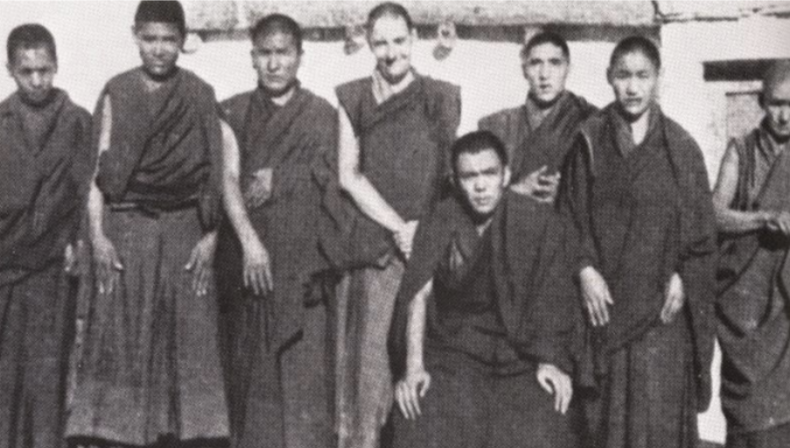
Dillon as Jivaka, fourth from the left, with other monks
Today, some transgender people can suffer insult and even physical violence. The problem does not lie with them, but with people’s ignorance and misunderstanding. Buddhists at least should have more understanding of transgender people because their condition may well be explained by Buddhism – specifically by the doctrine of Rebirth.
A person may be reborn as, say, a male in successive lives during which time masculine attitudes, desires, traits and dispositions become strongly imprinted on their mind.
This would determine that he be continually reborn into a male body or that his consciousness would shape the new embryo into a male form – whatever factors are responsible for the physical characteristic of gender.
Then, for either kammic, genetic or other reasons, he may get reborn into a female body while retaining all the long-established masculine psychological traits. Of course, this same process could be responsible for a male feeling that she is really female.
If this or something like it, is the cause for being transgender, it would mean that this condition is a natural one rather than a moral perversion as some theistic religions maintain.
In the Udāna, the Buddha said that traits or dispositions (vāsasā) developed through a succession of lives (abbokiṇṇanī) may well express themselves in the present life and that they need not be “an inner moral fault” (dosatara).
Thus, informed Buddhists should be accepting and understanding if or when they encounter a transgender person.
Wise Steps:
Understanding that transgender persons are equally capable of practising the Path we should offer them support rather than criticise them
Recognise that there are many spectrums to the world rather than viewing things in black and white
TLDR: How can the suttas and teachings aid us in our meditation journey? Paul shares his initial struggles and how the Buddha’s discourse to Mahanama immensely helped him with his mindfulness and mental state.
My Past — An On-and-off Meditator With Wavering Interest in Buddhism:
Even since learning about Buddhism and trying to study and practice it, I used to think the only practices to cultivate the mind were sitting meditation with eyes closed and walking back and forth slowly.
Since my first attempts to practice meditation back in 2009, I found it a very peaceful experience but also often beset by drowsiness. Furthermore, not long after completing the sitting meditation, after getting on with the activities of the rest of the day, the peaceful state was quickly lost and I didn’t feel noticeably different than if I had not meditated.
Even after years of doing regular sitting meditation on and off and going on several multi-day meditation retreats, this problem persisted. It wasn’t hard to do sitting meditation, even for days at a time at a meditation retreat. I didn’t feel like it was having an effect for long after getting up off the meditation cushion.
Even though I found the Buddha’s teachings to be very wise and studied them in much depth, not seeing much benefit from the practices made me ambivalent and wavering about Buddhism as a whole.
Turning point: The Buddha’s Discourse to Mahanama the Sakyan
This problem persisted through many years until around the time I came to learn about one of the Buddha’s discourses with Mahanama the Sakyan, one of the Buddha’s foremost lay followers.
In AN 11.12, Mahanama asks the Buddha: “…we spend our life in various ways. Which of these should we practice?”
In addition to specifying the cultivation of the 5 spiritual powers that should be cultivated to support awakening, the Buddha gives Mahanama six topics that should be recollected: The Buddha, Dhamma, Sangha, ethics, generosity, and devas.
The Buddha then tells Mahanama he should develop these recollections “…while walking, standing, sitting, lying down, while working, and while at home with your children.”
This stood out to me. These things can be done not just while doing sitting meditation or walking slowly back-and-forth for walking meditation but at any time and anywhere.
What are the effects the Buddha lists of practising like this?
“When a noble disciple recollects the Realized One their mind is not full of greed, hate, and delusion. At that time their mind is unswerving, based on the Realized One. A noble disciple whose mind is unswerving finds inspiration in the meaning and the teaching and finds joy connected with the teaching. When they’re joyful, rapture springs up. When the mind is full of rapture, the body becomes tranquil. When the body is tranquil, they feel bliss. And when they’re blissful, the mind becomes immersed in samādhi.” – AN 11.12
Exploring The Practice More By Finding Modern Teachers Who Practise in This Way
As I was learning more about his practice, I began to discover Thai Forest Teachers who practice using ‘Buddho’, ‘Dhammo’, ‘Sangho’, or similar phrases anytime and anywhere they could. For example, Venerable Ajahn Maha Boowa practised using ‘Buddho’ even while doing chores. Venerable Ajahn Anan Akiñcano teaches us to “always keep ‘Buddho’ in the heart, whether standing, sitting, walking, lying down, or whatever else we might be doing.” Ch’an Master Sheng Yen teaches the practice of reciting the Buddha’s name at any time and in any place to purify the mind.
The most common method in the Thai Forest Tradition seems to be “Buddho”. However, I usually prefer “Buddho, Dhammo, Sangho” because the longer phrase is easier for me to focus on.
How It Helped
Following the practice:
Walking anywhere: “Buddho, Dhammo, Sangho”.
Sitting on the bus or MRT: “Buddho, Dhammo, Sangho”.
Eating alone: “Buddho, Dhammo, Sangho”.
Working at a task that doesn’t require full concentration: “Buddho, Dhammo, Sangho”.
While talking break at work: “Buddho, Dhammo, Sangho”.
Doing walking meditation back and forth: “Buddho, Dhammo, Sangho”.
Pretty much any activity becomes an opportunity to practice and purify the mind.
Practising as such now for over a year, my mind has become so much more tranquil and clear than all the years in the past when just doing sitting or walking meditation based on breathing, mindfulness of the body, or metta. It is even better than when I went on several multi-day meditation retreats because it is so much more stable.
At night, I can fall asleep so much faster. During the day, I am more clear-headed, more aware of unhealthy thought patterns, and much more easily able to let go and be free of cravings for unhealthy food, unhealthy thought patterns, and other unwholesome activities. It’s been especially helpful in the moments and at the times of day when my mind is the most stressed and prone to greed, hatred, and delusion arising.
It also greatly strengthened my faith in Buddhism. Any time becomes a time when one can feel a connection to the Buddha, contemplate his positive qualities, and help cultivate a calm, clear mind, and compassionate mind.
Even if I don’t feel tranquil at some particular point while engaging in this practice, it is still helpful because it gives my mind something positive to focus on. This practice provides a refuge when feeling overwhelmed by negative emotional states.
Unexpectedly, I’m able to maintain a regular sitting meditation practice much better now than in all the years in the past because I’ve developed the habit of mindfulness much more strongly by practising throughout the day.
Wise Steps:
It may help to combine this practice with mindfulness of breathing, mala/prayer beads, or mindfulness of the body (for example, when feeling stress, tension, or strong emotions or doing an activity such as walking or eating).
Finding a rhythm such as one syllable per step or one syllable for the in-breath and one for the out-breath can make the practice simple and enjoyable.
See the Related Resources section below for more detailed teachings on practising in this way.
Related Resources on Mindfulness of the Buddha in Any Circumstance