Buddhism is a spiritual tradition that has attracted many people globally. At the core of this ancient wisdom are the Buddhist suttas, sacred texts that convey the teachings of the Buddha.
We have curated a list of six must-visit websites that can be your gateway to experiencing the life-changing power of the Dhamma.
Before we begin, it is good to start by understanding how we can ‘befriend’ the suttas.
Befriending the suttas:
Why should I read? What benefits does it bring?
The Buddhist suttas offer guidance for people at all stages of their path and provide a comprehensive set of teachings.
Although some of the teachings may seem contradictory at first, careful reflection can help you resolve any apparent conflicts and deepen your understanding.
Plus, the suttas provide practical advice on real-world topics and validate personal experiences, which can be a huge boost of confidence in the Buddha’s teachings. You can also learn how to spot fake Buddha quotes.
And if that’s not enough, reading the suttas can also energise your meditation practice and fill your mind with positive, uplifting content – a welcome respite from the negativity of modern media.
Sutta Central is an invaluable resource for those looking to explore the Buddhist suttas across multiple languages and traditions. The site provides translations from the Pali Canon, as well as texts from the Chinese Āgamas, the Tibetan Kangyur, and Sanskrit sources.
Key Features:
Translations available in multiple languages
Comprehensive coverage of various Buddhist traditions
Popular suttas and stories to help you get started
Regular updates and new translations added
2. Access to Insight
Access to Insight is a Theravada Buddhist website providing access to many translated texts from the Tipitaka, and contemporary materials published by the Buddhist Publication Society and many teachers from the Thai Forest Tradition.
Key Features:
Over 1,000 suttas available in English translation
Commentaries and essays for further understanding
A diverse range of topics covered, from mindfulness to ethics and meditation
User-friendly navigation and search functions
3. 84000
84000.co is a groundbreaking project aimed at translating the vast corpus of Buddhist texts from the Tibetan Buddhist teachings (Kangyur) into modern languages. With a strong emphasis on accuracy and preserving the cultural context of the original texts, this resource offers invaluable insights into the world of the Mahayana and Vajrayana traditions.
Key Features:
High-quality translations of Tibetan Buddhist texts from the canonical collection.
The 84000 Reading Room (read.84000.co) with reading filters by topic and theme to help you find a text of interest.
New publications added regularly, with in-depth articles and editorial content delivered through their newsletter (84000.co/subscribe)
4. Suttafriend.org
Suttafriend.org is a cool and personable website that enables readers to use dynamic tags to navigate through teachings based on people, feelings, places, and even idioms! It’s like having a personal guide that helps you find the exact teachings you need at any given moment.
Key Features:
Tags that are relatable to us in daily life
Get to know people of Buddha’s time in a fun manner
In-depth access to different Suttas
5. UB’s Mahayana Text Collection
University at Buffalo brings the Mahayana text to life by collating the different Buddhist masterpieces for easy reading. It is often difficult to find accessible Mahayana text in a digital, compiled manner that is purely in English. Navigate this website for hidden gems like Heart Sutra and Diamond Sutra.
Key Features:
Access to ancient Chinese texts that are now in English
Identify various authors, and essays on these ancient texts
Learn in-depth about Mahayana teachings
6. Fake Buddha Quotes
It sucks to share fake news, or even worse, fake Buddha quotes. Goodreads.com is one of the major origins of such errors, attributing many random wise sayings to the Buddha. Reading more suttas would enable you to spot fake quotes when you see them.
Quiz: Which one is a real Buddha quote?
“Be kind to all creatures. This is the true religion.”
“If hate worked, I would teach you that”
“If a man’s mind becomes pure, his surroundings will also become pure”
“Whatever has the nature of arising has the nature of ceasing”
Answer at the end of the article!
Key Features:
A compassionate approach to uncovering fake Buddha Quotes
Resources that point readers to the real quotes by Buddha
A robust comment section to ask questions
Conclusion
In conclusion, these six essential resources offer a wealth of knowledge and insights to support your journey into the world of Buddhist suttas.
By exploring these sites, you will gain a deeper understanding of the teachings, practices, and philosophies that form the core of this ancient wisdom.
Embrace the transformative power of Buddhism and embark on a journey of personal growth, mindfulness, and spiritual fulfilment.
Quiz Answer: D. The rest are ‘Fake’ Buddha Quotes.
TL;DR: Pei Jing muses about his two retrenchment experiences and the Dhamma lessons he took away: 1) save up a quarter of your salary when you do earn; 2) investigate and understand your suffering; 3) do good; 4) play up your strengths.
If there is a relatively unique experience that I can claim, which even the Prime Minister of Singapore can’t lay claim to, it is probably the fact that I have been retrenched before. Not once, but twice.
P.S. Pei Jing has his own blog! Read more of his muses here.
My first retrenchment
The first layoff was in May 2008. The call came when I was at my desk, in the investment bank’s office at Two International Finance Centre in Hong Kong.
On a good day, from my office, you could see clearly across Victoria Harbour into Kowloon. But most of the time, we were working for such long hours that I almost took the view for granted.
“Please come up to this meeting room.”
I knew what it was about, but I was so tired from pulling the all-nighter the night before that I felt numb.
I entered the meeting room and saw the Managing Director of my team seated with a stranger I didn’t know. “This is X from HR”, said the MD.
What happened next was a bit of a blur. But it was unmistakable that I was getting laid off. I suppose I only had myself to blame. When my direct boss asked me what I was going to do with my annual bonus, I told him that I was going to leave to study. So now I was getting laid off right before the bonuses were being paid off.
“What happens if I don’t accept this retrenchment amount of two months salary?” I asked. “Then you’ll get nothing,” said the HR lady.
So I signed, but not without some anger as the annual bonuses were 6 months and above. When I passed the form to her, she reminded me, “Please remember that you’re not supposed to disclose the amount to other people.”
I was angry.
Angry at the fact that I was given a pittance. Angry at the fact that I was made to work an all nighter just before they laid me off. Angry that they also laid off other colleagues who were extremely hard working but kept those who were well connected to the rich and powerful. Angry at the lies they had told us.
Up until the last moment, they kept telling us that they won’t lay off first-year analysts.
But I was also curiously happy because that one year of investment banking was miserable.
My parents came up from Singapore to visit me in Hong Kong once. Yet for the entire fortnight, they saw me a grand total of five meals, as I was tied up with work. When they left, they had gone to the trouble of buying some ginseng to brew, and kept telling me to watch out for my health.
My usual working hours were from 9am to 3am on weekdays. On weekends I would go in around 12pm to 1pm, often staying until 3am.
The salary was really high (HKD 55,000, which was around S$11,000 back then or $14,000 in today’s value) but this was an insane cost on my life. So I had planned to leave anyway. When I surrendered my Blackberry, I was told that I was the only one who was smiling as I did so. And why not? That device was torture.
Unlike my other peers who were laid off before me,I was allowed to stay in the office to say bye to people before I left for good. “The others”, I was told, “went up to the meeting rooms and never came back to our floor. Their secretaries then packed their stuff into boxes, which was mailed to them.”
I bid farewell to my buddies, but also to the assistants and other colleagues, before I walked off home to sleep. My manager came to say bye, with tears in his eyes as he said sorry.
What was the point of saying sorry when he had already pulled the trigger? At that point, I thought he was just trying to make himself feel better and I couldn’t wait to leave his presence.
An unusual encouragement
On the way home in Central, Hong Kong, I came across a very unusual sight.
There were multiple regular beggars (mostly from mainland China), especially on this particular overhead bridge that I crossed daily. The way they begged was almost comical: one grey-haired lady kept kowtowing profusely at every single pedestrian who walked past while there’s another regular who just bowed down and never looked up.
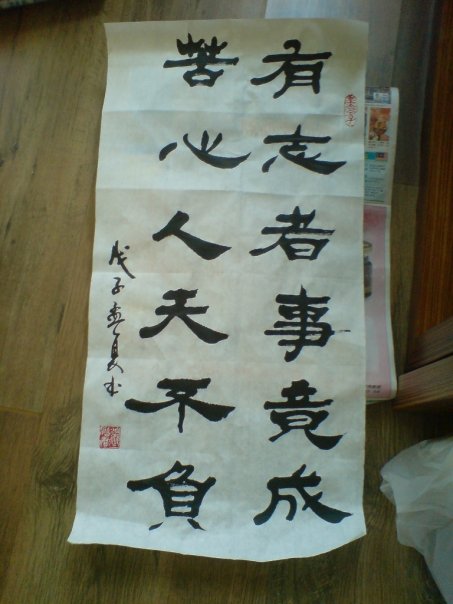
This guy I met was not a regular. He was armless and handless but he was focused purely on his calligraphy. His calligraphy was amazing: his skill with his two stumps was much better than most able-bodied Chinese I know.
Incidentally, the calligraphy he wrote was especially apt for my retrenched state of being. The broad meaning of the phrase is, “Those with a will/direction, will definitely succeed. Those who suffered (for their will), Heaven won’t abandon them.”
First set of couplets I received from the calligrapher.
There were pretty high odds that I was getting laid off. Rumours had been going around that my ex-firm was not doing well and there would be layoffs. Colleagues who had experienced layoffs in other firms told me, “you just wait. They will fire all the locals but protect their own.” As someone who had zero political connections, I was expecting to be laid off anyway.
But the odds that, at the very moment I was walking home from being retrenched, an ARMLESS and HANDLESS calligrapher will be writing THIS phrase … ? It was encouraging, and perhaps a sign.
I stood there watching him work and said to him after a while, “Your calligraphy is beautiful! How much is this piece?” I thought he was going to say something ridiculous but to my huge surprise, he said, “Whatever price you think this is worthwhile.”
On the spot, I offered him a sum of money (that I cannot remember) and also commissioned him to write up my school motto ‘To strive unyieldingly’ (“This is a saying from I Ching”, he said, which turned out to be true.) Both pieces are now framed up at my parents’ home.
(This was my special commission to him after I walked back)
Same fate, different outcomes
Even though I had not been particularly deliberate in saving up money, I still had enough after my retrenchment that I estimated I could keep my apartment and live the way I did for easily another six months and then some. In the worst case, I was prepared to just dump everything and return home to Singapore.
That’s when I heard the story of Y, an ex-colleague from the same firm. Y was laid off earlier than me. Unlike me, Y wasn’t smiling when she gave up her Blackberry. When I met Y with other friends at a meal, Y clearly looked distressed and asked around if anybody knew of any banking job opportunities.
A mutual friend later shared that Y had only half a month of rental left in her bank account. I was shocked, “Huh? What did she spend her salary on??” It turned out that Y had spent almost her entire salary on not just branded bags, shoes, designer clothes, but also massage packages, spa treatments, pedicures & manicures (which she had bought by a lump sum package because it was “cheaper”).
The mutual friend also told me that Y had a habit of urging everyone around her to spend money, because “you’re a banker, you can afford it!”
Never did Y realise back then that she could not afford to lose being a banker.
The second retrenchment
One year later in April 2009, my second layoff was much less dramatic.
I had left Hong Kong and joined a proprietary trading firm in Singapore, which was started by two Irish proprietary futures traders. It was a small outfit of less than 12 people, based in UOB’s building.
When we first joined, they told us we each had a Profit & Loss (financial statement) with a S$15,000 downside limit. Over the months, the downside limit reduced to $12,000, then $10,000. By the time I got laid off, my account loss was around $9,000.
After I made my final losing trade, I got called into the office, was told “it’s not working out”, and was then asked to leave. This time with no retrenchment benefits at all.
A few months later, the firm wrapped up its operations in Singapore. And a few months later, it wrapped up for good.
[Years later, I read Michael Lewis’ book “Flash Boys” and recognized what had happened to our firm: we were basically bled dry by high frequency traders. We would hit the offers, only to be filled in at prices that were significantly different from the offers we hit.]
No more “fooling” around
This second layoff had no “divine signal”, no signs of encouragement. As the American saying goes, “fool me once, shame on you; fool me twice, shame on me.”I was beginning to wonder if the finance industry was fooling me twice. I wondered if I should continue or I should find something that is more meaningful beyond aiming to make rich people richer.
My initial instinct was to try and apply what I learned at the trading outfit, but it is different when you are a retail trader versus at a professional outfit: the lag times are even greater; there are significantly larger margins you have to pay and there is almost no “edge” (i.e. advantage) you have in the market.
Most importantly, my psychology was also fraught: I needed to make money, which magnified the emotions and made trading harder.
After a few months of trying to trade my own account, depleting my savings, and feeling emotionally exhausted from chasing money for its own sake, I decided to apply only to public service jobs. I wanted to spend my time working on something more meaningful. That was how I started my decade-long career in the public service.
What I learnt from retrenchment
Looking back, I think there are a few lessons that I drew from my two retrenchments, which might help others who are facing impending retrenchments. Where appropriate, I have also included excerpts from the Buddhist texts.
Pre-Retrenchment: Always have some savings, ideally a quarter.
Startup funding is measured in time. Every startup that isn’t profitable (meaning nearly all of them, initially) has a certain amount of time left before the money runs out and they have to stop. This is sometimes referred to as runway, as in “How much runway do you have left?” It’s a good metaphor because it reminds you that when the money runs out you’re going to be airborne or dead.
For any individual, I would recommend saving up a runway of at least 6 months of your monthly necessary expenses, excluding your long-term savings. That gives a lot of psychological freedom, because you are not in a state where you need to make money. That freedom was what I had during my first layoff but not during my second layoff.
Take a balanced approach to your budget
But one also shouldn’t go to the extreme of hoarding without any expenditure at all! Nor should one spend too much (like my ex-colleague Y). Instead, you need to strike a balance in your personal finances, avoiding both extremes.
And what is accomplishment in balanced finances? It’s when a gentleman, knowing his income and expenditure, balances his finances, being neither too extravagant nor too frugal. He thinks, ‘In this way my income will exceed my expenditure, not the reverse.’ It’s like an appraiser or their apprentice who, holding up the scales, knows that it’s low by this much or high by this much. In the same way, a gentleman, knowing his income and expenditure, balances his finances, being neither too extravagant nor too frugal. He thinks, ‘In this way my income will exceed my expenditure, not the reverse.’ If a gentleman has little income but an opulent life, people will say: ‘This gentleman eats their wealth like a fig-eater!’ If a gentleman has a large income but a spartan life, people will say: ‘This gentleman is starving themselves to death!’ But a gentleman, knowing his income and expenditure, leads a balanced life, neither too extravagant nor too frugal, thinking, ‘In this way my income will exceed my expenditure, not the reverse.’ This is called accomplishment in balanced finances.
Then what should you use your wealth for? Make yourself happy and pleased first, followed by the people around you.
Then King Pasenadi of Kosala went up to the Buddha in the middle of the day, bowed, and sat down to one side. The Buddha said to him, “So, great king, where are you coming from in the middle of the day?”
“Sir, here in Sāvatthī a financier householder has passed away. Since he died childless, I have come after transferring his fortune to the royal compound. There was eight million in gold, not to mention the silver. And yet that financier ate meals of rough gruel with pickles. He wore clothes consisting of three pieces of sunn hemp. He traveled around in a vehicle that was a dilapidated little cart, holding a leaf as sunshade.”
“That’s so true, great king! That’s so true! When a bad person has acquired exceptional wealth they don’t make themselves happy and pleased. Nor do they make their mother and father, partners and children, bondservants, workers, and staff, and friends and colleagues happy and pleased. And they don’t establish an uplifting religious donation for ascetics and brahmins that’s conducive to heaven, ripens in happiness, and leads to heaven. Because they haven’t made proper use of that wealth, rulers or bandits take it, or fire consumes it, or flood sweeps it away, or unloved heirs take it. Since that wealth is not properly utilized, it’s wasted, not used.
Suppose there was a lotus pond in an uninhabited region with clear, sweet, cool water, clean, with smooth banks, delightful. But people don’t collect it or drink it or bathe in it or use it for any purpose. Since that water is not properly utilized, it’s wasted, not used.
In the same way, when a bad person has acquired exceptional wealth … it’s wasted, not used.
When retrenched: remember the Noble Truths
When you are being retrenched, it can feel like a punch in the gut. A million questions and emotions will be flying through your head, “What do you mean I’m being laid off?” “I need this job to feed my family.” “Why am I fired but not that lazy ass on level 26?” for etc.
The next thing to recognise is that your mind’s first reaction is to flee away from the suffering as fast as possible, either through denial or repression. Your mind is also likely to be defiled by negative emotions like anger or a strong desire to be somewhere else.
Consider the (First Noble) truth: life is suffering. To be born is to suffer, to exist is to suffer, as taught by the first sentence in this passage from the Buddha’s First Sermon:
“This noble truth of suffering should be completely understood…”
By seeking to understand your experience, you might ask yourself, ‘Why am I suffering? What’s the cause for this suffering?’ At a fundamental level, the (Second Noble) truth is, your suffering is caused by you wanting or craving something.
“Now this, bhikkhus, is the noble truth of the origin of suffering: it is this craving which leads to renewed existence, accompanied by delight and lust, seeking delight here and there; that is, craving for sensual pleasures, craving for existence, craving for extermination.
The original Pali word for “craving” is taṇhā, which is also the word for THIRST.
The following is a useful guiding question. Anytime you’re suffering, ask yourself, ‘What is it that you want?’ That wanting is the cause of your suffering, because…
“Now this, bhikkhus, is the noble truth of the cessation of suffering: it is the remainderless fading away and cessation of that same craving, the giving up and relinquishing of it, freedom from it, nonreliance on it. [In Pali: yo tassāyeva taṇhāya asesavirāganirodho cāgo paṭinissaggo mutti anālayo.]
These are the four ways of letting go, of not wanting:
Caga – giving, generosity;
Patinissaga – letting go;
Mutti – free, releasing;
Analaya – Non-reliance, not-resting, not-sticking, a “Teflon mind”.
I would double down on caga. In fact, when you’re retrenched, I would strongly encourage you to volunteer and just give your time: go out of the house and do some volunteer work for a cause that inspires you. Because that makes unstealable wealth for you!
Make more unstealable wealth.
The Buddha gave this great definition of wealth that cannot be stolen from you, which I’m calling ‘unstealable wealth’.
“He has a hundred thousand gold coins, not to mention the silver!”
“Well, Ugga, that is wealth, I can’t deny it. But fire, water, rulers, thieves, and unloved heirs all take a share of that wealth. There are these seven kinds of wealth that they can’t take a share of. What seven? The wealth of faith, ethical conduct, conscience, prudence, learning, generosity, and wisdom. There are these seven kinds of wealth that fire, water, rulers, thieves, and unloved heirs can’t take a share of.
When you’re retrenched, it can sometimes feel tough. ‘My dream job was taken from me! Oh, that lovely (employment benefit) that I loved!’
The Buddha’s definition of unstealable wealth reminds us that there are things that cannot be taken from us. You probably gained a lot of knowledge from your work: that’s not something that can be taken from you (except by time).
For example, I learned how to do financial valuation models in banking (which has made me extremely skeptical about all financial projections!), but I also used some of the trading-comparable techniques in analyzing companies when I started work in the Economic Development Board.
Also, your acts of generosity, kindness, compassion, all cannot be stolen from you by others, nor removed by your ex employer. It’s something you have done before, and belongs to you. To exercise generosity, kindness, and compassion, to keep your Five Precepts and ethics, all these require no money to do! So what’s stopping you from making more of this “unstealable wealth” while you’re unemployed?
Even if you feel that somehow this unemployment situation was due to your bad kamma, you can’t get rid of bad kamma by “burning” it or just “tolerating” it. All the more, you should go out and just go good!
Suppose a person was to drop a lump of salt into a small bowl of water. What do you think, mendicants? Would that small bowl of water become salty and undrinkable?”
“Yes, sir. Why is that? Because there is only a little water in the bowl.”
“Suppose a person was to drop a lump of salt into the Ganges river. What do you think, mendicants? Would the Ganges river become salty and undrinkable?”
“No, sir. Why is that? Because the Ganges river is a vast mass of water.”
“This is how it is in the case of a person who does a trivial bad deed, but it lands them in hell. Meanwhile, another person does the same trivial bad deed, but experiences it in the present life, without even a bit left over, not to speak of a lot. …
From the discourse above, we learn that you don’t burn bad kamma: you dilute it to the point where the bad kamma is like a lump of salt in a Ganges river of goodwill and good kamma.
You focus on making good kamma, on the positive, on the joy that arises from the intention (more in the latter). The more good kamma you make, the less your bad kamma from the past is going to impact you.
Again, the Buddha has some great advice on the kamma leading to long life, health, beauty, influence, wealth, status and wisdom:
“Master Gotama, what is the cause and condition why human beings are seen to be inferior and superior? For people are seen to be short-lived and long-lived, sickly and healthy, ugly and beautiful, uninfluential and influential, poor and wealthy, low-born and high-born, stupid and wise. What is the cause and condition, Master Gotama, why human beings are seen to be inferior and superior?”
“Student, beings are owners of their actions, heirs of their actions; they originate from their actions, are bound to their actions, have their actions as their refuge. It is action that distinguishes beings as inferior and superior.”
…
…This is the way, student, that leads to short life, namely, one kills living beings and is murderous, bloody-handed, given to blows and violence, merciless to living beings.… This is the way, student, that leads to long life, namely, abandoning the killing of living beings, one abstains from killing living beings; with rod and weapon laid aside, gentle and kindly, one abides compassionate to all living beings.
…
… This is the way, student, that leads to sickliness, namely, one is given to injuring beings with the hand, with a clod, with a stick, or with a knife….This is the way, student, that leads to health, namely, one is not given to injuring beings with the hand, with a clod, with a stick, or with a knife.
…
… This is the way, student, that leads to ugliness, namely, one is of an angry and irritable character…and displays anger, hate, and bitterness…. This is the way, student, that leads to being beautiful, namely, one is not of an angry and irritable character…and does not display anger, hate, and bitterness.
…This is the way, student, that leads to being uninfluential, namely, one is envious…towards the gains, honour, respect, reverence, salutations, and veneration received by others….This is the way, student, that leads to being influential, namely, one is not envious…towards the gains, honour, respect, reverence, salutations, and veneration received by others.
… This is the way, student, that leads to poverty, namely, one does not give food, drink, clothing, carriages, garlands, scents, unguents, beds, dwelling, and lamps to recluses or brahmins.…This is the way, student, that leads to wealth, namely, one gives food…and lamps to recluses or brahmins...
Tips on Looking for a New Job
When looking for a new job, it is useful and important to know what you’re looking for or not. It’s also important and useful to know what you’re good at or not: this depends whether you’re just starting out in your career, or you’ve more experience.
If you’re just starting out, I think you should just try different things and learn from your experience. For example, I learned from my two layoffs that:
(a) I hated the investment banking lifestyle;
(b) I really didn’t have a knack for day-trading futures;
(c) After a while, the pointlessness of making rich people richer really wore me down.
With time and experience, you know what your strengths are and that then allows you to figure out where and how you should play to your strengths in your future jobs.
I’ll end with this beautiful Buddhist parable of a quail playing to its strengths, outwitting a hawk. May you be a quail that finds your clods of soil!
“Bhikkhus, once in the past a hawk suddenly swooped down and seized a quail. Then, while the quail was being carried off by the hawk, he lamented: ‘We were so unlucky, of so little merit! We strayed out of our own resort into the domain of others. If we had stayed in our own resort today, in our own ancestral domain, this hawk wouldn’t have stood a chance against me in a fight.’—‘But what is your own resort, quail, what is your own ancestral domain?’—‘The freshly ploughed field covered with clods of soil.’
“Then the hawk, confident of her own strength, not boasting of her own strength, released the quail, saying: ‘Go now, quail, but even there you won’t escape me.’
“Then, bhikkhus, the quail went to a freshly ploughed field covered with clods of soil. Having climbed up on a large clod, he stood there and addressed the hawk: ‘Come get me now, hawk! Come get me now, hawk!’
“Then the hawk, confident of her own strength, not boasting of her own strength, folded up both her wings and suddenly swooped down on the quail. But when the quail knew, ‘That hawk has come close,’ he slipped inside that clod, and the hawk shattered her breast right on the spot. So it is, bhikkhus, when one strays outside one’s own resort into the domain of others….
Wise Steps:
Aportion a quarter of your salary towards your savings when you are employed.
If you were retrenched, try to understand your suffering using the Noble Truths.
Yield your mind to perform acts of generosity, goodwill and letting go. These form the ‘unstealable wealth’ that retrenchment can’t even take away from you.
Recognise your strengths and play up to them when searching for your next job!
TLDR: Single and in your late twenties? Mabel shares her stories of realisation and wisdom from navigating the dating world. From opening the door to your heart to understanding the drawbacks of mundane love, this article explores deeper into struggles of dating in the environment which pushes us to find romantic love.
Being single in your late twenties seems to scream that you are broken and bad. It feels like a problem that needs to be fixed.
A life devoid of romantic love is often painted to be imperfect and empty. And although I’ve been happily single and mostly unperturbed by narratives like these, my immunity has been waning the older I get. I feel pressure, shame, and anxiety. Dating used to be fun and exciting, but now it feels like a chore.
Dating leaves us feeling vulnerable, afraid and imperfect.
It is such a courageous thing we do – showing up for complete strangers, opening up to them, and letting them into our lives. No matter how many times I’ve done it, it still scares me. I’m so thankful to have met with nice people and formed genuine connections. Looking back, I’ve made mistakes and probably caused some hurt, but it is also through experiences like these that I learn about myself.
Here are a few things I’ve learned as a twentysomething navigating the dating scene:
Tip 1: Opening the door to your heart
During the dating process, I noticed a lot of self-sabotaging tendencies that emanate from feeling not good enough.
I felt the need to have achieved certain things or look a certain way before I am worthy of romantic love.
I would meet nice guys who show interest, and think to myself: ‘oh, he can’t be interested in me, he’s too good for me’. I would be fearful that they would see my flaws and lose interest.
Using dating apps magnified this feeling of inadequacy. I felt like a two-dimensional, searchable item looking to fit into someone’s dating checklist.
I had to take on society’s demands and live up to its expectations to feel worthy of love.
These feelings of imperfection and deficiency stemming from a strong sense of self could lead to love prone to impurities and more suffering. We could end up being in relationships that don’t serve us, or find a partner for the wrong reasons.
Only when we extend loving-kindness to ourselves can we examine love with a neutral mind, and know when to keep trying or when to end things.
I read renowned Australian monk Ajahn Brahm’s Opening The Door To Your Heart 10 years ago, and I’ve always thought the key message was being kind to others. The story, I realised, was about opening the doors of our hearts to ourselves as well.
You do not have to be perfect, without fault, to give yourself love. If you wait for perfection, it never arrives. We must open the door of our hearts to ourselves, whatever we have done.
Tip 2: Understanding the drawbacks of mundane love
I extended this unreasonable yardstick for worthiness to my partners. After ending things with a few guys, I unwillingly acknowledged that perhaps I’m part of the problem.
The Buddha points out that we suffer due to cravings that arise when we don’t understand ourselves. I unpacked my approach towards dating and saw how easily put off I am by signs of flaws and recognised the ideals and desires I projected onto others.
These are desires not rooted in reality, and I was creating suffering for myself.
Dating apps with their filtering functions and abundance of choice give us the illusion that there is a perfect human being out there. I loved the idea that I would find someone with instant and perfect compatibility.
But the truth is there are no relationships with no conflicts, and we will always have to work through inevitable differences.
Conditioned things are impermanent and unsatisfactory. We and our partners, as unenlightened beings, will always have our own sets of defilements which will render the dating process unsatisfactory at times.
Almost all of us reach dating age with some form of wound or trauma. Perhaps the more space we can allow for the deficiencies of love and the flawed reality of nature, the better chance we’ll have at being good at love.
Suffering ends when ignorance-based cravings end, not when you find ‘true love’.
Tip 3: Knowing what you want and communicating it
When I started using dating apps, I knew I was looking for a committed relationship with someone who shares similar values. So I would swipe left on guys who were looking for something casual, or guys who ‘don’t know yet’ simply because our goals were not aligned.
I believe this saved me a lot of time and heartache. During the dating process, I have found it helpful to communicate these goals and needs.
Don’t assume that they will figure it out on their own, or that they should know these things instinctively.
It is worth investigating what we are looking for in a relationship. Are we hoping to end suffering with love? Are we looking for an antidote to boredom? Are we hoping to gain coarse rewards through this relationship such as sexual pleasure, wealth, social status, or fame? Is this kind of relationship sustainable?
I reflect on these questions quite a bit.
It is when both partners are ethical, of good character, and equal in standard of conduct that they can live together enjoying all the pleasures they desire. (Numbered Discourses 4.53 Living Together). Perhaps we could use this as a guide when dating.
Dating is a skill and something we can learn to be better at through experience. By practising more qualities of metta (the superior kind of love), we can strive to be one who neither suffers from this dating process nor be the cause of others’ suffering.
Wise Steps:
Be respectful and kind, and treat the other person the way you would like to be treated.
If you’re feeling burnt out from dating, take a break, don’t go through the process mindlessly. Enjoy the beauty of being single.
Reflect on what you’ve learned from previous relationships or dates. Did it teach you something about what you want and don’t want? What are the ideals, desires and expectations that you tend to project onto others?
Does applying Buddhist principles of compassion and kindness make you a walking doormat at the workplace? How about attractive colleagues at work? PJ Teh, a former Strategic Planning manager at EDB, challenges that view and gives us points to ponder under this mini-article series.
The last section of this mini-article series deals with conducting oneself. Missed the first two? We’ve got your back!
TLDR: How should we conduct ourselves at work. What is better than focusing on improving on our faults? How do we deal with attraction at the workplace when we are in a committed relationship?
In particular, it is important to cultivate one’s own mind correctly. Personally, I think the most pertinent would be the use of the Metta sutta.
Loving Kindness is one of the most important qualities to cultivate in the Dhamma, and it helps tremendously in removing many of the largest defilements such as ill-will.
That is the reason why I deliberately recited the Metta Sutta when I was studying in Copenhagen: it helped me with coping with the road rage on the bike lanes during Peak hours!
Two kinds of thoughts
But in addition, it is also important to focus correctly on one’s own wholesome attributes. Remember Buddha’s teaching on two kinds of thoughts:
Whatever a mendicant frequently thinks about and considers becomes their heart’s inclination.
If they often think about and consider sensual thoughts, they’ve given up the thought of renunciation to cultivate sensual thought. Their mind inclines to sensual thoughts.
If they often think about and consider malicious thoughts … their mind inclines to malicious thoughts. If they often think about and consider cruel thoughts … their mind inclines to cruel thoughts.
So whatever you focus and dwell on about yourself, that’s what your mind will incline towards.
There is a tendency (due to our societal conditioning, especially education) to focus on our faults and to also focus on using willpower to overcome our faults.
What is truly right effort?
On the surface, this might seem to be aligned with the Sixth Factor of the Eightfold Path, Right Effort. But if you read the details of Right Effort, it is quite clear that the Buddha’s description of Right Effort is NOT the use of willpower, but about using wisdom-power to grow wholesome mental qualities and reduce unwholesome ones.
Each of these Right Efforts requires seeing and understanding correctly, not about powering through or simply wishing for one’s mind to not have unwholesome states.
“And what, mendicants, is the effort to restrain? When a mendicant sees a sight with their eyes…When they hear a sound with their ears … When they smell an odour with their nose … When they taste a flavour with their tongue … When they feel a touch with their body … When they know a thought with their mind, they don’t get caught up in the features and details. If the faculty of mind were left unrestrained, bad unskillful qualities of desire and aversion would become overwhelming.
And what, mendicants, is the effort to give up? It’s when a mendicant doesn’t tolerate a sensual, malicious, or cruel thought that’s arisen, but gives it up, gets rid of it, eliminates it, and obliterates it
And what, mendicants, is the effort to develop? It’s when a mendicant develops the awakening factors of mindfulness, investigation of principles, energy, rapture, tranquillity, immersion, and equanimity, which rely on seclusion, fading away, and cessation, and ripen as letting go.
And what, mendicants, is the effort to preserve? It’s when a mendicant preserves a meditation subject that’s a fine foundation of immersion: the perception of a skeleton, a worm-infested corpse, a livid corpse, a split open corpse, or a bloated corpse.”
The same four Right Efforts are applicable in the workplace. E.g. assume you’re married but you meet an attractive new colleague of your desired sex.
The tendency will be for your mind to cling to one aspect that you find attractive (e.g. their hairstyle). How should you react to that?
– Restraint: recognise that if you allow your focus to just go wherever desire tells it to go, you will just end up feeling more and more desire for the person, maybe threatening your own relationship. So, direct your attention to some unattractive part of the person e.g. the pimple on their face.
– Giving up: when the desire arises, don’t indulge in the desire or fantasies, but instead focus on getting to a more balanced mental state
Similarly, if your bias is towards aversion, then focus on cultivating what you truly admire about the person, in order to get to a more balanced mental state.
A smart quail vs an arrogant hawk
The last excerpt from a sutta that I want to cover is a recent text I encountered, which is a great strategy for an individual in a workplace.
Basically, find your own territory where you have a competitive advantage over others. Even a quail, with the right conditions, can beat a hawk, as the Buddha spoke about in this text:
“Once upon a time, mendicants, a hawk suddenly swooped down and grabbed a quail. And as the quail was being carried off he wailed, ‘I’m so unlucky, so unfortunate, to have roamed out of my territory into the domain of others. If today I’d roamed within my own territory, the domain of my fathers, this hawk wouldn’t have been able to beat me by fighting.’
‘So, quail, what is your own territory, the domain of your fathers?’
‘It’s a ploughed field covered with clods of earth.’
Confident in her own strength, the hawk was not daunted or intimidated. She released the quail, saying, ‘Go now, quail. But even there you won’t escape me!’
Then the quail went to a ploughed field covered with clods of earth. He climbed up a big clod, and standing there, he said to the hawk: ‘Come get me, hawk! Come get me, hawk!’
Confident in her own strength, the hawk was not daunted or intimidated. She folded her wings and suddenly swooped down on the quail. When the quail knew that the hawk was nearly there, he slipped under that clod. But the hawk crashed chest-first right there.
That’s what happens when you roam out of your territory into the domain of others.
So, mendicants, don’t roam out of your own territory into the domain of others. If you roam out of your own territory into the domain of others, Māra will find a vulnerability and get hold of you. “
There are many other sutta texts which have great applicability to the workplace, illustrating and applying many Buddhist principles that are useful to human beings. I hope this has sparked some interest for you to explore the sutta texts in more detail, and please do share with me when you encounter something interesting or relevant!
Wishing you happiness, health and peace of mind and body.
Wise Steps:
Ponder about how we can apply right effort at the workplace. It’s not about using willpower, but understanding and learning to see with wisdom. What would you restrain & give up?
Which areas at work do we have a competitive advantage, like the quail vs. the hawk? Ask your close colleagues what they think you are excellent at doing, which is very natural or effortless for you to do.
This is a reflection piece as contemplated by the author based on the Buddha’s teachings. As such, it may not contain the truths as taught by the Buddha. The author hopes the reader takes away useful bits that may resonate and discard whatever parts that make no sense without any aversion.
TLDR: Our minds are seldom at peace. Peace means having lasting contentment and not being piqued by the smallest things. Yet our mind seems to know there is something peaceful beyond our mundane experiences. For this reason, our minds are always searching for a refuge.
For many years my mind searched for a refuge. Refuge means a place of safety and protection from dangers according to the Oxford dictionary. When it comes to the mind, dangers would point to non-acceptance, anger, indifference and insincerity from others. A refuge for the mind would be friendship, acceptance, love and honesty instead. The mind also seeks good repute and wealth, so that it indirectly receives respect, love, admiration and acceptance from others. Observing myself and others, I found there is not a time when our minds are not seeking refuge.
Why does the mind seek refuge?
Looking back into a faraway past, I remembered when my mind first gained consciousness of its senses.
When I was around three or four years old, I remember sitting at the threshold between the living room and the kitchen drinking a bottle of hot milk. Although I do remember glimpses of consciousness, such as being wrapped in a cloth tied to a spring attached to the ceiling. I was being bounced up and down and I think I hit my head and cried.
From the time of ‘waking up’ to the awareness of this life, I remembered being an observer to most events around me. I did not know anything except enjoying playing with the neighbours. A distinct memory of my mother crying and packing to leave home was etched in my mind as my sister tried to stop her. My sister was maybe six years old? I am three years younger than my sister, and I was at the table drinking my hot cup of milo for breakfast. I only observed and felt no emotions.
The time my mind began searching for love and safety was when my father began verbally abusing me.
He would scare me into a corner and cane me too, especially if I fell ill. I was prone to asthmatic cough and was barred from certain foods. My father’s family has a history of asthma. He scolded me because seeing a doctor would eat away his already low pay as a hawker.
My awareness of the lack of approval from my parents and their relatives was the start of the mind seeking refuge from someone or something to balance this suffering.
Back then, academic ability was highly prized and perhaps they hoped I would do well and bring them pride but I’m not a scholar.
Other reasons for seeking refuge
I was speaking of what I perceive to be my early cause for seeking a refuge for the mind.
The truth is, the mind seeks refuge due to a host of other causes too. Causes such as boredom, loneliness, belonging, disappointment, or just do something to find meaning in life.
If we look deeply, it seems the mind is incapable of being at rest for long. Action is primed in our system. Our entire system on earth – the weather, the animals and people are all acting upon one another so that not taking action, or not making a choice is not an option at all. Weather changes can disrupt our day, animals can cause us harm – in today’s terms, the harm comes from a virus. Even when nothing is disturbing the mind, it seeks a goal to feel secure.
Be wise about the refuge you seek
In The Noble Search Sutta (MN. 26), the Buddha talked about two types of refuge we seek. He called them the ignoble and noble search.
He said the ignoble search is someone seeking a refuge in what is birth, death, sickness, sorrow, defilement and ageing when he himself is not spared from these things.
The objects of ignoble refuge for the mind include spouse, children, possessions such as animals, land, the house and slaves. During the time of the Buddha, most laypeople were married with children and they were either kings, farmers, merchants or slaves. Society during that time is not very much different from our time today. We still seek a sense of security in a partner, in our children, our jobs, savings, possessions and friends.
It is not wrong to seek these things, except don’t expect them to last or be stable for a long time. They are all subject to the ravages of impermanence. What is born, will die. While alive, we inflict upon one another our defilements (greed, ill will, confusion), as what I had experienced from my parents and friends. What we possess will one day decay and become others’ belongings. It is not to despair over the lack of stability in life, but rather to know and be wise about them. Our own body and mind too are insecure things that do not last.
A noble refuge for the mind
The opposite of an ignoble refuge would be a noble refuge for the mind. In the words of the Buddha:
“Suppose that, being myself subject to birth, having understood the danger in what is subject to birth, I seek the unborn supreme security from bondage, Nibbāna. Suppose that, being myself subject to ageing, sickness, death, sorrow, and defilement, having understood the danger in what is subject to ageing, sickness, death, sorrow, and defilement, I seek the unageing, unailing, deathless, sorrowless, and undefiled supreme security from bondage, Nibbāna.”
– The Buddha, MN. 26
Nibbana is the release of the mind from always wanting (craving). Not wanting something is wanting something else. The mind, in wanting, is never at peace. There is something within us that is unageing, unailing, sorrowless, birthless and deathless. As it already exists, there is no need to crave for it, but to discover it like an archaeologist digging to find a treasure.
What is outside of us, is subject to ageing, ailments, sorrows, birth and death. We crave refuge from what is outside of us because we are ignorant of the gem within us.
Is the noble search open to lay people?
Since the permanent peace we seek is already within us, it is open to anyone who is curious, who seeks real security and stability whether one is a lay person or a monastic.
Of course, unlike a monastic, a lay person cannot devote 24 hours a day to perceive and experience this unageing, unailing, sorrowless and deathless gem in us.
What is seen is easy for the mind to believe in its existence. What is subtle and unseen, is difficult for the mind to believe in its existence. Therefore, there are a lot more lay people than monastics. However, being a lay person does not mean we cannot put the practice into our everyday lives.
How to seek the noble refuge as a lay person?
A lay person who wants to experience the peace within learns to tread The Noble Eightfold Path. The path is the practice of reflection, cultivating virtue, tranquility and wisdom. A lay practitioner can have family, possessions and a job.
Depending on a person’s seriousness in the practice, s/he can reduce outer activities, unnecessary speech and spend time meditating everyday. Also to be mindful of one’s actions and thoughts in daily life. To show patience and love whenever unpleasant experiences arise. Also, to learn not to cling to goals but to enjoy living each moment as it is.
It may sound like a tall order. But fortunately, the practice gets easier and more fun to do each time. We can become bored after attaining worldly skills such as computers, language and technical knowledge. But when it comes to living a virtuous, wise and calm life, there is no end to learning until one reaches lasting contentment, or what the Buddha said, Nibbana, which takes lifetimes.
Wise Steps:
Spend time relaxing without needing to do anything
To relax, intentionally tell your mind and body to let go and just breathe in and out
Meditate without a goal or intention
Go about your daily life relaxed without a goal, being aware that goals can easily be changed so you can flow with it.