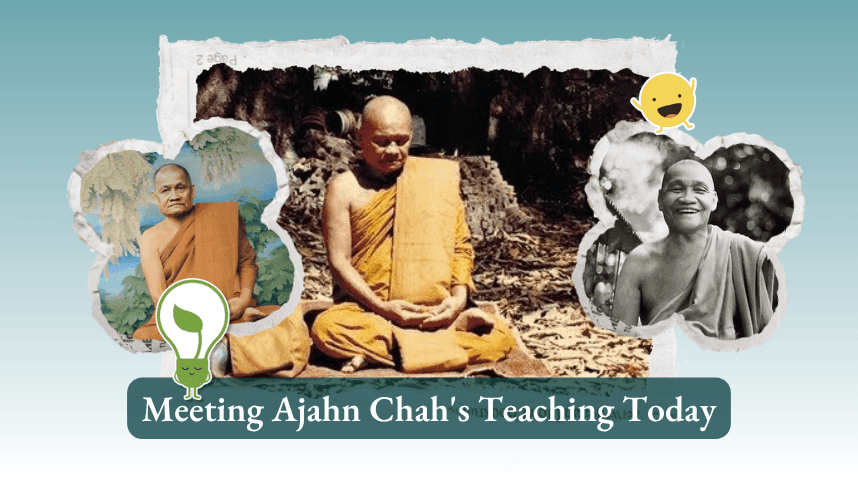
Across 26 – 27 December 2025 in Kuala Lumpur, the Ajahn Chah Remembrance Day (ACRD) 2025 “honours the life and teachings of Venerable Ajahn Chah Subhaddo, a revered Thai Forest Tradition master who passed away on 16 January 1992.”
Four HOL contributors, who had participated in ACRD 2025, were invited to reflect on Ajahn Chah’s and his disciples’ teachings, specifically those that straightened their views and inspired their practices.
In this short anthology, we explore the skillful illustration of simple yet profound Dhamma teachings through using day-to-day analogies. These powerful metaphors imprint understanding of the Dhamma right into the heart. They anchor the mind with a keen awareness of reality, like a kite soaring against the worldly winds of suffering.
Claire
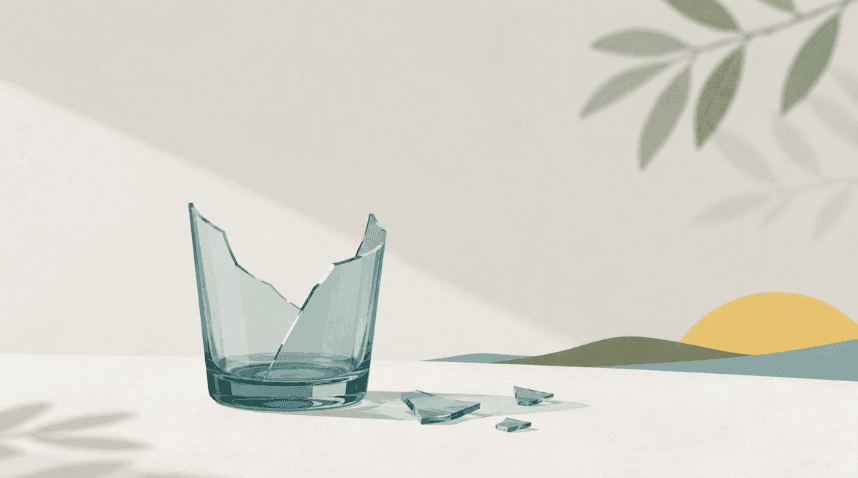
When the Glass Is Already Broken
There have been many teachings from Ajahn Chah that went straight into my heart. I’d like to share with you a small lesson from Luang Por that is particularly memorable for me.
The story goes that one day someone asked Ajahn Chah how genuine happiness is possible in an ever-changing world that is full of loss and suffering. Ajahn Chah smiled, held up the glass he had been drinking from, and said,
“To me, this glass is already broken. I drink from it. It holds my water admirably, sometimes reflecting the sunlight in beautiful patterns. If I tap it, it gives off a lovely ring. But when I set it on a shelf, and the wind knocks it over, or my elbow brushes it off the table, and it shatters on the floor, I say, ‘Of course.’ When I understand that the glass is already broken, every moment with it is precious. Every moment is just as it is, and nothing needs to be otherwise”.
Cherishing What Cannot Last
It’s a precious teaching that encapsulates Anicca, Dukkha and Anatta (impermanence, suffering, and non-self). Our lives are just like this.
For instance, this body that we have can be seen as borrowed.
It will die and decompose eventually. The people that we love will one day leave us for one reason or another.
The list goes on.
I used to cry a lot over matters related to Vibhava-tanha. But now, I just try to cherish everything that comes my way. When one truly knows that nothing lasts, one can treasure and live in the present moment even more.
Ezra
A Glimpse of Total Commitment
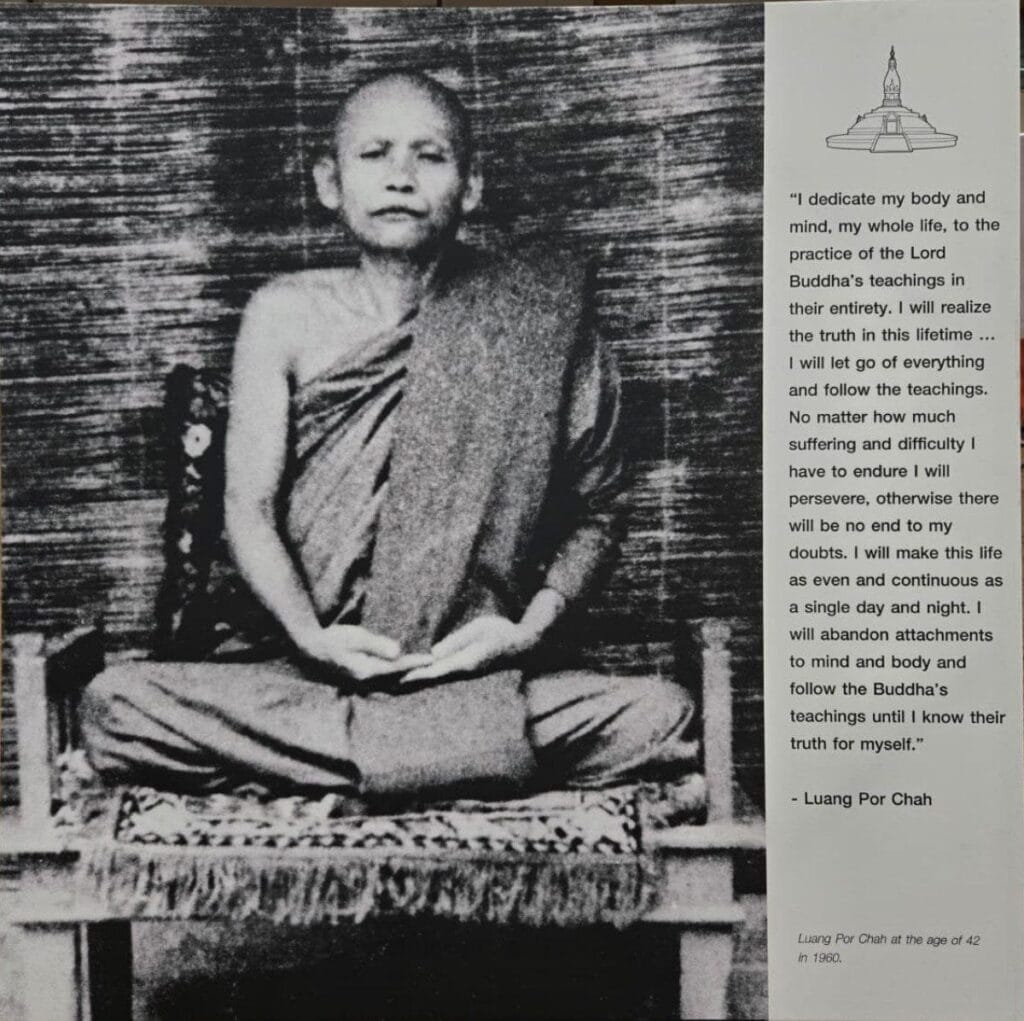
Ajahn Chah’s quote as exhibited in ACRD 2025
“I dedicate my body and mind, my whole life, to the practice of the Lord Buddha’s teachings in their entirety. I will realize the truth in this lifetime … I will let go of everything and follow the teachings. No matter how much suffering and difficulty I have to endure I will persevere, otherwise there will be no end to my doubts. I will make this life as even and continuous as a single day and night. I will abandon attachments to mind and body and follow the Buddha’s teachings until I know their truth for myself.”
It was my first time reading this quote, which was displayed alongside a photo of a younger Ajahn Chah. I didn’t know a lot about Ajahn Chah at that time, but I was very inspired by his commitment and dedication to the practice.
I thought to myself that I would like to have the same level of dedication and commitment.
But how does one let go of everything and abandon all attachments, unless one has decided to live a monastic life?
That being said, the burdens of life are indeed tiring. I look forward to laying everything down to have true freedom one day.
KH Tee
From Concept to Direct Experience
Though I was born after Ajahn Chah’s time, I feel deeply grateful for the blessing of encountering the treasure trove of Ajahn Chah’s teachings through his students, such as Ajahn Brahm and Ajahn Jayasāro.
Since I was exposed to the Dhamma at a young age, I have the tendency to approach the Teachings intellectually. This tendency is occasionally accompanied by attachment and conceptual proliferation, which can be a hindrance to the arising of true Insight.
Ajahn Chah’s masterful and direct way of teaching has softened that attachment. It guides the mind to investigate and verify the Dhamma experientially. I began to see the practice and the liberating insights not as lofty ideals, but as a living path that frees the mind from suffering, accessible in the here and now, when the conditions are ripe.
Stillness, Suffering, and Release
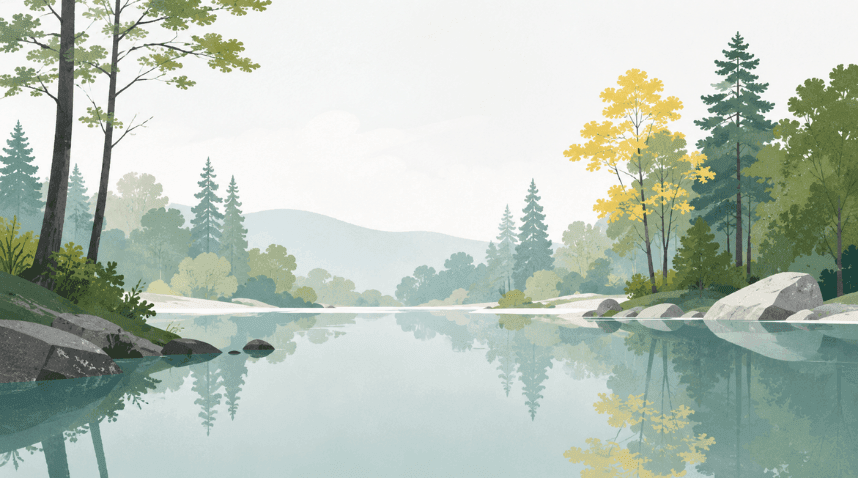
Ajahn Chah’s well-known imagery of A Still Forest Pool is one of the most powerful metaphorical teachings on mindfulness and clear comprehension, which has deeply inspired my practice.
Ajahn taught that when we let things follow their natural course, the mind becomes still like a clear forest pool, unperturbed as it clearly observes and understands the true nature of all conditioned phenomena.
It is such a beautiful invitation to incline the mind towards a happiness arising from inner stillness. One arose simply by allowing things to arise and pass away in their own natural course.
Each time I recollect this teaching, the effort to sit through change without grasping, resisting, or denying arises easefully.
Ajahn Chah’s teachings on the two kinds of suffering — one from clinging to the pleasant and resisting the unpleasant, the other from fully feeling the constant change of experience, be it pleasant or unpleasant — reframed how I relate to suffering. It imbues me with the courage to fully meet reality without flinching, even when it is painful.
By seeing the futility of grasping at what is inherently changing, the mind begins to be interested in the possibility of a path beyond suffering, a path of skillful release. What once felt unbearable becomes manageable, sustaining my patience and reinforcing trust in the workings of kamma.
Rare is the arising of such a wise teacher who teaches the Dhamma-Vinaya so skillfully (AN 3:114), and the opportunity to hear and practice the True Dhamma (Dhp 182).
With deep gratitude towards these rare conditions, may Ajahn Chah’s legacy continue to be a supportive condition for many beings with little dust to encounter the Dhamma, cultivate the Noble Eightfold Path, and realize the highest bliss of Nibbāna.
Si Jing
From Knowing to Living the Dhamma
Like the Buddha, Ajahn Chah taught us through simple metaphors that cut straight to the heart. Over the two days of ACRD, several of these metaphors stayed with me.
I’ve always enjoyed reading the suttas, and it’s easy to mistake reading for practice. One recurring reminder was that the Dhamma isn’t meant for intellectual appreciation alone: it has to be lived.v
Ajahn Chah’s metaphor of the ladle in the soup encapsulates this: you can be fully immersed, yet never taste the true Dhamma.
That got me moving towards a more balanced approach to the teachings.
At a time when I felt that I wasn’t “good enough” nor practising “hard enough,” another teaching landed.
Patience, Humility, and Steady Effort
I held the fixed view that long daily meditation equates to being a good practitioner. This mentality has caused a lot of suffering, as I neither sat frequently nor for long durations.
Luang Por Pasanno offered the following teaching:
“Don’t try to be a ten-wheel truck when you’re just a little wheelbarrow.”
This reminder gave me permission to meet the practice, and myself, where I am at — rather than through self-judgment and criticism.
Finally, the emphasis on being patient continuously changed how I relate to encountering plateaus in the practice.
Ajahn Chah compared practice to rubbing two sticks together to start a fire: often nothing seems to happen, and we stop just before the spark occurs. However, when we rub the sticks consistently without stopping, we may start a fire eventually.
The “earthworm practice” that Luang Por Pasanno described echoed the emphasis on patience-endurance.
Like a blind earthworm, sometimes practising the Dhamma is simply moving forward despite no clear view of the path ahead.
These analogies helped me trust small, consistent effort and to keep at it even when results aren’t obvious.
The metaphors taught reflect Ajahn Chah’s (and his disciples’) wisdom and skill as a teacher. May these teachings inspire and encourage you as they did for me!
Walking the Path Here and Now
Ajahn Chah may no longer be physically present with us, yet his teachings remain vividly alive through the way they are practised.
Across these reflections, a common thread emerges: the Dhamma is not something to be admired from a distance. Dhamma is to be tested, lived, and realised in the conditions of our daily lives.
Whether through patience in uncertainty, letting go of fixed views, or meeting experience with honesty and humility, the path unfolds in gradual, steady shifts of understanding.
Ajahn Chah’s and his disciples’ teachings remind us that sincerity and continuity of practice provide the conditions for spiritual progress. In this way, we may continue to meet Ajahn Chah—not just in memory alone, but in every moment we practise.
TLDR: There are lessons hidden under any experience. Have you ever thought of going through life like a painter working on his/her painting?
Recently, I picked up a new interest to embrace a slower life pace. Registered for acrylic painting for adult beginners, I went to first class with an open mind, even though I couldn’t draw a proper stickman for that matter 😅
While the first painting I created was not exactly something I am comfortable showing around, I may have gotten a hang of the process for now.
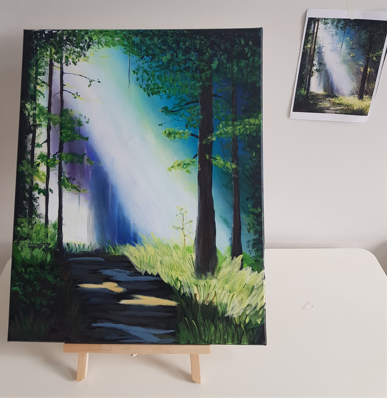
This is the sixth painting I’ve undertaken in the guided art class, completed in three sessions of about eight hours in total. It is also the first painting requiring more than one session to complete – the most challenging one so far!
“So what has painting got to do with internal/spiritual growth?” You may wonder.
These are a few things I learned from the couple of lessons I have attended:
There is a sample picture for reference, but everyone’s painting will be different
A sample picture is given for each class to guide amateur painters like me. Similar to journeying life, we learn from others who have lived before us.
Intriguingly, the painting process mirrors the defining steps in expressing one’s autonomy in face of the reference picture: Do we choose more vibrant or darker blue for the sky? Do we place the trees closer together or further apart?
Even when the person paints the same composition again, the result may be different. It is impossible and unnecessary to make a carbon copy out of somebody else’s art and life.
A painting can be completed in two hours or ten hours; depending on how much effort we consciously give and how much detail we enrich onto the canvas. The time spent and the number of stages completed are subjective to the person going through the experience.
Feeling unsatisfied, I may continue trying to ‘fix’ the painting. Often, it might be better to stop trying to fix something and continue to the next step. When I return to that troubling area again eventually, it may have blended into the overall painting.
We decide individually if we have done enough to our best ability – whether we are satisfied or whether more could be done. There isn’t a fixed stop line.
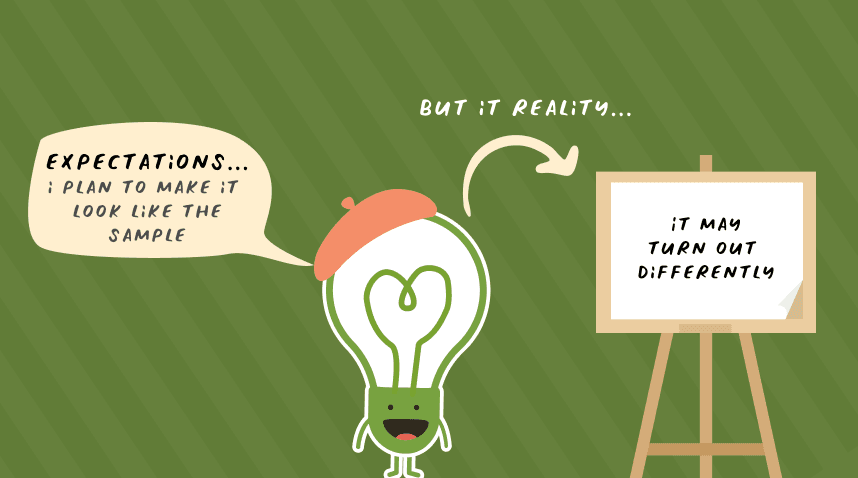
I can draw a frame of the expected result, though it may not turn out that way
All the students sketched the initial composition for their paintings: light and shadow, trees’ form, pathway’s lines. Multiple adjustments to the original sketch were made throughout the session.
When the tree’s form looked odd, I enhanced the tree size to match the distance proportion. When the shadow didn’t look natural, I added shades of blue or white.
This is closely akin to life in general: I can plan how I would like my day to go, though it may unfold differently many times.
I may have to adjust accordingly, for example, starting a meeting later when the train is late, choosing another restaurant when the one chosen has a long queue, etc.
These adjustments do not mean that part of the day is ruined. The day is just how it needs to be. Like scaling tree size for a more proportionate painting, holding things lightly and making adjustments as needed makes a peaceful day.
When I want to correct a part of the painting, I need to recall which colours I had used to recreate the same colour mix
Even after several sessions, I still find it difficult to recreate blended colours. Throughout the session, mindfulness and keen observation of my actions were required to recall which green and how much of green I’ve mixed into the blue to get colour for the background.
Making mistakes and corrections are part of life. It may be helpful to reflect on what had been done previously to make restorative actions or even to pick up from where I feel I took the wrong turn and follow a different direction from there.
Nature is not symmetrical; the imperfect strokes are what makes nature paintings beautiful
I enjoy the symmetrical look of buildings and architecture for the clean and tidy vibes. This preference sneaked unconsciously into my painting classes.
I still remember having asked my art teacher during the first lesson, “Why does my flower field feel odd?”
Her answer: “It is too planned. Too symmetrical. And nature is not that way.”
That need for orderliness was just the tip of a ‘perfectionism’ iceberg. I’m aware of the many times I stare at the canvas or the times when I hold back my brush just before it touches the canvas, thinking “What should I do next?”
Such hesitance is not unlike many decision-making situations I have been in. Worried about making the wrong decision, I revisited my thought process to ensure I cover all angles before actually setting course. While it is essential to do my research and decide carefully, I often find myself ruminating longer than necessary before taking action.
When I spent more time hesitating in class, I fell behind in the subsequent steps and eventually just rushed along to complete the class.
As the serial late-finisher among the students, I was still not yet fully satisfied with the result!
I have learnt to pace myself for more balanced efforts in each stage of painting and it has worked quite well now.
Wanting to follow society’s commonly accepted ‘rules’ to make the ‘perfect’ choices, I gave myself an unreasonable amount of pressure. Through painting, I learned that life is imperfect.
As much as I’d like it to be ‘perfect’, there are many areas beyond my control that could look better with imperfection – like nature’s asymmetry
The full picture can be seen clearer from a distance
When I’m deeply immersed in class, I can see every single stroke up close: colour gradients and shapes that can look unusual from some angles. A comment will arise in my mind “This looks odd. It’s not as nice as I’d like it”.
The teacher then reminds me to stand back, view the painting from a distance or even look at it through my mobile phone’s camera. I often realise the colours and shapes gel in well as a whole with this view.
I recall the times at work or in my personal life when I was deeply entrenched in the situation that I forgot that in the grander scale of things, the conflict was not the most important thing.
The few times I managed to catch myself getting too entangled in my position/view in the disagreement, I took a breath and a step back. It helped to diffuse the tension I was feeling and loosen the grip of my perspective.
Thanks to the painting experience, I learnt the usefulness of taking a step back and catching my breath.
Learning from Painting
These are the few lessons I gathered from my painting lessons, not only the painting skills but also general life lessons 😊 I am glad I registered for them and I look forward to more learning opportunities.
I hope this sharing would encourage others to pick up new/old interests that have been put off due to ‘life demands’.
And who knows, there could be hidden lessons underneath the activities or at the very least, an additional experience for a richer life?
Wise points:
There are life lessons in mundane activities, we could be pleasantly surprised if we are aware and remain open to seeing what we can learn
Like painting, lift the tendency to control every single stroke/action. The result may be a positive one
When we are immersed too deeply in the situation, it may be helpful to take a step back and assess it from a distance
TLDR: When we don’t understand death, life can be very confusing. Recognising death’s uncertainty, we not only do what we like but do what matters.
Death is a reality no one likes to talk about. An ex-co-worker passed away lately and so did a friend’s sister. Throughout my life, I have seen the passing of family members to acquaintances. Either by illness and even accidents – some were sudden while others took a while to die. They include the old and the young. Reflecting on death inspired me to write about the mindfulness of death. However, being mindful of death does not mean we constantly lament and harp on this fact till the last breath. It is about how understanding death helps us live a good life.
Awareness of Death
The unique ability of humans is our ability to be more aware of death compared to less intelligent life on earth. Despite this awareness, we do not pay much attention to it. What do I mean by paying attention to the reality of death?
We do not pay attention to the fact we have no control over the timing of our death. But yet we try to control everything else in our lives. We aim to live a good life measured by what we have or have not. We try to control our environment and others for this good life to happen. When in reality, if we cannot control when and how we die, how much control can we have over life?
This does not mean we give up on life to be lazy and lie down to sleep all the time. But the lack of awareness of death’s uncertain timing is a big reason most of us live stressful, discontented, and sometimes acrimonious lives.
The Good Life Is Linked To Death
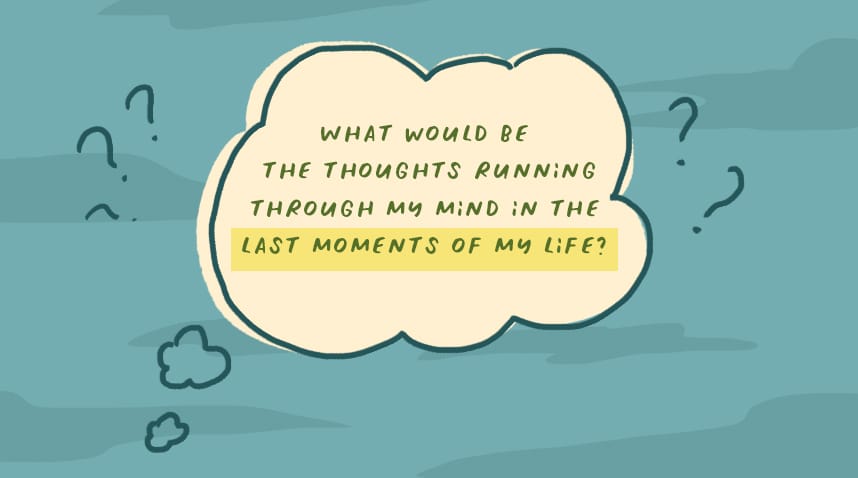
When we don’t understand death, life can be very confusing. This is one of my favorite sayings of Ajahn Chah, a forest meditation master. A simple way to look at this could be imagining our last moments at death. I have reflected on this a lot. What would be the thoughts running through my mind in the last moments?
Do I want to busy myself and sweat the small things in my life? No.
Do I want to spend my life in a state of discontentment and blaming others for obstructing my well-being? I must admit, I had begrudged others in my youth but also noticed I was really unhappy. It is not something that I want.
Having a good career and boasting about it wasn’t part of my plan too. I saw early in my life how fame and wealth come and go. Through my reflection, I saw how nothing really mattered in our striving because it will all be forgotten with time. If I died and became nothing, would having fame, having a fantastic career, and having good food or living in a big house give me a sense of satisfaction at death? Even if I had a loving partner or family, I had to leave them at death and there is no satisfaction at all – having lost my mother to death made me realize this.
That was what I reflected on in my youth. There was mindfulness of death in me. But I had no answer to what makes a fulfilling life. I focused instead of doing what I liked.
Mindfulness of Death Helps Us Let Go
Growing up I had thought the purpose of life was to achieve things and be satisfied at death. Only to realize that satisfaction never lasts. There was this constant thirst to fill the emptiness of the heart.
What filled my heart was recalling the good I had done in my life. Lifting the spirits of an intern in my company to helping another youth find stability in her career and life. Recalling how I had helped others filled my heart. The achievements I had at work could not really remember. Even if I did, they did not fill my heart, compared to how I was able to help others in little ways I could.
A good life should be a life that is relaxed and joyful, without guilt or regrets. To be relaxed is to be able to let go at every moment. We could have goals in life. Goals from learning a new skill to climbing the career ladder.
Understanding that we can never really have full control of people or of our environment, all we can is to do what is needed at this moment and then let it go.
To let go does not mean we are lazy or we do not care. To let go is to know that we don’t know what will turn out the next moment so there is no point thinking or holding onto it. Even if we want to help someone, that person may not want to receive help. So, we can only take whatever opportunity there is to help and let go rather than force a person to receive help or to expect an outcome.
Filling Our Own Hearts
What really matters is our heart. Mindfulness of death in every moment allows us to let go. Letting go we allow ourselves to grow in patience and inner security. Patience because we allow things to unfold from our actions without needing control. Inner security because mindfulness of death makes us aware of our mind, speech, and action. They all have a consequence on our conscience. This helps us become responsible for our actions. It would not be very pleasant to die with regrets of hurting someone or living a selfish life with the time we have.
Wise Steps:
Calling to mind our last moments allows us to let go of the trivial negativities that we hold so closely.
Knowing that many things are truly not within our control, to cultivate patience without the need for control.
To guard our hearts against regrets and guilt, develop compassion towards ourselves and others so that our impending death may be peaceful.