TLDR: In the second part of our pilgrimage series, Tate Aung acquires a symbol, a wooden Buddha rupa. She experiences a pivotal moment of renunciation by giving away a prized possession, exemplifying the importance of relinquishing attachments for spiritual growth. Next, Angela Tan’s contemplation on death during a Ganges River cruise in Varanasi leads to profound insights on life’s impermanence and the cultivation of of virtues in pursuit of liberation.
Going on a pilgrimage often brings us to some unexpected realisations and experiences. In this second instalment of our three-part pilgrimage series, we delve into two reflections by two fellow pilgrims, Tate Aung and Angela Tan as they navigate the paths of renunciation (Nekkhamma) and death contemplation (Maranasati) amidst the sacred landscapes of India.
From the pursuit of generosity to contemplating life’s impermanence, their narratives offer some poignant insights into the essence of spiritual growth and the pursuit of enlightenment.
Nekkhamma by Tate Aung
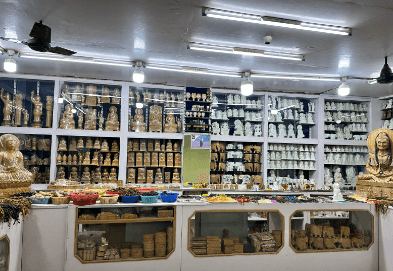
In the serene setting of Rajgir, a town in the district of Nalanda in Bihar, India, I made a significant acquisition – a beautifully carved wooden rupa made of wood from the sacred Bodhi Tree.
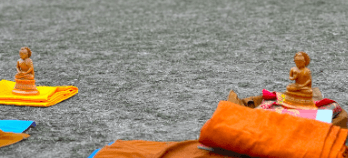
This rupa of Lord Buddha in his most austere state of renunciation was to me a symbolic reminder of the suffering the Buddha felt, along with his unwavering determination on his path to enlightenment. Reflecting on my disposition, characterised by what I perceive as a lack of Viriya (effort) and a tendency to procrastinate, I had wanted to place this rupa in my home as a stark reminder to infuse more effort into both my spiritual practice and work life.
The journey of this rupa did not end with its purchase. I carried it to the Mahabodhi Temple in Bodhgaya, where it received blessings at the Buddha Metta statue.
It then further continued at the deer park in Sarnath where the Buddha first proclaimed the Dhamma to the world.
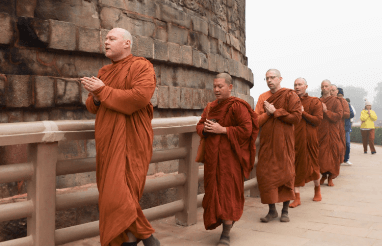
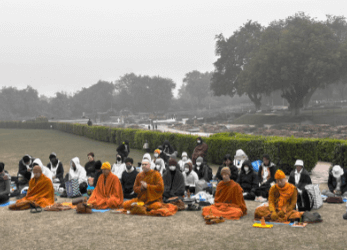
While our group circumambulated with the rupa around the stupa (commemorative monument)at the deer park, the recited teachings of the Dhammacakkhapavathana Sutta and the Anatta-lakhana Sutta from ~2500 years ago echoed in the air. I would think that layers of blessings were bestowed upon the wooden rupa.
I had brought along another rupa on the trip to the deer park to offer to Kruba Joe, a monk accompanying us on this pilgrimage. However, while everyone was meditating, I became quite distracted and was in a deep dilemma on what to do when I saw that the rupa intended for Kruba Joe had a small crack at the back.
As good as my intention was to give it away, I could not unsee the crack on the rupa’s back and thought how “less-than-beautiful” it was when compared to the other rupas gifted to the other monks who were around.
Right then, I recalled the goodness of my dear kalyāṇa-mitta(spiritual friend), Kaylee, who previously gave a singing bowl to Phra Danny (despite her initial desire to keep it for herself…)
Inspired by her example, I too decided to give away the “ultra-blessed” Austere Buddha rupa intended for myself to Kruba Joe. Honest to Buddha, the Austere Buddha rupa not only had very good craftsmanship but also cost twice as much, hence I did feel the pinch and was quite unwilling to part with the rupa, and more so, the blessings associated with the rupa.
Oftentimes, most of us only give away things we don’t need, and things we don’t find difficult to give away.
You could say that I was delighting in the pleasant sense-object like the rupa, and growing a dangerous attachment to it that could cause me some suffering over it in the future.
Hence, the act of giving away a prized possession became an expression of renunciation, serving as a reminder to not only give away what is easy but to part with what is most difficult (which includes renouncing our defilements).
On the topic of renouncing our defilements, while I was at Rajkir, Bihar (prior to reaching Uttar Pradesh), I had indicated to my dear kalyāṇa-mittas(spiritual friends) that yes, I would be taking the Eight Precepts, and hence would not be eating after 12:30pm.
Yet, the allure of an exquisite buffet upon arrival at our hotel in Uttar Pradesh tested my commitment. Succumbing to temptation, I found myself on the brink of breaking my precepts during this pilgrimage. In a moment of intervention, a wise kalyāṇa-mitta, Heng Xuan, gently told me off by mentioning that “..breaking your precepts is very bad kamma…. you said you were going to take 8 precepts”. He also said something along the lines that it was bad for my “Sacca Parami” (transcendent virtue of truthfulness) too.
That stopped me in my tracks.
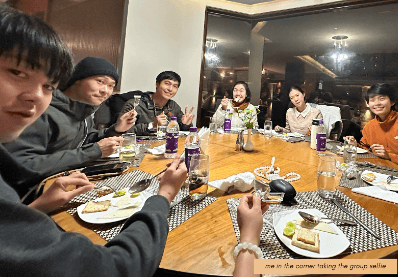
This timely piece of advice halted my wavering, and I chose to recommit to the precepts, a decision we celebrated as a team, captured in a joyful photo with the entire DAYWA group observing the eighth precept successfully.
The conscious and intentional act of stepping away from temptations which lead us astray from our commitments is a powerful act of renunciation.
Pana time for eight preceptors
In essence, this entire pilgrimage served as a powerful reminder that every action we undertake is a fuel for our Parami (Virtues). The habit to renounce not just material possessions but also our inner defilements, such as tanha (craving), becomes crucial in propelling us forward on the raft towards the shores of Nibbana.
Maranasati (death contemplation) by Angela Tan
Witnessing the four sights of ageing, sickness, death and an ascetic, the Buddha sought a way out of suffering. On this pilgrimage, the sight of death (through viewing cremations happening right before our eyes) was a particularly impactful one.
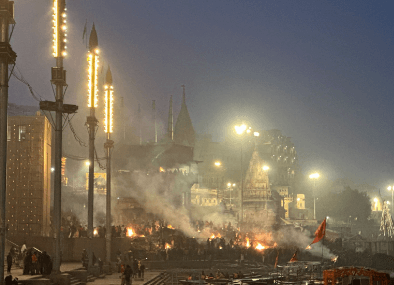
Burning Ghats
After days of meditation and visiting holy sites, we were treated to a cultural experience; a cruise on the Ganges – one of the most sacred rivers in the world.
Prior to boarding the Ganges cruise, we learnt that some Hindus believe that people who die in the city of Varanasi can achieve moksha (liberation). As part of their death rituals, some Hindus cremate their deceased relatives at a famous ghat (defined as: a level place on the edge of a river where Hindus cremate their dead.) Then, their ashes are put into the Ganges river where some Hindus believe that the deceased can reunite with their god Shiva.
As we boarded the cruise and headed for the famous cremation ghat, I could not help but anticipate sadness. I carried with me some preconceived notions of death – in Chinese culture, death rituals are often associated with a sombre sense of loss and heavy feelings.
Upon disembarking near the cremation ground, my eyes were indeed filled with tears – from the fumes of five recently deceased bodies burning all at once! When my watery eyes cleared, I saw family members of the deceased surrounding the fire, looking at ease with where they were and what they were doing. It was nothing like what I expected. There were no tears, no wailing, an absence of distress.
On the contrary, there was a sense of acceptance. And I was not the only one who felt this. Later on the way back to our evening rest, other pilgrims shared the same sentiments too. Death, to the Hindus, is a natural part of life. This is part of the notion of “Right View” expounded by the Buddha.
This experience led me to reflect that no matter your situation, whether you are rich or poor, happy or upset, sick or healthy, death is inevitable. It is a short sprint between life and death.
What matters most is to continually do good, give generously, learn earnestly, forgive steadfastly and patiently cultivate.
The next day, contemplating this experience about death allowed me to have a joyful meditation session. I was able to disengage from my ever-planning mind and enjoy the present moment, one breath at a time. Having returned from the pilgrimage, I continue to practise death contemplation whenever I walk past funeral services.
Conclusion
As we draw the curtain on this chapter of contemplation and revelation, both Tate’s and Angela’s stories shed light on the intricate journey of spiritual growth while seeking enlightenment. From Tate’s journey of renunciation, marked by the relinquishment of material attachments to Angela’s profound contemplation on death and impermanence, their encounters remind us of the transient nature of existence and the urgency to cultivate good virtues that aid us to liberation.
May their insights inspire us to be more determined in our spiritual practices, guided by the light of wisdom and the aspiration for Ultimate Happiness and freedom.
Wise Steps:
1. Reflect on material (or mental) attachments: Take time to identify attachments to material objects and contemplate the possibility of letting them go for a better cause, understanding that renunciation can lead to spiritual growth and a lessening of our attachments . The same could apply to our mental attachments – to objects, experiences, views and perspectives.
2.Embrace impermanence (anicca): Contemplate on death regularly to cultivate our acceptance of life’s transient nature and prioritise actions that contribute to spiritual development and well-being. Regular reminders on impermanence also provide us with a sense of urgency to practice.
Ghost Month Series: This series explores different angles of the 7th Lunar Month, also known as the Ghost Month. Festivals, Cultures, and Religions often mix together in one place, offering space for different interpretations. We, like you, are keen to explore more. Discern what is helpful to your practice and discard whatever is not.
TLDR: The encounters with an unseen being leads to a reflection on human nature and how we relate to other beings in Buddhist cosmology.
One Fateful Night
At barely 6.30pm, the women’s compound of Wat Boonyawad was almost pitch dark within the forest. I hastened my footsteps after finishing walking meditation near the main gate – tempo accelerando. There was no one else. In that solitude, I wished someone was with me — just not the unseen sort, whatever it wanted with me.
My torch was barely strong enough to see beyond one metre from my feet. Leaves crunched beneath me, like in The Slender Man.
Near my kuti (small practitioner’s hut) after I had washed my feet, leaves rustled and a breezy presence weaved through the surrounding forest. Yet, my skin pricked with heat. Panicking, I ran up the steps to the door.
Meeting the Ghost of my Mind
I fumbled for the key, with the torch gripped in between my teeth. Jaws tightened. The fear of being caught up by a menacing force crescendoed as each attempt to slot the key into the lock pad failed. Mosquitoes hummed impatiently beside my ears. Quick. Quick.
Finally, the lock turned and I slammed the door tightly behind me. All that hooting and howling from the forest grew claustrophobic; their sources unbeknownst to me. The forest has its ways to play tricks on the mind. This meditation retreat was my first ever to stay alone in a forest hut within a Thai monastery. So much unknown to fear for.
The relief of getting into the kuti (meditation hut) did not last, I hurried to the little altar to light up the candles, the heart-throbbing at my throat.
Buddha, help me. Bow. Dhamma, help me. Bow. Ajahns, help me. Bow. The candles flickered in the twilight.
I inched my way to unwind the huge windows for ventilation; my eyes averting the ominous world outside. What if a ghastly face stared back at me? At that thought, my hair stood on its ends as a chill ran down the spine. Spinning out of the sensation, I plunged to the floor into a half-lotus position for sitting meditation.
Buddho buddho buddho.
Buddho buddho.
Buddho.
Bud-dho.
Bud-dho.
Bud–dho.
Bud—-dho.
When hyperventilation evolved into a smoother and more refined breath, I saw clearly all that fear about ghosts was merely the sensitive mind misdirecting its alertness. I believed in ghosts’ presence within Buddhist cosmology.
At that time, I also assumed their nature to seek me out in avenging my past karmic misdeeds and sucking my energy dry with evil trances.
That such a hateful encounter was bound to happen kept my heart from sinking into the peace. It wasn’t the forest that was playing tricks. My defiled mind was the culprit puppeteer, pulling strings on a ghost puppet.
The First Encounter
No, I would not let that made-up ghost rob me of the peace that can develop from retreating thousands of miles away from home. The fear mis-manufactured from baseless perceptions and thoughts can stay.But I did not wish to indulge its willfulness, despite not understanding it fully.
With that determination to set aside fear, the heart finally found its resting spot in even more refined breaths: a clear quiet space opened up within my mind. The candles at the altar had gone out by then. The nocturne calls of animals were distant. This was one of the rare peaceful moments in the retreat, truly. A deep state of focus, tranquil, alert.
Soon, a face showed itself in my mind’s eyes. No vengeful entrance — gradual, weightless.
Just a head dripping in blood, rotten flesh, long hair; her round bloodshot eyes stared into me. The body trailed off. A very… sorry plight; nothing threatening.
I couldn’t explain how I knew this presence to be true but I did. The fear that I experienced earlier did not arise again. No goosebumps. No chills. I steadied the mind on the being, looking right back. I did not wish her away, neither did she seem to want to go away. Not yet.
Here, memories of reading Mae Chee Kaew’s biography where she communicated to ghosts using her heart surfaced within my mind. I was definitely not Mae Chee Kaew, but maybe I could try communicating to the ghost too.
What do you need from me? What is helpful for you?
Share merits. You have been practising the Dhamma.
I will wish you well. Hope you can receive them.
Eyes shut tight still. My heart turned inwards further and channel whatever wholesome bits it could find towards the being in front:
May you receive all the blessings from the goodness I had cultivated since the start of my life. May you have the merits you need for a fortunate rebirth. May you seek safety and refuge in the Buddha, Dhamma and Sangha. May you be free from all sorts of suffering in the future. May you be well and happy.
These phrases repeated in my mind like a playlist on loop, religiously as if my life–her life–depended on them. The sphere of goodwill (metta) radiated outwards to imbue her presence within it. Not long after a few cycles, the unseen being took her leave –gently, gradually, lightly–much like how she appeared but with more ease. The meditation came to an end too.
Do I know you? I wanted to ask but I didn’t. A sense of familiarity lingered, although I could not quite put a finger to it.
Moonlight shone through the canopy; their piercing beams reflected off the forest floor, lighting up the pitch dark from before. I took three candles outside, keen to place them along the earthen path for walking meditation. Finally, I was brave enough to venture out after nightfall. Before this night, moonlit walking meditation was completely unfathomable.
Affinity Knows no Boundaries
In my subsequent stays at various forest monasteries, trips to Kuala Lumpur, even at home, when I was alone in meditation and there were particular still moments of clarity at night, unseen beings of similar profiles would appear in my meditation. Each time, they asked for merits. Each time, I tried to maintain my compassion to share merits. Afterwards, they would leave quietly.
The restless mind was still afraid of the dark and jumpscares, but the fear was more manageable than the very first encounter.
These encounters were at least half a year apart so I thought that the beings were different individuals.
It was not until my India pilgrimage that I realised a trend.
Final Encounter in Pilgrimage
The hotel we stayed in at Vesali was haunted. According to Thai Forest Venerable Luang Por Piak, tens of thousands of hungry ghosts hung around the hotel. At the worst of my cough, I felt nauseous on the first night, after returning from a day of breakdowns. A Thai female doctor with the tour suggested treating me with acupuncture, which I desperately accepted. Anything to get me out of that bodily hell.
Moments after the acupuncture began, I slipped into unconsciousness while I was trying very much to be mindful of the needles. Soon, I fainted on my bed.
That night, I woke to a persistent furious hammering on the windows. Calling out to my Thai roommate from my crippling fear of angry ghosts, I hid under the covers, still weak from earlier. She went up to check the curtains and found monkeys. Nothing to be afraid of. Go back to sleep. How? I could barely feel safe.
On the second evening in Vesali, a second acupuncture session occurred in another hotel room, in which its inhabitants complained of paranormal activities from the night before. Despite the crowd receiving treatment, I caught a waft of ‘off-energy’. While sitting in meditation at a dimly lit corner, the mind gathered into stillness.
Soon enough, a familiar image of a bloody head and wispy long black hair came into view – the same request ensued.
This time I finally recognised her although she was hovering at the corner. An insight struck: this was the very same unseen being who sought my attention at Wat Boonyawad and thereafter.
She had followed me to India! She had been following me all this while! In sharing merits, I recollected about the wholesomeness from visiting the key Buddhist holy sites thus far and wished her to rejoice in the rare occasions arising from that pilgrimage. That night, I slept soundly.
At the last stop of the pilgrimage – Varanasi, my tour group disclosed that my Thai roommate (gifted with supernatural vision) had seen a ghost sitting on my bed that very night in Vesali. That was definitely goosebumps-inducing. Rounding up the trip at a final chanting session in Deer’s Park, I made a determination to dedicate all the merits from the pilgrimage to the unseen being.
Since then, she has not visited me in meditation. I would like to think that she has gathered sufficient merits to be reborn in a better place.
How Can We Live Better in this Cosmic World?
My unseen encounters left a lasting effect on my practice. They taught me to face my fear of darkness and to respect the presence of unseen beings. Now, I make a point to share merits every morning chanting and when I offer meal dana to monks. Sharing merits help to cultivate generosity in the immaterial world.
I have not mentioned the unseen encounters to my spiritual friends openly, for fear of coming across as boastful. The intention of sharing my encounters here is to help readers reflect that there are deprived states, where unseen beings exist in our cosmic world.
They exist out of their attachments and/or hatred to this material world, which they were not able to relinquish upon their death as humans.
(While I have not met malicious beings, I have heard stories of where ghosts have party hangouts in rooms for extended periods.)
Reflecting on the deprived states of ghosts, can we then work on our attachments, anger and hatred in this human life?
Perhaps, as much as I have encountered the manifestations of an unseen being, the visualization mirrored the hatred contained within my heart. Using the same Dhammic approach of awareness and acceptance, I can introspect on what the heart needs and what is beneficial for it. Then, apply the balm of loving-kindness and compassion.
To the being and myself: wherever you may be, I wish you well and hope you benefit from the Buddha’s dispensation, always.
Wise Steps:
Casper the friendly ghost is not untrue — ghosts primarily want sharing of merits when they manifest to you.
If you encountered ghosts as malicious, share even more merits. Done from a mind of pure generosity, offering a Sangha Dana can generate merits for unseen beings who could receive them for long-term welfare and fortunate rebirth.
With compassion towards the deprivation ghosts exist in, we may contemplate our strong attachments and begin to let go of the hatred we experience within our hearts.