TLDR: Buddhism says we regularly mistake reality for something else. Writing a book about a bat and the Buddha made me wonder how often I’ve been doing exactly that.
You know what I love about catching up with like-minded friends? Somehow, we never stay at the usual “How’s work? How’s life?” for very long. Give us a cozy space and enough time, and suddenly we are talking about childhood, identity, family expectations and all the strange ideas we picked up while growing up.
This happened one evening in Chiang Mai with my Best Korean Friend Forever. I remembered I attended a program organised by a temple, Monks’ Chat in Chiang Mai, where anyone can sit down informally with Buddhist monks and have a conversation.
People come with questions about Buddhism, meditation or monastic life, although the conversations often wander into ordinary things too. That was how my BKFF and I met. Over the years, we went on to volunteer together at school camps, travel through India on spiritual journeys and even celebrate Vesak together in Seoul. She works closely with children and researches play and playgrounds, which has given me a completely different way of looking at how children make sense of the world around them.
That evening over coffee, she spoke about some of the pressures people grow up with in Korean society. There is the expectation to marry, fit in, study hard, find a respectable career and somehow arrive at this picture of a successful life.
As she was talking, I kept thinking, “Wah, Singapore also quite similar.” We laughed about it, but there was something very familiar in what she was saying. So much of what we believe about a “good life” is already waiting for us when we are young.
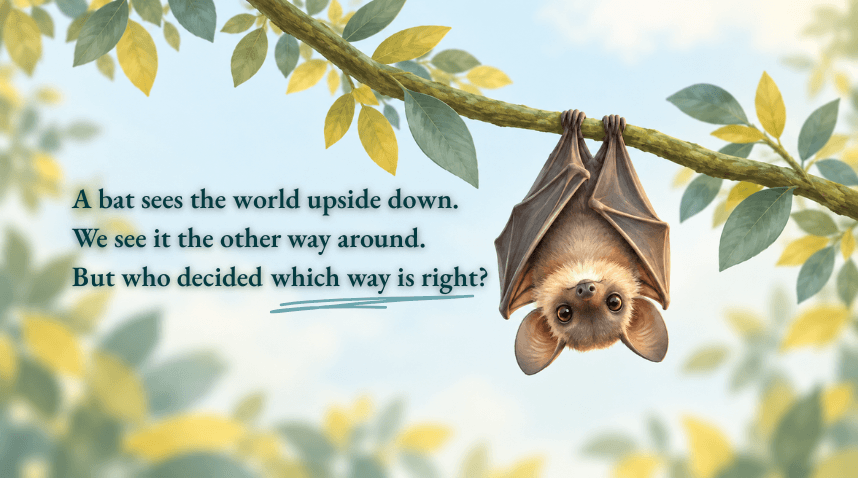
We inherit these ideas from family, school, culture and the people around us, and sometimes we carry them for years without really asking whether they make sense for us. Somewhere in that conversation, I told her about a book that had been slowly forming in my head: a conversation between a bat, who sees the world upside down, and the Buddha, who asks him to take another look at what he thinks he knows.
I wanted the book to be readable from the beginning to the end, but also from where it finishes back to where it starts. The two directions would not compete with each other. Instead, they would invite the reader to consider whether there is only one correct place from which a story, or even a life, must begin.
“Write it,” she said.
And so I did.
From an Idea to a Dharma Reflection
The idea was honestly quite playful. I noticed that both Buddha and Bat begin with the letter B. On its own, the letter B has no particular meaning. It becomes meaningful only when it is placed beside other letters, recognised through a language and understood by a mind that has been taught how to interpret it. From there, B can become Buddha, bat, belonging, belief, bias or countless other words.
It made me wonder how much of the world works this way. We are born into languages, cultures and systems that existed before us, and we learn to recognise their meanings so naturally that we rarely pause and question them. We learn that the alphabet begins with A and ends with Z, but few of us stop to ask why Z is always last and A is always the starting alphabet. Who created the alphabet anyway?
We learn what success means, what a family should look like, how a body should behave, what is respectable and what should be hidden. Eventually, these inherited meanings become so familiar that we begin to call them reality.
I spent almost a month in Lamphun, surrounded by longan plantations, trying to work out how this book could be read in both directions. It was not easy to solve. At times, it felt as though I had created an impossible task for myself. Yet the difficulty was also part of what kept me going.
I wanted the form of the book itself to challenge the assumption that there must always be a front and a back, a correct direction and an incorrect direction, an upright position and an upside-down one.
I wanted the form of the book itself to challenge the assumption that there must always be a front and a back, a correct direction and an incorrect direction, an upright position and an upside-down one.
The bat became important to me because it does not need to be corrected. Its experience of the world is different, but difference is not necessarily an error. The Buddha is equally important because he does not simply reassure the bat or give it an easy answer. Their meeting allows a deeper question to arise: when I say that something is true, am I seeing reality itself, or am I seeing reality after it has passed through my senses, memories, habits and conditioning?
Seeing Through the Five Skandhas
My writing slowly steers toward the phenomenological breakdown of lived experience from the Buddhist teaching of the Five Skandhas, also known as the Five Aggregates.
The Five Aggregates are a Buddhist way of describing how we experience the world: through the body, feelings, perception, our mental habits and memories, and consciousness. They are constantly working together, so quickly that we rarely notice the process. We simply arrive at a conclusion and think, “This is what happened.”
Say someone speaks to me in a certain tone. I feel uncomfortable and read their expressions as criticism.
Almost immediately, my past experiences and insecurities join the conversation in my head, and I conclude, “This person doesn’t respect me.”
Something did happen, of course, but part of the experience was also shaped by what I brought into that moment. Buddhism extends this to our six senses: what we see, hear, smell, taste and touch, as well as the mind itself. A memory or thought can stir us just as strongly as something happening right in front of us. Seeing this process more clearly gives us a little space to question the stories we so quickly believe.
This teaching made me think about how quickly the mind turns contact into preference. We see something and want more of it. We hear something and immediately resist it. We recall an experience and continue suffering even though the original event is no longer occurring.
The senses themselves are not the problem. Seeing is simply seeing and hearing is simply hearing. The difficulty begins when feeling becomes craving, perception becomes certainty and a passing experience becomes part of the identity we must protect.
This does not mean that everything is unreal or that nothing matters. I prefer to understand it as saying that things are not independently real. They arise through causes, conditions and relationships.
A word depends upon letters, language, history and a mind capable of recognising it. A personal identity depends upon a body, family, culture, memories and countless relationships. Even the meaning of “upright” depends upon where we are standing.
The bat and the Buddha therefore became more than two characters in a story. They became two ways of approaching experience. The bat carries a perspective shaped by its own body and way of living. The Buddha represents the possibility of seeing the conditions beneath a perspective without condemning the person who holds it. Their encounter does not ask us to decide which one is right. It asks whether we can become less rigid about the reality we have constructed.
Seeing the world upside down
There is another teaching that the Buddha taught that has unknowingly unsettled me over the years. The Buddha suggested that suffering does not begin because reality is inherently painful. Rather, it begins because we repeatedly mistake reality for something it was never meant to be.
In Buddhist psychology, these are known as the Four Inversions (vipallāsa), four fundamental ways in which we turn the nature of existence upside down.
We take what is impermanent to be permanent, what is ultimately unsatisfactory to be a lasting source of happiness, what is constantly changing to be a fixed self, and what inevitably decays to be something permanently beautiful.
These are not moral failings or flaws in our character. They are simply habits of perception. We spend our lives editing reality until it resembles the story we wish were true.
When we expect things to stay
Looking back, I realise I have lived inside every one of these inversions. Not because I lacked knowledge, but because knowing something intellectually is very different from living as though it were true.
I knew people grew older, relationships changed, careers evolved, and bodies eventually failed. Yet emotionally, I still expected things to remain as they were. I assumed my body would always cooperate with me.
I imagined friendships would continue unchanged simply because they had always been there. I believe home is a specific location. Every major loss felt less like a natural part of life and more like life had somehow betrayed me.
It took years to realise that reality had broken no promise. It was simply doing what it has always done. The reality is everything changes.
When enough is never enough
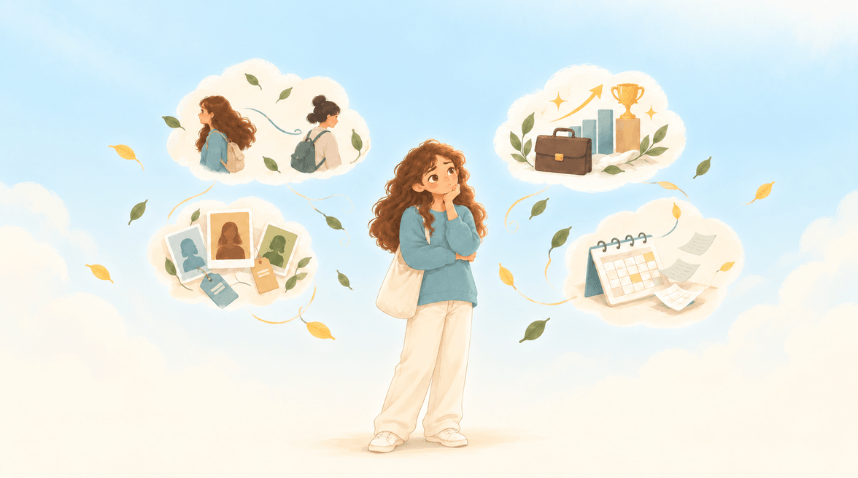
For much of my life, fulfilment always seemed to exist just beyond the next milestone. Another job to climb the ladder. Another happy client to meet. Another meaningful project. Another opportunity to prove that I was moving forward.
Each achievement genuinely brought joy or certain satisfaction, yet none of them stayed for very long. The problem was never that these experiences lacked meaning. It was that I had asked temporary experiences to provide a permanent emotional home. I had expected moments to become destinations.
The story I keep calling “me”
Perhaps the inversion that surprises me most is the belief that I know who I am. Throughout my life, I have introduced myself through the identities I happened to occupy at that particular moment: designer, creative director, queer person, writer, disabled person, Buddhist.
None of these descriptions is false, yet none of them have remained entirely unchanged either. Living with a feeding tube transformed my relationship with my body. Leaving Singapore reshaped my understanding of belonging.
Even relocating to Chiang Mai continues to redefine what success, purpose and even home now mean to me. The labels have helped me navigate different chapters of my life, but they were never the whole story. They describe experiences I have lived through, not a permanent self waiting to be discovered.
They describe experiences I have lived through, not a permanent self waiting to be discovered.
Loving what cannot be kept
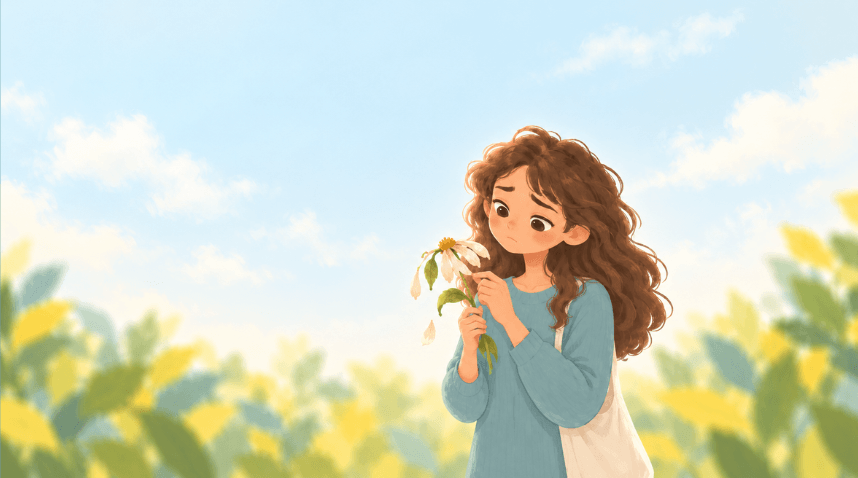
Even beauty, I have come to realise, is something I often misunderstand. Not simply physical beauty, but the beautiful stories I attach to people, places and seasons of life.
I once imagined that youth, health and relationships could somehow be preserved if I take care of them carefully enough. I assumed other people’s lives were perfect simply because they appeared well enough from where I was standing.
Over time, I have discovered that beauty has never existed apart from fragility. The mountains outside my home are beautiful because the sun moves across them each day. A friendship is beautiful precisely because one day it will end.
My own body has become more beautiful to me not despite its scars, but because each scar reminds me that life continued when I thought it could not.
When I first encountered these teachings, I misunderstood them as a form of meaninglessness. It sounded as though Buddhism was asking me to stop enjoying the world by reminding me that everything disappears.
Now I hear something much gentler. The invitation is not to love life less, but to stop demanding that it become something it has never promised to be. There is an extraordinary freedom in allowing impermanence to remain impermanent, happiness to remain fleeting, identity to remain fluid, and beauty to remain inseparable from change.
Perhaps this is why the bat in the book matters so much.
Thomas Nagel reminded us that every creature inhabits a world shaped by its own body and senses. A bat experiences a reality I will never fully know, no matter how much I study it. The Buddha gently extends that insight inward.
The greater mystery may not be the bat’s reality, but my own. Even within my human experience, I rarely encounter the world directly. I meet it through memory, desire, fear, identity and hope. I do not simply perceive reality; I participate in constructing it.
The Four Inversions are not abstract Buddhist doctrines. They are descriptions of how the mind bends the world until it feels familiar, even when familiarity comes at the cost of truth.
Perhaps wisdom, then, is not about discovering a hidden reality waiting somewhere outside ourselves. Perhaps it begins much closer to home, by noticing all the ways we have been seeing the world upside down, and learning to unthink “reality”.
What this book meant to me
I wrote this book because I wanted to explore these questions without giving readers a Buddhist philosophy lecture. Through a simple conversation between a bat and the Buddha, I hope readers of different ages can play with their own assumptions and notice how quickly the mind decides what is true. The Dharma is always there, in the questions around perception, clinging and how we make sense of our experiences.
As I get closer to publishing the book, I find myself thinking about this even more. A bat and a human live in the same world, yet experience it very differently. Perhaps we are like that too. We each see life through our upbringing, memories, fears, hopes and habits. I still don’t know what makes one perspective right and another wrong. Maybe that is where the Dharma confronts us and forces us to reflect back.
So I’ll leave you with the same question the bat asked the Buddha: if the world looks upside down to him, and perfectly normal to us, who, exactly, is standing the wrong way up?
So I’ll leave you with the same question the bat asked the Buddha: if the world looks upside down to him, and perfectly normal to us, who, exactly, is standing the wrong way up?
Wise Steps
- Notice what you expected to stay: When change hurts, ask yourself: what was I hoping would remain the same? Sometimes the struggle comes from expecting people, bodies, relationships or circumstances to stay as they were.
- Question the stories you keep repeating: “This will make me happy.” “This is who I am.” “My life should look like this.” Some stories are inherited, others we create ourselves. Occasionally, it is worth asking whether they still make sense.
- Turn it upside down: Take something you feel certain about and look at it from another position. What if success looks different? What if beauty can be temporary? What if who you are is still changing? You don’t always need another answer. Sometimes, just turn the question around.