Buddhist Film Reviews is a partnership series between HOL & THIS Buddhist Film Festival 2021 (25 Sept – 8 Oct’21). Themed “Open your mind”, THISBFF 2021 features 15 thought-provoking documentaries and feature films from 12 countries.
TLDR: Comparing the lives of an old monk and his young apprentice, this film reflects on simplicity, love, and a life’s journey
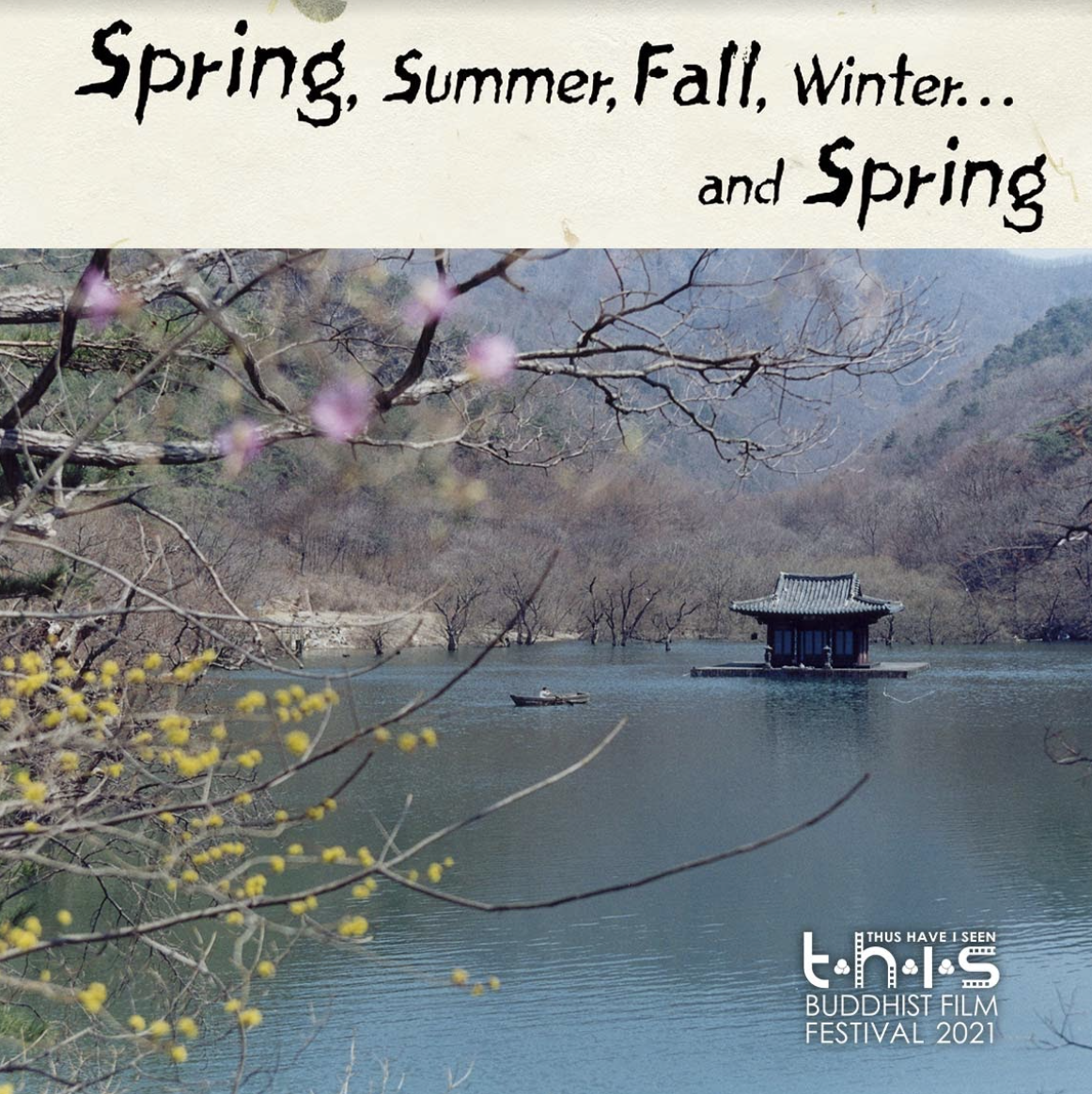
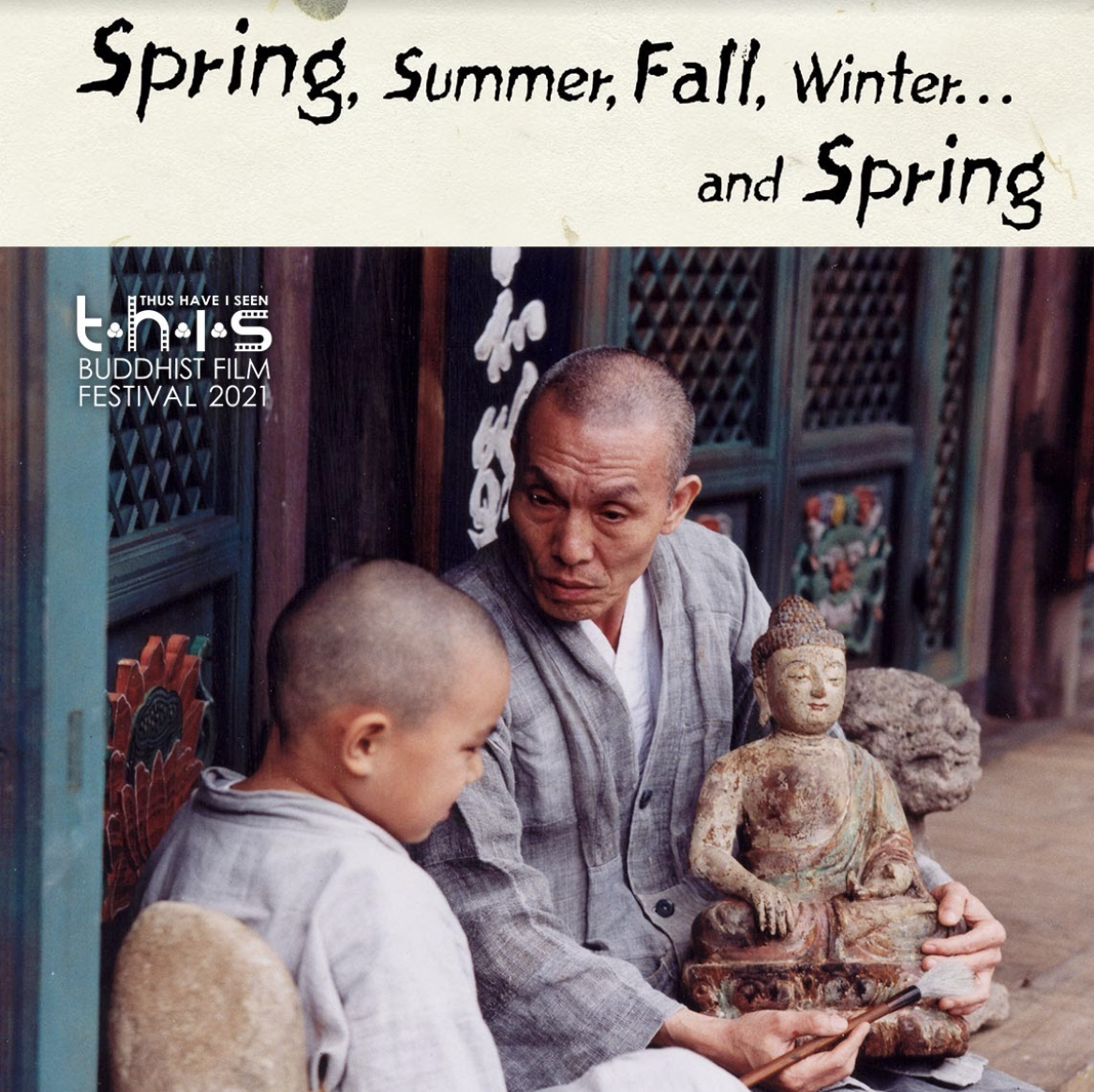
Spring, Summer, Fall, Winter… and Spring is a beautiful Korean movie that reflects on our life’s journey, the choices we make, and subsequent consequences. The movie is set in a temple floating upon a tranquil lake in the middle of an untouched forest. It revolves around two main characters: an old monk and his young apprentice. They sustain themselves by gathering herbs from nature, engaging in simple chores, and recitation of suttas or Buddhist scriptures.
Watching the young apprentice living his youth in such peaceful surroundings in comparison to our bustling days, I thought surely, he would be much happier than us?
After all, we are constantly seeking that “peaceful” place, somewhere where we can be one with ourselves, and achieve the happiness that can be so elusive.
The Four Seasons
Through this movie, director Kim Ki-duk leads us through a comparison between the lives of the old monk and his young apprentice. As the season changes into years, both individuals are transformed. The young apprentice experienced various emotions as he grew from a child to a man. As Kim Ki-duk says, “I think that a human being’s life is very similar to the four seasons. The four seasons all have very different characters”.
What we see in this film is that in each phase of our lives, or as our mind changes, we also begin to form certain views, emotions, and actions. An example is a young apprentice who began to develop a physical attraction to a young girl. As he drew away from monkhood and entered the lay life in pursuit of his “love” subject which he believes would bring him happiness, his desires eventually drove him to commit a crime. With the police hot on his heels and his heart like burning coal, he decided to return to the temple of his youth.
The World Of Men
Here, we are shown a comparison of the old monk who has lived in simplicity all those years, unperturbed by external distractions. Despite physical struggles with his ageing body and a solitary life with nothing more than a cat as a company since the young apprentice left, the old monk remains calm throughout the film. He also dispenses short teachings of wisdom, to cool his apprentice’s feverish heart.
“Didn’t you know beforehand how the world of men is? Sometimes we have to let go of the things we like. What you like, others will also like.”
Letting go of desires is a key teaching in Buddhism. And though this film mainly depicts two monks, I doubt the director is sending us a message to leave all our loved ones behind, shave our heads and live in a secluded temple.
Instead, my understanding of the movie and its simple similes through the scenes is that peace and happiness are not found outside, but are simply a state of mind.
Stone In Your Heart
If we let our lust and anger dictate our minds, we may make regrettable choices. These choices do not just affect those around us, but they can become a heavy burden in our hearts.
“You will carry the stone in your heart for the rest of your life”. This was one of the old monk’s first wise teachings at the beginning of the film. As the story nears its closing, we see that the young apprentice who is now in his middle age has begun to understand an important thing; although he may not be able to undo the wrong he has committed in the past, forgiveness and patience are the key factors to finding peace in his heart again. This was shown as he hauled a heavy rock up a hill, and when it finally came to a rest, his face was both clear and serene.
With this film, do not expect much drama. In fact, there are barely any lengthy dialogues. There are no special effects or tear-jerking moments.
I expected to be bored, but as the film progressed, I found to my surprise a spiritual depth to the movie reminding me to let go, forgive and be patient as I find happiness through the four seasons of my life.
Liked what our author experienced? Book your tickets right now!
Ghost Month Series: This series explores different angles of the 7th Lunar Month, also known as the Ghost Month. Festivals, Cultures, and Religions often mix together in one place, offering space for different interpretations. We, like you, are keen to explore more.Discern on what is helpful to your practice and discard whatever is not.
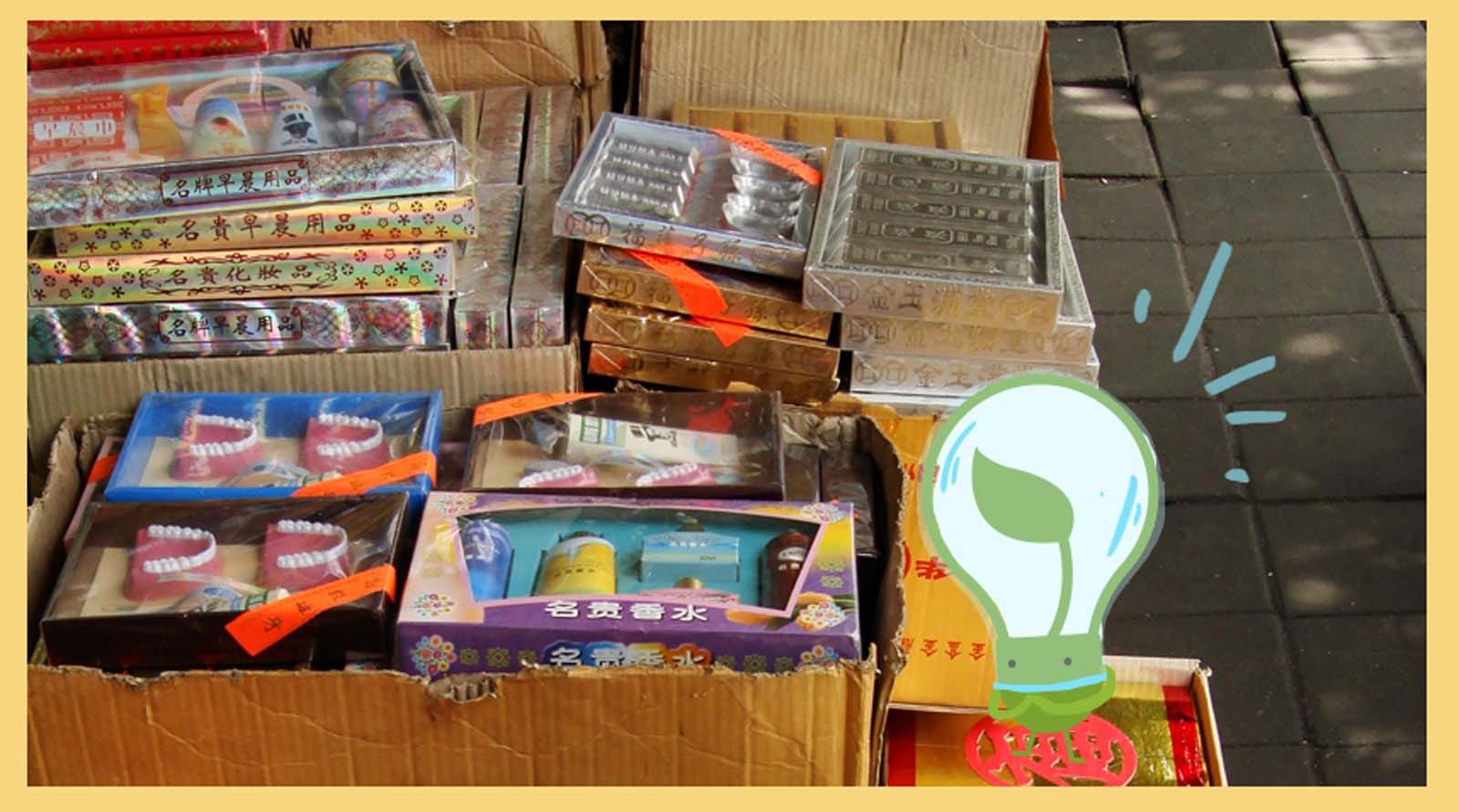
During a funeral ceremony in ancient China, paper-made models of houses, sedan chairs, treasure chests, clothes, daily utensils, and even effigies of servants, were burnt as the cortege was leaving home for burial in the cemetery.
The original meaning of such an act is to show everyone present that all former possessions of the deceased cannot be brought along to the next life.
At one’s death, everything one had ever owned has to be left behind. The burning only emphasizes this message, as it is the most graphical, symbolic, and dramatic way of showing total loss!
There is a Chinese saying that ‘no possessions can be brought along to the next existence; the only thing that follows one is his deeds, or ‘kamma’ ‘ ( 万般带不去,唯有业随身 ).
Furthermore, his relatives and friends only follow the deceased up to the grave, but soon turn to go home, leaving the dead alone in his tomb!
Thus, the burning of cheaply-produced paper models and effigies served as an effective educational tool. Witnessing how fire consumes every ‘former possession’ of the deceased, even an illiterate peasant or young child was able to understand this sense of total relinquishment at death.
Today, this practice is completely misunderstood by the majority of Chinese. Instead of the original meaning, paper-made models have been turned into “paper offerings” – with the mistaken thought that whatever one burns, his departed relatives will obtain in the netherworld!
Hence people nowadays burn paper models of the latest i-Pads, smartphones, LED screens, and “paper money” in inflated sums in order to please the dead.
All these will not help the departed ones at all.
In fact, this misunderstanding will only harm the living by maintaining their ignorance and delusions.
Many people assume that whatever is fancied in life is also fancied in the netherworld.
Instead of burning “paper offerings”, one can perform ‘Dedication of Merits’ (Pāli, ‘Pattidāna ’) to help their departed relatives.
Wise Steps:
Recognise the possible different reasons why burning paper money became a tradition. Understand that there may be more than one reason. For example read Mothership.sg’s take on it here
Though one may have more knowledge on Ghost Month, do not seek to aggressively change other’s behaviour (e.g. burning paper money). Instead, start a conversation to understand why others perform certain rituals. At times, being kind is better than being right. Sharing at the right time matters too!
When walking past burning paper and effigies during this month, reflect on the impermanence of all our possessions
TLDR: When we don’t understand death, life can be very confusing. Recognising death’s uncertainty, we not only do what we like but do what matters.
Death is a reality no one likes to talk about. An ex-co-worker passed away lately and so did a friend’s sister. Throughout my life, I have seen the passing of family members to acquaintances. Either by illness and even accidents – some were sudden while others took a while to die. They include the old and the young. Reflecting on death inspired me to write about the mindfulness of death. However, being mindful of death does not mean we constantly lament and harp on this fact till the last breath. It is about how understanding death helps us live a good life.
Awareness of Death
The unique ability of humans is our ability to be more aware of death compared to less intelligent life on earth. Despite this awareness, we do not pay much attention to it. What do I mean by paying attention to the reality of death?
We do not pay attention to the fact we have no control over the timing of our death. But yet we try to control everything else in our lives. We aim to live a good life measured by what we have or have not. We try to control our environment and others for this good life to happen. When in reality, if we cannot control when and how we die, how much control can we have over life?
This does not mean we give up on life to be lazy and lie down to sleep all the time. But the lack of awareness of death’s uncertain timing is a big reason most of us live stressful, discontented, and sometimes acrimonious lives.
The Good Life Is Linked To Death
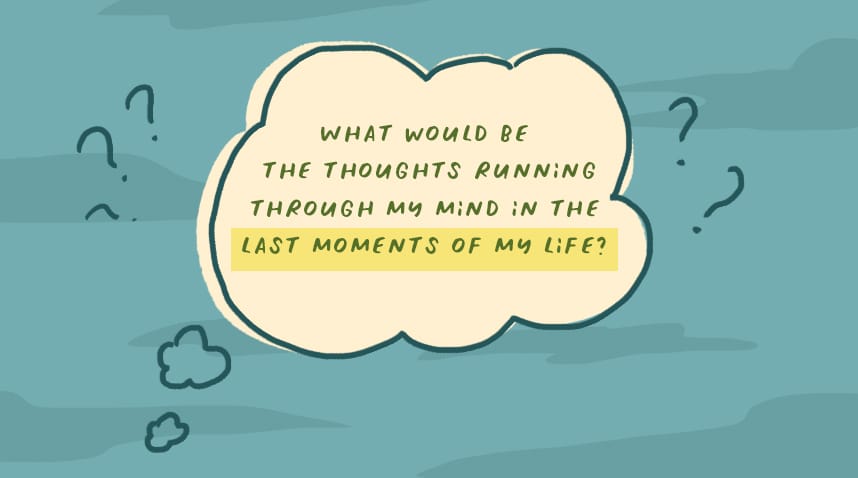
When we don’t understand death, life can be very confusing. This is one of my favorite sayings of Ajahn Chah, a forest meditation master. A simple way to look at this could be imagining our last moments at death. I have reflected on this a lot. What would be the thoughts running through my mind in the last moments?
Do I want to busy myself and sweat the small things in my life? No.
Do I want to spend my life in a state of discontentment and blaming others for obstructing my well-being? I must admit, I had begrudged others in my youth but also noticed I was really unhappy. It is not something that I want.
Having a good career and boasting about it wasn’t part of my plan too. I saw early in my life how fame and wealth come and go. Through my reflection, I saw how nothing really mattered in our striving because it will all be forgotten with time. If I died and became nothing, would having fame, having a fantastic career, and having good food or living in a big house give me a sense of satisfaction at death? Even if I had a loving partner or family, I had to leave them at death and there is no satisfaction at all – having lost my mother to death made me realize this.
That was what I reflected on in my youth. There was mindfulness of death in me. But I had no answer to what makes a fulfilling life. I focused instead of doing what I liked.
Mindfulness of Death Helps Us Let Go
Growing up I had thought the purpose of life was to achieve things and be satisfied at death. Only to realize that satisfaction never lasts. There was this constant thirst to fill the emptiness of the heart.
What filled my heart was recalling the good I had done in my life. Lifting the spirits of an intern in my company to helping another youth find stability in her career and life. Recalling how I had helped others filled my heart. The achievements I had at work could not really remember. Even if I did, they did not fill my heart, compared to how I was able to help others in little ways I could.
A good life should be a life that is relaxed and joyful, without guilt or regrets. To be relaxed is to be able to let go at every moment. We could have goals in life. Goals from learning a new skill to climbing the career ladder.
Understanding that we can never really have full control of people or of our environment, all we can is to do what is needed at this moment and then let it go.
To let go does not mean we are lazy or we do not care. To let go is to know that we don’t know what will turn out the next moment so there is no point thinking or holding onto it. Even if we want to help someone, that person may not want to receive help. So, we can only take whatever opportunity there is to help and let go rather than force a person to receive help or to expect an outcome.
Filling Our Own Hearts
What really matters is our heart. Mindfulness of death in every moment allows us to let go. Letting go we allow ourselves to grow in patience and inner security. Patience because we allow things to unfold from our actions without needing control. Inner security because mindfulness of death makes us aware of our mind, speech, and action. They all have a consequence on our conscience. This helps us become responsible for our actions. It would not be very pleasant to die with regrets of hurting someone or living a selfish life with the time we have.
Wise Steps:
Calling to mind our last moments allows us to let go of the trivial negativities that we hold so closely.
Knowing that many things are truly not within our control, to cultivate patience without the need for control.
To guard our hearts against regrets and guilt, develop compassion towards ourselves and others so that our impending death may be peaceful.
TLDR: When we are at the height of our career success and plummet into failure overnight, what do we do? Gather our courage to see things from a different perspective.
The Highs Could Only Go Higher Right?
2019 was an amazing year for my career. I achieved the coveted promotion by securing large revenues for my company, the bosses had only praise for my hard work, and I earned nearly 1-year worth of bonus.
Times were good, and when January of 2020 approached, I had only big plans for the year. This was going to be the zenith, I knew that I would achieve my second promotion, earn even more money and shine ever bigger.
In a natural turn of events, I knew nothing.
The moment COVID began impacting Malaysia, my career nosedived in a single day. All the deals I had lined up were halted, and the tumultuous journey began.
Long were the days of tough talk with the bosses; it felt almost like a consistent interrogation revolving around my presence in the company despite my lack of revenue. It was apparent how the company now saw me as a burden.
The Crash Of Change
I was entangled in a mass and mess of emotions; my mind alike to the sea that I so love, unpredictable. Fury, jealousy, melancholy, had a wonderful time consuming my waking thoughts.
Thoughts of “Why can’t they understand my difficult situation?” and “Why are they making things difficult for me?” only oiled further anger within.
To soothe this heat, I began plotting to create reputation damage to the company. Sharing this with a good friend, he merely asked “What is the point of harming others and oneself?”
Building Courage Again
That phrase gave my mind a sudden epiphany. For years I have heard the phrase ‘embrace change’, but now I am behaving like a temperamental child robbed of desires.
It is odd how I welcome change with a big hug only if it is in my favour yet loathe the tide’s natural turn when my desires are unmet. What I needed, was quite simply courage.
Courage to admit that success and failure are betrothed, there is nothing shameful about failing. Courage to refrain from blaming an external party for the source of my negative emotions, and instead to realise that I am still a lot of work in progress. Courage to embrace change, both positive and negative with grace.
I found the Dhamma quote on being unshakeable when the winds of life blow inspiring:
TLDR:The pandemic and climate change have shown us how fragile our minds can be during times of great change. How can we take care of our minds and learn to be our own psychologist?
We spend a great part of our lives busy with our studies, career, starting a family to taking care of the family. Much of our thoughts go towards achieving a goal or doing something we enjoy. All of these seem perfectly normal, which it is since it’s how our industrialized society has functioned for generations. It is a cycle of life as we know it on earth. We are born, study, get a job, start a family, hopefully have enough to enjoy our retirement and then die.
In order to keep the cycle going, we accept the stress that comes along with it – since life is sweet and bitter right? Stress is becoming more salient with current conditions. While not everyone is clinical depressed, any unexpected change in our lives – already upended by Covid 19 and with more to come – could easily tip one over into serious depression. If you are already feeling some anxieties about the uncertainties you are facing and seeing a counsellor or psychologist is not yet a necessity, what can you do? The good news is, you can start learning to be your own psychologist.
Here are six ways on how you can do so!
1. Seeing Impermanence
There is much to worry about in our lives, especially with changes in our current economy and climate. Also, the pandemic has shown us that our lives or the retirement we work towards are not guaranteed. We could catch the virus and die, we never know. While we all dislike changes that challenge our lives, these changes are actually great opportunities for us to recognise impermanence. Changes have always been there, but we never notice it until it disrupts our lives.
Impermanence seems to be built into nature to make us feel uncomfortable in order that we may start looking inwards. Why do we have fears? Man’s greatest fear, as well as that of plants and animals, is death. The fear of death drives our behaviours. Behaviours we never suspect would come from this fear of death.
Why is there fear of death within our hearts? Perhaps we can look at our perception of the nature of change itself.
2. No Beginning, No End
If you have had a walk in the park, you might have noticed leaves falling from trees. The fallen leaves are mostly old and yellowed. There are young leaves too who have fallen from the trees. In the wilderness, these leaves decompose. Their decomposition becomes fertilizer for earth, so that more plants and trees may grow.
Plants don’t grow without water or the sunlight.
As plants turn sunlight into energy, we consume the energy of the sunlight through plants. We too, partake in the sunlight and water the plants consume, in order to survive.Our bodies are intertwined with nature.
Like a piece of paper, our bodies too contain the elements of plants, sunlight and water.
As our bodies age and die, it too could become fertilizer for earth to grow new organisms. Truth is, there is no beginning or end, but only change. One body change to another just like water turning into ice due to conditions. Despite learning about change in elementary science, we however, do not think this constant change in nature applies to us.
Our bodies are a part of nature dependent on nature. It does not belong to us. We identify with our bodies. We identify people we know with their bodies. With this identification that the body is “I”, there is always this feeling of holding onto the body. The Buddha talked about three types of feelings. We can easily feel pleasant and unpleasant feelings. What about neutral feelings? Is your mind holding onto the neutral feeling in your body when the grosser feelings are absent?
3. Investigating Perception
Our perception on normal days is impeded by mundane knowledge. When we see a tree for example, we look at it with the image we already have in our minds. With this image in our minds, we think we already know the tree and so we don’t pay attention to it. Otherwise, we look at the tree and think about what type of tree it is, if it produces flowers or fruits, or if it can be of any use for us.
It is the same when we look at people.We think we already know the person – the name, the face, the body, the school s/he came from etc. Or we produce an image in our minds of this person and hardly pay any attention to him/her.
But if we look deeper, we may find that the relationship with have with our world is based on the images we have in our mind. Isn’t it ludicrous that various feelings emerge from just having relationships with the images in our minds?
If you haven’t noticed the image in your mind, you might have noticed the narratives and voice in your mind on different objects you come into contact with.
4. Seeing the World as It Is
Our habitual identification with our perception and body do not allow us to really see things as it is. Try letting go of what you know or think you know. Look at your body without your thinking you already know who you are. What is this body and mind? Isn’t it strange and yet fascinating that this body, dependent on earth, water and sunlight, is able to move and speak? Isn’t it amazing that the brain, which lives on glucose is able to think?
When you take a walk in the park the next time, let go of the image you already have of the plants and trees. Look and listen without having preconceived notion. Let go of your feelings about them and see. What do you see?
5. Effects of Wrong Identification
We have not really lived because of the mundane knowledge we have identified with. We live in a way where we do not notice what’s around us and we get bored easily. If boredom is the only problem, then maybe it isn’t that bad. But no. We have fears, stress and anxieties and we don’t truly enjoy each breath or moment that passes.
We identify with fleeting images and narratives in our minds that are conditioned. Conditioned things are built and dependent on one another. Conditional things are how nature functions and it includes our mental and emotional world. Sadness cannot arise without happiness. Death cannot come without birth. These dualities create one another. Being concentrated on one or the other mental or emotional state create more likes and dislikes in our mind producing actions. In this endless cycle, we are living between dullness and restlessness, birth and dying, pleasure and fear. Underneath the gross states is a neutral feeling we hold onto we call “I”, which we emphasize with gross feelings. Anything threatening the survival of this feeling of an “I” causes stress and fear. It truly is an ocean in a storm even if subtle.
6. Letting Go
To begin with the small steps of letting go of duality is to start seeing and hearing with a fresh mind every moment. This is a repeated intentional action we take in our minds all the time. Why let go? The wise throughout the ages have said the same thing – if the mind and body truly are ours, it would not change. If earth truly is our home, why do we die?
Impermanence is a great teacher that teaches us to let go with everything we do. We do what we have to do and let it go. If we want to experience good effects, just do good by way of compassion, friendship and non-expectation. Let things unfold and observe if the law of cause and effect is truly real in our experience.
For every negative emotion, there is the positive counterpartin our world of duality. If you are impatient, there is also patience within you. It’s not that it’s not there, but you may not have explored it as much as impatience.
Recognise how desire feels. Does it feel good? Does it make you feel contentment? Funny thing about desire is, there is this heightened feeling that drives action and produces a pleasant thought in our minds.
We tend to think desires bring gratification and so chase after it. But truth is, behind every desire also lies disappointment, regrets and sadnesswhen we don’t get what we want, or when what we want disappears in this world of impermanence.
Staying Curious
By being curious and inquiring into our feelings and impermanence, we learn to be our own psychologist. We begin with noticing how our minds are identifying with different feelings, thoughts and objects that never last. Slowly and surely, insights will arise on the nature of impermanence. In the process we will slowly learn to let go of anxieties and fears while enjoying every breath without holding on, for nothing truly belongs to us.
Wise Steps:
1. Be curious about your experiences in terms of feelings (pleasant, unpleasant and neutral). See how each action, driven by desire, bring up an effect in your experience.
2. Put away the knowledge you have about your environment and the people around you. See them for what they are, and not the relationship you have with them in the image of your mind.
3. Notice with curiosity how each feeling in you ceases eventually. Don’t act on the impulse and see if the feeling persists when you don’t indulge in it. See impermanence in your experience.