TLDR: This is a story of how a rescue dog became my Dhamma guide. She showed me compassion, simplicity, and forgiveness in daily life.
In Her Eyes: A Living Dhamma
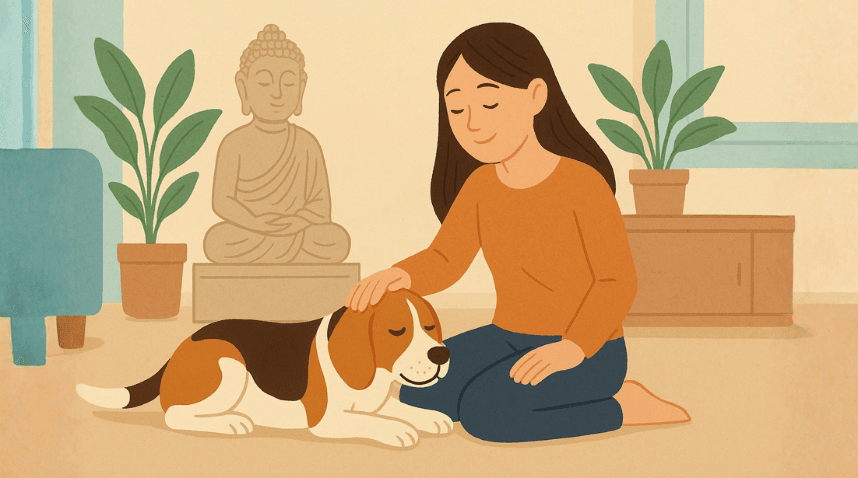
When I adopted my ex-breeding dog, Maya, 1.5 years ago, I thought I was rescuing her. Little did I know she would become one of my closest Dhamma teachers. Through our journey together, she has illuminated core Buddhist teachings in ways no book or lecture ever could.
Companionship in Silence
In a world filled with constant noise and distractions, my dog taught me the beauty of noble silence. I discovered that while sitting quietly with her, our breaths, unconsciously synchronised in the stillness, created a language of its own. The language of love as the deepest connections need no words. A gentle glance. A soft sigh. The way she leans her furry head against me. These wordless moments speak volumes about trust and understanding. I found contentment in her eyes, the way she communicates everything through just a look. Happiness. Gratitude. Love. All without uttering a single sound. In those shared quiet moments, she offered me her full attention and I learnt to do the same.
I began to see that these silent exchanges held the same sacred quality I sought in meditation. What the Buddha taught about noble silence and mindful awareness became not just concepts, but a shared stillness between us in the here and now.
Maya leaning her body against me as she sleeps. How fortunate it is to have someone who thinks your space is the safest place in the world.
Contentment in Simplicity
“Just be here with me”—this seems to be her only request. Her joy in my mere presence reflects the Buddha’s teachings on contentment (santuṭṭhi) being the greatest wealth (Dhp 204). While I often catch myself chasing after wants and needs, she demonstrates that true happiness requires very little.
Her contentment with the simplest things: basic necessities—food, shelter, and companionship—mirrors the simplicity that the Buddha advocated. Watching her bask in the sunlight on the sofa or curl up beside me in sleep, I was reminded of the inner peace that arises when we stop chasing and simply rest in what is.
Maya suntanning herself in the morning shines.
Unconditional Forgiveness
Despite her separation anxiety whenever I’m away, she never holds grudges. Each time I return, even after a long day away, she greets me with a wagging tail and excited zoomies, as if saying, “You’re back! That’s all that matters!” Once or twice, she would turn away from me, as if expressing her disappointment that I had left her. But this never lasted longer than a minute before she gave in to her lovely demeanour again and would come to me with kisses, eyes full of affection. This quiet forgiveness aligns with the Buddha’s teaching that hatred cannot be ceased by hatred, but only through love (Dhp 05).
Her natural ability to live in the present moment, free from past hurts, teaches me daily about letting go. She is my living example that it is possible for my heart to remain open and soft, to forgive.
A Lesson in Selfless Protection
One evening while walking at the void deck, an unleashed dog twice her size lunged at her, biting her big floppy ear and circled for a second attack. In that moment, I stepped between them without hesitation. I saw its teeth. I knew the risk. But instinctively, I protected her. Only later did I realise the depth of that moment. That spontaneous act of putting her safety above mine uncovered a motherly sense of protection that I didn’t know I had in me. For a brief instant, the sense of “me” disappeared. What remained was love in its most selfless form.
That moment brought the Buddha’s teaching on anattā (non-self) to life. Compassion had arisen not through effort, but naturally—revealing a truth far deeper than words.
Maya at ease in her fluffy bed.
Finding the Middle Way in Love
Perhaps the most challenging lesson came through learning to manage attachment. I had to slowly navigate learning how to love without clinging. Initially, my attachment to her was overwhelming. Every moment away from her brought worry and distraction. She occupied my thoughts constantly, even when she was by my side. During work, during meals, even during meditation, my monkey mind was flooded with thoughts of her. I was physically present, but emotionally entangled. Through time and awareness, I began to recognise this as a form of craving. One that is way too unhealthy than I’d like to admit. I began to turn to the Buddha’s teaching on the Middle Way. Gradually through time and practice, I learned to maintain loving care while softening my grip. To love her fully, but with freedom. To be present, but not possessed.
In this balance, I discovered equanimity (upekkhā)—not detachment, but a steadiness of heart that allowed love to breathe sustainably. This balance reflects the Buddha’s central teaching of the Middle Way, which disavows extremes, whether of indulgence or austerity.
Maya showing her belly and a silly face
A Living Path
This journey with my rescue dog has brought the Buddha’s teachings to life in unexpected ways. Through her, I’ve experienced:
The peace of silent presence
The wealth of simple contentment
The freedom of unconditional forgiveness
The clarity of selfless compassion
The wisdom of the Middle Way
In her joy, I feel muditā—sympathetic joy. In her pain, I feel karunā—compassion. In our quiet days, I feel mettā—loving-kindness. And in our ever-changing relationship, I learn upekkhā—equanimity.
She didn’t need a meditation hall, a robe, or a chant to teach me the Dhamma. Her lessons were embedded in every shared breath, every quiet look, every act of forgiveness. Through her, I’ve realised what the Buddha meant when he said mindfulness should be brought into every moment: not just while sitting on a cushion, but in the way we care, relate, and respond.
My four-legged furbaby came into my life as a dog in need. And yet, she became my guide on the path to enlightenment. Maya is constantly reminding me, gently and persistently, that the path to awakening is all around us. The living Dhamma shows me that the Buddha’s teachings remain as relevant today as they were 2,600 years ago, manifesting in our everyday experiences and relationships, sometimes in the wagging tail of a grateful dog.
Sensing the world through scents with her beagle nose
Wise Steps:
Take mindful pauses throughout the day. Briefly stop, breathe, and bring your full attention to the present moment, allowing space for awareness to arise amid daily busyness.
Practice forgiveness with an open heart. When someone disappoints or hurts you, respond with understanding rather than resentment, remembering that love can dissolve even the deepest sting. If a dog can do it, so can you!
Notice the Dhamma in everyday interactions. Be attentive to how simple acts, such as caring for a pet or sharing a moment of presence with a loved one, can reflect core Buddhist teachings such as compassion, non-attachment, and equanimity.
Editor’s note: In conversation with Sayalay Sujata, a financial broker turned Buddhist Nun. Cheryl shares her learnings and insights from her chat!
TLDR: The chase, the corporate life, where can we find happiness? Sayalay Sujata, a Buddhist Nun, shares more about her journey and that you need not become a monastic to experience contentment in life!
The chase of travel, wine, food, and luxury
Sayalay grew up in a family where material wealth was not abundant, and she thought pursuing and owning material wealth will help to fill that lack and bring her happiness in life. And thus, the endless pursuit for the 5Cs’( this was in the 80s, 90s) began.
She worked hard in the banking industry and was living the “material dream.” With a high-paying job, her luxurious lifestyle was enviable to many looking from the outside – travelling, wine and dine, expensive exotic food were the norms.
However, as she filled her life with material pleasures, somewhere deep down, she was still unable to deny the sense of emptiness within her, and she was stuck in the state of, ‘having everything, yet not feeling happy.’
With a stroke of right luck and good timing, she went for her first seven-day meditation retreat without much expectations.
She followed the teacher’s instructions, and on the fifth day, she experienced a short but profound moment of peace, calm and joy in her heart. And she found the answer right then and there to her question: “Where can happiness be found?”
That was the start of her Dhamma journey which eventually led her down the path of taking up the robes of a monastic.
Her story taught me that thinking that happiness comes from outside – either from another person or some activities or achievement in our life, can cause us a lot of disappointment.
Perhaps happiness is not out there, nor in the next moment, but right here and now. We complicate happiness by adding on terms and sometimes impossible conditions – after getting a pay rise, after $X million, after the next social media post.
This perspective narrows the definition of happiness to become outcome-specific, as it is conditional upon getting what we want. By extension, when things don’t go the way we want, life becomes miserable.
Stopping the scrolling and grounding our attention
In Sayalay’s journey, it seems that the answer to happiness is to stop the pursuit. It was when she disconnected from the world and come into the present moment with no expectations, that she found happiness. Simply pause, and connect to our present moment – through the five senses. It was when she interacted with her experiences of the world through what she sees, hears, touch, taste, feel, that she was able to feel a deep sense of peace.
Maybe when you are next on the MRT, stop scrolling and just take a gentle in and out breath and ground your attention back to your physical body. It helps brings us back to the here and now, to take in where we are on our journey (pun intended), and for the possible first time, experience the abundance that we already have in our lives.
Happiness is simple, happiness does not ask for much and we can awake to that by remembering to be present in the here and now.
After 20 years as a nun, what is the path?
The conversation with Sayalay also took a deeper turn as she reflected on her 20 years as a monastic. We discussed the idea of renunciation.
Traditionally, most people will think that ordination (to become a monk or nun) is the only path for someone who chooses to practice Buddhism seriously.
But after walking through the whole journey herself, she realized that ordination is not the only path we need to walk towards to find true peace and happiness.
To find true peace and happiness, the answer lies in getting to know ourselves better. Reflecting on the ups and downs in our life can bring clarity to what contributes to a happier life, and on the flip side, what perpetuates our stress and restlessness.
This helps us to focus on the important areas in our lives, and relinquish the conditions for suffering. No matter what outfit you come packaged in, be it a monastic or lay person, “Theravadan”, “Mahayanan” or “Tibetan”, she reminds me that mental relinquishment is much more important than physical relinquishment and if done right, you can experience a sense of peace and grounding.
For example, relinquishing your bad habits and selfish thought patterns yields more happiness than clinging to the identity of “being a Buddhist,” and engaging in endless debates on which is the “best” Buddhist tradition.
Escaping the judging mind
Often, I get caught in the packaging rather than the contents – and project my expectations and ideals rather than focus on the heart of the teachings.
For example, when observing rituals or chanting ceremonies that I’m unfamiliar with, I notice that my mind jumps into the “judging mode” and I wear a sceptical lens.
Rather than appreciating the peaceful practice, my mind compares the experience and immediately labels it as “good” or “bad”.
Sayalay’s timely sharing on looking at what’s important, not just the packaging taught me to open my heart and invite curiosity into whatever I experience in the present moment, and more importantly, to take the opportunity to reflect on whether judging others contribute to my happiness.
If it doesn’t add to long-term happiness in my life, then use the experience as a lesson in “relinquishment” of my views.
Despite being a monastic for 20 years, Sayalay has a very humble presence that makes her easy to talk to and for me to open up to. I have learnt a lot from Sayalay’s inspiring journey and found many relatable aspects of her life that I experience in my own life. It reminded me that everyone is on their journey searching for meaning and true happiness in their lives, and the least we can do is to try to encourage each other on the wholesome path of seeking.
Wise steps:
Finding pockets of time during your commute, to know what’s going on in the moment to breathe and just be with your breath
Whenever we are caught up in a critical mind, to pause our judgments and ask, does judging others make us happy?
This teaching is extracted from a Dhamma talk by Ajahn Achalo, the abbott of Anandagiri Forest Monastery in Thailand. The talk was given in one of the meditation retreats. View the full talk here.
The following is a transcript of the above video with some edits.
Transcript
Many times, what we want from religion is somewhat superficial. Many people want to make offerings so that they can be rich, and many people are not so strict with upholding the precepts. There are even many people listening to Dhamma talks with the want to notice which list of Dhamma that Ajahn talked about – if it’s the 37 wings for awakening, or the 5 powers, or the 5 hindrances, and then they think that’s the lottery number. They’d take down the number and wish to win the lottery. Ajahn Chah sometimes said all these people who come, and they are making the wish: “may I be rich, may I be rich, may I be rich”, he said all they are doing is wishing for more suffering.
A lot of rich people have a lot of suffering. When you become very wealthy, and you’d get a big ego. When you have a lot of stuff, some of them please you, some of them displease you. You can be very attached to comfort, such that the slightest bit of discomfort is very irritating. Hence, being wealthy, being successful doesn’t necessarily mean an increase in happiness. It does give one a certain amount of freedom, but it gives one a lot of headaches as well. Other people want your wealth, you don’t know who you can trust, even your children would be fighting over their inheritance. It can be quite ugly sometimes.
The Buddha taught that greed is like a river. He said, “There is no river that floods like greed.1” It can be boundless if we feed it.
One of the dangers of being too wealthy is that you can feed your greed all the time.
So, the world is a dangerous place in terms of increasing delusion, in terms of increasing kilesa2. And the Buddha taught the middle way – knowing the right amount, knowing moderation, training in contentment. When we train in being contented, it’s like, “Oh! This is what it feels like to be content. It’s really nice, actually.” Actually, contentment is a bit nicer than getting what you want all the time.
When we get what we want all the time, there’s a kind of heat to that, a dizziness, and intoxication. Not very much mindfulness, and there’s a big sense of self. It’s vulnerable. When you get what you want a lot, what happens when you don’t get what you want? A lot of suffering.
There’s a growing understanding that that which knows suffering isn’t suffering. And, there’s a growing understanding that if you really maintain your mindfulness consistently that you’ll start to experience a tremendous sense of peace. And then, if you cultivate wisdom and start to understand the worldly Dhammas you’d understand that praise is just praise, blame is just blame, pleasure is just pleasure, pain is just pain. Fame is just that much. Ill repute is just that much. And you’d find that there’s much less reactivity and more wisdom, and then you realise, “Oh, this is really valuable. This is really worthwhile.”
The Buddha says peacefulness is the highest happiness3.
When the hindrances are weak, when a bad mood evaporates, when you notice impermanence, when you can be with pain with patience, when you can observe things that you used to react to that you’re not reacting to, it’s really nice. A real sense of relief, a sense of coolness, a sense of fullness. That’s why we do these contemplations. They orient us to take responsibility, to contemplate the truth, and to really have a good look inside, and to find that refuge. And when we do that, we’d find that it is very rewarding in a very cool, simple, and natural way.
1. Dhammapada verse 251 – There is no fire like lust; there is no grip like hatred; there is no net like delusion; there is no river like craving.
2. Kilesa– affliction; distress; especially that which afflicts, that which stains; an affliction, a defilement; a defiling passion, especially sexual desire, lust
3. Dhammapada verse201 There is no fire like lust and no crime like hatred. There is no ill like the aggregates (of existence) and no bliss higher than the peace (of Nibbana).
TLDR: Deep down, we want happiness. Happiness is something that can be cultivated systematically – it starts inwards. Although it is not easy, it is very worth it.
I realized from a young age that what I wanted in life was to be happy and that all my pursuits in life arch towards either instant or delayed gratification. With time, I noticed that this was a common human condition – we all want happiness, and fear pain! And perhaps the only reason why we pursue different things in life is because our definition of what brings happiness differs.
Being the scientific and engineering nerd that I was, I started my search in secondary school to find the ultimate life “hack” to happiness. I read widely and listened to talks by people who were smarter and wiser than me.
Over time, I found certain common underlying principles (or equations) that described what I experienced in life well.
1) The Happiness Equation
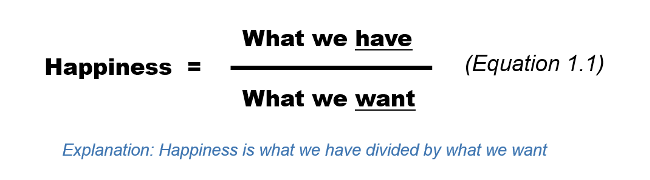
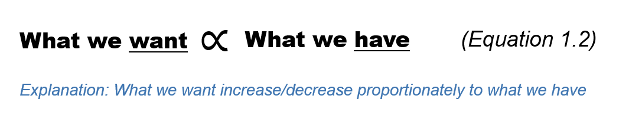
Observing the various ways people seek happiness, I noticed they converge upon 2 main methods (refer to equation 1.1):
· Method A: Having more things (increasing the numerator); or
· Method B: Wanting fewer things (decreasing the denominator)
This is apparent in how different people who have similar things (i.e common numerator) can have vastly different levels of happiness. For example, $100 is a fortune to a beggar, but small change to a millionaire. Both Methods A and B described above are valid routes to happiness, but require very different kinds of effort.
Method A (having more things) entails relentless external work to ensure the constant accumulation of possessions. Meanwhile, Method B (wanting fewer things) requires a deep commitment to inner work to cultivate the subtle craft of gratitude and contentment.
It is tempting to take the higher/nobler stance and claim that “wanting less is the way to go!” However, for the majority of us who are not renunciants (monks/nuns), it would be quite presumptuous to claim that we are not attached to at least some desires/possessions. While it is normal for laypeople to pursue some amounts of pleasure and fun, it is also important to be aware of the relationship between “having” and “wanting”.
I found that no matter how much I acquired, I was never satisfied – simply because the more I had, the more I wanted!
This phenomenon of hedonistic adaptation is well-studied by psychologists, and it describes how humans tend to adapt to pleasures/simulation in life. We require more intense simulation the next time round to get the same amount of happiness (similar to drug addicts, really). A common example is how lottery winners often return to their default state of happiness (or unhappiness) after the initial novelty of their prize wears off.
Considering the above, I decided a few years back that while I may never become a full-fledged renunciant, I would strive towards reducing my “wants” and cultivate contentment as my game-plan for happiness.
2) The Theory of Change
Making this choice to reduce my “wants” was the easy bit. Quickly, I realized that my “wants” were not leaving without a fight.
I also realized that this inner battle was not fought on a single front, but was instead spread across many skirmishes throughout various aspects of my life!
I realized that reducing my “wants” meant choosing a healthier Kway Teow Soup instead of the sinful Fried Kway Yeow for lunch; it meant not sending a paggro (passive-aggressive) text when I had to cover work for my teammate, and it was about being disciplined enough to Work-From-Home at 3 pm after lunch instead of Sleep-At-Home.
It was about being patient when irritated, and being calm when excited. More than anything, this inner work called for complete honesty about my flaws and imperfections – and committing to work on them for the rest of my life.
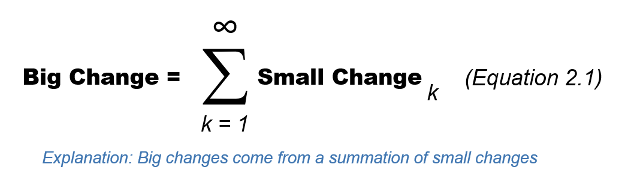
I found that reducing my “wants” was a big ambition indeed! But I also reflected that perhaps most of us may never really achieve a singular “big” change in life.
Rather, the biggest change comes from a compilation of small efforts – and the smallest things are everything (refer to equation 2.1).
3) The Happiness Graph
To direct all our efforts towards reducing “wants” instead of increasing “haves” is certainly the tougher path that is less travelled – but are other pursuits worth a similar heroic effort? To answer this, I plotted the long-term “happiness forecast” arising from adopting both Methods A and B (refer to equation 1.1).
Taking a closer look at my everyday experiences, I noticed that the pleasures that can be derived from our senses, while no doubt enticing, are still ultimately limited and transient.
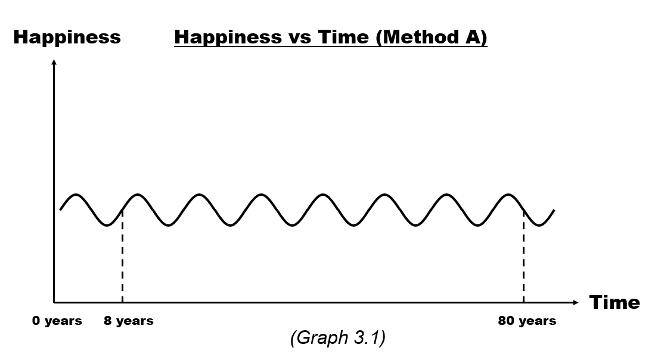
Coupled with the rule of hedonistic adaptation, I found that the greatest joys – and tragedies – when mapped onto the greater scheme of life, often account for little more than minor blips on our happiness scale (refer to graph 3.1).
For all my efforts and strivings through decades in life, I realized that if they were not directed in the right direction, I will likely find the 80-year-old me not all that happier than my 8-year-old self. That was a really sobering thought!
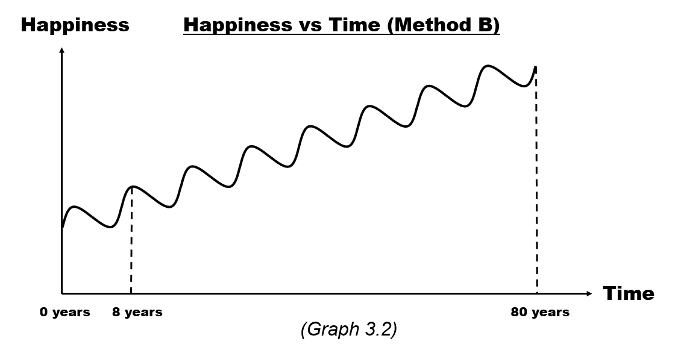
Method B takes on a far more positive outlook. By observing the examples of well-practised spiritual teachers committed to the cultivation of contentment and gratitude (amongst other spiritual qualities), I saw that with the right effort and method, it is possible for one’shappiness to steadily increase with time (refer to graph 3.2). I experience this within myself as well.
As I continue to invest in my inner work and spiritual cultivation, I notice that I have a brighter mind-state, a more resilient spirit, and a more caring and compassionate stance towards others compared to 8 years ago (2013) when I begun my spiritual practice. Of course, there are days when the lights get dimmed – but as a whole, I am happy, which is all I ever wanted!
Equations can only get us so far. What we encounter in our everyday lives is the practical lab where the spiritual rubber meets the road.
As we journey on through life, instead of always wishing for a smooth problem-free ride, perhaps a more worthwhile aspiration to have is to grow the requisite mindfulness and wisdom to view each living moment as an opportunity for spiritual growth.
It is a life (or countless lives) time work – but what could be more worth it?
Wise Steps:
Take ownership of our happiness – don’t blame external circumstances