
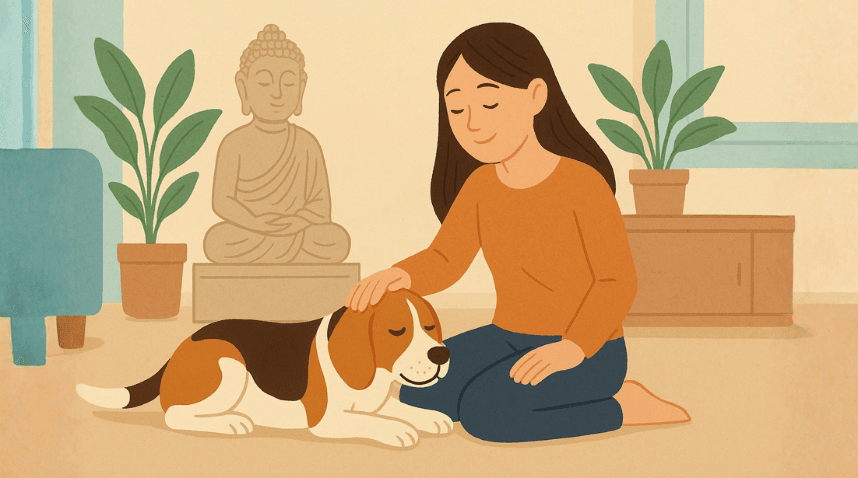
TLDR: This is a story of how a rescue dog became my Dhamma guide. She showed me compassion, simplicity, and forgiveness in daily life.
In Her Eyes: A Living Dhamma
When I adopted my ex-breeding dog, Maya, 1.5 years ago, I thought I was rescuing her. Little did I know she would become one of my closest Dhamma teachers. Through our journey together, she has illuminated core Buddhist teachings in ways no book or lecture ever could.
Companionship in Silence
In a world filled with constant noise and distractions, my dog taught me the beauty of noble silence. I discovered that while sitting quietly with her, our breaths, unconsciously synchronised in the stillness, created a language of its own. The language of love as the deepest connections need no words. A gentle glance. A soft sigh. The way she leans her furry head against me. These wordless moments speak volumes about trust and understanding. I found contentment in her eyes, the way she communicates everything through just a look. Happiness. Gratitude. Love. All without uttering a single sound. In those shared quiet moments, she offered me her full attention and I learnt to do the same.
I began to see that these silent exchanges held the same sacred quality I sought in meditation. What the Buddha taught about noble silence and mindful awareness became not just concepts, but a shared stillness between us in the here and now.

How fortunate it is to have someone who thinks your space is the safest place in the world.
Contentment in Simplicity
“Just be here with me”—this seems to be her only request. Her joy in my mere presence reflects the Buddha’s teachings on contentment (santuṭṭhi) being the greatest wealth (Dhp 204). While I often catch myself chasing after wants and needs, she demonstrates that true happiness requires very little.
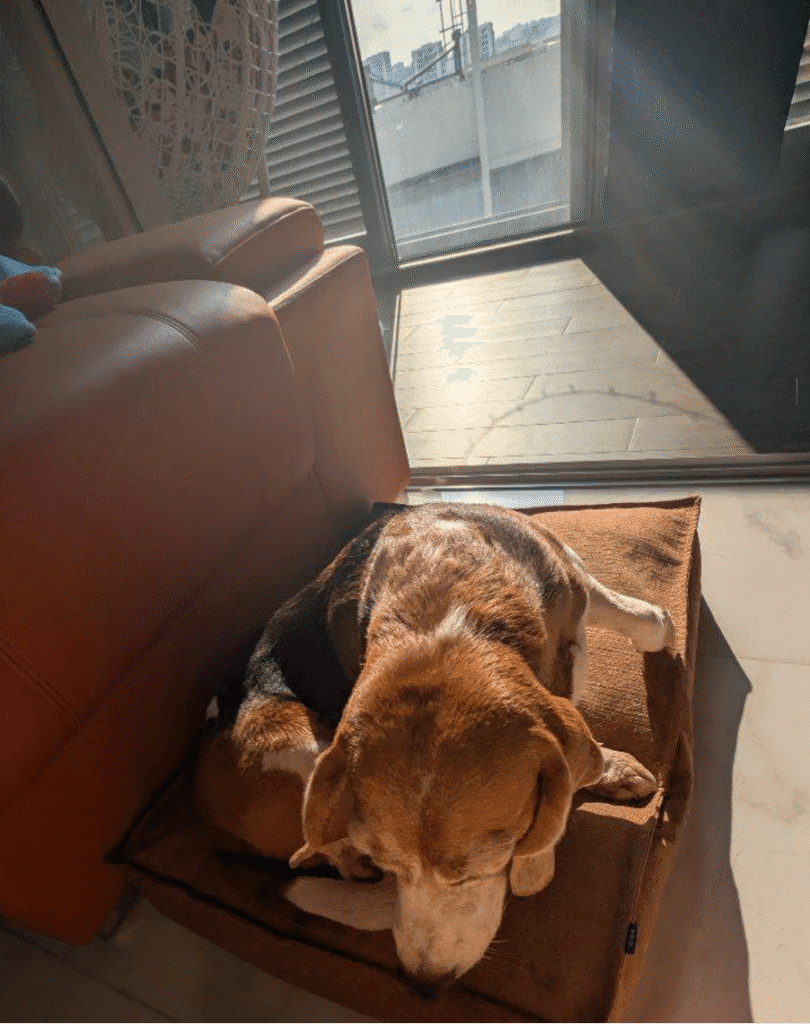
Her contentment with the simplest things: basic necessities—food, shelter, and companionship—mirrors the simplicity that the Buddha advocated. Watching her bask in the sunlight on the sofa or curl up beside me in sleep, I was reminded of the inner peace that arises when we stop chasing and simply rest in what is.
Unconditional Forgiveness
Despite her separation anxiety whenever I’m away, she never holds grudges. Each time I return, even after a long day away, she greets me with a wagging tail and excited zoomies, as if saying, “You’re back! That’s all that matters!” Once or twice, she would turn away from me, as if expressing her disappointment that I had left her. But this never lasted longer than a minute before she gave in to her lovely demeanour again and would come to me with kisses, eyes full of affection. This quiet forgiveness aligns with the Buddha’s teaching that hatred cannot be ceased by hatred, but only through love (Dhp 05).
Her natural ability to live in the present moment, free from past hurts, teaches me daily about letting go. She is my living example that it is possible for my heart to remain open and soft, to forgive.
A Lesson in Selfless Protection
One evening while walking at the void deck, an unleashed dog twice her size lunged at her, biting her big floppy ear and circled for a second attack. In that moment, I stepped between them without hesitation. I saw its teeth. I knew the risk. But instinctively, I protected her. Only later did I realise the depth of that moment. That spontaneous act of putting her safety above mine uncovered a motherly sense of protection that I didn’t know I had in me. For a brief instant, the sense of “me” disappeared. What remained was love in its most selfless form.
That moment brought the Buddha’s teaching on anattā (non-self) to life. Compassion had arisen not through effort, but naturally—revealing a truth far deeper than words.

Finding the Middle Way in Love
Perhaps the most challenging lesson came through learning to manage attachment. I had to slowly navigate learning how to love without clinging. Initially, my attachment to her was overwhelming. Every moment away from her brought worry and distraction. She occupied my thoughts constantly, even when she was by my side. During work, during meals, even during meditation, my monkey mind was flooded with thoughts of her. I was physically present, but emotionally entangled. Through time and awareness, I began to recognise this as a form of craving. One that is way too unhealthy than I’d like to admit. I began to turn to the Buddha’s teaching on the Middle Way. Gradually through time and practice, I learned to maintain loving care while softening my grip. To love her fully, but with freedom. To be present, but not possessed.
In this balance, I discovered equanimity (upekkhā)—not detachment, but a steadiness of heart that allowed love to breathe sustainably. This balance reflects the Buddha’s central teaching of the Middle Way, which disavows extremes, whether of indulgence or austerity.

A Living Path
This journey with my rescue dog has brought the Buddha’s teachings to life in unexpected ways. Through her, I’ve experienced:
- The peace of silent presence
- The wealth of simple contentment
- The freedom of unconditional forgiveness
- The clarity of selfless compassion
- The wisdom of the Middle Way
In her joy, I feel muditā—sympathetic joy.
In her pain, I feel karunā—compassion.
In our quiet days, I feel mettā—loving-kindness.
And in our ever-changing relationship, I learn upekkhā—equanimity.
These are the Four Brahmavihārās, not as ideas, but as lived truths.
Dhamma in Every Moment
She didn’t need a meditation hall, a robe, or a chant to teach me the Dhamma. Her lessons were embedded in every shared breath, every quiet look, every act of forgiveness. Through her, I’ve realised what the Buddha meant when he said mindfulness should be brought into every moment: not just while sitting on a cushion, but in the way we care, relate, and respond.
My four-legged furbaby came into my life as a dog in need. And yet, she became my guide on the path to enlightenment. Maya is constantly reminding me, gently and persistently, that the path to awakening is all around us.
The living Dhamma shows me that the Buddha’s teachings remain as relevant today as they were 2,600 years ago, manifesting in our everyday experiences and relationships, sometimes in the wagging tail of a grateful dog.
Wise Steps:
- Take mindful pauses throughout the day. Briefly stop, breathe, and bring your full attention to the present moment, allowing space for awareness to arise amid daily busyness.
- Practice forgiveness with an open heart. When someone disappoints or hurts you, respond with understanding rather than resentment, remembering that love can dissolve even the deepest sting. If a dog can do it, so can you!
- Notice the Dhamma in everyday interactions. Be attentive to how simple acts, such as caring for a pet or sharing a moment of presence with a loved one, can reflect core Buddhist teachings such as compassion, non-attachment, and equanimity.