
Summary
What does it really mean to live a successful and happy life? For many of us, success is measured by our career, financial security, home and material achievements. But Ven Drachom invites us to look beyond external success and explore a deeper understanding of happiness through Buddhist practice and meditation. Drawing from his experience as a former Singapore Special Forces operative and his journey as a Buddhist practitioner, he reflects on responsibility, purpose and three profound questions: Where do I come from? What am I here for? And where am I going next?
Ven Drachom challenges the common idea that happiness comes from external pleasure. A good meal, comfortable surroundings or enjoyable experiences may bring temporary pleasure, but these feelings eventually fade. True happiness, he explains, comes from within: “I’m happy from within. That’s happiness.” Through Buddhist meditation and understanding the mind, we can develop greater inner peace, contentment and emotional resilience, rather than constantly relying on external circumstances to make us feel happy.
At the heart of Buddhist practice is the mind. Ven Drachom reminds us, “The most amazing thing you have is your mind.” Yet the mind can also become the source of suffering through attachment, aversion and self-cherishing. This is why he describes a Buddhist practitioner as a “spiritual warrior”someone who learns to confront the causes of suffering within rather than constantly searching for an external enemy.
Meditation, therefore, is not about forcing the mind to stop thinking. Instead, it teaches us to observe our thoughts without immediately becoming controlled by them. The goal is not simply to experience peace, but to develop clarity and wisdom. As Ven Drachom puts it, “I did not want to be peaceful for peaceful sake so that I can in a state of clarity.” With greater clarity, we can respond to life’s challenges more wisely, cultivate compassion and ultimately create greater freedom from suffering.
About the Speaker
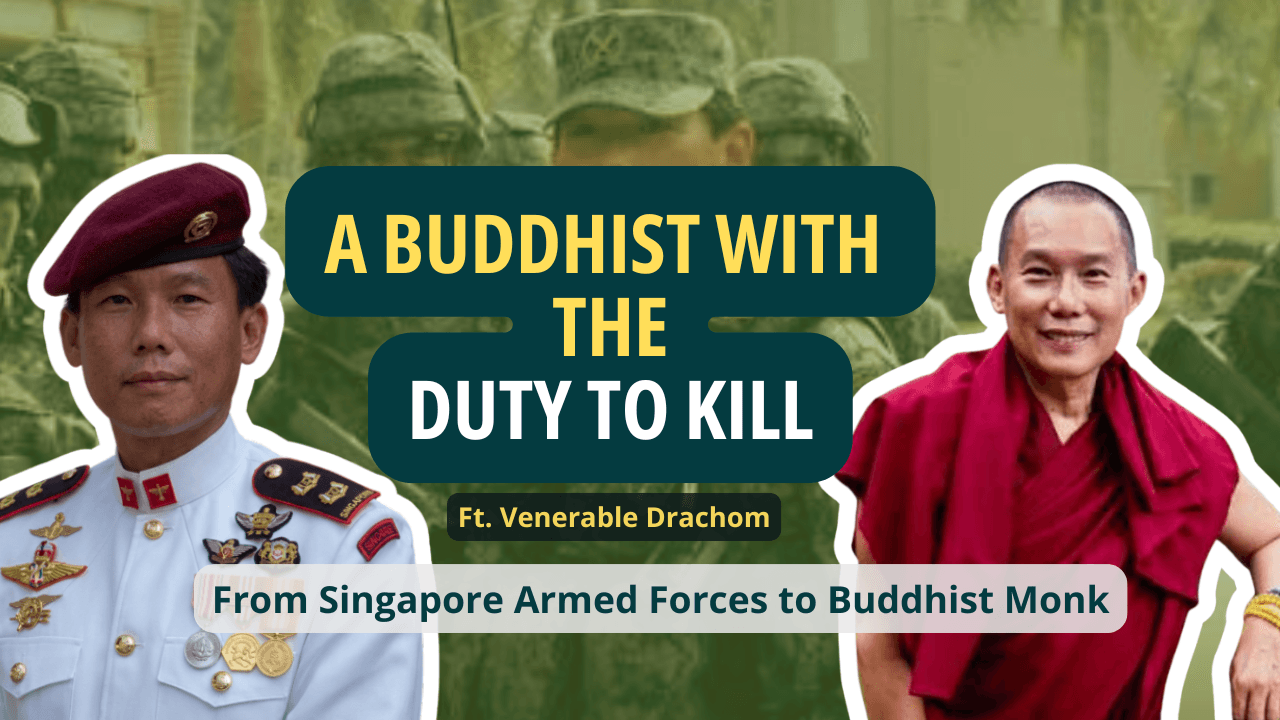
👤 Venerable Tenzin Drachom is a Singaporean Buddhist monk whose extraordinary life has taken him from the front lines of Singapore’s Special Forces to the path of spiritual practice. Before becoming a monk, Ven. Drachom spent 32 years in the Singapore Armed Forces as a Special Forces commando. He was part of the team that stormed Singapore Airlines Flight SQ117 during the 1991 hijacking, an operation that rescued all the hostages and was completed in just 30 seconds. He also underwent some of the military’s most demanding training, including the US Navy SEAL course, and served as an instructor who trained generations of officer cadets.
Yet behind this formidable military career was a lifelong connection to Buddhism. Raised in a Buddhist family, Ven. Drachom began practising in his teens and continued to deepen his practice throughout his years in the military. After retiring from the SAF in 2013, he travelled to Dharamsala, India, where he began his monastic journey. He was later ordained by His Holiness the Dalai Lama and received the name Tenzin Drachom. Today, he draws on the same discipline, resilience and mental training that shaped his military career to cultivate wisdom, compassion and inner freedom, while sharing the Dhamma through teachings, meditation and retreats.
Key Takeaways
🧠 Your mind is your greatest resource
Rather than constantly looking outside ourselves for happiness and fulfilment, train the mind that shapes how we experience life.
🥋 Become a spiritual warrior
Being a spiritual warrior means turning inward to confront self-cherishing, attachment and the mental patterns that create suffering, rather than treating the outside world as the enemy.
🌱 Happiness is cultivated from within
External pleasures are temporary, but cultivating inner contentment allows us to experience a more stable sense of happiness that isn’t entirely dependent on changing circumstances.
Transcript
Full Transcript
Ven Drachom: [00:00:07] External success is what generally people around here see: all the big house, successful, got house. The internal success is having a mind. I have enough. Then secret success when you’re able to use teaching, the blessing of the Buddha, to get enlightened.
Cheryl: [00:00:20] What’s the hardest part about facing your own mind?
Ven Drachom: [00:00:22] This is the part where concentration come inside meditation. And [music] for me.
Cheryl: [00:00:29] So, Venerable Tenzin Rajel, on March 27, 1991, your team stormed a hijacked Singapore Airlines plane. In under 30 seconds, all four hijackers were dead and every hostage is alive. Can you walk us through that moment?
Ven Drachom: [00:00:42] So, the operation is called Operation Thunderboat. So, that time I was part of the special force. We were given a task, that means, uh, we are trained to deliver a certain thing. So, in the those are crisis or situation that depend international people, then the army will call in. If it’s local, then the police will be called in. So, that one I still remember because I was training diving the day before, then they activated us.
Ven Drachom: [00:01:05] So, after the whole operation, so we decided that whatever the detail should be kept as an operation security. So, we’re not reop, but one a couple of things we learned from the thing: if you want the thing to go well, you have to rehearse, rehearse, rehearse, rehearse and rehearse. If you practice long enough, then whatever you go up there, then you going to run perfectly. You’ll run perfectly because you have rehearsed the moment very, very well.
Ven Drachom: [00:01:36] So, before we do our practice, so what we want to get out from our practice, what is the thing that you want? You want to be just happy temporarily or what? So, as soldier, we go out there, obviously something that, uh, we destroy so that for a greater purpose. We did not kill people because we like to kill people. Of course, if you don’t do the correct thing, there will be more to come. Then more people will be at danger risk.
Ven Drachom: [00:01:51] My teacher Ribbu said that if you kill, you’ll go down to hell. I say I got no problem going for the sake of people. Let me go. I got no problem with that.
Ven Drachom: [00:02:03] So, all of us will pay some price somehow, somewhere. But we decided that if it’s for the greater good of all the thing, then it’s all worthwhile. That’s what we are called to do. So, all of us got responsibility. Whether you really identify the responsibility of this life correctly or not. Have you even think about what is called responsibility?
Ven Drachom: [00:02:19] So, as I like to see the world because now I travel pretty much, then I see that there’s so much of different thing that Singaporean take for granted. I like to use the word for granted. It’s like that it must be like that. Who say it must be like that? Yeah, you have created some crevice life good karma to be born in the stable country, but it’s not going to be every time for your whole your life. You do not create all the condition correctly during this, as I reflect back.
Ven Drachom: [00:02:43] So, now it’s about 35 years. So, it’s not that one moment. It takes 10, 20, 30 years of practice to come to that moment. All the things that you see in that split second, whatever thing is years and years of preparation, rehearsing, making it well.
Ven Drachom: [00:02:58] When you correlate to your practice, then you know, so what’s my mission, my task in life, you know? Is it come here and work, go some shopping, eat some food, buy, buy a house, go for some holiday? Is that all? Is that all? Is that the all the best? Well, for some people that’s the best because they have not discovered something more deeper, because the spiritual people will talk to think about if there is a next life.
Ven Drachom: [00:03:16] If you’re spiritual enough, you’ll ask where I come from, what I came here for and where I’m going next. You will ask these three question because all major religion will will give you different answer, different perspective.
Ven Drachom: [00:03:34] So, if you this podcast is going out, someone that’s listening for the very first time, curious, right? Because I s I must come from somewhere. I cannot come from a chinkham, correct. So, what am I here for?
Ven Drachom: [00:03:45] They say I’m here for to do whatever.
Ven Drachom: [00:03:47] Most people did not even ask this very basic question. Maybe I said they said the most basic one is to be happy. So, what is happy? It it means I’m very happy. I care the people not necessary. But I say I need to get the job done. I was entrusted the task. I get the job done.
Cheryl: [00:04:00] I’m curious, what do you think most people get wrong about happiness these days?
Ven Drachom: [00:04:03] Okay. They they mistaken the external pleasure. I no taste touch. Right. To me it’s called pleasure. Happiness is within. Pleasure means you see something nice, you hear some nice music, smell some nice smell, eat some good food, maybe the bed is very good bed, then you sleep there, or very nice.
Ven Drachom: [00:04:20] Okay, imagine that you go to the best hotel wherever you say that’s the best. You stay 100 days, you can’t wait to get out. You can’t take it anymore because that pleasure will diminish. Oh, I like massage. Yeah, massage here. You try to maybe 1 hour nights, try 100 hour, you’ll be sore.
Ven Drachom: [00:04:34] So, that’s what they all term as happiness for general people is called the suffering of change in the lumb, that means you have to stop doing whatever thing. You cannot eat forever. Eat one durian, nice. Try 100 durian, do 10 is enough. Oh, this noodle very nice, but they eat this one time noodle 10 bowl, it’s not very nice anymore.
Ven Drachom: [00:04:51] So, that’s temporary pleasure, temporal, but we thought that that is the thing we chase. That’s why that’s the mistake that the real thing is knowing the mind inside here. Your mind got no desire, absolutely in control. Nothing affect me anymore. Our mind is by nature got the potential to become Buddha. They call Buddha nature takaba rang.
Ven Drachom: [00:05:08] But most of us never discover because they did not find their teacher. So, they got no chance to even discover. The most amazing thing you have is your mind. The most precious thing animal also got mind, but they don’t have the ability like the human being because we can analyze. We can start to think. We can start to create.
Ven Drachom: [00:05:28] We can create thing that far imaging most amazing one. That’s what the Buddha decided to do 2,500 years ago.
Ven Drachom: [00:05:35] Buddha was the greatest codebreaker. He he told us that is called temporary. So, for most of you is called there’s external success, internal success, secret success.
Ven Drachom: [00:05:44] External success is what generally people around here see: all the big house, successful, got house, got car. Some buy car park below, so I got car but don’t drive.
Ven Drachom: [00:05:56] Some will have watch. You need to be thousand R chic to wear all your watch.
Ven Drachom: [00:06:00] [laughter]
Ven Drachom: [00:06:01] You don’t need so many watch. So, that’s external success. But there’s some form of basic external success is important.
Ven Drachom: [00:06:06] [clears throat] So, that can support your body and your livelihood. Then I call internal success. The internal success is having a mind that can find peace within without the intervention of something external. That means I have enough. That means you know the nature of a mind.
Ven Drachom: [00:06:20] The internal success of having generate compassion, generate loving kindness, generate wisdom, generate a meditative appation that it can be quiet by itself. That means you’re most happy when you know anything from outside. I’m happy from within. That’s happiness.
Ven Drachom: [00:06:36] Then there’s a secret success. So, this secret success is a success when you’re able to use the whole potential together with the teaching, the blessing of the Buddha to get enlightened. That’s the most amazing. That’s called superior and also the most secret success that many people are not PV2.
Ven Drachom: [00:06:51] Happiness is from within, that’s more stable. The other one is called udeolic pleasure of I no taste touch temper.
Cheryl: [00:07:01] So, most people think happiness is pleasure, but happiness to you is contentment and inner from within, and then the Buddha unlocks an even higher happiness, which is—
Ven Drachom: [00:07:10] Yeah, the the teaching of the Buddha is by listening, you contemplate and you meditate. There’s a certain method of bringing out just a sugar cane. First might have sugar cane. Then the contemplate is squeeze out the juice of sugar cane. Then after that you need to drink the thing, then you say that you got the juice.
Ven Drachom: [00:07:26] So, a lot of the people in some sutra, they actually the Buddha say, oh, come on, you are just having sugar cane. You haven’t taste the sugarcane yet. You got sugar cane. So, just happened a lot of people right now, there are plenty. You go to the internet, there are plenty of teacher giving teaching.
Ven Drachom: [00:07:34] There are plenty of sugar cane. You can get the sugarcane. You got truckload of sugar cane. This whole year of sugar cane, but you never taste sugarcane before.
Ven Drachom: [00:07:47] For the very moment you were in the presence of someone who get the thing, you suddenly feel quite good. Like in hall, they got someone like incense. You smell, oh, pretty nice smell. But when you go back, you don’t have the sense because you’re not near the person who practice.
Ven Drachom: [00:07:55] But if the person who do well tell you now, now, now, I teach you how to make incense. You take a packet, you do this. After a while, say, so that’s where you transform by understanding the meaning of the teaching.
Ven Drachom: [00:08:03] Without the correct teaching, you couldn’t become anything.
Cheryl: [00:08:11] And I’m very curious because you went from being trained, right, as you mentioned earlier, training consistently many times, um, to neutralize external threats to becoming what you call now as a spiritual warrior. Um, what is a spiritual warrior? What does that actually mean?
Ven Drachom: [00:08:29] When you say warrior means you destroy something, correct? As a Buddhist, we destroy thing that is harmful to oneself, harmful to oneself. And there’s uh the thing that’s more harmful to oneself is actually our self cherishing and self grasping.
Ven Drachom: [00:08:37] And we got a self cherishing shell grasping it manifest in uh we call it in the in a practice 51 mental factor. There are six five om present mental factor, six root delusion, 20 secondary negative delusion, 11 virtues, four interchangeable and five positive ascertaining mental factor.
Ven Drachom: [00:08:54] So, when you know the all the shape of it all came from our mind, our mind under the control of self cherishing, there’s a me first and others. All the thing that we see right now, we actually experiencing the fruit of our karmic action. Nothing too special.
Ven Drachom: [00:09:11] We are fighting yesterday war. People can help you solve problem, but to dissolve problem you need to use your own mind. So, a spiritual warrior is very determined to destroy from the very root the cause of all the suffering. They do not hide outside. It’s inside your mind, your way of thinking.
Ven Drachom: [00:09:26] And by changing the correct way of thinking, correct thought, correct view, then you have correct speech, correct action, correct livelihood, correct mindfulness, correct action, correct concentration.
Ven Drachom: [00:09:34] Then using this [clears throat] eight noble path, the three higher training, if you destroy something inside. So, a spiritual water is someone who destroy something, the self cherishing, self grasping, that’s the real enemy.
Cheryl: [00:09:47] What’s the hardest part about facing your own mind?
Ven Drachom: [00:09:50] This is the part where concentration come inside meditation. You will have involuntary thought like a video. I went retreat many times in the mountain when you going to have a non married if purify enough of negative karma.
Ven Drachom: [00:09:57] So, our our life is like this. We are in a cinema. I’m using a metaphor right now. We are in a cinema watching a big screen of whatever karmic imprint we created.
Ven Drachom: [00:10:06] If you are familiar with the 35 mm projection slide, the particular thing is frame by frame, frame by frame, moving at a certain speed, and you project with a light source behind. As you look at the particular film itself, then you see yourself inside there and we engross ourel inside there. Oh, I like this, I don’t like this. You start to create all the emotion, all the whatever experience packet and pack it and pack it and packet of mental experience.
Ven Drachom: [00:10:40] If I ask you right now all your whole life, right, whatever have you become right now are just packet of experience, moment of experience. So, a lot of people we focus at the screen and we scream at the screen and try to distract. No, we can’t because they really projected out.
Ven Drachom: [00:10:52] So, when we start to meditate, we are actually coming to the projector. The film, right? So, we do something. We can cut the film. Those part we don’t like, we cut away. We call purify the negative karma. Those part we like, we create, we add new one.
Ven Drachom: [00:11:06] Then for the very first time you got you start to watch: it’s my karmic projection right now. Nothing more real, like in a dream.
Ven Drachom: [00:11:14] That’s why in the vajutra one, like a star, a vial, aberration, a lamp. So, when you face your mind, of course in the very beginning thoughts will keep coming out.
Ven Drachom: [00:11:24] If you hold fire, you will be burned by fire. If you watch the fire, not going to be burned by fire. You can’t stop your mind to stop thinking. One, your mind will continue produce wave.
Ven Drachom: [00:11:31] It’s nonsensical. Tell your mind stop thinking. The way you tell him stop thinking, even he stop thinking, is because you give a concept, stop thinking. The idea is to watch every thought that come out to a certain point.
Ven Drachom: [00:11:40] Then they realize that, oh, I realize I’m looking at the flame right now. A lot of people are engrossed in the flame. So, they realize they can’t, they cannot do anything, already happen.
Ven Drachom: [00:11:52] What what can the best, especially for those people who don’t practice and not hear the Dharma? They suffer mentally and physically. But if you watch, oh, I can do something, the intervention. I can cut the film. I can project the thing.
Ven Drachom: [00:12:00] As you start to meditate, you realize that. But where’s the light? Where the thing come from? You start to look back. Oh, it’s my light source in my mind. My mind projecting on that without the light source.
Ven Drachom: [00:12:11] Where you’re focusing is where you’re focusing on that as real. That become real. You’re focusing on this. So, in your life, what you focusing on right now? Are you focusing on external success, internal success or the secret success?
Ven Drachom: [00:12:19] If no one tell you, say I didn’t know that a secret success, I say yeah, rare are those people who have chance to even hear the name. Even rare to hear even one of the DT name. But because the internet, they’re all over the thing.
Ven Drachom: [00:12:32] But you will not be able to make sense because you need you need someone. It’s just that term. Our practice, our body is like the iPhone, you know? All the teaching, the blessings, like the software update. You need to be always with your teacher. You need to patch. You need to have a patch so the teacher will give.
Ven Drachom: [00:12:40] But if you never update your software, you’ll never work. So, Shakimoni Buddha is the greatest because he designed the most perfect software. Depend on he taught the software. It’s called the Perfection of Wisdom Sutra series inside the thing.
Ven Drachom: [00:12:57] So, facing your mind after a while, because they’re self cherishing every time you suffer, I know it’s self cherishing. I don’t like this, the eightworldly dharma. I want people to praise me. I want people to respect me. I feel good when people get, I get some pleasure. I feel good when I got some freebies, you know.
Ven Drachom: [00:13:16] Oh, I don’t like when people don’t respect me. I don’t like when I lose something. I don’t like when I got lousy experience. All these are self cherishing.
Cheryl: [00:13:25] So, help me understand self-cherishing a bit more. It seems like it’s that experience of liking and disliking.
Ven Drachom: [00:13:30] Yes. Because of the liking and disliking, this is called the five omi present mental factor because this is always happen every moment. You see something, there will be a intention, contact, feeling, discrimination, attention you hold.
Ven Drachom: [00:13:38] So, when you hold your mind, discrimination will say, like yesterday, let’s say you eat a very nice plate of noodles. If today I ask you where is a place good to raise your previous most recent thing, that noodle very good, you’ll go there.
Ven Drachom: [00:13:47] And because of the attachment become gross and gross, you like that feeling very much. That day to go there noodle shop no more. You fill up the last plate, you’re going to be a little bit displeasure, upset, correct?
Ven Drachom: [00:13:55] Or you manage to buy that whatever toy you have and people destroy it. Then you’re going to create all the aversion, all the negative emotion, all came from this.
Ven Drachom: [00:14:12] And La Matisha say every negative emotion under control cherishing will create the root cause of suffering in the tree lower realm.
Ven Drachom: [00:14:19] So, we suffer for that. We suffer for that. So, right now as I practice, I like to say that because I’m with my teacher for 35 years. So, I don’t claim anything.
Ven Drachom: [00:14:27] But I know that when the thing happen, if I feeling lousy, not so good, I breathe. [sighs]
Ven Drachom: [00:14:37] [gasps]
Ven Drachom: [00:14:39] I’m three breath away from the thought.
Ven Drachom: [00:14:41] I don’t change the thought. I walk away three breath. Like a rubber band, you go back again. But if you take a rubber band, every day you pull 1,000 time.
Ven Drachom: [00:14:48] After a while, the rubber band lose exactly. Whatever you pull, you stay there. It don’t spring back. Right?
Ven Drachom: [00:14:52] So, meditation is like that. You have to be persistent for the first 100 days.
Ven Drachom: [00:14:56] Then after a while that rubber band will loosen. So, meditation is like pulling the rubber band. Pull, pull, pull, pull, going back. I say when’s the last time pull rubber band? Huh? Two weeks like rubbing got fire. You have to do it so consistently. The idea is about effort.
Cheryl: [00:15:10] I’m more emphasizing the particular effort. Right now, on the point of effort, I want to understand how do you find a balance, um, between exerting too hard and, you know, being too slack on oneself? What is the middle point of—
Ven Drachom: [00:15:25] I tell you whatever you do for others never enough. Whatever you do for them—
Ven Drachom: [00:15:28] [laughter]
Ven Drachom: [00:15:29] But the in the fourth perfection or perfection or reluation doesn’t point. So, they say, okay, I I want to relax so that I can do on the bigger scale of thing. I need to I need to eat. I need to drink water.
Ven Drachom: [00:15:37] So, there’s this great practitioner that I highly admire. His name, he was a great—he in his earlier part of life he killed 37 people from sorcery, and the later part of life he met his teacher. He purified a lot, then um then he achieves in one lifetime full enlightenment, become Buddha.
Ven Drachom: [00:15:54] That means he achieved the four bodies of a Buddha. His teacher was sending him off, then gave him a scroll in case that things get very, very difficult. You ought to open the scroll, and inside here will be my instruction for you to free.
Ven Drachom: [00:16:01] So, he practiced by himself in the cave. It was really difficult. He was green color because he decided to eat whatever food that’s there. Outside the cave there’s nets. So, he become green color.
Ven Drachom: [00:16:17] So, a certain point was really difficult for him. Then he he decided the scroll and the instruction of his teacher say, go and eat good food.
Ven Drachom: [00:16:26] [laughter]
Ven Drachom: [00:16:26] Right now our practice become eat good food become mean practice. Eat good food become main practice. So, the whole thing is to practice well is to where is that line?
Ven Drachom: [00:16:33] In the beginning you cannot push yourself. So, you have to do to a certain point. I think this part especially meditation especially hitting your lumb as a average Singaporean we all got got opportunity to study at least A level or most of them now in the university.
Ven Drachom: [00:16:41] We have uh increased our ability to analyze thing, think about thing. So, this is perfectly for Dharma because the Buddha say uh wise mens and monks do not just accept me because uh you respect me.
Ven Drachom: [00:16:50] You should take my teaching like rubbing, cutting, melting. Go by listening, contemplating, meditating, because then once you have experienced it for yourself, then you know it’s true.
Ven Drachom: [00:17:06] Then you should say that I’m your teacher. I find that’s very useful. So, for Singaporean, when they do the thing, do not really believe what I say. I say that right now really you’re holding on to fire, get burned. If you’re a wave of fire, you see the fire, not get burned.
Ven Drachom: [00:17:14] You got a thought. You can hold a thought like this. It’s going after a while going to be unbearable for 15 minutes. But you the thought is still in your hand, but you rest it. The thought still there.
Ven Drachom: [00:17:28] It’s a little bit more bearable. It’s based on your orientation of thing. We are not trying to stop thought. We just watch it for a while. Once you’re able to watch the thought, the thought, the effect of the thought don’t affect you so much.
Ven Drachom: [00:17:44] To a certain point of time, because in the beginning you do you’re not aware that you’re actually giving energy to the thought by engaging. I don’t like, I don’t like.
Ven Drachom: [00:17:53] When you say I don’t like the thought, the mind say okay, I don’t like the thought, don’t like the thought. So, you’re holding on tighter. But once you start to breathe and you’re not giving your mind any instruction, after a while the mind say this sounds better. Do less. We’re actually doing a lot, a lot, a lot, a lot. Just watch.
Ven Drachom: [00:18:10] Then to the particular mind, one trick is to make your mind as light as a feather. M, how do we do that?
Ven Drachom: [00:18:14] Breathe. Watch. If you got a lot of thought, correct? Watch the thought, the thought will disappear by itself. This you have to experience yourself.
Ven Drachom: [00:18:21] You watch the thought long enough. Not say I like, don’t like. That means you sit straight. Sit still. Sit silent. Sit straight. Sit still. Not moving.
Ven Drachom: [00:18:29] Moving means moving towards the thought. You don’t move. Sit silent means talking to the thought. You can shout or whatever. No conversation. After a while, you find some space.
Ven Drachom: [00:18:39] You need to strengthen the thing to a certain point that you got all the experience such that you can then go somewhere and sharpen this practice and then you sustain it.
Ven Drachom: [00:18:42] That means nothing can affect you anymore. This spontaneous loving kindness: may everyone be free of suffering.
Ven Drachom: [00:18:51] May everyone have happiness and the causes of happiness. So, not only want to free them from suffering, I want to free them from the suffering and the causes of suffering.
Ven Drachom: [00:18:56] A lot of us doing those on charity is actually freeing them from suffering. That’s very good. But not from the cause of suffering because they continue to create cost. I think that’s the where the Dharma come inside right now by understanding of one noble truth, by understanding every cause will create a certain effect, by understanding all the infallibility of karma.
Ven Drachom: [00:19:20] The fact karma is such an important topic. A lot of people mistaken karma as well. Oh, everything karma. Say yeah, correct, you got half correct.
Ven Drachom: [00:19:28] Like the previous life, you create certain virtue, generosity, you got 10 fridge worth of food. But this life can create fresh karma. You can go and buy new food, put food, put food, put food, put food, put food, put food, put food, put food, put food, put food, put food, put inside the fridge.
Ven Drachom: [00:19:35] One, if you don’t do anything, ring, correct? Okay, that’s your kama. But you can create fresh kama. They can top up one. And in tantra, in vajrana, in mahana sutriana, they are powerful method. They can top up one. Not one fridge. You can buy 100 new fridge. You can buy 200 new fridge for people.
Ven Drachom: [00:19:51] Oh, those are the amazing things. So, a lot of people get half. They did not know that you can create fresh karma. You also can destroy those karma you don’t like, like go and cut those film you like to see one. These are the meditation technique.
Ven Drachom: [00:20:00] So, when I deal with thing coming out, I say that if the thought don’t help me, nothing should affect my mental peace because when I’m peaceful I can do much more for other people. I did not want to be peaceful for peaceful sake so that I can in a state of clarity.
Special thanks to our sponsors:
Buddhist Youth Network, Lim Soon Kiat, Alvin Chan, Tan Key Seng, Soh Hwee Hoon, Geraldine Tay, Venerable You Guang, Wilson Ng, Diga, Joyce, Tan Jia Yee, Joanne, Suñña, Shuo Mei, Arif, Bernice, Wee Teck, Andrew Yam, Kan Rong Hui, Wei Li Quek, Shirley Shen, Ezra, Joanne Chan, Hsien Li Siaw, Gillian Ang, Wang Shiow Mei, Ong Chye Chye, Melvin, Yoke Kuen, Nai Kai Lee, Amelia Toh, Hannah Law, Shin Hui Chong, Dennis Lee, Kayliam, Darren
🙏 Sponsor us: https://handfulofleaves.life/support/
Editors and Transcribers of this episode:
Azraf Mahir, Tan Si Jing, Ng Yah Tyng, Cheryl Cheah
Visual and Sound Effects
Anton Thorne, Tan Pei Shan, Ang You Shan