
TLDR: I once treated devas as background, then suttas and practice made them feel close. They now sit naturally in my Buddhist practice.
I never expected devas to play a role in my practice. For most of my early years as a Buddhist, devas were something I recited about in chants, not beings I felt any real connection with. They existed somewhere in the background of the cosmology, like distant stars. Present, but not personal.
All of that changed slowly, through stories in the suttas, through teachers I trusted, and through moments in my own practice that I could not explain away. Over time, I realised something simple and humbling.
The universe described by the Buddha is far more crowded, compassionate, and interconnected than I had assumed. And devas, far from being exotic or frightening, are simply beings who walk a few steps ahead of us.
Their lives are shaped by accumulated virtue, generosity, and wisdom. They rejoice when we do good. They incline towards practitioners who are sincere. And sometimes, they help.
This article is not meant to convince anyone. It is simply my personal reflection on how devas have become a meaningful part of how I practise.
Learning Who the Devas are
The first time I seriously paid attention was while reading the Ratana Sutta. The verse calling upon all terrestrial and celestial beings to listen attentively and protect the humans who make offerings struck me deeply. There was a sense of relationship hidden inside that line. Not the relationship of worship, but of mutual kindness.
We practise. They protect. We share merits. They rejoice. They honour us when we honour them.
The more I read, the more I realised how rich the Buddhist world truly is. Thirty-one planes of existence. Terrestrial beings like tree spirits and land guardians. Celestial devas in the heavens of the Four Great Kings, the realm of the Thirty Three Gods, and the Brahma worlds. Some have immense power. Some are gentle protectors. Some are spiritual companions. Some are very much like us, just with longer lives and subtler minds.
Knowing this changed something in me. I began to see that we are not practising alone.
Stories that Opened my Heart
Certain sutta episodes stayed with me. One was the story of Nanda’s mother in AN 7.53. She recited a Dhamma verse and was overheard by King Vessavaṇa, the guardian deva of the North. Not only did he speak to her, he even asked her to dedicate merits to him. And she could. The Buddha and the arahants accepted her offering the very next day.
That story taught me two things.
Devas can and do communicate with humans.
And devas value wholesome deeds. They rejoice in them the way a good friend rejoices in your happiness.
Another story that I return to often is the one about the boy Chatta. He received only a short teaching from the Buddha: taking refuge and the Five Precepts. He died suddenly that same day. But that tiny seed of faith and virtue was enough for him to be reborn in Tavatimsa Heaven as a radiant deva. He even returned to thank the Buddha. It made me realise how sensitive the devas are to even the smallest goodness.
And then there was the story of the Kosala monk who absentmindedly sniffed a lotus. A deva appeared and reminded him that even a small unwholesome act can disturb the mind. There was no scolding. Just kindness and urgency. Almost like a friend who does not want to see you fall.
These stories softened me. They made devas feel real, not theoretical. And they made me wonder: if devas value virtue so deeply, then what about my own mind? What am I offering to them?
Moments that made Devas Feel Close
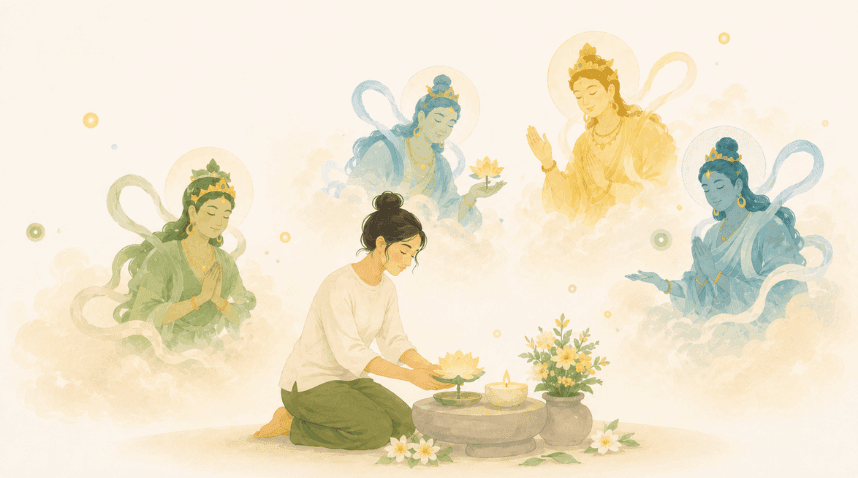
I will be honest. There were times in my practice when things felt heavy. A long stretch of difficulties. A period of isolation. Nights when my meditation was steady but my heart was not. In those moments, I sometimes reflected on the Uposatha teaching about recollecting devas.
The Buddha says that when a noble disciple recollects the faith, virtue, generosity, and wisdom of the devas, and recognises those qualities in themselves, the mind becomes bright and joyful. I tried it out of curiosity at first. But the effect was real. It was both softening and uplifting for the heart. The practice felt less lonely, as if I were joining a much bigger community of beings striving in their own ways.
It was around then that I began consciously dedicating merits to the devas. Not out of fear. Not out of superstition. But out of respect. These are beings who support the Dhamma, protect the noble ones, and rejoice in goodness. Offering them merits felt natural, the way one might send a blessing to someone who has helped you quietly from the background.
And over time, certain moments in my life felt… aligned. Fortunate. Protected. I do not claim anything dramatic. But I have seen enough to know that when the mind is steady and the intention is good, help sometimes arrives in ways we cannot predict.
What Devas Taught me about Refuge
One thing that struck me again and again is that devas themselves take refuge in the Triple Gem. King Sakka praised the Buddha countless times. Brahmā Sahampati bowed to the Buddha and implored him to teach. The devas in the suttas never present themselves as the final refuge. They always point back to the Dhamma.
Knowing this helped me avoid the fear of “depending on devas.” I depend on the Buddha, the Dhamma, and the Sangha. The devas are companions on the path, just in different realms.
When I chant the verses honouring the devas, it is not worship. It is respect for beings who have walked the path longer than I have. And it is gratitude for their protection, which the texts describe again and again.
How I Now Practise with Devas in Mind
My relationship with devas has become simple and natural. Nothing dramatic. Nothing mystical.
I try to live cleanly. I try to keep to the precepts well. I try to practise loving kindness because AN 11.15 makes it so clear. A mind filled with metta is protected by humans and non-humans alike. You sleep at ease. You wake happily. You feel supported.
I dedicate merits to devas often, especially after offerings, retreats, and moments of clarity. Not because they need my merits, but because they rejoice in goodness the way we rejoice when a friend does something kind.
I remember them not as supernatural figures, but as beings striving in their own way, encouraging practitioners, guarding the Dhamma, and gently nudging us towards wholesome paths.
In that sense, “networking with devas” is not about gaining power. It is about cultivating sincerity. The more genuine the mind, the more naturally devas draw near. The purer your intention, the more harmonious the path feels.
A Closing Reflection
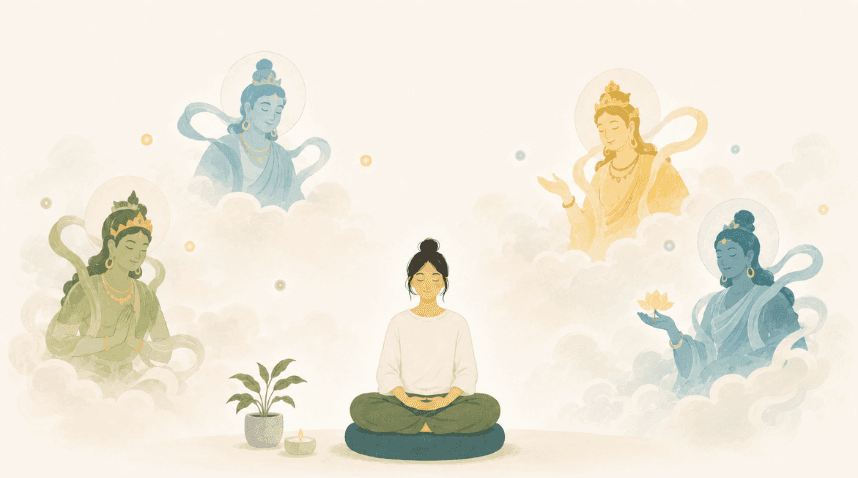
I used to think the Buddhist path was a solitary one. One human. One cushion. One mind. But the more I practised, the more I realised this journey is supported by countless conditions. Teachers. Friends. Ancestors. The Sangha. And yes, devas.
When practice is sincere, and virtue is steady, devas and humans alike rejoice. They offer protection in ways we cannot always see. And they remind us that the Dhamma is not a lonely path. It is a shared universe of beings walking towards the same freedom.
If this topic feels unfamiliar to you, take your time. There is no pressure to believe anything quickly. But if you ever feel a moment of quiet faith, or a sense of unseen support during your practice, allow yourself to consider the possibility that you are not practising alone.
Sabbe sattā sukhitā hontu.
May all beings, seen and unseen, be well.
Wise Steps
- Begin with refuge and intention by recalling Buddha, Dhamma, Saṅgha and resolving to practise for the good of all beings, then notice how your motivation steadies.
- Recollect devas after settling the breath by naming qualities they embody ( faith, virtue, generosity, wisdom ) and matching each with a recent action of your own.
- Dedicate merits after wholesome acts by briefly wishing “may devas and beings who support the Dhamma rejoice” and feel the heart widen rather than grasp.