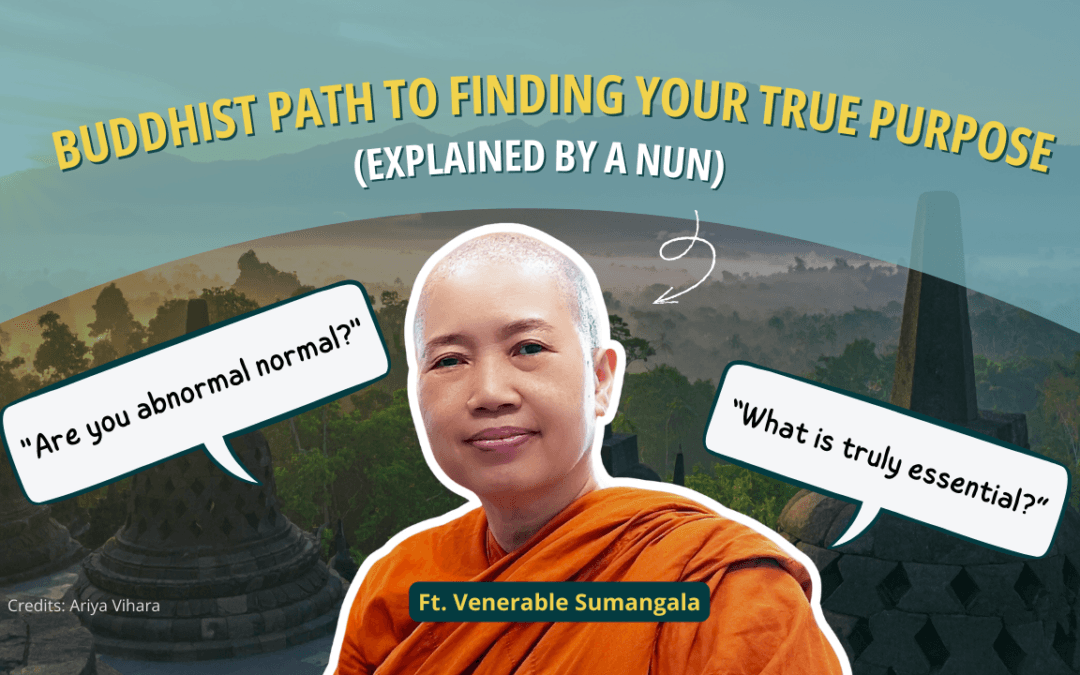
Ep 65: The Buddhist Path to Finding Your True Purpose ft. Ven Sumangala

Ep 65: The Buddhist Path to Finding Your True Purpose ft. Ven Sumangala

https://youtu.be/IK0KphAxygA

Summary

What gives life true meaning beyond achievement, comfort, and success? In this episode, Venerable Sumangala reflects on purpose, happiness, and the Buddhist path—challenging modern ideas of fulfillment and inviting us to look inward. Through teachings on non-attachment, mental training, and the Noble Eightfold Path, this conversation explores how lasting happiness comes from freedom of mind, not endless striving.

In a world driven by speed, consumption, and constant comparison, Venerable Sumangala offers a countercultural perspective: that peace is not found by adding more to our lives, but by understanding what is truly essential. She speaks about the quiet stress underlying modern living, the illusion of control through success, and how mindful awareness allows us to appreciate life without clinging to it—pointing toward a simpler, steadier form of happiness that can be cultivated here and now.


About the Speaker

👤 Venerable Sumaṅgalā Therī is the Abbess of Ariya Vihara Buddhist Society. She embarked on her spiritual journey in Buddhism at the age of 19, inspired by the serene sight of a monk and people meditating, which deeply delighted her heart. This initial inspiration led her to actively pursue, learn, and practise the Buddha’s teachings, with a particular focus on meditation.

She holds a B.A. in Psychology and in 1999, she completed her M.A. in Industrial and Organizational Psychology, both from Universiti Kebangsaan Malaysia. Furthering her academic and spiritual education, Ven. Sumaṅgalā Therī obtained an M.A. in Philosophy (Buddhism) from the International Buddhist College, Thailand in 2011.

Her formal journey into monastic life began in 2005 when she left the household life to become an Anagarika. Her ordination as a Dasasil (akin to a Sāmaṇerī) took place in November 2008 under the sacred Sri Mahābodhi at Bodhgaya, India. Her preceptor-teacher was Ven. Mahinda Mahāthera, a proponent of Mettā and one of the early disciples of the late Ven. Dr. K. Sri Dhammananda Nāyaka Mahāthera from Malaysia. Her meditation teacher was Ven. Nadimale Sumedhā Maniyo of Sri Lanka, who guided her in samatha-vipassanā meditation practices.

On 21 June 2015, she took her higher ordination under the guidance of preceptor Ven. B. Sri Saranankara Nāyaka Mahāthera – the Chief Judiciary Monk of Malaysia, and bhikkhuni preceptor-teacher Ayya Santinī Mahātherī of Indonesia.

In 2004, inspired by the late Venerable K. Sri Dhammananda Nāyaka Mahāthera, she decided to start a bhikkhunī training centre to complete the Fourfold Assembly for Theravādin practice: bhikkhu, bhikkhunī, upāsaka and upāsikā. In 2015, she pioneered the formation and registration of Ariya Vihara, Malaysia’s first Theravāda Bhikkhunī Nunnery and Dhamma Training Centre. In 2019, she received a government allocated land for the building of the project with construction to commence in the first half of 2025.

From 2014 to 2023, she inspired six short-term Theravāda Samanerīs to go forth for good, including the first 3 Cambodian Samanerīs to do so. She has assisted more than 50 bhikkhunīs in higher ordinations in Bodhgaya, India.

Currently, she serves as the Abbess and President of Ariya Vihara Buddhist Society and is an advisor of Gotami Vihara Society in Malaysia. Ven. Sumaṅgalā Therī is actively involved in conducting meditation retreats and giving Dhamma talks in various centers and camps, sharing her deep understanding and experiences in the Dhamma with others.

She is one of the recipients of the 23rd Anniversary Outstanding Women Awards (OWBA) 2024, in honour of the United Nations International Women’s Day.


Key Takeaways

Purpose Beyond Success

Modern ambition promises fulfillment, but lasting meaning comes from understanding suffering and cultivating inner freedom rather than external identity.

Non-Attachment, Real Peace

By loosening our grip on desires and outcomes, the mind becomes lighter, steadier, and less shaken by change or loss.

Train the Mind

Regular mindfulness and meditation build clarity and emotional resilience, helping us respond to life with wisdom instead of habit.


Transcript

Full Transcript

[00:00:00] Ven Sumangala: if a person live a hundred years without a purpose, so, what they do is eat,

[00:00:04] Ven Sumangala: sleep,

[00:00:05] Ven Sumangala: then play, play,

[00:00:07] Ven Sumangala: pain, pain,

[00:00:08] Ven Sumangala: die.

[00:00:14] Cheryl: Welcome to the Handful of Leaves podcast. My name is Cheryl. And today I have Venerable Sumangala as my guest. Today, we question the purpose of life. A lot of us wonder around just doing our nine to five, and then after that we spend five to nine on scrolling on IG, scrolling on TikTok.

[00:00:34] Cheryl: Then day by day, it just goes by and one day we are 60. So what truly is the purpose of life and how can we make our day to day more meaningful? My guest today, Venerable Sumangala, is a fully ordained nun of 10 vassas and she’s also the president of

[00:00:51] Cheryl: Ariya Vihara Buddhist Society, Malaysia’s first Theravada bhikkhuni nunnery and Dhamma training center.

[00:00:57] Cheryl: She’s also an advisor to

[00:00:58] Cheryl: Gotami Vihara Society in Malaysia. Welcome Venerable Sumangala.

[00:01:02] Ven Sumangala: Thank you. Namo Buddhaya.

[00:01:05] Cheryl: Namo Buddhaya so to begin off, I will start with a cheeky question, which is what is the purpose of your life?

[00:01:15] Ven Sumangala: My purpose of life is

[00:01:17] Ven Sumangala: to live every moment as it is. The main purpose is to be free from suffering and feeling free.

[00:01:27] Cheryl: Can you share a bit more what does feeling free mean?

[00:01:30] Ven Sumangala: So when we practice the Dhamma,

[00:01:32] Ven Sumangala: we will come to the stage of the mind where we get into the insight of what reality is, which is impermanent, constant change. And because of that, you can see there’s no entity that is in operation.

[00:01:48] Ven Sumangala: Then from there,

[00:01:49] Ven Sumangala: then the practice of letting go of desire and also the attachment on things in the world, even regarding with our body, we have that kind of sense of understanding that everything that we see, we experience is a fleeting nature.

[00:02:09] Ven Sumangala: So, if you understand that, then you would not want to crave and also grab or attach.

[00:02:19] Ven Sumangala: Thing comes and thing goes. We make good use of it when it is necessary or in need. But other than that,

[00:02:26] Ven Sumangala: when it comes, it comes. When it goes, it goes. If we don’t hold that attachment, then everything will flow freely.

[00:02:34] Ven Sumangala: We don’t get stressed and upset,

[00:02:37] Ven Sumangala: angry over the change of things or not getting what we want. So I think this is a very important insight to experience that freedom from all this entanglement and the grip of desire and attachment. Once the mind understand the reality, I think we will be free. And then because of that, we are happy. Not because we look for, but because we experience that happiness through that freedom from attachment.

[00:03:04] Cheryl: Wow. Sadhu. Well, does this also mean then that purpose will be changing and flowing? And if that’s the case, then why do we need purpose?

[00:03:17] Ven Sumangala: Well, when we are young, when we don’t have the understanding of the Dhamma or the truth, this is the process that we go. I mean, in the past when I was young, I mean, all of us go through, right?

[00:03:29] Ven Sumangala: And when we are young, people will ask, what’s your ambition? So I would say, oh, my ambition is to become a doctor. Then the mission start to change again because your inclination may change. So our purpose of life, we think, is to be or to become somebody.

[00:03:44] Ven Sumangala: And so if our purpose of life just to become and become and become, there’s no end. So these are the things that is ongoing. So we don’t have any really purpose, but we just live life like passing time. We don’t have a direction. But at the same time, we also know that we are not really that happy, although we have all the material things.

[00:04:05] Ven Sumangala: And we are also worried,

[00:04:08] Ven Sumangala: have fear,

[00:04:09] Ven Sumangala: and we are confused,

[00:04:10] Ven Sumangala: we don’t know our destination. So if we do not have any purpose in life, this is how we are going to live our life. Like I used to share with people,

[00:04:20] Ven Sumangala: even if you live a hundred years right, and then if you look at it, people will say,

[00:04:26] Ven Sumangala: wow such a long life.

[00:04:27] Ven Sumangala: It must be a good life. But one third of our life is what? Sleeping. Can you imagine you sleep for nearly 33 years in your life, doing nothing. Then another one third of your life is what? You’re taking care of this body. Then another third, then they say, oh, Venerable, normally, you know, it’s work. So, but I say if you live 100 years old, the likelihood is 12, 13 years old, you play, play, right?

[00:04:56] Ven Sumangala: Then 80 to 100 years old, what happen? Here pain, there pain. So, if a person live a hundred years without a purpose, so, what they do is eat, sleep, then play, play, pain, pain, die.

[00:05:11] Ven Sumangala: I ask them meaningful or not. If we are not aware, this is the life that we are going through. And this is what we see around us. And we think that majority doing that, so it must be true. But actually, sometimes majority may not be correct. And so we have to be very careful to see why we are facing stress, unhappiness,

[00:05:35] Ven Sumangala: the feeling of bored, upset, angry, not satisfied, fear, and then worry,

[00:05:42] Ven Sumangala: so much worry about our career, about family, about future.

[00:05:47] Ven Sumangala: Why is this happening? It’s because we do not know. We do not have purpose in our life. So it’s important to ground ourselves. to have a purpose. What is purpose? Very simple. Everybody say, if I have a car, I’ll be happy. If I have a house, I’ll be happy. If I have a career, I’ll be happy. So what do you want?

[00:06:08] Ven Sumangala: Not the car, not the house, not the partner. Happiness. So how to find the happiness. So happiness doesn’t come from just spending time doing, all these other things without that kind of mindfulness and awareness of how they can get out from that, unhappiness or unsatisfactoriness and fear and confusion.

[00:06:33] Ven Sumangala: Because we want happiness, we want freedom. But how to get there? So it’s important that we set the goal, how this purpose to be is because we want to find true happiness and freedom. So there is a path that leads to that. And we are so fortunate. 2,600 over years ago until today,

[00:06:53] Ven Sumangala: we still have this path to true happiness and freedom. That is the Noble Eightfold Path that the Buddha taught. And the Buddha also went forth to search for this path. And of course, he found the path and we are so fortunate we are the followers or the disciples of the Buddha.

[00:07:11] Ven Sumangala: We have like kind of a more in advance package for us to find true happiness and freedom. It’s only whether we take it or not,

[00:07:20] Ven Sumangala: or we just make a wish and do nothing. We must put into action. Then we can actually realize

[00:07:27] Ven Sumangala: the true happiness that we are looking for, the freedom that we are looking for, and live meaningfully.

[00:07:33] Cheryl: Can you share more about

[00:07:36] Cheryl: true happiness and freedom,

[00:07:37] Cheryl: and the happiness from material success?

[00:07:42] Ven Sumangala: As we look for something that is material, whether is money or is in the form of thing or is in form of relationship,

[00:07:52] Ven Sumangala: we get pleasure actually from the material association. And so we thought this is like the true happiness, but actually, this is sensual pleasure,

[00:08:04] Ven Sumangala: the senses are activated and derive the pleasure in it. But this happiness, we know that it is very fleeting and when the visual object is not there, then we feel unhappy.

[00:08:17] Ven Sumangala: Whereas the happiness that come from true happiness is a happiness that come from within.

[00:08:22] Ven Sumangala: It’s a cultivation of mind. We can see between a mind that is distracted and a mind that is calm and peaceful. What is the happiness that come from material things? Because when we don’t have it, that’s why we feel very restless. Especially when they say going for meditation, right? Then they sit still there, don’t move, close your eyes, don’t see, don’t hear. Don’t move. Yeah, that’s a time where a lot of people say, well, it’s torturing, they say. But actually no, that is the path to the happiness. Because right when the mind starts to be trained to know how to look within to the mind itself in a way that if the mind is scattered, distracted, restless, what would be the way, the method to help it calm down without looking at things or without hearing it.

[00:09:17] Ven Sumangala: So we silence everything around us, and then just go deep into the mind, and then there’s always method that the Buddha already shown us. For example, even like mindfulness of your in breath, out breath,

[00:09:29] Ven Sumangala: then metta bhavana,

[00:09:31] Ven Sumangala: means cultivation of mindfulness on your loving kindness,

[00:09:35] Ven Sumangala: then on your compassion to see joy and equanimity.

[00:09:40] Ven Sumangala: And then also there are methods that help us to cultivate, like for example,

[00:09:44] Ven Sumangala: the loathsomeness of attaching to the body, which we are attached so much and we think so beautiful,

[00:09:50] Ven Sumangala: but every day, you know,

[00:09:51] Ven Sumangala: it has turned out so much stinky things, yeah?

[00:09:54] Ven Sumangala: we still say, oh, it’s nice, it’s nice, when the moment it comes up from a body, we say yucky. But how come when it’s in the body, this is so beautiful. So it’s kind of to come to reality, we need to have that bravery to really address. It is true, you know, is reality. We still live like normal, but we understood that so that we don’t get the kind of a desire or attachment over something that actually is not what it is. So, if we cultivate the mind, then we establish a true experience of love, kindness. And it doesn’t become something that is so self centered, we feel the spaciousness of things.

[00:10:39] Ven Sumangala: And also the interconnectedness of all things. And then we see the beauty of how we actually change without holding to it. So we can embrace it as you move along. We are happy and at peace. So that happiness of within one is not so much of the kind of happiness that people think, you need to have a stimulant from external source.

[00:11:03] Ven Sumangala: But this kind of happiness, it actually spring up. The Buddha expressed it like in a lake, there’s a spring water that comes up. So it gives us that cool feeling, comfortable, calm, at peace, clear, light, and so embracing, and they can kind of be even more clear in knowing and understanding things around.

[00:11:28] Ven Sumangala: And at the same time, keeping the mind very, very stable and very peaceful. So, one is from outside, the other one is from inside. So, I think in our daily life as a layperson, we need both, right? Only thing we, we have to understand that the external one, in order to experience that, yes, we earn our money, we can spend on ourselves and for our family, relatives and friends.

[00:11:55] Ven Sumangala: Well, we spend it rightfully. And then we can gain happiness to the money that we earn. And so the pleasure that we experience. But at the same time, we also know the danger of sensual pleasure. So, if they don’t go to the extreme. I think for a lay person, that’s how they live their life.

[00:12:14] Ven Sumangala: But at the same time, it’s important to couple with what we call the spiritual cultivation of happiness that comes from within. So, when you’re able to develop this, then you do not seek the external happiness anymore, because all the time you can maintain that, uh, that peace, that calmness in your mind.

[00:12:35] Ven Sumangala: So that is even better, isn’t it? Because if you keep seeking, you know, there’s no end to it. And then when you lose it, then you already feel imbalanced.

[00:12:45] Cheryl: I think what really stood out to me is that the Buddha’s teachings is almost contrarian where the whole society is about maintaining and upkeeping beauty. The Buddha tells us, hey, the body is not so beautiful. And when, you know, so many companies, consumerism is geared towards getting more and more and more, the Buddha says, Hmm, sense pleasure is not true happiness.

[00:13:11] Cheryl: I’m just trying to reconcile the idea of finding true happiness with the reality of how much suffering it is. So for example, getting material or sense pleasures is so easy. Just one click of the button, then we get to see something that we like, or just one, one click of the button again, we get to order a food that we like.

[00:13:32] Cheryl: But then you ask us to sit down, meditate, fall asleep, restless, then anxious thoughts come. So what advice would you have for people who are struggling to find that internal happiness and easily get distracted with the sensual pleasures of the world?

[00:13:51] Ven Sumangala: The world that we are in, it is such. And not only that, you know, we are pushed to the kind of speed that I think a human mind, if they are not mindful, they go off tangent, because the speed that they are pushing the human today, yeah, is very, very fast, right?

[00:14:11] Ven Sumangala: You feel like you are being pushed around. Even though you don’t want to, whether the emails or WhatsApp, whatever, that keep coming, right? Now is the era of AI. It’s even more. You don’t even understand yourself so much, but the AI will understand you better. They know what you crave for. They know what you’re attached and they keep coming and feeding you.

[00:14:34] Ven Sumangala: So, if you don’t sit back and reflect, then, you know, our life is just like spinning and spinning and spinning, and then, when you spin around without your own control, then what will happen? You get confused. You just feel like life is so stressful. And this is the danger of it.* *So, as I think a wise person, we should actually come out from that cycle, and then look back into it. Actually, what the Buddha teach is not about suffering. The Buddha taught us, the end of suffering, you have a choice.

[00:15:06] Ven Sumangala: So we must have this wisdom to see that, that what is the reality. So if we go against reality, that’s why we go spinning. But what the Buddha taught us, a lot of people misunderstood, because the Buddha say there is suffering. So people say, Buddhism always tell us suffering, nothing but suffering.

[00:15:24] Ven Sumangala: We are, you know, still enjoying our life. But we also get all the stress. All the fast paced kind of life that we cannot sometimes breathe. Because everywhere we see, everybody is the same. What choice do we have?

[00:15:38] Ven Sumangala: Last time I remember, my boss, when I put in the letter for resignation cum retirement. Right at the age of 39. Then my boss was thinking,

[00:15:53] Ven Sumangala: you have things to enjoy. You are at the peak of your career. Why are you going to let go all these things. Don’t you think they are abnormal?

[00:16:02] Ven Sumangala: So then I told him, I said, it’s true, it’s abnormal, but there are different kind of abnormality in the normal curve. So there are majority that fall in the normal curve, and those, there are normal curve is actually because they are majority, but their lifestyle, everything is against reality. And they can get sick.

[00:16:23] Ven Sumangala: They can get stressed, get depressed. And when they cannot handle it, then they will fall into the abnormal, abnormal, which is very serious depression and out of the normal group, which is also abnormal. Yeah, but it’s only the abnormality still can be contained with the stress.

[00:16:41] Ven Sumangala: But I said there’s another kind of abnormality which is abnormal normal.

[00:16:47] Ven Sumangala: They are abnormal because they are small group, but their lifestyle their everything that they do according to the order, according to the reality

[00:16:54] Ven Sumangala: But because they are small group and very few people wants to do that, although they know it’s good, they always think, not for me, only maybe the Buddha or only those monastic people can do, but not us.

[00:17:07] Ven Sumangala: But the result is they are normal, because they are living according to the order. Naturally, it will lead you to peace, happiness, freedom, which everyone is wishing for.

[00:17:21] Ven Sumangala: But when come to action, they do separately. They do differently against what they wish. So how to get back? So the Buddha say, we have to know what is essential is essential. What is unessential is unessential. And then only we can get to the essential.

[00:17:38] Ven Sumangala: It cannot be. You want to be happy, then you do something else. I want to find peace, but then you keep having craving, you want this, you want that, right?

[00:17:47] Ven Sumangala: So like, for example, you wish for a big house. But then I said, then, no, you have to toil and toil to pay for your house. But then after that, so big, your house, and nobody clean. Then you have to get a maid. Then toil and toil to pay for the maid. Then I say, then you don’t have time, you are always in the office.

[00:18:06] Ven Sumangala: Then, who is enjoying the house? Your maid, not you.

[00:18:10] Cheryl: Which is so true, yeah.

[00:18:12] Ven Sumangala: So you see, the order is such, so you have to follow the order. Then from the order, you will still find enjoyment. Because you know that everything is interconnected, and it doesn’t belong to anyone, it’s appreciation of all things without being possessive. So when we are living, why not be really rejoice, right? In this journey, we can really see so many we can appreciate without possessing, right? So then we feel light, isn’t it? So why not, you know, just simple. Our life actually four requisites only.

[00:18:46] Ven Sumangala: You can live already. The rest is a want.

[00:18:48] Ven Sumangala: I worked there for five years.

[00:18:50] Ven Sumangala: Only then they already promote me to branch manager. I didn’t ask for it. What would I be within three years or five years? I just say to be happy and to make others happy.


Special thanks to our sponsors:

Buddhist Youth Network, Lim Soon Kiat, Alvin Chan, Tan Key Seng, Soh Hwee Hoon, Geraldine Tay, Venerable You Guang, Wilson Ng, Diga, Joyce, Tan Jia Yee, Joanne, Suñña, Shuo Mei, Arif, Bernice, Wee Teck, Andrew Yam, Kan Rong Hui, Wei Li Quek, Shirley Shen, Ezra, Joanne Chan, Hsien Li Siaw, Gillian Ang, Wang Shiow Mei, Ong Chye Chye, Melvin, Yoke Kuen, Nai Kai Lee, Amelia Toh, Hannah Law, Shin Hui Chong, Dennis Lee, Kayliam, Darren

🙏 Sponsor us: https://handfulofleaves.life/support/


Editors and Transcribers of this episode:

Hong Jiayi, Tan Si Jing, Bernice Bay, Cheryl Cheah


Visual and Sound Effects

Anton Thorne, Tan Pei Shan, Ang You Shan


Get connected here:

Telegram Instagram YouTube Facebook

Is There a Right Time to Leave My Job?

Is There a Right Time to Leave My Job?

TLDR: This reflection shares a personal reflection on why and when to leave a job. It offers guiding questions to help uncover your own push and pull factors, reflect on your intentions, and assess your readiness to leave. Ultimately, it encourages making career choices with clarity, compassion, and intention.

“Should I quit my job?”

Many of us might have had this thought cross our minds when our work doesn’t fully align with our values. This misalignment could be due to various reasons, such as a heavy workload, family commitments, location of the workplace, or an unsupportive work culture.

The first time this question came up was in my second year working in healthcare. The work demands had become overwhelming, and I started to experience burnout. I began to question if this career was truly for me and started reflecting on the misalignment I felt. 

Eventually, after countless rounds of reflections, I managed to overcome that phase of burnout. I learnt how to better manage my boundaries and priorities, and I also started to apply self-care and self-compassion (karuṇā) in my journey. I began having regular check-ins with myself, which helped me ensure that I did my work intentionally instead of getting through each day to fulfil the work demands.

The second time this question came up was in my fifth year of work. This time, the conditions were different. I wasn’t feeling burned out, and I enjoyed the supportive work culture. Many of my seniors and colleagues empowered and supported me, and some of them even became my friends whom I enjoyed hanging out with outside of work.

There weren’t many push factors; rather, the workplace became my comfort zone. This time, the choice to leave wasn’t driven by aversion, but by a desire to pursue what truly mattered to me. 

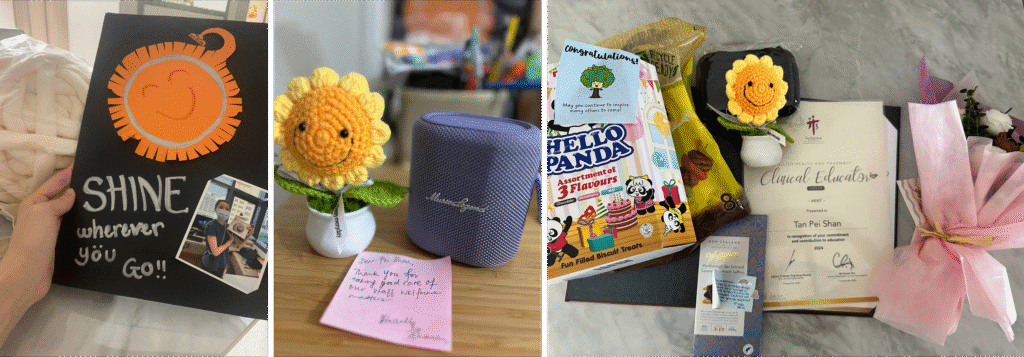
Farewell gifts from my colleagues 🙂

Some of my relatives and my parents were initially concerned about me leaving. Additionally, a few of them remarked that I was really lucky to have a stable and supportive work environment.

Here are some guiding questions that enabled me to reflect deeper and ultimately decide why and when I should leave. 

A. “Am I still growing in areas that align with me?”-  Reflecting on push and pull factors

Is There a Right Time to Leave My Job?

My workplace gave me opportunities to explore wellness at work, leadership, and clinical education, which were areas that I really enjoyed. However, these took up only about 10–20% of my time, and the majority of my day was still spent on the usual work routines.

After some time, it felt instinctive to me that since work took up the majority of my waking hours, it should be aligned with what mattered to me.

I reflected on what I would want to do if I had more time:

  • To spend more time with my grandparents (they’re getting older and time with them is really precious)
  • To go for Buddhist retreats
  • To visit Plum Village in France (it’s been on my bucket list for 4 years!)
  • To explore other areas within healthcare, like palliative and home care
  • To try out teaching yoga and music

These became the pull factors that gave me the courage to venture out of my comfort zone.

When you’re free, maybe you can also take some time to reflect on your own “push and pull factors” at work too!

  • Push Factors (Why do you want to leave your current job?)
  • Pull Factors (What matters to you and is calling you forward?)

B. Understanding your intention: Uncovering the deeper layers behind your desire to leave

Sometimes I hear my friends say things like:
“I want to leave my job because the work demands are overwhelming.”
“My boss is horrible.”
“The work environment is toxic.”

But not many of us pause to really reflect on what those words truly mean, or what deeper values and lessons are behind our suffering.

Here are some examples of how we can try to look deeper:

Example:

What we say or feelWhat we might really value
“My boss is horrible.”I value leaders who are open to feedback and change.
“I feel limited at work.”I want to grow in a specific area, but the current system doesn’t support it.
“The work environment is toxic.”I need a safe space that allows for mistakes and learning.
“Work demands are overwhelming.”I value work-life balance and personal wellness.
“The job doesn’t pay enough.”I want to feel valued and have the financial freedom to enjoy life.

(These are just some examples of what might be true for some people. It may or may not apply to your own situation.)

If the misalignment is something that can be changed in your current role, you might not actually need to leave your job. For example, in my second year, I was able to overcome burnout by learning to prioritise and set clearer boundaries with my time and energy.

Leaving your job isn’t always the answer to a “better life”. Sometimes, things aren’t greener on the other side.

A friend of mine left her job due to burnout but unknowingly landed in another job that had even more demanding expectations. She ended up struggling again and had to terminate that contract too.

It’s important to know why you’re leaving, and to carry those values with you when you’re looking for your next role. For instance, if you value a good work culture or work-life balance, maybe you can ask the interviewer about the team culture, or even request a shadowing session before committing.

C. Do I have enough? Am I ready to leave?

After contemplating my decision, I also spoke to my sister and some friends who had left their careers to understand more about their journeys. I explored platforms and networks that could support my next steps. I also calculated my savings and estimated expenses to ensure I have enough to tide through my unemployment period.

I remember reading a post by The Woke Salaryman that said:
“You should have X months of salary saved in your account (X being the number of months you plan to take off). So if you want to take a 6-month break, aim for 6 months’ worth of salary saved in liquid cash.”

All of these conversations and preparations helped me feel more assured that I would be okay even if I leave my job.

Conclusion: Life after leaving

Is There a Right Time to Leave My Job?


It’s been months since I left my job and I’ve been focusing more on the things that matter to me. I have gone for retreats, pilgrimages in Nepal and India, and I finally visited the Plum Village in France last August. I’ve been spending more time with my grandparents, teaching seniors yoga once a week, exploring music, and doing locum healthcare work.

Photos taken on my pilgrimage.
Photo taken at Kushinagar (Buddha’s death place) on my India Pilgrimage
Photo taken at Plum Village Retreat in August

I realised that we actually have some control over how we spend our time. We’re not necessarily limited to the traditional 8–5 lifestyle, especially if we’re willing to trade some stability for a bit more freedom.

Ending off with a quote by Thich Nhat Hanh:

“Our vocation can nourish our understanding and compassion, or erode them. We should be awake to the consequences, near and far away, of the way we earn a living.”

Whatever path you choose, may it lead you toward becoming a kinder, wiser, and more fulfilled version of yourself.


Wise Steps: 

  1. Reflect on your push and pull factors — Take time to identify what’s making you want to leave your current job and what’s drawing you toward something new.
  2. Uncover your deeper values — Go beyond surface frustrations and ask yourself what you truly need to feel fulfilled and supported at work.
  3. Assess your readiness — Review your finances, talk to trusted people, and make a plan to ensure you’re prepared emotionally and practically if you decide to leave.

Ep 61: How I Built a $200M Business Without Crossing These 5 Lines ft. Ying Cong

Ep 61: How I Built a $200M Business Without Crossing These 5 Lines ft. Ying Cong

https://youtu.be/-Uxw9ivl8Tw


Summary

What happens when a startup founder takes Buddhist precepts seriously — not just in meditation halls, but in high-pressure boardrooms and tough layoff conversations? In this candid episode, we speak with Ying Cong, co-founder of Glints, on what it means to lead a company without losing yourself. He shares how his practice of the Dhamma has shaped everything from how he hires and manages people, to how he navigates co-founder conflict and difficult decisions — all while trying to be firm in kindness.


About the Speaker

👤 Ying Cong is a long-time meditator and the co-founder of Glints, a leading career platform in Southeast Asia. Over the past decade, he helped scale the company from an idea incubated by JFDI to a regional startup featured in major publications like The Straits Times and Yahoo News. As Glints’ former CTO and current machine learning engineer, he has worked on recommender systems, fraud detection, and data infrastructure—though he jokes that most of it is just “glorified data cleaning.”

His Dhamma journey began in his teenage years and continues to deepen through regular meditation, observing the precepts, and periods of monastic training in the Thai forest tradition. He is quietly exploring how to balance the responsibilities of lay life with the path of practice.


Key Takeaways

Holding the five precepts builds deep trust

While startup life often celebrates “hustle at all costs,” Ying Cong stuck to his precepts — even when pitching investors. Over time, however, this radical transparency became a strength. Colleagues began to trust him deeply, even sharing difficult truths others couldn’t access.

Culture is shaped by how you show up, not what you say

From hiring to meetings, people look to the leader to understand what’s “normal.” When Ying Cong opened up about uncertainty and shared his misgivings, others followed suit. But when leaders modelled secrecy or pure task-focus, people shut down.

Every employee is carrying something

After managing 40–50 people over 11 years, Ying Cong observed something simple yet powerful: “Everyone is suffering, to some extent. The only question is how much they show you.” Being present and listening with care — not just for what’s said, but for what’s held back — often reveals what’s really going on beneath performance issues or disengagement.

Transcript

Full Transcript

[00:00:00] Cheryl: Has there ever been a moment in your career where you were not able to hold your five precepts?

[00:00:06] Ying Cong: No. No. It’s been, that was my inviolable principles, uh, ever since, uh, I was young. I have, okay, there are situations where I’ve come close.

[00:00:24] Cheryl: Welcome to the Handful of Leaves podcast, a Southeast Asian platform sharing Buddhist wisdom for happier life. My name is Cheryl, the host for today’s podcast, and my guest today is Ying Cong, who is the co-founder of Glints recruitment platform that has expanded to eight markets.

[00:00:46] Cheryl: I just wanted to catch on a word that you said, you know, treating people, uh, your team like a family.

[00:00:50] Ying Cong: Mm-hmm.

[00:00:51] Cheryl: Right. In one of your articles you wrote about how you always struggled a little bit about personal boundaries.

[00:00:59] Ying Cong: Ah, yeah.

[00:01:00] Cheryl: So, like, you know, you are friendly with everyone, but you also don’t want to be too close.

[00:01:04] Ying Cong: Yes. Yeah.

[00:01:05] Cheryl: How did that work with treating everyone as family?

[00:01:09] Ying Cong: I’ve since stopped adopting that lens, uh, when it comes to colleagues and you treat your employees as family, um, there’s a lot of unspoken assumptions around that. So one of it is that they will never, never leave you. Right? And, and in this lifetime at least they’ll stick to you through, uh, thick and thin and also vice versa.

[00:01:31] Ying Cong: You will never abandon them. Hmm. But it’s just not realistic in a company, right? People do, uh, underperform for various reasons. Sometimes they perform very well in the first few years, and then their motivation shift or the job scope change. In a startup, you’re always changing. You’re growing, right, and the roles expand very quickly.

[00:01:48] Ying Cong: And it does come to a point where even the people that you cherish the most, sometimes they can’t live up to the job scope or you can’t live up to their expectations and you have to have that conversation to leave. When I was treating my employees as family, um, those conversations were much harder.

[00:02:05] Ying Cong: I tend to avoid them, um, because who would ever fire your own brother or sister? It’s like, it’s very heartless thing to do, right?

[00:02:12] Ying Cong: Yeah. Yeah. But then when in a company setting, actually the more heartless thing to do is to let them to continue to underperform in a role where, you know, they’re no longer suited for. Because their self esteem will start taking a hit. And the company doesn’t benefit from it.

[00:02:28] Ying Cong: And you also, um, compromise on the other employees who depend on them. Yeah, so, so I started to draw that boundary, like, okay, we treat each other with respect, right? We also build that relationship at certain times where we are outside of work, but when it comes to work, there’s a clear boundary about, okay, this is what you have to perform, uh, and this is what the company can give to you, right?

[00:02:50] Ying Cong: So you have to make those boundaries, underlying boundaries very clear in your mind, and also when you talk to the employees. Um, but of course the close danger of that is it becomes too transactional.

[00:03:01] Cheryl: Mm-hmm. Yeah.

[00:03:02] Ying Cong: It becomes like, oh, you gave me this, I give you that.

[00:03:03] Cheryl: Mm-hmm.

[00:03:04] Ying Cong: Right. So it just becomes a balance. You do have to, at some certain moments, you do find that relationships, like during one-on-ones, don’t just talk about work. Mm-hmm. I know some managers do that. They just talk about what, just what you got done, how can I help you to get the next thing done?

[00:03:17] Cheryl: Yep.

[00:03:17] Ying Cong: Right. Um, but the best managers I’ve seen, they are also sensitive to the employees underlying needs.

[00:03:23] Cheryl: Mm.

[00:03:24] Ying Cong: And once you, once you do that, when I’ve been, I, I think I managed maybe close to 40, 50 people on and off across the 11 years. Right. And I, I noticed one thing is that everyone is suffering to a certain extent. Mm. Um, it is just about how much they tell you about it. Mm. Right. Even the happiest and cheeriest employees, the most upbeat ones, there’s always something that’s bothering them.

[00:03:46] Cheryl: Mm.

[00:03:46] Ying Cong: Right. And it can be very obvious things, very immediate thing like, oh, my immediate family member passed away or is having a illness. Or it can be very subtle things, sometimes they just can’t really articulate it. Mm-hmm. Like for a lot of my employees when I was running the Vietnam team, they felt that maybe the strategy wasn’t too clear.

[00:04:04] Ying Cong: Right. But it’s a very underlying feeling and they don’t know what the next direction is for their lives because of this. So there’s some uncertainty.

[00:04:11] Cheryl: Mm.

[00:04:11] Ying Cong: And when you talk to them and you really listen, uh, with your heart then these kind of things start to bubble up.

[00:04:17] Cheryl: Mm. Yeah.

[00:04:17] Ying Cong: Because they will first tell about their work. That’s a very immediate thing. And they’re tell about immediate family life. They’ll tell you about facts. Mm. But you can just see in the way they talk to you where they hesitate a little bit or, um, they have this little bit of holding back about telling you certain things, and that’s when you can sort of pick up, oh, okay, maybe certain things are not going all too well over here.

[00:04:38] Ying Cong: So then you can ask. So you ask them for permission, “I can ask you about this?”, and then they give you permission and you can talk about it.

[00:04:44] Cheryl: Wow. Yeah. Yeah. I, I think, wow, the people under you are very lucky to have you. Someone like you as a manager who really listens and want to understand them in a holistic way. Yes. Yet being firm in being kind. Yeah. Not just nice by showing respect to them.

[00:05:02] Ying Cong: Imagine right when you’re under a lot of pressure from your board or your leaders above you to achieve a certain target. Then if you are not very mindful about it and in what conditions, sometimes you’re not mindful, especially about relation, the softer stuff like, uh, you, you are maybe seen as too soft, if you are too soft to your employees too, and then you are trying to just push that down to the next level, right?

[00:05:24] Ying Cong: But then for me, as part of that whole, you know, journey of transformation, like what the startup journey meant to me, one of the things I also realized is that, you know, that connection that you have people.

[00:05:35] Cheryl: Mm.

[00:05:36] Ying Cong: That is actually what makes me come alive. Mm. No matter how momentary it is, how fleeting it is. Mm. As long as I come in the contact you and there’s a, there’s a personal connection. Mm. Right. That actually makes the day very meaningful to me. Yeah. Yeah. So little things. These are little things. These are little things.

[00:05:51] Cheryl: Yeah. Nice. And how do you translate individual meaning, individual significance to a team or even a regional team?

[00:05:59] Ying Cong: Yeah, that is the difficult part. Um, because you realize things are very difficult to change and the hardest thing to change of all is other people. Even, even though they are working in a hierarchy under you, right? You were hired, uh, they were hired by you. Uh, it is very hard to change people.

[00:06:18] Ying Cong: Right, though, uh, you can influence a certain culture. So the way I look at it is: culture — when you hire people, they usually fall within a certain range. So let’s say, let’s say for me, I do value people who are very open and transparent, who value connection, uh, who are also quite, uh, on the ball about their task, right?

[00:06:40] Ying Cong: So you can break it down into certain sort of knobs that you see, like in a culture. So like transparency, there are cultures that are very transparent and cultures that are very opaque, right. Then being on the ball: there are cultures that are more task-oriented and more relationship-oriented. Mm-hmm.

[00:06:53] Ying Cong: So each of these things that when you hire people, they fall within a certain range. Mm. And then how you act as a leader day to day influences how, where they fall within that range. Mm. Yeah. Because when people come into any certain setting, um, any certain social setting and company is one of them, they tend to look up to the leader to set the tone.

[00:07:13] Cheryl: Yeah.

[00:07:13] Ying Cong: Because they’re not, they, they’re not the ones who founded this company. They don’t know what to, to, to think or to feel yet,

[00:07:19] Cheryl: or what’s acceptable.

[00:07:20] Ying Cong: Or what’s acceptable. Yeah. What’s, what’s the norm. So they look up to the leader for a range of what the norm is as well as their peers. Yeah. So I find that if I model the behavior that I want to see in my employees, where I’m very open about sharing about my misgivings or my feelings or things that I thought about the strategy that I’m not so sure about, then it really opens them up to share also their misgivings.

[00:07:44] Ying Cong: Right. And they become more vulnerable at the same time. I also seen it the other way around when we hire new leaders and these leaders have a very different setting from me. Right. More task-oriented, a little bit more opaque. Right. And then people start to clam up.

[00:07:57] Cheryl: Right.

[00:07:58] Ying Cong: They’ll be more efficient in the short term, but they’ll clam up in the long run. And, and so it is really, it does come down from the leader. The leader, how you model your behavior in meetings, in all your interactions. It will trickle down, uh, to the, to the whole employee base after, after a certain time.

[00:08:13] Cheryl: But do you ever run into the, I guess, hiring fallacy of hiring people that are more like you? Mm, yeah. Yes. And yeah. Then how do you counter that? For example, you know, you are giving the example of the leader who was very different.

[00:08:26] Ying Cong: Yes, yes.

[00:08:27] Cheryl: But I’m sure he also brings with him a lot of benefit.

[00:08:30] Ying Cong: That’s right. That’s right. That’s right.

[00:08:31] Cheryl: How you maintain that, right?

[00:08:32] Ying Cong: That is, that is one of the difficult part about… like you can never be perfect. So there’s a reason why we hired that leader and he’s still with us, and because he’s making impact in a certain way. The problem… yeah, we made the problem in the beginning.

[00:08:46] Ying Cong: We hire a lot of people who are very, uh, friendly, very warm. And, uh, a a flip side of that is that you tend to not address fundamental problems in the company so head-on.

[00:09:00] Cheryl: Mm.

[00:09:00] Ying Cong: Yeah. So, yeah. So we brought on this leader because, uh, he was a good contrast to us. Mm-hmm. Yeah. He could, right in the first interview and the first meeting, he really made it very clear to employee base, okay, these are the problems that I see in the company that I feel we have to address.

[00:09:14] Cheryl: Mm-hmm.

[00:09:15] Ying Cong: Right? But then the balance that he need to strike is that he has to abide by certain inviolable principles that you want to have as a company. So one of the inviolable principles that we realize that we want to have, because there are people who violated them, is that you want to do this in a constructive spirit. Do it in the spirit of “let’s build this back together”.

[00:09:35] Cheryl: Mm.

[00:09:35] Ying Cong: Because we have hired leaders who also have that critical mindset, very objective, but they have the mindset of, oh, “everyone in the past they did a bad job.” Mm-hmm. Right? “Let me take this all down. And I do it my own way.” Right. It is not a collaborative, constructive, “build this together” kind of mindset.

[00:09:52] Ying Cong: And that’s caused a tremendous amount of damage in the culture, in the business. Yeah. So to answer your question, to summarize it very succinctly, right, is you want to have a base of inviolable principles, sort of like a, in Buddhism we have the five precepts that are inviolable. Yeah. Right. The foundation.

[00:10:10] Ying Cong: But then above that base you can have very different configurations and that gives you contrast and that gives you diversity as a leadership team. Yeah.

[00:10:19] Cheryl: Beautiful. One very interesting thing that I want to ask you: has there ever been a moment in your career where you were not able to hold your five precepts?

[00:10:29] Ying Cong: No. No. It’s been, that was my inviolable principles, uh, ever since, uh, I, I was young. I have… okay, there are situations where I’ve come close.

[00:10:42] Cheryl: Mm-hmm.

[00:10:42] Ying Cong: And usually the principle about not lying.

[00:10:45] Cheryl: Mm.

[00:10:46] Ying Cong: There’s the principle that we are taught not to lie, but actually if you read the sutta more closely, actually there’s some variations of it where there’s stronger forms of it, where you don’t even tell white lies or you don’t embellish the truth and you try not to, you don’t gossip also.

[00:11:02] Ying Cong: Right. Nothing that’s divisive. So I come close to that when you have to pitch to investors and, and I, I made a mistake where I was sharing too openly about all the problems in the company. I remember there was this one investor meeting where my co-founder brought me and they were pitching AI, yeah, as one of the, uh, one of the value propositions or the competitive advantages of Glints, and then I just came into the meeting and this investor asked me, “Hey, so how’s the AI?” Then I say, “Oh, not very good yet. Still a lot of things to work on. Very basic at the moment.”

[00:11:36] Cheryl: Oh no.

[00:11:38] Ying Cong: Then my co-founder like, just face palm silently in the back and after the meeting he told me, “Hey, can you don’t do that or not? Doesn’t help my case at all.” The investors did join, uh, still invested eventually because of other reasons. Yeah. So I had to learn to manage that.

[00:11:56] Ying Cong: Right. So I still… but I still hold my line. I wouldn’t tell a, an explicit lie. Mm. But I would see the situation and actually the Buddha did talk about this, like, what’s the right thing to say at the right time?

[00:12:07] Cheryl: Mm.

[00:12:07] Ying Cong: Right. So I, I know that wasn’t very helpful to my co-founder at, at the very least. Right. So I, I learned that there are many ways you can present the facts that’s still being truthful.

[00:12:18] Ying Cong: Right. But it’s more aligned to what this, what the situation cause for. Mm-hmm. Right. Yeah. So, so I learned in, in certain meetings I would say, uh, when you ask about the situation of the AI, I tell them, “okay, this is the current foundation that we are building and this is where we, we feel like we can get to. And this, uh, this is a roadmap to getting there.”

[00:12:36] Cheryl: Mm.

[00:12:36] Ying Cong: Instead of just being saying, “oh, we’re not there. It’s very basic.”

[00:12:39] Cheryl: Yeah. It is about packaging the truth in a way that’s beneficial for yourself and others. Yes. It’s a very difficult, um, thing to balance, especially when there’s so much pressure to, to get some investors money and, and all that.

[00:12:55] Ying Cong: Correct. Correct. Correct, correct, correct.

[00:12:56] Cheryl: But have you seen how the five precepts protected you in the workplace?

[00:13:02] Ying Cong: Yeah, it’s protected me in other ways. I think the biggest one is when you are consistently truthful, and when sometimes to your own detriment, then people will trust you actually.

[00:13:14] Ying Cong: Mm, yeah. People will trust you. So the people in my company know me as like the principal who, who was a monk before. And, and they do trust me with very, uh, some very personal sharings.

[00:13:27] Cheryl: Mm.

[00:13:27] Ying Cong: Because they know that I always tell them, I always share the truth, even when it’s ugly from the management team or the leadership team, from a strategy perspective.

[00:13:37] Ying Cong: I tell them, okay, this is what exactly is difficult for the next phase that we are going into. I still remember, um, this, this also during the COVID period, uh, where we have eventually to, to lay off, uh, a portion of employee base in order to save the company. PR/ marketing team person, she wanted me to lead that message first, right?

[00:14:00] Ying Cong: Because in the past, uh, we, we had slightly different, slightly different approaches like with me and my co-founder, my CEO. So he’s more polished, right? Mm-hmm. You try to frame the message in a way that’s palatable, um, easy to digest for the employee base. So in the past, for example, the PR crisis, you try to frame it in a way that saying that, okay, yeah, we stand strong.

[00:14:21] Ying Cong: It wouldn’t affect us so much. But then my approach was slightly different and I was like, okay, this is exactly what happened. This is exactly what we screwed up and this is what we can do better. Mm-hmm. Right? And I find employees over time, they, they respond to the second way better. Mm-hmm.

[00:14:37] Ying Cong: Right? Um, when you, when you treat them as intelligent human beings, they also respond in kind. They’ll see you as someone trustworthy. Right. So, so yes, it is helped me in that way. So we find that many times right when employees leave us, it is not because, the company was going through difficult times.

[00:14:54] Ying Cong: Mm. It’s because when we go through difficult times and we didn’t tell them the whole truth. Mm. Then that’s when they felt like the trust has been broken. Yeah. There was a period in time when our, after our Series A, uh, before our Series A, we were running out of cash. We were actually down to two months of payroll and it was a team of 15 people.

[00:15:10] Ying Cong: And we sat him around the table and we, I, I… and we told them very, very honestly. We only have two months of payroll left. We’re not sure whether we can close this next round.

[00:15:20] Cheryl: Mm-hmm.

[00:15:21] Ying Cong: But if you want to leave, you can. We are, we can leave on good terms. We can pay you the last two months of pay.

[00:15:27] Cheryl: Mm-hmm.

[00:15:28] Ying Cong: And then everyone stayed. Mm-hmm. Everyone stayed for that. The reason because we were honest and, and they wanted, they wanted to stick through to see what happened next. Mm-hmm. But then there were periods where we were less than honest, less than open about what’s going on in the company.

[00:15:41] Ying Cong: Like a leader left, right, because of some mismanagement on our part. And we didn’t tell them the full truth. We told them, oh, this person left because of their personal reasons. Mm. And people just immediately after the announcement come ask me, “Hey, is that true or not?”

[00:15:56] Cheryl: They know you will tell the truth.

[00:15:57] Ying Cong: “Tell me the real truth.” So I tell them.

[00:16:03] Cheryl: But can you also tell me about the biggest disagreement that you’ve had with your co-founders and how did you use Buddhist principles to overcome that?

[00:16:12] Ying Cong: The biggest one, the hardest one was when our third co-founder, uh, left us, we split. So we started off with three co-founders and we ran it for five years, and then we, around the fourth to fifth year, my current CEO, Oswald, and this co-founder who left, they started having major disagreements around vision, right? Where the company should go. That’s the biggest one, but also the underlying one that has been pegging them is difference in philosophy.

[00:16:44] Cheryl: Mm-hmm.

[00:16:45] Ying Cong: Um, this other co-founder who left, he was more process-driven. He’s much more about being very scrappy and going for quick wins. Right. Whereas Oswald, he’s about the bigger vision, where we can go in the long run and let’s not do things just for this small quick win in the short run. Yeah. And it is both perfectly valid, right. Um, both have very valid approaches.

[00:17:06] Cheryl: And what was your philosophy?

[00:17:08] Ying Cong: Me. Back then I was just interested in building the tech. Mm. Right. So I was like the neutral third party. Sometimes I come in to try to manage it, but unwillingly, begrudgingly. Uh, so I was also caught in between both of them.

[00:17:19] Cheryl: Mm.

[00:17:19] Ying Cong: Right. Uh, but this was building up for quite some time already. Even when we first —

[00:17:23] Cheryl: simmering.

[00:17:23] Ying Cong: Yeah. Just simmering in background, you know. When we first started the company, we already knew there were some differences, but we didn’t, we thought, okay, you can, people are really like, you can, you know, just be resolved over time.

[00:17:32] Ying Cong: So we just started building and building and building until eventually there was this, uh, internship business where we are helping polytechnics do internship trips to Jakarta, to different Southeast Asian markets. And we were charging for that. It was doing a good, a good amount of, uh, cash flow but that was it. They can’t, the business, you know, is not scalable. It cannot grow.

[00:17:54] Cheryl: Mm.

[00:17:54] Ying Cong: So this co-founder, like who eventually left right, he wanted to keep growing, growing that, trying to keep pushing and putting more resources in it. Um, but Oswald and I saw that, okay, maybe it, it’s quite clear this can’t scale, um, but we avoided a conversation for a while. Um, we just skirted around it and say, Hey, can you, yeah, this, there’s this problem, but you just keep running and see where you can go.

[00:18:16] Ying Cong: And then eventually the, the truth was very obvious. It can’t, it can’t grow anymore and we have to, uh, shut it down in order to grow this other part of business, which is more promising.

[00:18:25] Ying Cong: And it became very personal because this was his idea, this was his baby, and it was like him versus us, kind of a dynamic, uh, at the very end. So there, there came a point where we felt like, eventually Oswald and him couldn’t work together anymore. And now I was caught in between and they asked me to decide, oh, what should next step be?

[00:18:46] Cheryl: Oh no they (push the responsibility) taichi it to you to make the tough decision.

[00:18:48] Ying Cong: Yeah, because I was a neutral third party right. So I was caught in between and I really didn’t know what to do. It was, it was so, such a difficult, I was close friends with, uh, both of them. And then I thought, okay, in such situations, what would the Buddha do?

[00:19:05] Ying Cong: Like what, what would I be taught when I was learning from my teachers in the past? How would they approach this kind of situation? And first of all, what I did was, um, I, I first took away the emotions. Just from a very detached point of view, look at, from the business fundamentals, what’s the path that we will approach.

[00:19:21] Ying Cong: Mm-hmm. Right? And that, that came much more naturally to me because of the meditation practice. You’re always taught to, at a certain point, look at your emotions. Look at feelings from a third person’s point of view. Mm. Okay. Yeah. How much suffering is it causing you? And I was doing that for the business.

[00:19:37] Ying Cong: Mm. Then after I made the business decision, it is around how do you then execute that business decision in a way that’s the most compassionate, uh, to both parties, to everyone involved. And, and, and, and that was the approach I took. So you, you first approach it with wisdom, a little bit more calculated, but with wisdom then you then apply it with, uh, compassion after the decision has been made.

[00:20:01] Ying Cong: Yeah. So that’s the approach I took, I first told everyone, this is the, the cold hard facts, right? We can’t avoid this. This business cannot grow. This is where it’s more promising. Uh, this is where we need to go. Right. And then it was about, uh, approaching with them in the, in the most compassionate way.

[00:20:18] Ying Cong: So it’s like telling the co-founder, “I know that you have built this for this, this amount of time. I know it’s your baby and we acknowledge all the efforts that you put in. Um, but this is why I think we cannot go on any further.” Mm.

[00:20:29] Cheryl: Right.

[00:20:29] Ying Cong: So, and then

[00:20:30] Cheryl: so compassion seems to me, um, is by acknowledging the effort that a person put in. Yeah. Um, and showing a lot of gratitude to the, to what they’ve done and contributed.

[00:20:39] Ying Cong: Correct.

[00:20:39] Cheryl: Anything else?

[00:20:40] Ying Cong: Correct. Correct. I think those two actually go very far already.

[00:20:44] Cheryl: Yeah.

[00:20:44] Ying Cong: Because, I’m not sure, if you have been in the business world for 10 years, you realize that sometimes it is in quite short supply just acknowledging a person’s efforts, being grateful for what they’ve done. Right. Um, and also it’s, and also acknowledging that the friendship between both of you isn’t affected by this decision. Right.

[00:21:03] Cheryl: Is it really though?

[00:21:07] Ying Cong: For me, it was true, like I kept it because a big part of why sometimes people don’t dare to make these kind of decisions about letting people go or shutting down a business is because they are affected. They’re afraid that this person might feel, uh, excluded, right, or left out. And I’ve been on the other, I’ve been on the receiving end too, when I have to, I’ve been informed that my business unit has been shut down.

[00:21:27] Ying Cong: Mm. Right. And the biggest fear that I have is, well, I lose my, uh, my identity in this group where they start to reject me. Will I be, will I be ostracized? Yeah. So that is something that you have to assure, uh, right up front also. Yeah. So this is a part of that connection. You, you start to see these fears when you are open to that person’s, uh, inner, inner thoughts and inner feelings.

[00:21:50] Cheryl: Yeah. Wow. And that really reminds me about a sutta about metta, which is, I think it’s in the Dhammapada. Mm-hmm. Where, you know, all beings just like us, fear death, fear pain. Yes. And only want to be happy. Yeah. Um, I think we will find a quote later and insert it somewhere here. Yeah. Um, but yeah, really being able to see the same fears that you have, um, exist in other people, even in difficult situations.

[00:22:19] Ying Cong: Exactly.

[00:22:19] Cheryl: And speak to that.

[00:22:20] Ying Cong: Exactly. Exactly, exactly. Yeah. For me, one of the biggest change that helped with that empathy right, was when I stood down as a CTO. Uh, and then, uh, I was leading a small team, and then there were, then, now I stood down, stood out that position again from complete management perspective, and I played a individual contributor role. Mm. And from a very conventional perspective, that seems like a demotion.

[00:22:44] Cheryl: Mm. Right.

[00:22:44] Ying Cong: But for me, it would just open up so many perspectives. Now I see things from also an individual contributor’s point of view. Mm. And I can empathize a lot of what the leaders say, how, how it actually affects the employees.

[00:22:55] Ying Cong: Mm. Right. There are a lot of fears that I have as leaders, uh, actually the employees have it by a slightly different form. Right. So, so to me that was very eye-opening, being able to play different roles and then you can see, oh, this is what they, how they felt when I say that, okay, now I’ll approach it differently the next time. Yeah, yeah.

[00:23:12] Cheryl: There’s a massive learning ground when you take on all the different hats without the ego of like, oh, this is demoting me. Correct, correct, correct. I’m co-founder.

[00:23:20] Ying Cong: Can always lean on the co-founder title.

[00:23:25] Cheryl: I’m very inspired by Ying Cong’s sharing and how he applies various aspects of his business from growing a, a team, leading a team and even to navigating disagreements between his co-founders and what I’ll be taking away is to have a giving competition with my friends and my colleagues. So thank you very much Ying Cong for coming on today’s episode. I hope you join us again. So, so to all our listeners, see you in the next episode. Stay happy and wise.


Resources:

Ying Cong’s article on giving: https://handfulofleaves.life/how-seeking-to-balance-everything-nearly-cost-me-my-relationship/


Special thanks to our sponsors:

Buddhist Youth Network, Lim Soon Kiat, Alvin Chan, Tan Key Seng, Soh Hwee Hoon, Geraldine Tay, Venerable You Guang, Wilson Ng, Diga, Joyce, Tan Jia Yee, Joanne, Suñña, Shuo Mei, Arif, Bernice, Wee Teck, Andrew Yam, Kan Rong Hui, Wei Li Quek, Shirley Shen, Ezra, Joanne Chan, Hsien Li Siaw, Gillian Ang, Wang Shiow Mei, Ong Chye Chye, Melvin, Yoke Kuen, Nai Kai Lee, Amelia Toh, Hannah Law, Shin Hui Chong, Dennis Lee


Editor of this episode:

Aparajita Ghose

Website: aparajitayoga.com


Transcriber of this episode:

Tan Si Jing, Cheryl Cheah, Bernice Bay


Visual and Sound Effects

Anton Thorne, Tan Pei Shan, Ang You Shan

Get connected here:

Telegram Instagram YouTube Facebook

Ep 60: The $200M Entrepreneur Who Meditates 2 Hours a Day ft. Ying Cong

Ep 60: The $200M Entrepreneur Who Meditates 2 Hours a Day ft. Ying Cong

https://youtu.be/RQl0yPGC9ho


Summary

Startup founder Ying Cong shares his journey of building Glints while applying Buddhist teachings to navigate the intense emotional highs and lows of entrepreneurship. He reflects on lessons in generosity, impermanence, and leadership through real-life challenges like layoffs and PR crises. His story reveals how Dhamma helps reframe success and suffering in business.


About the Speaker

👤 Ying Cong is a long-time meditator and the co-founder of Glints, a leading career platform in Southeast Asia. Over the past decade, he helped scale the company from an idea incubated by JFDI to a regional startup featured in major publications like The Straits Times and Yahoo News. As Glints’ former CTO and current machine learning engineer, he has worked on recommender systems, fraud detection, and data infrastructure—though he jokes that most of it is just “glorified data cleaning.”

His Dhamma journey began in his teenage years and continues to deepen through regular meditation, observing the precepts, and periods of monastic training in the Thai forest tradition. He is quietly exploring how to balance the responsibilities of lay life with the path of practice.


Key Takeaways

Meditation as a Leadership Tool

Regular practice helped Ying Cong stay grounded during stressful moments, including public controversies and internal crises.

The Power of Giving

Practicing generosity, even during financial strain, builds deeper trust and personal growth, dismantling ego-based attachment to money.

Everything is Impermanent

From funding offers to core team members, Ying Cong learns firsthand how clinging leads to suffering—and why letting go brings freedom.

Transcript

Full Transcript

[00:00:00] Ying Cong: Running a startup is like a compressed samsara on steroids because…

[00:00:05] Cheryl: Compressed samsara on steroids is the worst combination.

[00:00:09] Ying Cong: It’s very high, it’s very low.

[00:00:10] Cheryl: The gains and loss.

[00:00:11] Ying Cong: The gains and loss. Correct. Correct. The eight world winds actually shows up very strongly when you’re founder. Grew up as a very frugal and some might say stingy person.

[00:00:21] Ying Cong: Mm. Yeah. I still remember one of my friends… I think one day he just told me, Hey, actually you’re quite kiam siap, a weakness I have to work on, especially coming into contact with Buddhism, they talk a lot about giving, about dana, right? Giving, the joy of giving. And it’s not just about building good karma, it’s also about piercing that ego that you build up and letting it deflate a little bit when you give what is dear to you.

[00:00:50] Cheryl: Welcome to the Handful of Leaves podcast, a Southeast Asian platform sharing Buddhist wisdom for a happier life. My name is Cheryl, the host for today’s podcast, and my guest today is Ying Chong, who is the co-founder of Glints, a recruitment platform that has expanded to eight markets. Today we will be talking about how Ying Cong applies the Buddha’s teachings to grow and build a successful regional business.

[00:01:14] Cheryl: Let’s have Ying Cong introduce himself.

[00:01:17] Ying Cong: Hello. Thank you so much, Cheryl. Hi everyone. My name is Ying Chong. I’m one the co-founder of Glints. I started this company about 11 years ago now. We actually dropped out school to start this internship platform back then, and eventually it grew and right now we are one of the biggest job platforms in Indonesia, primarily.

[00:01:37] Ying Cong: We also have presences in Vietnam, Malaysia, Philippines, and a few other Southeast Asian markets. So for my role at Glints, I started off as a CTO at Glints but eventually I stepped down and I explored different roles within the company. So more recently I ran the Vietnam job marketplace and right now I’m also in charge of the machine learning operations within Glints.

[00:02:01] Ying Cong: As for Dharma, I was exposed quite young, when I was 10 years old. I still remember my uncle told me that you can see your past life if you meditate. So that was a hook and it got me, it got me addicted to this whole journey. And I also ordained as a Samanera for quite a few times when I was…

[00:02:20] Cheryl: what’s a Samanera?

[00:02:21] Ying Cong: Oh, I was a… it was a novice monk. Yeah. So you go there, you follow like 10 rules, 10 precepts and it just a 10 days kind of experience for you. So I did it a few times when I was in primary and secondary school. And then more recently I have been going for meditation retreats as well as pilgrimages with Cheryl actually, quite recently.

[00:02:42] Cheryl: And that’s how we recruited him to come on to today’s episode.

[00:02:45] Ying Cong: That’s right.

[00:02:47] Cheryl: So fast forward to today, Ying Chong was just sharing that he meditates two hours a day. Can you share with us how you… why do you prioritize meditation in your life and yeah, how do you find the time managing such a big business?

[00:03:02] Ying Cong: Yeah, so I was actually inspired on the pilgrimage by our teacher who brought us along — Ajahn Achalo. He is very big about the faith-based, way to approaching Buddhism and as well as making aspirations at the different, Buddhist sites.

[00:03:10] Ying Cong: So one of my aspirations was to continue the daily meditation practice I have but to step it up a little bit even more. So, I gave myself the goal to meditate 600 hours before my next birthday, which is…

[00:03:33] Cheryl: 600 hours. Wow.

[00:03:35] Ying Cong: About two hours per day if you do the math. Yeah. So that’s, that was, that was when I made that aspiration. And it is honestly… it is not easy, right? So for me, I do it a little bit before I go to work, about half an hour, 20 minutes, then one and a half hours after I come back from work. So that is how I try to fit it in. Mm.

[00:03:57] Cheryl: Your commitment and dedication is really inspiring. Could you perhaps share with us a time where meditation has helped you in a very pivotal moment managing Glints?

[00:04:07] Ying Cong: Mm, well, it’s only been a month since I made the aspiration, right? So we shall see. But I’ve been meditating fairly regularly since about five years ago, about halfway through my journey at Glints.

[00:04:20] Ying Cong: And I would say, I mean, it just helped me, like throughout the whole journey, a lot of very stressful moments as well as any good moments, right? You learn not to.. You learn not to attach to them. So there was a very particular… I remember there was a very particular PR crisis that happened to us about three, four years ago.

[00:04:41] Ying Cong: That was actually very, very stressful for the management team and the meditation practice actually helped me just very gently in the background. Right. So, as I explained earlier, we are a cross border hiring platform. So we have portals from different markets. So there was this one particular company, there was an Indonesian company.

[00:05:01] Ying Cong: They were hiring in Indonesia, actually, but they mis-listed their job listing in Singapore. Right. So it showed up in our Singapore portal. A Singaporean candidate applied for it, and this employer thinking that this candidate is not suitable, he just added a very blunt rejection reason. Say, no Singaporeans allowed. He thought it was a, he thought was a rejection reason that only the system can see, but actually we sent it to a candidate.

[00:05:27] Cheryl: Oh no.

[00:05:28] Ying Cong: And you must keep in mind that this was near the general elections period where there was this hot topic of foreign talent, right. And Singaporean is keeping their jobs here.

[00:05:39] Cheryl: That’s such bad timing.

[00:05:40] Ying Cong: Yeah, it was a terrible timing. So this, this candidate was super pissed off. he posted it on Reddit. Mm. And it initially was, it was fine. Like a few employees saw it and they flagged out to the management team. And as a management team, as a startup, you are always stretched, you’re always out of time, out of resources. So initially we didn’t really take it too seriously, right?

[00:06:07] Ying Cong: But then this thread started gaining some traction on Reddit. People started saying, oh, Glints is such a, you know, such a… is funded by Singaporeans right? But why is it not supporting Singaporeans? So this kind of comments started coming up, and eventually our CEO had to address it to the whole company.

[00:06:25] Ying Cong: But then understandably back then when he first addressed in the company he was slightly dismissive about it because you can imagine from his point of view, he’s trying to raise money. He trying to get a company to survive for the next round. And then this thing from Reddit came about. Mm. So he thought, okay, this is like a small thing, right?

[00:06:43] Ying Cong: We can just let it pass. We know that it’s, it is not our fault. Mm. Right. But then it started getting bigger and bigger. The fire started burning, so people started sharing that on their social media, on Facebook, on Instagram, and our employees flag it up to us again, this time with more like, more worry.

[00:07:02] Ying Cong: And I felt like, okay, this summer we really have to address it and address it the right way. So during all hands, I first of all apologized for the management team’s response in the first instance. And then we quickly got together a team to do that, coordinate the whole PR effort. So we contacted the candidate, apologized.

[00:07:22] Ying Cong: We also put out a statement. It was like a whole overnight thing that we did. And eventually it managed to get resolved. Mm. Right. But then, my reflection learning from the whole experience was that, you know, when you are running a company, a lot of things that happen to your company, you feel like it’s not your fault.

[00:07:40] Ying Cong: Mm. But you really do have to address it. You can’t ignore it. And a very short while later, when I reflect on this whole incident, I realized, oh, actually it’s a little bit like meditation. Hmm. Where, you know, sometimes a little bit of suffering comes up or some craving comes up. Right. And my tendency is to ignore it.

[00:07:58] Ying Cong: Mm-hmm. Like to look away from that suffering. But then when you look away then the suffering can still proliferate. Mm, yeah. So that was like a very interesting analogy that I saw from this incident where, oh, you have to sort of look straight at it, don’t flinch away, and then sort of address it in the wisest way you think is possible.

[00:08:18] Cheryl: It reminds me of the very famous quote, whatever you resist, will just keep persisting.

[00:08:23] Ying Cong: Yeah. Yes, yes, yes. Whatever you resist, persist, right? Mm. Yeah. Is exactly the same.

[00:08:27] Cheryl: And that’s what meditation helps us with, right? To really train our attention to go to the root cause of our suffering. Correct. And then finding the right way to address it.

[00:08:37] Ying Cong: Exactly. Exactly. Exactly. So it applies internally and in a company setting, it also applies externally to a bigger group of people. Yeah.

[00:08:45] Cheryl: So I’m curious. After, after the whole PR crisis. How, I guess, how has your company rebuilt its reputation?

[00:08:55] Ying Cong: Hmm. So that’s the tricky thing about reputation. It, it gets… it takes a long time to build and just a day to get destroyed. And thankfully we contained the situation. Mm-hmm. It didn’t go too far beyond those few people who were posting on social media and then the Reddit, the poster eventually agreed to take it down. Mm-hmm.

[00:09:16] Ying Cong: So that was contained, but within those people who knew about it, I mean, you then have to spend the next few years doing the right thing to rebuild it again. Mm-hmm. Yeah. So. That is the hard truth about reputation. Yeah.

[00:09:28] Cheryl: Yeah. So easy to just break apart. Exactly. Exactly. And it takes years to build trust. Yeah.

[00:09:34] Ying Cong: Takes years to build. Yeah. Yeah. Yeah.

[00:09:35] Cheryl: So I’ve come across your writings in the Handful of Leaves platform. Mm-hmm. And something very interesting that came up to me was the concept of giving.

[00:09:44] Ying Cong: Ah, yes. Yeah.

[00:09:45] Cheryl: You mentioned that, you know, givers experience the most joy. Yeah. And that’s almost counterintuitive in our normal corporate world today, where everyone’s about taking, getting ahead. Maybe you can share a personal story where choosing selfless giving in your business actually benefited you and your team.

[00:10:02] Ying Cong: Hmm. The reason why I picked that topic to write about in Handful of Leaves is because I grew up as a very frugal and some might say stingy person. Yeah. I still remember one of my friends, one day he just told me, “Hey, actually you’re quite kiam siap”. So I realized that was a weakness I have to work on, especially coming into contact with Buddhism.

[00:10:26] Ying Cong: They talk a lot about giving, about dana, right? Giving, the joy of giving, and it’s not just about building good karma, it’s also about piercing the ego that you build up and letting it deflate a little bit when you give what is dear to you. So, it is a really a lesson that I have to learn the hard way.

[00:10:43] Ying Cong: And Glints, I mean, in the beginning, I have to be honest, when I started this company, one of the big goals for me was financial freedom. Mm-hmm. Right? To build up a base of financial freedom for myself. But then we really quickly realized that if you want to build something meaningful and big and impactful, you need people to jump on board together with you. And for that to happen, you have to give. People who won’t work for someone who is not gonna give to them. Mm-hmm. Right? So that is just the basics of human relationship. I still remember it very clearly, this one incident during the COVID period.

[00:11:24] Ying Cong: This was the early period COVID, early 2020s, where people didn’t know what was gonna happen to the economy and everyone just froze up. Like the whole economy just froze up. Everybody stopped hiring. Mm. And we are a recruitment platform, so when people stop hiring, our businesses dried up and we very, very quickly realized we have to cut down our cost in order to survive.

[00:11:48] Ying Cong: So there was this very dreadful meeting, like I still remember where basically the whole management team sat down together. We say we had to cut our costs by this much. The biggest cost in most companies is the labor. Yep. Right? So we have this whole spreadsheet of everybody’s names and their salaries beside them.

[00:12:00] Cheryl: Oh, that gives me the jitters, because I have been through a layoff before and what he’s saying is scary.

[00:12:06] Ying Cong: Oh yes. Oh yeah, yeah. HR, right? So yes, HR was at the table too. Yeah. So basically we had to… each leader has to commit to cutting a certain amount of costs from their team and like basically letting go a certain number of team members from their team. Yeah. So me, I was running the engineering team back then as a CTO and also product and design.

[00:12:27] Ying Cong: So I also had to commit to a number of cuts. And there was this one designer, he was our designer lead back at the time, and he was one of our very early designers who really helped us in the beginning. But unfortunately part of that decision I had to let him go. And I remember I did a call with him.

[00:12:44] Ying Cong: He was based in the Philippines. It was a Zoom call and I told him the situation, right? And I say, we have to, you know, let you go. And at that moment he started crying. Mm, yeah, he started crying. He was very scared and very sad. And he told me that he, yeah, he has a new baby coming along the way, and maybe because of this situation, he has to move back to his hometown away from Manila, where the costs are lower.

[00:13:11] Ying Cong: And at that moment I didn’t know what to say. Right. So we ended a call very awkwardly back then. I said, yeah, I mean, sorry that this has to happen, but yeah. Sorry about this. And I ended the call. And then after I ended the call, there was a moment that I wanted to, you know, revert the decision and say, okay, we can keep you, right.

[00:13:32] Ying Cong: But then imagine, right, I already made a promise to my management team. We had that call, everyone has already made that decision, right? So it’s like a decision that we have to go through and it’s about how you can make it as easy as possible for this person. So, you know, we have a few conversations after that and eventually he agreed to go, but he also asked for an extra month of severance.

[00:13:56] Ying Cong: And then, as you know, in HR and also in our management team, they teach you never to give exceptions in this kind of situations to any employees because they will incur like unfairness and resentment in everyone else. So it’s a very difficult situation and I thought very long and hard about it. And I also meditated on it a little bit.

[00:14:13] Ying Cong: Eventually I decided to give him, but out of my own salary, right? So I told him, okay, I’ll give yeah, this one month, I understand your situation. But this, it is a personal favor, right? It’s not, it is not a company policy, right? And he said, yeah, thank you so much. I know it’s very hard, but it’s hard for all of us.

[00:14:32] Ying Cong: So eventually we parted on good terms and he managed to do well for himself. And actually a few years later he did rejoin us for a while as a designer again. Yeah. So that was very hard for me. Back then, I was so tight on money. We all took pay cuts as founders too. And for me, when growing up, money was a very scarce resource in my family.

[00:14:53] Ying Cong: So it was like a… it’s like a thing for me, like, to give up money. And so that was a difficult situation. Yeah. But eventually when I did that, I also instantly just felt more relieved. Yeah. For some reason I just felt relieved. I felt I did the right thing.

[00:15:08] Cheryl: Mm.

[00:15:08] Ying Cong: Yeah.

[00:15:08] Cheryl: What do you think you let go of from being someone who’s kiam siap –yeah, right, holding on tightly to the money — to taking out portion of your income when times are tough for you as well. What do you let go of?

[00:15:20] Ying Cong: Hmm. So one thing I realized is that money is a story that we tell ourselves, right? Back then when I was young, I thought it was a resource that we owned. But actually beyond being able to sustain, feed yourself, feed your family, have a place to stay, it is a story that we tell ourselves.

[00:15:37] Ying Cong: So the story I was telling is that money represented how well I doing, how safe I feel in life, how much status I have. Right? There was a story I told myself at the beginning of Glints. Then I have to let it go. Right. Still had to let it go.

[00:15:51] Ying Cong: I started to see, okay, that actually that’s not true. Right. You can, you save in other ways and then sometimes, yeah, people don’t really ask you how much you have in your bank account. It’s not like you’re gonna stop next month also right, for a lot of us.

[00:16:05] Ying Cong: So I began to let go of the story and when you let go the story, then things like this become easier. Oh, this is a story. I can, yeah, it’s fine if I give like a portion of my salary. Right. It’s fine. Yeah.

[00:16:16] Cheryl: Oh, that’s really beautiful.

[00:16:19] Ying Cong: Thank you.

[00:16:19] Cheryl: And initially you also shared that when you wanted to create something meaningful, you have to bring people on board. Yes. And that’s by giving? Yes. So what does “meaning” mean to you now? After this 11 years journey with Glints and… 11 years and ongoing.

[00:16:37] Ying Cong: Oh yeah. And ongoing. It never ends. It’s like Samsara.

[00:16:40] Cheryl: Oh no.

[00:16:42] Ying Cong: Yeah. Oh yes. Okay. So that has been a huge transformation for me. I always joke with my co-founder because he’s also a Buddhist. Ah, yeah. And I joke with him that running a startup is like a compressed samsara on steroids because…

[00:17:00] Cheryl: Compressed samsara on steroids, that’s the worst combination.

[00:17:03] Ying Cong: …there’s so much pain and pleasure and it’s very high, it’s very low.

[00:17:07] Cheryl: The gains and loss.

[00:17:08] Ying Cong: The gains and loss. Correct, correct. The eight worldly winds actually shows up very strongly when you’re founder.

[00:17:14] Ying Cong: Mm. And people join you, but people also leave, and this also happens on a very compressed timeline. So in the beginning, when I first started Glints, what it meant for me partly was what I mentioned earlier, right? The financial stability, the financial freedom it can grant me. Mm. And of course I have dreams of becoming someone of status within the tech community.

[00:17:38] Ying Cong: So that was my initial founding motivation. Not the noblest or brightest, but that was honestly how I started. And then very quickly you realize, okay, those things, first of all, they don’t come that easily. Mm. Right. And even if they came, they also go away quite quickly. Mm. Right. I remember when we were running the business, we bootstrapped it for the first few years, and then all of a sudden there was this CIO from a competitor firm, I shan’t name, but they are a much bigger firm in our space. And then they, he came…

[00:18:07] Cheryl: Was it blue?

[00:18:11] Ying Cong: (laughing) So yes, he came and he basically had a few conversations with us, coffee chats. Mm-hmm. And then suddenly at the end of those coffee chats, he asked, you know, you guys seem to be doing something quite promising. What if I give you a few million dollars, like two or $3 million?

[00:18:27] Ying Cong: And then, you know, back then we were so poor, right? So my co-founder kicked me under the table and was like, yeah, don’t say anything.

[00:18:34] Cheryl: Go for it!

[00:18:35] Ying Cong: And then , we tried to hold ourselves and be serious, right? But after he left, we just like, whoa, banging the wall. Okay. We made it. wow, that’s the most money that we ever seen in our whole life.

[00:18:48] Cheryl: And that’s the ultimate success in the startup world, right? Yeah. Bought out by someone else.

[00:18:51] Ying Cong: Correct. Correct. Correct. Yeah. And then we were so happy we thought we made it. And then at the next meeting he ghosted to us. That’s why I didn’t wanna name the company. He ghosted to us. He didn’t reply our calls. He didn’t show up anymore for our meeting. And that was it. Just like that. Oh, so…

[00:19:12] Cheryl: Wow. Your hopes are just dashed.

[00:19:13] Ying Cong: Yeah, just dashed immediately. Ah, yeah. So in that few… and this all happened over one week. Yeah. So in that one week we saw that whole… this whole thing, right? Where you had this gain that you thought you had, and then it was immediately lost and it was just so painful and it’s so obvious to me, how fickle all these things were.

[00:19:30] Ying Cong: Mm. Right. So that was in the beginning, right? So it was about fame, a little bit of money. But then eventually I started to build a team and I started building very strong relationships with the team. And at that point in time, this is about like four, five years in, right?

[00:19:44] Ying Cong: I thought, okay, because maybe this, the startup is about the relationships that you built along with you, the people around you. And I started forming very strong, close relationship. I treated them like family almost. Mm. So, that was my middle phase. And then eventually I realized no matter how well you treat people, eventually they will still leave.

[00:20:05] Ying Cong: Mm-hmm. Yeah. They’ll leave your company, and for different reasons. Right. Sometimes it’s mistakes that you made as a manager sometimes because the company’s not going the direction they want, you’re not providing the growth they need, and sometimes it’s just impermanence. Mm-hmm. They just need to leave because they have been here for too long.

[00:20:21] Ying Cong: Yeah. And when, at first, when a few of these core members started leaving, I felt very impacted. Because this was my family. Mm-hmm. And this was the meaning of why I was building this startup. Mm. But then I realized, okay, maybe this what the Buddha meant. Mm. Even the most… with the noblest of intentions, with the biggest of efforts, things that you treasure will still leave you.

[00:20:42] Ying Cong: Mm. And this was the case in the middle phase. I realized, ah, eventually, eventually, all of the core team that I build up in that phase after three to four to five years, all of them left. All of them left except for the few founders, and new people came in.

[00:20:57] Ying Cong: And I realised, okay, well this, I thought this was a very… higher level of meaning, right? Compared to money to the fame, but even this was impermanent. Even this was impermanent. And now I’m into the third phase now where I see everything just changing. Mm-hmm. And you do your best in that situation. There are some things that are still durable in a business. Right. Like your customer relationships, like your brand reputation, that last longer in the context of a human lifetime.

[00:21:23] Ying Cong: Mm-hmm. But you have to keep reminding — eventually they will still fade away. Right. So you try to do this in a way to develop yourself. Also, you treat it as a vehicle to develop your giving. For me it was part of that your sort of impact to the world. Right. So it’s more like a training and those kind of qualities, they tend to stay with you longer than money, than people. Yeah.

[00:21:46] Cheryl: This really reminds me of the sutta, the noble and ignoble search sutta where the Buddha say, why bother — i’m not quoting like exactly, but — why bother searching for things that are liable to break down, liable to, you know, impermanence. Yeah. Why not search for things that, you know, go beyond the deathless, go beyond the cycle of Samsara, the deathless.

[00:22:10] Ying Cong: Correct, correct, correct, correct, correct. That was, that was actually, yeah, it took many years of pain to actually see what the Buddha is talking about in that sutta, right. In the beginning, I was exposed to Dhamma and I did it firstly for the past life psychic power. And then in the middle it was like, maybe the jhanas are very nice and samadhi is very nice and can maybe help you with your worldly life.

[00:22:35] Ying Cong: Right? With my school, with concentration. And then you start to experience all this, like you really just put your best effort and try to hold things right, like people, and they still leave and you’re, oh, okay, yeah, maybe there was something else. Yeah. And I think that’s what the Buddha was pointing to.

[00:22:51] Cheryl: That’s where you start to develop the wisdom to see things as they are. That’s really nothing that can be satisfactory in things that are just liable to change and break down.

[00:22:59] Ying Cong: Exactly. Exactly. And there’s this phase where I was actually quite burnt out. I was quite burnt out. I didn’t know why , I was just feeling a bit down. And I realized it because, you know, life just doesn’t give you what you want.

[00:23:17] Cheryl: And the problem with it is we delude ourselves into finding different objects and hoping the same thing, that it won’t change.

[00:23:24] Ying Cong: Yes, yes, yes. But after a while we see the pattern.

[00:23:26] Cheryl: Yeah. Then like, ah, shit, the Buddha is still the genius.

[00:23:29] Ying Cong: There’s no running out of this samsara. Yeah. There’s no getting permanent satisfaction.

[00:23:34] Ying Cong: Yeah.

[00:23:35] Cheryl: But yes, saddhu. I really loved how you find meaning now, which is to find a way to treat everything that you experience as a way to develop and train yourself. Yeah. Yeah. Which is much more lasting and beneficial for you as well.

[00:23:48] Ying Cong: Yes, yes.


Resources:

Ying Cong’s article on giving: https://handfulofleaves.life/how-seeking-to-balance-everything-nearly-cost-me-my-relationship/


Special thanks to our sponsors:

Buddhist Youth Network, Lim Soon Kiat, Alvin Chan, Tan Key Seng, Soh Hwee Hoon, Geraldine Tay, Venerable You Guang, Wilson Ng, Diga, Joyce, Tan Jia Yee, Joanne, Suñña, Shuo Mei, Arif, Bernice, Wee Teck, Andrew Yam, Kan Rong Hui, Wei Li Quek, Shirley Shen, Ezra, Joanne Chan, Hsien Li Siaw, Gillian Ang, Wang Shiow Mei, Ong Chye Chye, Melvin, Yoke Kuen, Nai Kai Lee, Amelia Toh, Hannah Law, Shin Hui Chong


Editor of this episode:

Aparajita Ghose

Website: aparajitayoga.com


Transcriber of this episode:

Tan Si Jing, Bernice Bay


Visual and Sound Effects

Anton Thorne, Tan Pei Shan, Ang You Shan


Get connected here:

Telegram Instagram YouTube Facebook