TLDR: Most lies are small and unplanned. But they still erode trust and self-respect. Buddha’s framework for Right Speech shows a better way.
Think about the last time you said you were busy when really you just didn’t want to meet someone. Or when you nodded along in a meeting, pretending you understood, just to avoid slowing things down. These aren’t dramatic fabrications, but they’re still untrue.
Because these lies feel small, we tell ourselves they don’t matter. But over time, they become the default, shaping how others see us and how we see ourselves. If we can practise honesty in these small moments, the big moments become less daunting.
Why We Default to Half-Truths
Most lies aren’t carefully plotted. They’re quick escapes from discomfort, judgment or vulnerability. We tell them to protect our privacy, like sidestepping a nosy colleague’s question about our salary.
We tell them to save face, like saying we’re almost done with a task that hasn’t even been started. We tell them to avoid conflict, like reassuring a parent we’re “still thinking” about marriage when we’ve already decided.
Sometimes we even do it to make ourselves look better, claiming we “led the project” when our role was much smaller.
Each time, we might feel the relief of avoiding an awkward moment. But underneath, trust wears thinner — both our trust in others and theirs in us.
Buddha’s Five Gates of Right Speech
The Buddha’s teaching on right speech is a core principle in Buddhist ethics, designed to help people communicate truthfully and skillfully while also minimising harm. Right speech, as outlined in the Noble Eightfold Path, includes abstaining from four kinds of speech: lying (false speech), slanderous or divisive speech, harsh speech, and idle chatter.
The Buddha offered a simple filter for our words: are they factual, timely, pleasant/gently spoken, beneficial, and spoken with goodwill?
Factual means we resist the temptation to add, twist or leave out details that change the truth. Timely means we choose the right moment to speak, because even true words can be harmful if badly timed. Beneficial means the words help rather than simply airing our feelings. And goodwill means they’re rooted in kindness, not in the desire to hurt or score points.
When our words pass through all four gates, they have the power to strengthen trust. When they don’t, even harmless-seeming lies chip away at it.
Navigating Truth Without Harming
Yet, the suttas recognises that speaking the truth can sometimes cause harm. The Buddha’s conduct gave guidance on navigating this ethical dilemma. If a question would put someone in danger or create unnecessary harm, outright lying is not condoned, but neither is unnecessary truth-telling that would cause suffering. In some stories, the Buddha remained silent when answering directly would have led to harm.
Silence is often preferred to lying. If the truth would harm, a practitioner may choose to stay silent or give a non-committal response.
Diversion in the form of changing the topic, answering with another question, or speaking about something else is not explicitly forbidden, as long as it does not cross into deception.
Right Speech Guidance
Types of Speech
Ai En’s elaboration
Lying
Always avoid, even for small gains; never deliberately mislead
Harmful Truth
Prefer silence or skillful, honest ambiguity over harmful truth
Diverting/Changing Topic
Acceptable if not deceptive and does not cause harm
Idle/Pointless Chatter
Avoid; speak only if it is meaningful and timely
Slandering/Harshness
Abstain; use speech to promote harmony and goodwill
The Buddha’s practical approach to right speech helps people stay committed to truth while recognising the complexity of human interactions.
Rather than offering rigid rules, he encouraged mindfulness, compassion, and discretion in navigating speech, always returning to the question of whether words are beneficial, kind, true, and timely.
How we apply it? Here are some scenarios
Practical applications: Buddha in the Workplace
Office life offers endless opportunities for half-truths. A report isn’t close to finished, but we say it’s “almost done” to buy time. A client’s email has been sitting in our inbox all morning, but we claim we “never saw it” because we didn’t want to deal with it yet. A team project gets praise and we quietly let people think we were the lead, when in fact we only handled a small portion. Even something as simple as being asked about our pay can nudge us toward a made-up figure instead of simply saying, “I prefer to keep that private.”
Your boss asks, “Is the report ready?” and your brain starts scrambling. You have not even opened the file. The easiest escape is to say “almost done” and hope to buy some breathing room. The problem is, that slips straight into lying, and in the Buddha’s guidance even a small gain like a few hours of peace is not worth the cost of bending the truth.
A better approach is to stay honest while keeping the tone calm and constructive. You could say, “It’s not done yet, but I’ll start this afternoon and send you an update by tomorrow.” This shows you are on top of it and gives them something specific to expect.
Or, “I have not started yet; other priorities came up, but here’s my plan to get it moving.” Here you are admitting the delay and focusing straight away on the solution.
Or, “It’s still at the starting stage, so I’d like to adjust the deadline to make sure it’s done well.” This frames you as someone who cares about quality, not just speed.
Each of these responses passes the Right Speech test: they are factual, given at the right time, beneficial to the person asking, and delivered with goodwill. When you practise answering like this often enough, honesty stops feeling like a nerve-racking leap and starts becoming your default way of speaking.
Buddha Meet Your Nosey Aunty
It’s the classic family reunion scene. You’re piling food onto your plate when an auntie leans in with that familiar smile: “So… are you seeing anyone?”
Your reflex might be to laugh it off with, “No, too busy with work,” even if that’s not the full truth. It’s the safe answer, but let’s be honest ,it’s still a lie. And if you pad it out with a story about how “work has you travelling non-stop,” you’ve drifted into idle chatter, giving them something to chew on that’s not actually real. So, what will the Buddha say in such a situation?
Right Speech offers a cleaner way through. You can tell the truth without handing over your entire love life. You might say, “I’m not dating anyone at the moment.” Clear and simple — no room for misinterpretation.
Or, “Ask me again in a couple of months.” This one’s gentle but firm, signalling you’re not inviting more questions. And most likely, they’ll forget all about it months later.
Or, “I’m seeing someone but I’d rather not share details yet.” This is what the Buddha would call skilful, honest ambiguity — truthful, but private. You protect your boundaries without misleading.
These answers pass the Right Speech filter because they’re factual, timely, and delivered with goodwill. You’re not shutting your relative down, but you’re also not handing them a story you’ll have to keep straight next year. And the best part? You leave the table feeling lighter, because you’ve told the truth in a way that still feels safe.
In Social Life: Outgrowing a Friend Group
You know that uni friend group that still invites you out? The ones you’ve quietly outgrown. You appreciate the history, but these days the connection feels forced. Every invite comes with a little knot in your stomach — and the go-to line, “Busy with work,” slides out almost automatically.
A more skilful way is to speak honestly without burning the bridge. You could say, “Thanks for the invite, but I’m not up for going out these days.” That’s simple, factual, and gives them a gentle clue that your priorities have shifted.
Or, “I’ve been spending my time differently lately — I’ll reach out if I’m free in the future.” This makes space for distance without closing the door entirely.
Or, “I’m not joining this time, and I think I’m stepping back from group outings for now.” It’s the clearest option, and sometimes the cleanest endings are the kindest.
The first few times will feel awkward. But the relief of no longer having to invent excuses is worth it and you leave the friendship on an honest note instead of letting it fade under a fog of small lies.
Building Truthfulness as a Habit
Like any habit, truthfulness takes practice. Studies suggest forming new behaviours often takes 30 to 60 days. One useful method is habit stacking, attaching a new action to an existing routine. For example, after your morning coffee, take 30 seconds to mentally rehearse a truthful response to one tricky question you often get.
Defining “go-to” phrases in advance removes hesitation. Instead of being caught off guard and defaulting to a lie, you’ve got a prepared, truthful answer ready. Over time, that becomes your reflex.
Lying takes more mental energy than telling the truth, especially when you need to remember past stories. Research shows that the more you practise truthful speech, the more instinctive it becomes. Even in pressured situations, honesty can become your default.
The key is repetition; choosing small moments to tell the truth builds the resilience to stay honest when the stakes are higher.
Closing Reflection
Every time you replace a half-truth with a clear, kind response, you reinforce the habit. Right Speech, backed by modern habit research, isn’t abstract philosophy. It’s a daily practice, and every truthful sentence is another step towards a lighter, freer way of living.
Not lying (truthfulness or sacca)is considered a vital perfection (pāramī) on the Buddhist path to Nibbāna (enlightenment).
The Buddha and enlightened disciples are described as never breaking the precept against lying throughout their long spiritual journeys. Truthfulness is both a sign and a cause of deep spiritual attainment. The “perfection of truthfulness” is explicitly cultivated to reach and safeguard the highest realisation.
Practical steps you can try this week:
Pause before answering to check if your reply passes the four gates.
If it doesn’t, reframe until it does.
Practise boundary-setting phrases that are honest but private.
Wholesome Wednesdays (WW): Bringing you curated positive content on Wednesdays to uplift your hump day.
Be humble. Don’t claim credit. Heard this at work or during projects? How often do we undermine ourselves at work and amongst friends? Here are two stories today to help you take credit when it is due and how to remove hesistance
1. I don’t deserve it, other people do much more.
2. Interrupting your what ifs
I don’t deserve it, other people do much more.
Cr: Unsplash
What’s going on here & Why we like it
Ajahn Brahm, a famous Buddhist monk, shares his personal experience of refuting praise as a norm and his further reflections on it. We have time-stamped the segment on this talk for those busy folks! In Asian societies, taking credit can be frowned upon and we sometimes feel devalued. Ajahn Brahm reminds us to celebrate our wins and have a little fun
“I was saying no. I don’t deserve it, other people do much more than me….I realised I deserved that and that changed me. I started to realise how often we refuse praise and how wonderful it is when we accept praise”
Wise Steps
Taking in praise enables us to strive harder and be worthy of future praises. Take in the little wins of life that makes you smile!
Mel Robbins, a famous podcaster, shares how we can overcome resistance and a ruminating mind that keeps playing through our what-ifs. We like it because we are often paralysed by the prospect of failures and do not see the possibilities. Comfort can become a place that holds us back from reaching out towards a brighter and happier life.
“What if it all works out? What if this turns out to be the hardest thing I do but the best decision I’ve made.”
Wise Steps
When was the last time you placed a bet on yourself and not what others said? Try Mel’s technique of replacing the critic within with something more supportive.
TLDR: Surviving a long-distance relationship is not easy and some say it’s a work of art. It requires firm conviction with a goal in mind, effective and mindful communication as well as the willingness to compromise.
“Hey, since you are enlisting soon, aren’t you afraid of long-distance relationships (LDR)?”, “You are going to Tekong, how is your relationship going to survive?”
These were the exact words directed to me when I enlisted back in 2016. I am certain I am not the first to receive such comments. As a terribly unromantic person, I had concerns about keeping the relationship going.
Thankfully, despite the distance, my partner and I recently celebrated our 5th anniversary. We have emerged stronger and closer than ever before.
Before sharing my observations, it’s crucial to note that LDR has the disadvantage of being subjective. Hence, no single manual works for everyone.
Nevertheless, I hope my 3 observations provide a brief guide to survive the “apocalyptic nature” of LDR.
1. Sharing Commonalities
It’s a common misconception that sharing commonalities means sharing common interests and hobbies. Of course, when both parties share the same goals, values, interests and hobbies, this alignment ideally benefits any relationship.
What happens when interests diverge? Do relationships naturally break apart due to the lack of shared passions?
The sustenance of a relationship need not be based on shared hobbies. My partner and I are on the opposite ends of many spectra. I am more liberal while she is conservative; she is idealistic while I am pragmatic. Touch is her love language while I prefer to take a step back.
We do not share many common interests. I find her interest in Korean drama stodgy while she sees my interest in books boring. However, we share the common goal of tying the knot. To me, having an end goal in mind is crucial as it sets the relationship’s foundation in place.
The author & his partner celebrating their 5th-anniversary over dinner
With a firm foundation, both parties can erect pillars to grow their relationship.
Just like the black pepper tree that requires a stake to lean on to grow, every relationship would require a pillar with a firm base. This helps in both managing conflict and strengthening communication.
Many conflicts in relationships arise from selfish thinking and rash decisions made without consultation. Working towards the goal of marriage, my partner and I discussed issues ranging from career pathways, education prospects, investment and housing plans, and even which side of the family will look after our future kids.
We thought that if we aligned from the start, there is less chance of being in a rude shock when communication falters. If one individual was prepared for marriage but the partner refused to be tied down, it would end in eventual separation.
In the inevitable ups and downs of a relationship, having a pillar of shared commonalities mitigate squabbles. A firm foundation realigns us back on course if we deviate.
Living in a separate time zone, I often take Singapore’s safety for granted and forget to check if she is back home safely from work. A conflict might arise if there is an assumption of me lacking the effort to show concern.
Now and then, we clash over ‘trivial’ pickings. I would much rather have these ‘trivial’ arguments than have her suspect my intentions when I am abroad. This is because she knows that we have marriage as the end goal.
By doing so, trust is built. We may argue over the ‘processes’ but never the outcome. In turn, she understands that I live by the Buddhist’s 5 precepts and thus has the faith in me to do the right thing.
2. Mindful Communication
Communicating effectively is a crucial aspect of any relationship. The willingness to communicate effectively. At the start, it was difficult. We were both used to the physical presence of one another.
From meeting up and chatting all day to not even chatting at all on some days was tough.
As a result, we fought a lot more. However, we realized what we fought over was not due to the absence of physical presence. What we fought over was the lack of effective communication.
Effective communication entails presenting your views, feelings and values in the way best understood by the receiver. I was not doing that. When we spoke, my replies were often monologue, indirect and anti-climactic. I was merely regurgitating what happened throughout the day and mainly talking about “myself”.
I assumed that sharing my daily overseas routine would keep the conversation going and promote understanding. These assumptions proved to be wrong. While it is instinctively in our nature to talk about ourselves to feel a sense of validation and sympathy, boredom eventually sets in and attention wanders.
Such boredom or agitation is a result of your neural receptors being starved of the attention needed to feel a sense of self-validation.
In simple terms, people don’t always want to listen to everything about you.
My self-esteem was boosted at the expense of my partner and it soon became one-way traffic where our communication was living off the other. There wasn’t an outlet for her to express her daily discontent or the opportunity to talk about “herself”.
Being aware of this, we made the effort to rectify it and that has helped us tremendously in our LDR since. Be mindful of the tendency to unconsciously fall into the “Self-Appreciating trap”. We unintentionally fall for such traps because we are not mindful of our speech. The lack of tack in our speech tends to cause offence, which may gravely affect our relationship.
The Buddhist teachings of the noble eightfold paths include right speech as one of its core tenets. I view right speech as not just abstention from telling lies, slander or abusive language but also mindful speaking.
Being aware of how we speak and what we talk about, clear boundaries are set.
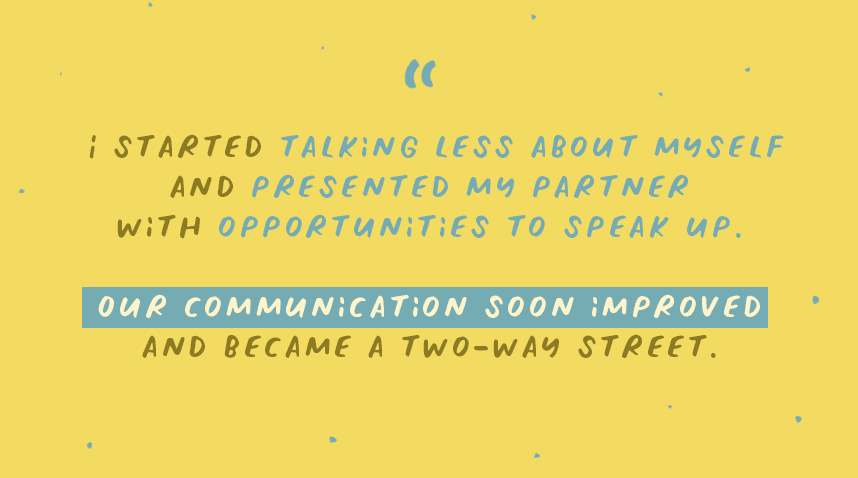
As I hone my mindfulness, I started talking less about myself and presented my partner with opportunities to speak up. Our communication soon improved and became a two-way street.
Moreover, incorporating mindfulness in our everyday speech and actions allowed us to be considerate of one another’s needs.
By practising mindfulness, we have transformed the way my partner and I communicate and have mitigated many potential flashpoints. Until today, even when I am studying abroad, our communication has improved and that boils down to being aware of how we communicate.
3. Put in the Effort & be Willing to Compromise
Humans can be selfish. However, we humans can cooperate too. Each partner can coexist in a relationship but opt to pursue his/her interest. Be it to flaunt the relationship as social status or to be satisfying sexual needs. If one is not putting in the effort into the relationship and is bent on pursuing his/her own “selfish” endeavours, the relationship is unlikely to last.
It takes two hands to clap. For the couple to succeed in a relationship, they must put away their differences, identify potential weaknesses and cooperate to work towards the goal.
If both parties share the same commonalities, then the relationship has a set goal.
However, the outcomes only become real if the process is set in place and acted upon through effort.
Thisinvolves compromising on some of your interests for the relationship. For example, living in different time zones, I had to stay up past midnight and she would wake up early to skype. Although this does not seem like much, it reflects two points in maintaining a healthy LDR:
Firstly, we both share the same commonality and are willing to put in the effort to achieve it. Secondly, that process meant that both parties had to compromise, forgo sleep, etc to keep the relationship growing.
My mentor once mentioned, “Sharing similar hobbies doesn’t necessarily make the relationship work, it’s about you putting in the effort to settle your differences and make sure it works. It’s important to note that every relationship is a collective effort. Both parties must be prepared to put in the effort and willing to sacrifice some short-term interest for longer ones.”
Closing Thoughts
Undergoing an LDR or any relationship for that matter is no easy feat. Our relationship had to overcome numerous obstacles and social stigmas. However, our relative success can be attributed to these 3 takeaways.
These 3 lessons must be seen as complementary to one another and not mutually exclusive. Like me and many others who have gone through LDR, it’s not going to be easy but it is possible if one bears these 3 lessons in mind. In any relationship, it always takes two hands to clap.
Wise Steps:
Develop commonality in your relationship on how you envision it to be and the dreams you hold together
Practice mindful communication with your partner by avoiding the ‘self-appreciating trap’
Be willing to compromise, even if it means putting your ego & interest aside.