TLDR: Is Metta Meditation really beneficial? Jin Young shares his own personal practice and his relationship with loving kindness meditation. A 30-min guided meditation is included. You’re invited to test it out for yourself.
When you don’t know what to do, try out metta or loving kindness meditation.
Encountering Metta MeditationMy first encounter with metta was listening to Imee Ooi’s “Chant of Metta ”. Imee’s voice was angel-like, saccharine and soothing. I especially enjoyed her chanting of the Metta Sutta in Pali language, albeit not knowing much about the actual meaning behind those words back then.
My mom would sometimes play the CD around bedtime, and I guess it must have had some sort of sleep-inducing effect, much like lullabies for babies.
Lighting My Fire Of Metta
When I was fifteen, I sat through my first metta meditation under the guidance of Ajahn Brahm. Ajahn explained that the cultivation of metta is analogous to starting a fire. You can’t start a fire by lighting up a huge log.
Rather, you need kindling, easily combustible materials for starting a fire such as papers or small little twigs. Once the fire is started, one then adds on larger and larger twigs before moving on to solid pieces of wood.
When the fire is well maintained, you can further grow it until the passion of loving kindness is strong enough to embrace the whole universe and even your worst enemies.
But first, we need to start with kindling. Ajahn told us to visualize someone whom we can readily feel and send loving kindness to. For me, it was my late grandmother who had taken care of me when I was young. She showered me with unconditional love.
“Dear Ahma”
“The door of my heart is open to you”
“I will take care of you”
“May you be safe, well and happy”.
With these words, I felt my chest and heart glowing with love and warmth. We then proceed to send similar thoughts and wishes to our other family members, friends, acquaintances, animals, and all sentient beings.
It was an empowering experience to meditate on metta with Ajahn Brahm. The flame of “metta” was passed on from Ajahn to us, and from us to our loved ones and on and on.
Keeping the Metta Flame Glowing
Since then, I’ve tried my best to keep this flame alive wherever I go. In Selangor, I joined the Buddhist Gem Fellowship and attended a weekly guided metta meditation by Datuk Seri Dr. Victor Wee, another lay-teacher and compassionate mentor.
Dr. Wee’s cues were slightly different from Ajahn Brahm’s, but the spirit of loving kindness was the same.
I brought the practice of metta meditation with me to Japan and China, where I studied abroad for four years. Whenever I missed my family, encountered negative events, or felt like I was stuck in an uncertain and helpless situation, I turned to metta meditation for help.
I like to believe that by sending my thoughts of loving-kindness to my family and friends, they are protected by my wishes, and become well and happy.
By sending metta to a professor or a superior, he or she would give me an A+ or a pay raise (I’m only half-kidding). By sending it to someone with whom I’ve had a negative encounter, relationships will slowly turn for the better, enmity and ill will shall be transformed into love and light.
No, Metta doesn’t Solve Everything
Of course, there’s no guarantee that metta will always convert “negativity” into “positivity”, nor is it a panacea for everything in life.
However, I believe that it can help transform the state of one’s mind – To face life’s suffering and problems with a heart of loving-kindness and gentleness.
Over time, as I became a yoga teacher and started leading mindfulness retreat expeditions to the Himalayas, I’ve developed and come up with my practice and cues for leading metta meditation.
These cues are of course consolidated from the various teachers mentioned above. During this pandemic lockdown, I decided to record a 30-min long guided metta meditation. I share it with anyone keen to explore and integrate this practice into their lives.
“Watch your thoughts, they become your words; watch your words, they become your actions; watch your actions, they become your habits; watch your habits, they become your character; watch your character, it becomes your destiny.” This quote is often attributed to Laotzu.
Can we make metta “loving-kindness” the character and destiny of our life?
Wise Steps:
If you find it hard to send loving thoughts in your mind, find a safe space and utter them out in words.
Make it a habit to randomly wish someone to be well and happy each day, whether it’s mentally towards someone you love or to random strangers on the streets.
Meditate at least once a week to reset yourself energetically and spiritually.
Ghost Month Series: This series explores different angles of the 7th Lunar Month, also known as the Ghost Month. Festivals, Cultures, and Religions often mix together in one place, offering space for different interpretations. We, like you, are keen to explore more. Discern what is helpful to your practice and discard whatever is not.
TLDR: The encounters with an unseen being leads to a reflection on human nature and how we relate to other beings in Buddhist cosmology.
One Fateful Night
At barely 6.30pm, the women’s compound of Wat Boonyawad was almost pitch dark within the forest. I hastened my footsteps after finishing walking meditation near the main gate – tempo accelerando. There was no one else. In that solitude, I wished someone was with me — just not the unseen sort, whatever it wanted with me.
My torch was barely strong enough to see beyond one metre from my feet. Leaves crunched beneath me, like in The Slender Man.
Near my kuti (small practitioner’s hut) after I had washed my feet, leaves rustled and a breezy presence weaved through the surrounding forest. Yet, my skin pricked with heat. Panicking, I ran up the steps to the door.
Meeting the Ghost of my Mind
I fumbled for the key, with the torch gripped in between my teeth. Jaws tightened. The fear of being caught up by a menacing force crescendoed as each attempt to slot the key into the lock pad failed. Mosquitoes hummed impatiently beside my ears. Quick. Quick.
Finally, the lock turned and I slammed the door tightly behind me. All that hooting and howling from the forest grew claustrophobic; their sources unbeknownst to me. The forest has its ways to play tricks on the mind. This meditation retreat was my first ever to stay alone in a forest hut within a Thai monastery. So much unknown to fear for.
The relief of getting into the kuti (meditation hut) did not last, I hurried to the little altar to light up the candles, the heart-throbbing at my throat.
Buddha, help me. Bow. Dhamma, help me. Bow. Ajahns, help me. Bow. The candles flickered in the twilight.
I inched my way to unwind the huge windows for ventilation; my eyes averting the ominous world outside. What if a ghastly face stared back at me? At that thought, my hair stood on its ends as a chill ran down the spine. Spinning out of the sensation, I plunged to the floor into a half-lotus position for sitting meditation.
Buddho buddho buddho.
Buddho buddho.
Buddho.
Bud-dho.
Bud-dho.
Bud–dho.
Bud—-dho.
When hyperventilation evolved into a smoother and more refined breath, I saw clearly all that fear about ghosts was merely the sensitive mind misdirecting its alertness. I believed in ghosts’ presence within Buddhist cosmology.
At that time, I also assumed their nature to seek me out in avenging my past karmic misdeeds and sucking my energy dry with evil trances.
That such a hateful encounter was bound to happen kept my heart from sinking into the peace. It wasn’t the forest that was playing tricks. My defiled mind was the culprit puppeteer, pulling strings on a ghost puppet.
The First Encounter
No, I would not let that made-up ghost rob me of the peace that can develop from retreating thousands of miles away from home. The fear mis-manufactured from baseless perceptions and thoughts can stay.But I did not wish to indulge its willfulness, despite not understanding it fully.
With that determination to set aside fear, the heart finally found its resting spot in even more refined breaths: a clear quiet space opened up within my mind. The candles at the altar had gone out by then. The nocturne calls of animals were distant. This was one of the rare peaceful moments in the retreat, truly. A deep state of focus, tranquil, alert.
Soon, a face showed itself in my mind’s eyes. No vengeful entrance — gradual, weightless.
Just a head dripping in blood, rotten flesh, long hair; her round bloodshot eyes stared into me. The body trailed off. A very… sorry plight; nothing threatening.
I couldn’t explain how I knew this presence to be true but I did. The fear that I experienced earlier did not arise again. No goosebumps. No chills. I steadied the mind on the being, looking right back. I did not wish her away, neither did she seem to want to go away. Not yet.
Here, memories of reading Mae Chee Kaew’s biography where she communicated to ghosts using her heart surfaced within my mind. I was definitely not Mae Chee Kaew, but maybe I could try communicating to the ghost too.
What do you need from me? What is helpful for you?
Share merits. You have been practising the Dhamma.
I will wish you well. Hope you can receive them.
Eyes shut tight still. My heart turned inwards further and channel whatever wholesome bits it could find towards the being in front:
May you receive all the blessings from the goodness I had cultivated since the start of my life. May you have the merits you need for a fortunate rebirth. May you seek safety and refuge in the Buddha, Dhamma and Sangha. May you be free from all sorts of suffering in the future. May you be well and happy.
These phrases repeated in my mind like a playlist on loop, religiously as if my life–her life–depended on them. The sphere of goodwill (metta) radiated outwards to imbue her presence within it. Not long after a few cycles, the unseen being took her leave –gently, gradually, lightly–much like how she appeared but with more ease. The meditation came to an end too.
Do I know you? I wanted to ask but I didn’t. A sense of familiarity lingered, although I could not quite put a finger to it.
Moonlight shone through the canopy; their piercing beams reflected off the forest floor, lighting up the pitch dark from before. I took three candles outside, keen to place them along the earthen path for walking meditation. Finally, I was brave enough to venture out after nightfall. Before this night, moonlit walking meditation was completely unfathomable.
Affinity Knows no Boundaries
In my subsequent stays at various forest monasteries, trips to Kuala Lumpur, even at home, when I was alone in meditation and there were particular still moments of clarity at night, unseen beings of similar profiles would appear in my meditation. Each time, they asked for merits. Each time, I tried to maintain my compassion to share merits. Afterwards, they would leave quietly.
The restless mind was still afraid of the dark and jumpscares, but the fear was more manageable than the very first encounter.
These encounters were at least half a year apart so I thought that the beings were different individuals.
It was not until my India pilgrimage that I realised a trend.
Final Encounter in Pilgrimage
The hotel we stayed in at Vesali was haunted. According to Thai Forest Venerable Luang Por Piak, tens of thousands of hungry ghosts hung around the hotel. At the worst of my cough, I felt nauseous on the first night, after returning from a day of breakdowns. A Thai female doctor with the tour suggested treating me with acupuncture, which I desperately accepted. Anything to get me out of that bodily hell.
Moments after the acupuncture began, I slipped into unconsciousness while I was trying very much to be mindful of the needles. Soon, I fainted on my bed.
That night, I woke to a persistent furious hammering on the windows. Calling out to my Thai roommate from my crippling fear of angry ghosts, I hid under the covers, still weak from earlier. She went up to check the curtains and found monkeys. Nothing to be afraid of. Go back to sleep. How? I could barely feel safe.
On the second evening in Vesali, a second acupuncture session occurred in another hotel room, in which its inhabitants complained of paranormal activities from the night before. Despite the crowd receiving treatment, I caught a waft of ‘off-energy’. While sitting in meditation at a dimly lit corner, the mind gathered into stillness.
Soon enough, a familiar image of a bloody head and wispy long black hair came into view – the same request ensued.
This time I finally recognised her although she was hovering at the corner. An insight struck: this was the very same unseen being who sought my attention at Wat Boonyawad and thereafter.
She had followed me to India! She had been following me all this while! In sharing merits, I recollected about the wholesomeness from visiting the key Buddhist holy sites thus far and wished her to rejoice in the rare occasions arising from that pilgrimage. That night, I slept soundly.
At the last stop of the pilgrimage – Varanasi, my tour group disclosed that my Thai roommate (gifted with supernatural vision) had seen a ghost sitting on my bed that very night in Vesali. That was definitely goosebumps-inducing. Rounding up the trip at a final chanting session in Deer’s Park, I made a determination to dedicate all the merits from the pilgrimage to the unseen being.
Since then, she has not visited me in meditation. I would like to think that she has gathered sufficient merits to be reborn in a better place.
How Can We Live Better in this Cosmic World?
My unseen encounters left a lasting effect on my practice. They taught me to face my fear of darkness and to respect the presence of unseen beings. Now, I make a point to share merits every morning chanting and when I offer meal dana to monks. Sharing merits help to cultivate generosity in the immaterial world.
I have not mentioned the unseen encounters to my spiritual friends openly, for fear of coming across as boastful. The intention of sharing my encounters here is to help readers reflect that there are deprived states, where unseen beings exist in our cosmic world.
They exist out of their attachments and/or hatred to this material world, which they were not able to relinquish upon their death as humans.
(While I have not met malicious beings, I have heard stories of where ghosts have party hangouts in rooms for extended periods.)
Reflecting on the deprived states of ghosts, can we then work on our attachments, anger and hatred in this human life?
Perhaps, as much as I have encountered the manifestations of an unseen being, the visualization mirrored the hatred contained within my heart. Using the same Dhammic approach of awareness and acceptance, I can introspect on what the heart needs and what is beneficial for it. Then, apply the balm of loving-kindness and compassion.
To the being and myself: wherever you may be, I wish you well and hope you benefit from the Buddha’s dispensation, always.
Wise Steps:
Casper the friendly ghost is not untrue — ghosts primarily want sharing of merits when they manifest to you.
If you encountered ghosts as malicious, share even more merits. Done from a mind of pure generosity, offering a Sangha Dana can generate merits for unseen beings who could receive them for long-term welfare and fortunate rebirth.
With compassion towards the deprivation ghosts exist in, we may contemplate our strong attachments and begin to let go of the hatred we experience within our hearts.
Buddhist Film Reviews is a partnership series between HOL & THIS Buddhist Film Festival 2021 (25 Sept – 8 Oct’21). Themed “Open your mind”, THISBFF 2021 features 15 thought-provoking documentaries and feature films from 12 countries.
TLDR: A young monk is tasked to solve a series of puzzles in order to return home, but discovers something else in the process.
The definition of ‘home’ changes throughout one’s life. Whether we consider it synonymous to the place, people, or just a sense of safety and security, ‘home’ may be where the heart is – but even the most permanent residences are inevitably transitory in nature.
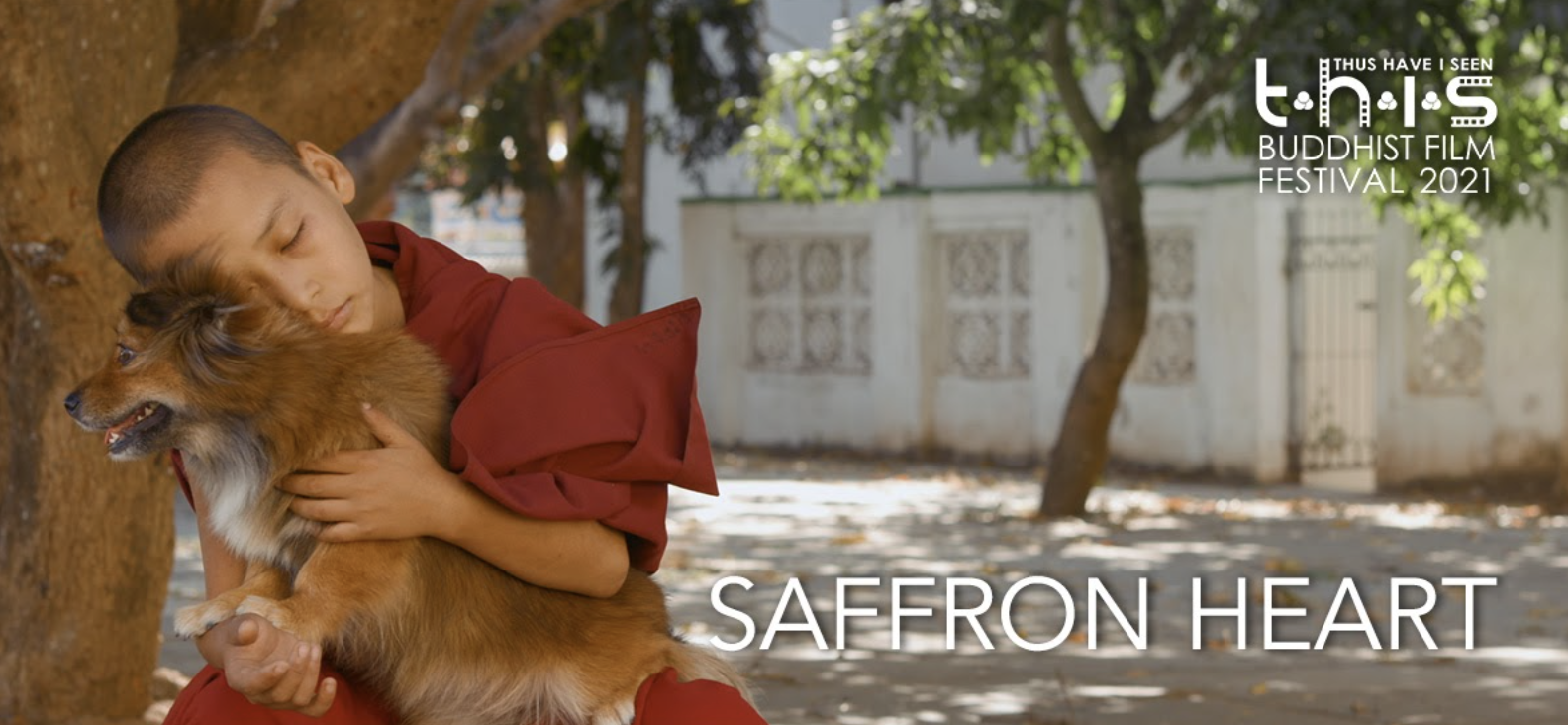
It is a lesson young Lobsang learns as he is sent to a Buddhist monastery at the tender age of ten. Uprooted from home and thrust into an unfamiliar environment, he quickly finds himself missing his home and his parents, and that yearning turns into several failed attempts at escaping the monastery.
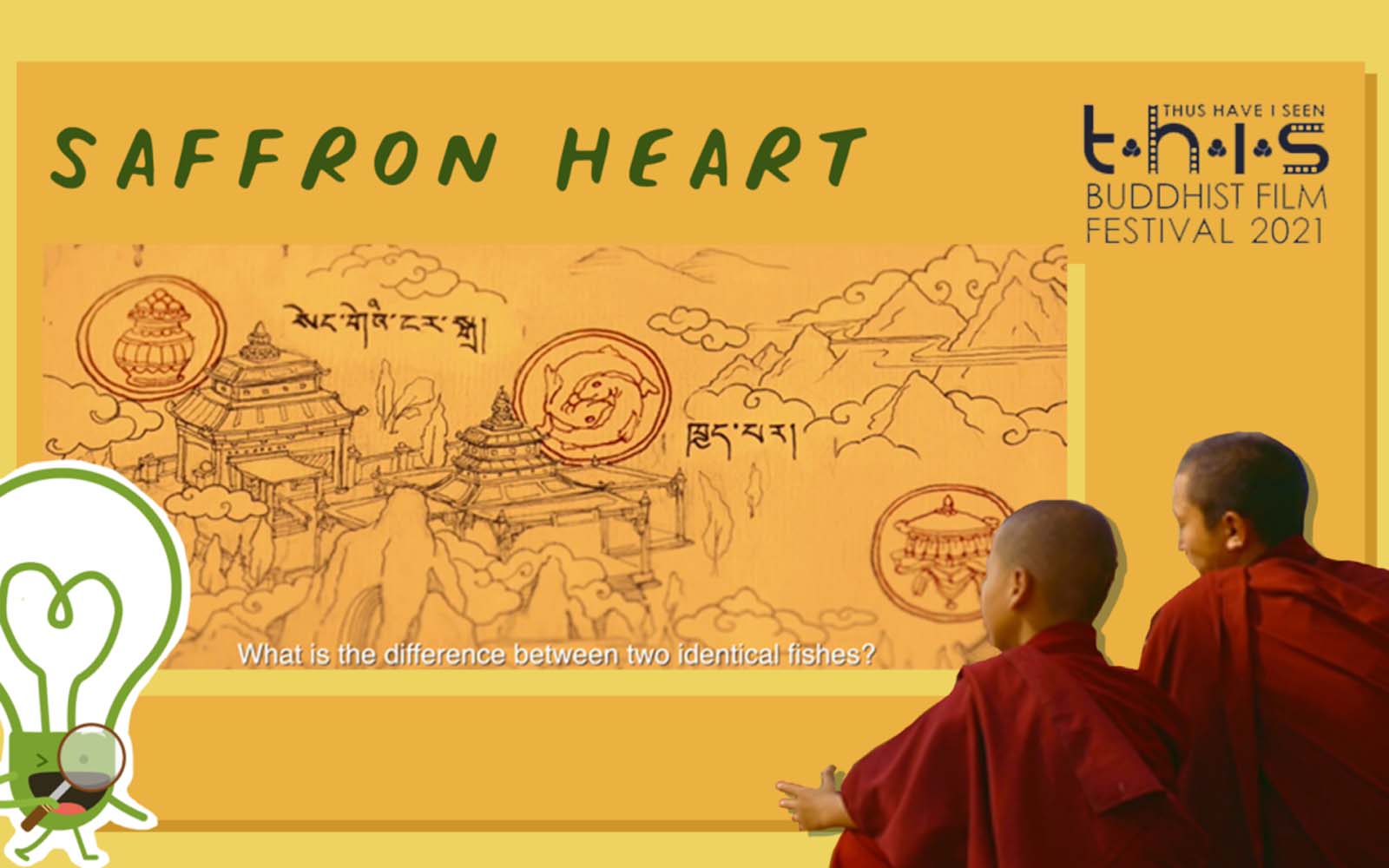
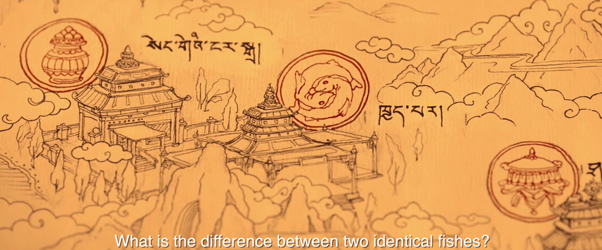
In response, his compassionate teacher draws him a map-quest consisting of a series of eight puzzles that upon solving would allow Lobsang to return home.
“Why do deers need an umbrella?”
“How do you hide a lion’s roar in a pot?”
“What is the difference between two identical fishes?”
Crafted in relation to the Eight Auspicious Signs in Tibetan Buddhism, each puzzle guides Lobsang towards a piece of Buddhist wisdom, with the young monk’s curiosity soon taking him around the monastery and out. Experimenting with meditation. Scouring dense forests and packed libraries. Even having a brush with the supernatural. Lobsang’s adventure is laced with philosophical questions on suffering and attachment, yet because of its colourful analogies, the lessons he takes away are accessible and creative takes on the Buddha’s teachings.
Filled with inquisitive questions on every encounter, Lobsang ensures that the audience tags closely along when it comes to learning and growth.
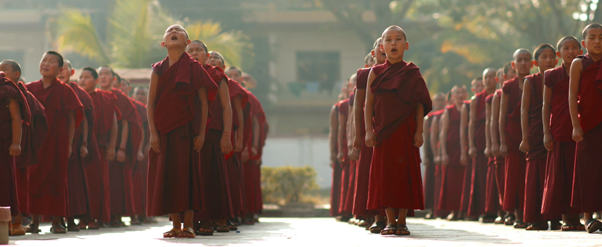
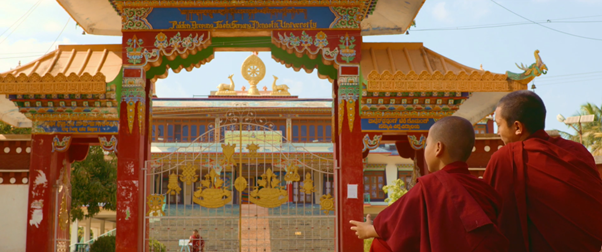
The film takes place in Drepung Gomang Monastery in Mundgod, India, where 2000 monks currently reside. Giving us a glimpse into the everyday lives of Tibetan monks living in India, from hours of chanting and reading, to the unorthodox practice of Buddhist debate in Tibetan Buddhism, life as a monk centred heavily on education for these young men, covering not just academic texts but also philosophical discourses on logic and conceptualisation.
Yet, practice for them also extends into laborious tasks like washing robes and kneading dough, dispelling any myths about how easy monkhood might be for Lobsang and any unknowing viewer.
After all, renunciation for them was not meant to be an escape from the monotony of life, but to study life itself so they can share their knowledge and wisdom with others.
Beyond the Buddhist lessons, Saffron Heart is at heart also a story of friendship.
Throughout the 90-minute film, we see a blossoming relationship between Lobsang and his senior novice monk Tashi, who was assigned to guide him along. Though the exposition in dialogue was at times lengthy, Lobsang and Tashi’s natural chemistry made them an endearing pair to watch and root for on their individual journeys of growth.
While the song choices for some scenes felt out of place at times, the cinematography was stellar throughout the film. Capturing Mundgod’s scenic mountainous landscapes and Drepung Gomang’s intricate architecture, any frame in Saffron Heart would not be out of place as a still.
Despite Lobsang’s initial feelings of entrapment and longing for home, the mise-en-scene of scenes in the movie conveys a sense of spaciousness throughout the film. Living a completely different life in our concrete jungle here in Singapore, it made me wonder about the parallels between freedom, our environment and the states of mind.
The debut feature film of filmmaker and music composer Paul McLay, Saffron Heart comes from simple motivations: a desire to help and to inspire. Channelling all proceeds from the film towards Tibetan refugees living in a conservation area in South India, the effort to raise funds for the displaced parallels the film’s central narrative of finding wisdom amidst adversity and change.
Framed in a way that is suitable for all ages – from kids curious about Buddhism, to adults looking for a heart-warming tale – Saffron Heart serves as a reminder that as we go about our personal journeys, it’s not the destination but the process that serves as our biggest takeaway.
Liked what our author experienced? Book your tickets right now!
Buddhist Film Reviews is a partnership series between HOL & THIS Buddhist Film Festival 2021 (25 Sept – 8 Oct’21). Themed “Open your mind”, THISBFF 2021 features 15 thought-provoking documentaries and feature films from 12 countries.
TLDR: ‘Wandering… But Not Lost’ is a documentary about Yongey Mingyur Rinpoche’s solitary journey in India and Nepal as he explored different terrains and places while centred on his awareness.
Last year, I bought a book by Yongey Mingyur Rinpoche titled In Love With the World. The book chronicles his experience wandering through India and Nepal as a way to practice mindfulness. Mingyur Rinpoche had for a long time intended to go away quietly for a personal three-year retreat in the world and finally realized it in 2011. This book on his journey is now translated into a visual form in the documentary Wandering… But Not Lost.
The book is not so much a travelogue into the different Indian and Nepali provinces but about the monk’s inner journey. Although his body is moving from place to place, there is the reminder for us to keep recollecting our awareness, like he did, no matter where we are and what we are doing.
As a tulku, Mingyur Rinpoche was born into privilege in the monastic aristocracy of Tibetan Buddhism. A tulku is a reincarnated lineage holder in Tibetan Buddhism, who as a child is raised and taught by students of his predecessor to be groomed into a teacher of Buddhist scriptures and meditation to continue the tradition and practice. With all these identities and expectations put upon him, Mingyur Rinpoche wanted to discover his true mind by letting go of all of his privileges and identities. He sought to do so by living as a wandering yogi.
Mingyur Rinpoche has been teaching internationally to both the monastic and lay community before he brought his plan for solitary retreat into fruition.
Heeding his late father’s advice, Mingyur Rinpoche slipped away in the middle of the night out of his home monastery – Tegar Monastery in Bodh Gaya to take a train to Varanasi, without anyone’s notice.
All Buddhist traditions practice mindfulness retreats but each may do it differently due to various cultures and environments. In Tibetan Buddhism, monks usually retreat to a remote cave to practice solitary meditation for a few years. He is tended to by an attendant who will help him with his basic necessities such as food. As a tulku, Mingyur Rinpoche had his taste of a solitary retreat in a cave, but not out in the world on his own. He had been inspired by the likes of Shakyamuni Buddha and Milarepa.
At the start of the adventure, the young abbot faced challenges immediately at the train station. He had not been used to handling money as his attendant was always the one buying tickets for him. He bought a ticket to the lowest class cabin, which he was also unaccustomed to. He sat amongst the crowd and meditated to the sound of the train and was mindful of his aversion towards the body odours found in every corner.
The real test came when Mingyur Rinpoche ran out of the few thousand rupees he brought along with him when he was at Kushinagar.
Kushinagar was the place where the Buddha entered parinibbana. It was also the place Mingyur Rinpoche nearly died. He fell ill from food poisoning, having begged for his first meal at a stall he once frequented. Debating whether to call for help or to allow things to be, Mingyur Rinpoche chose the latter and sat weakly against a wall to meditate on awareness.
The documentary features majestic views of the Himalayan mountains and valleys, as well as Indian and Nepali holy sites as Mingyur Rinpoche travelled and ate by depending on the kindness of others. The film included interviews with him about how he faced challenges by reminding himself to pay attention to awareness. Mingyur Rinpoche added that most people meditate to gain the feelings of peace. But the true purpose of meditation is to see awareness itself. He described awareness as a diamond sitting within us waiting to be discovered. But all we see are the coloured backgrounds that the diamond is placed against.
Mingyur Rinpoche’s journey took a turn for the better after his near-death experience in Kushinagar.
His body became weak, but his awareness brightened and expanded. He felt he was everywhere but yet nowhere. Saved by a retreatant on a pilgrimage in India at Kushinagar, Mingyur Rinpoche recovered from the food poisoning episode and emerged with joy and freedom as he wandered the streets and the mountains, feeling at home everywhere he went.
The documentary is a reminder for us to pay attention to the diamond within us. We can be in the city and our hearts are in the mountains. Or we can be in the mountains and our hearts in the city. But wherever our bodies may go, it is our awareness that is the real beauty against the backdrops of our own lives.
TLDR: Mindfulness practice is not limited to seated meditation sessions with closed eyes. With 4 simple steps, try cultivating an awareness of the present even on your next run.
In the Autumn of 2019, a continent and a half away from home, I picked up a tiny book from one of the many thrift stores in unassuming Birmingham. It was small enough to fit into the palm of my hand. Cheap enough that it cost a single pound. Yet what struck me most, was the title of Thich Nhat Hanh’s charming book How to Walk.
Sharing snippets on the essentials of mindfulness practice, the book is packed with short stories and illustrations of the impact mindful walking can have. The benefits are not limited to the person walking but also the world around them.
The book contains brief instructions on how slow, concentrated steps can be an opportunity to become more present. Although the contents of the book is short, walking meditation – or caṅkama in Pali – has had a long history, dating back to the Buddha’s time.
Resonating with its accessibility in my everyday life, even walks to the MRT station have become more enjoyable, despite the sweltering Singapore heat.
Yet for a working adult looking to pass his IPPT in a couple of months, long walks sometimes do not quite cut it. Naturally, I thought of taking it a couple of steps further (and faster), “Would it be possible to adopt the same concepts of walking meditation to running?”
Why Running and Mindfulness Might be a Good Idea
Some hate it, others live by it, but running has long been heralded as a tool for maintaining physical well being. However, our mental health also stands to gain from us hitting the pavement. Running releases endorphins, dopamine, serotonin and norepinephrine that can help relieve stress and provide a calmer state of mind. It minimizes cognitive decline, preventing degeneration of the hippocampus, the part of our brain that handles memory and learning.
Interestingly, there is growing evidence to support the marriage of two seemingly distinct activities. By staying focused on their physical sensations, thoughts and emotions as they run, studies have shown that runners can enhance performance, assist their recovery process and even reduce injury.
This became a training technique for long-distance runners to tackle the limits of their mental restraints.
Ok enough evangelising. How can we apply mindfulness to our runs? At its core, mindful running is about being anchored to the present. While it may sound at odds with an activity that is moving you from one place to another with each passing stride, this is not impossible to do.
Here is a quick 4-step guide:
1. Pay Attention to the World Around You
Firstly, you can start by paying attention to the world around you as you pass them by. Next, pay attention to the steps you take. One way of making your jog a more contemplative experience is to notice all that is around you, both visually and auditorily.
People walking by. The swaying of trees. Chirping of birds. Buildings in their various forms and colours. There is so much to take in, and yet each scene and soundbite is never more transient as you run, changing with each bend you turn and each street lamp you pass.
Above all, remember to keep a lookout for where your feet are going to land.
Note: As tempting as it is to catch up on that podcast or to blast your workout track, paying attention to your surroundings means no earphones for this run. Road safety yo.
2. Tune into Your Breath
Running is the perfect opportunity for you to practice one of the most fundamental meditation practices: watching your breath. It may seem trite and impractical to do so as you are huffing and puffing your lungs away, but that is precisely the challenge it provides in honing your concentration.
Beyond noticing each breath, running allows you to also observe how your breathing changes over the course of the run.
How does it compare at the start, middle and end? How much does it change from stride to stride? Are you breathing through your mouth or your nose? These are a few of the things you can ask yourself, as you tune into your breath.
3. Be Aware of the Rest of Your Body
Next, mindful running is also an opportunity to better synchronise yourself with your body. As you run, do a body scan. Which part of the foot is hitting the floor first: is it the ball, the heel, the toes? How do your feet feel, as it rises up and lands back down? The snugness of your feet in your shoe. The stretching of your shirt as your arms swing to the cadence of your stride. Notice the tension of your muscles – from your neck to your shoulders, thighs to calves.
Body scanning during your run provides a platform to better understand your body. Scanning helps respond to signs that you should slow down, rest and recover – preventing injuries and improving wellbeing.
4. Be Non-judgemental
Most importantly, practising mindfulness in running is to practice non-judgement. When running, too often we are caught up in performance, metrics and timing, instead of the run itself. Running mindfully does not require you to go fast, nor slow.
Running is ultimately about moving, and seeing any pace as a good pace for a run. So as you engage in these mindful runs, ditch your smartwatch and IPPT goals.
Listen to your breath, body and the present moment instead. And even if you cannot, remember to practice non-judgement on yourself.
Staying Present With Movement
In all, mindful running is another way by which we can cultivate an awareness of our present moment as we engage in our everyday lives. I have found the principles of walking meditation and mindfulness to be a perfect accompaniment to my runs. It has allowed me to feel more connected to not just myself, but also my environment.
That said, not every run has been a mindful run. But just like how fitness builds with time, whether you are a beginner athlete or a semi-pro running veteran, maybe it is time to add another tool to your exercise regime.
Wise Steps:
Try running without headphones or distractions, just be in the moment
Be aware of the number of times your mind criticises or praises yourself for overtaking/falling behind other runners