TLDR: Running felt awful at first where I was breathless, messy and discouraging. Sticking with a beginner’s mindset turned pain into something workable and even calming.
When I talk to my friends, some of them often say, “I don’t like running” or “I really hate running.” When I ask why, the answers are usually the same: “I feel breathless” or “I can’t maintain a consistent pace.”
Deep down, I resonate with them. I used to, and occasionally still do, experience that same unpleasant sensation while running. Yet, over time, I realised that the lessons running teaches my mind bring far greater satisfaction to my overall mental and physical well-being than the temporary discomfort it creates.
So, let me share what I’ve learned along the way:
1. It’s Hard At First, But It Gets Better
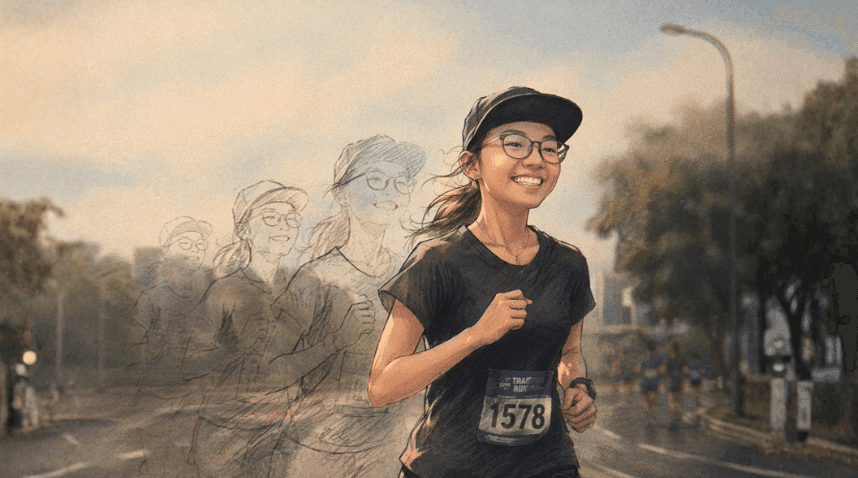
I started my running journey in mid-2024, largely because of friends. With a goal to complete a race in September 2024, we trained once a week. Back then, running just 3km felt like torture. Running was never my forte (and honestly, still isn’t), so I struggled with my breathing, my form, and my confidence.
But you never know unless you try.
I entered running with a beginner’s mindset: accepting that pain exists, that improvement takes time, and that small adjustments to breathing and technique matter.
Slowly, I realised something important: the pain is temporary. Once you pass that phase, running can become therapeutic. With the wind brushing past and the rhythm of my steps, I felt a sense of freedom. No overthinking, no monkey mind. Just breath, movement, and the present moment.
Looking back, this reminds me of something the Buddha often emphasised: training is gradual. The body learns in stages, and so does the mind. Discomfort does not mean something is wrong. It often means something is being learnt. When I stopped fighting the unpleasantness and simply stayed with it, the struggle softened on its own.
2. Do It Scared
After crossing the 5km mark, I decided to join a running club. I joined alone because the friend who recommended it couldn’t make it that day. It was intimidating, stepping outside my comfort zone, surrounded by experienced runners.
Thankfully, there were other first-timers, and we ran together.
However, midway through the run, I couldn’t hold my pace. From the middle of the pack, I slowly drifted to the back until the sweeper pacer stayed by my side. She shared tips with me, though I barely absorbed them as I struggled to breathe. Near the end, I decided to walk for a bit. She understood, it was a beginner’s struggle, and I returned among the last few runners.
What made me come back was curiosity. I wanted to try the advice she gave me. With a sense of ehipassiko, “come and see for yourself”, I continued running, joining other clubs and experiencing different group vibes. As an extrovert, I found this surprisingly fun!
It was scary at first. But fear fades when you show up, again and again.
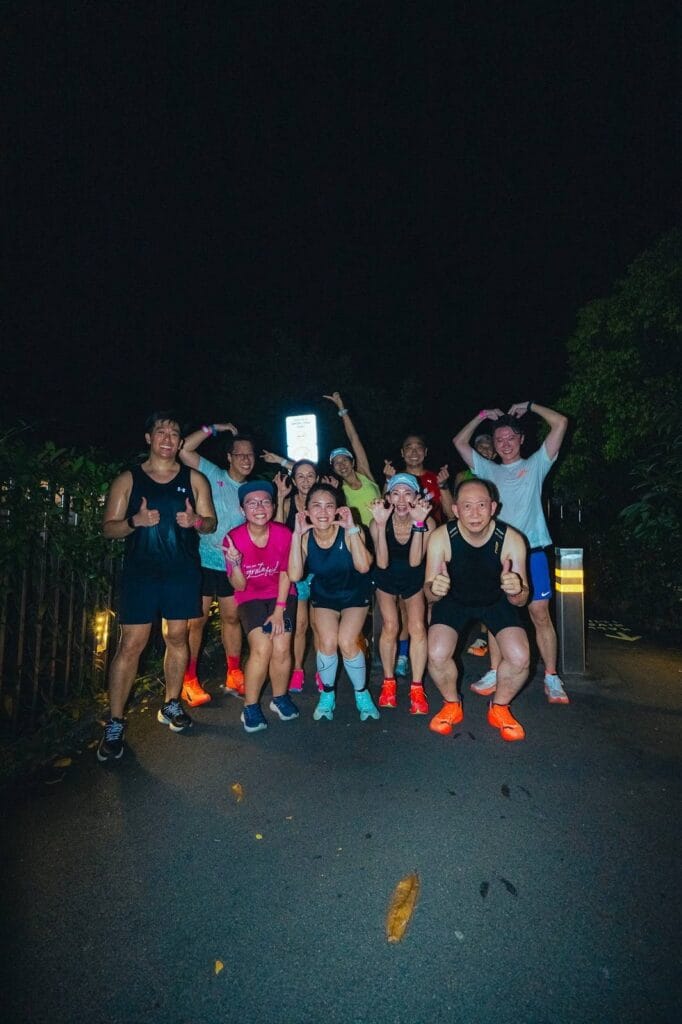
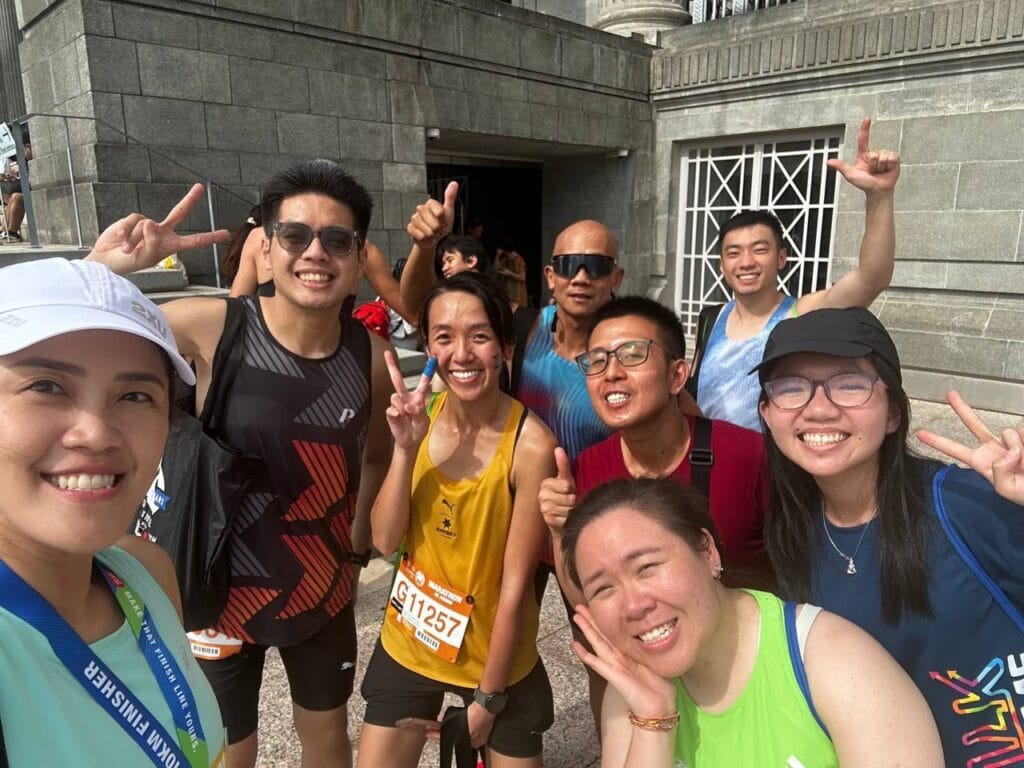
Over time, I made new friends. From running in silence to training and running together with marathon buddies. It was a meaningful connection I found through joining running clubs. I’m grateful to meet supportive camaraderie who share the same hobby.
3. Start Everything with Intention
As I went deeper into the running “realm,” I learned that there are different training types and zones. Some runs push speed; others require slowing down to build long-term strength.
Once I understood this, I began setting intentions before every run. The temptation to compare myself, to look left and right, is always there. But the grass is always greener on the other side. Your own grass grows when you water it consistently.
So my intention became simple: show up, water my own grass, and trust that results will come in their own time. I push myself to a level that still feels okay, without pushing my body to the point of burnout. Somemore it’s fun to switch various training in a week too!
4. You Don’t Always Get What You Want… And That’s Okay
Every training plan comes with goals. But life gives lemons often times…
I once aimed for a 6:30/km pace in a 10km race and finished at 6:33/km, ending the race feeling nauseous. That experience taught me to start steady instead of getting swept up by the crowd (I had run the first 2km at a 5:00 pace). There was also a time on my first ever half-marathon where my watch malfunctioned at the 9km mark and restarted from zero. So I didn’t get any PB (personal best) recorded on stats for both races that I was looking forward to.
When my watch restarted from zero, I was reminded that suffering often comes not from what happens, but from what we cling to.
It’s actually a reminder to let go of the desire for validation and proof. The frustration tells me to enjoy the process, and going back to the reason why I run in the first place: to experience a little bit of “freedom” and to have fun enjoying different moments in life.
I take heart too in Ajahn Brahm’s, a famous Australian meditation master, saying that:
“Your job is not to ask for things the world can’t give you. Your job is to observe. Your job is not to try to prod and push this world to make it just the way you would like it to be. Your job is to understand, accept, and let it go.”
5. Surround Yourself with People Who are Better Than You
Or in other words, it’s okay to be the “dumbest” in the room.
When I wanted to improve my speed, I joined interval training sessions. Puma Run Club became my choice because of its structured coaching. Yes, the pressure was there, but I learned to embrace my pace and enjoy the companionship.
It also teaches me to loosen my attachment to the sense of “self.” Insecurity still arises, thoughts like “I don’t fit in” or “I’m so slow compared to them.” Instead of getting caught in them, I observe these thoughts like floating clouds. I recall the idea of “self” is shaped by conditions and is constantly changing. Hence, with this understanding, I can come with an objective intention to learn, without feeding my insecurities.
It turns out by running with people more experienced than me, I learned practical tips through shared stories. My pace and endurance slowly improved and I gained friendships along the way.
6. Cherish the Companions
One of the most beautiful things about running communities is their positivity. I’ve never felt discouraged by seasoned runners. They don’t judge you for running slowly, because they understand it’s part of the process. Any fear or negativity I felt initially came from my own mind. Once I let go of the negative mindset, I come to run with a lighter heart.
Happy people celebrate effort. And that energy matters to keep going, improving in running or just striving in ‘life’ in general. Most of the runners are very supportive! Some of us also ran 21KM and came on both days to cheer for other runners too!
Beyond Running
I’m grateful to meet friends from the running community with whom we can talk about other aspects of life! From helping a friend get her race bib, work life, to travel, family, even I found my neighbour whose house in Jakarta is just 2-3 units away from mine! XD
It was really fun getting to know new friends and broadening my perspective, too!
Also, other areas of my life have improved. I gained clarity during my quarter-life crisis, and yes, as a side effect, I finally reached a weight I had been aiming for since upper primary school 😂.
More importantly, running taught me lessons beyond exercise. It reshaped how I face challenges, helped me reframe difficulties, and reminded me to keep going, even when life feels uncomfortable. Last but not least, having supportive friends is really important in the journey – they are your fuel to keep going when you feel unmotivated!
I hope I continue to have the right conditions to maintain a beginner’s mindset, one that allows me to keep learning and experimenting (taking in the essence of ehipassiko) in many forms: exercise, meditation, creativity, leadership, and beyond, with a single intention: to be a better person every day.
Thanks for reading! Hope this sharing also inspired you to be better for your own physical and mental well-being!
Cheers, Ditt
Wise Steps
Start with a beginner’s plan and accept early discomfort, because training is gradual for body and mind, like running 3km easy while noticing breath without judgement.
Join a group even if you’re anxious, since fear shrinks with exposure and support, like turning up alone to a club run and sticking with the sweeper.
Set a clear intention before each session to curb comparison, such as deciding today is a slow zone-2 run and ignoring faster packs on the park loop.
TLDR: A serendipitous Eventbrite listing led me from being stuck in secular mindfulness apps to walking on the Noble Eightfold Path. This article is about how I found a spiritual community in Dhamma Assembly for Young Working Adults (DAYWA), and how my early steps in the Dhamma have opened up new horizons.
How Suffering Led Me to (Meditation) Apps
I was born to a family of “free-thinkers”; we humans should stand on our own feet, without religion as a “crutch”. Given my scepticism towards religion, I never thought I would join a religious community.
In my late twenties, stress from work and life brought me to secular mindfulness practices. I downloaded and used a full suite of meditation apps, from Headspace to Medito to Happier.
Despite some progress, I felt like I had hit a wall. It was hard to calm the mind for meditation, and I felt stuck – stress would still overwhelm me, old habits would pull me back. Something important was missing.
A Serendipitous Turn of Fate
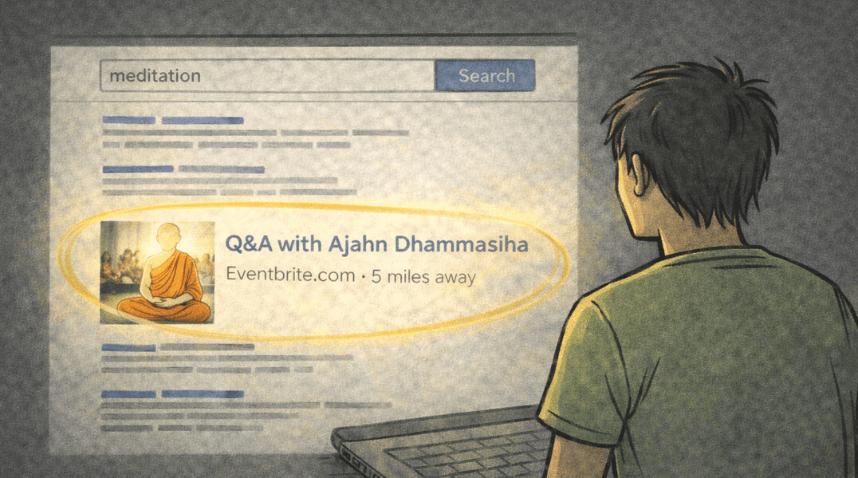
In my search for the missing piece, in late 2023, I stumbled upon a YouTube video of a monk’s teachings. It struck a chord in me. I sensed that I needed more than simply “being mindful”: I needed meaning, guidance, and community. Eager to learn more about the Dhamma (though I didn’t know the term then), I searched for Buddhist events on Eventbrite.
One entry caught my eye, “Finding Peace in a Noisy World – Q&A with Ajahn Dhammasiha” (Jan 2024), hosted by the Dhamma Assembly for Young Working Adults (DAYWA). Amidst the ups and downs of life, the message of finding peace resonated with me. I was also looking forward to meeting fellow young adults with similar concerns.
Finding Community
The Q&A with Ajahn Dhammasiha was an eye-opening introduction to DAYWA. I realised many other young working adults shared the same questions and concerns, to which Ajahn offered clear, practical guidance. As DAYWA brought together people aged 20-39, it was easy to connect.
Ajahn Dhammasiha answered a question I’d been stuck on for months: “Why does mindfulness fade the moment work gets hard?”
He said very calmly, try training the conditions, not just the mind. Keep basic precepts, simplify one habit, and sit at the same time daily.
It felt embarrassingly obvious, and exactly what I hadn’t been doing.
I fondly remember the warm welcomes, including from Heng Xuan. When he heard that I found the talk via Eventbrite, he was a little surprised, as it was rare for folks to learn about DAYWA from Eventbrite, and DAYWA rarely posted there. This serendipitous find gave me the feeling that “things happened for a reason”.
Moving Deeper into DAYWA
The positive introduction to DAYWA led me to find out more about them. DAYWA’s offerings were simple, community-oriented and effective, such as weekly meditation sessions, mindful runs, Dhamma discussions, and a Commune chat (Telegram group chat for members who have attended at least three events).
As an organiser and regular attendee of community events, I was impressed by how well-run DAYWA was. Information was clearly communicated, and planning was thoughtful, e.g. sharing event venues with confirmed attendees only, to ensure that there were sufficient facilitators. The organisers brought their experience in running start-ups to DAYWA: starting small, iterating fast, and scaling up. Instead of profit, the purpose was to bring the Dhamma to more young adults.
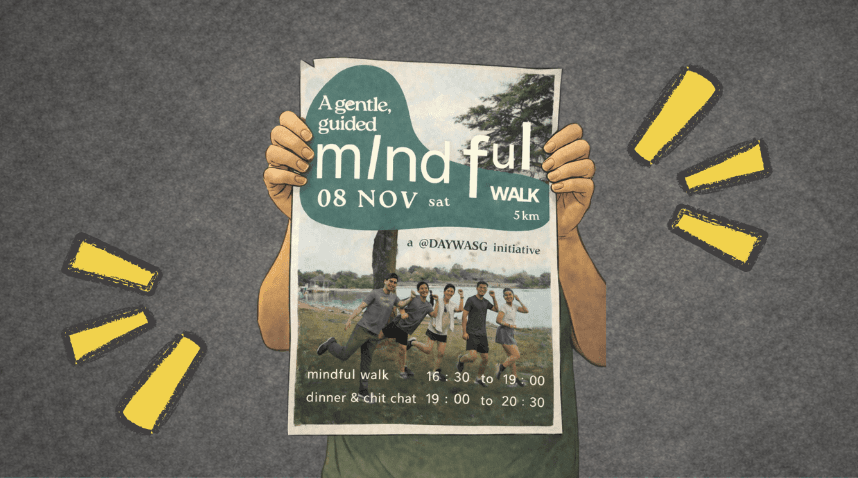
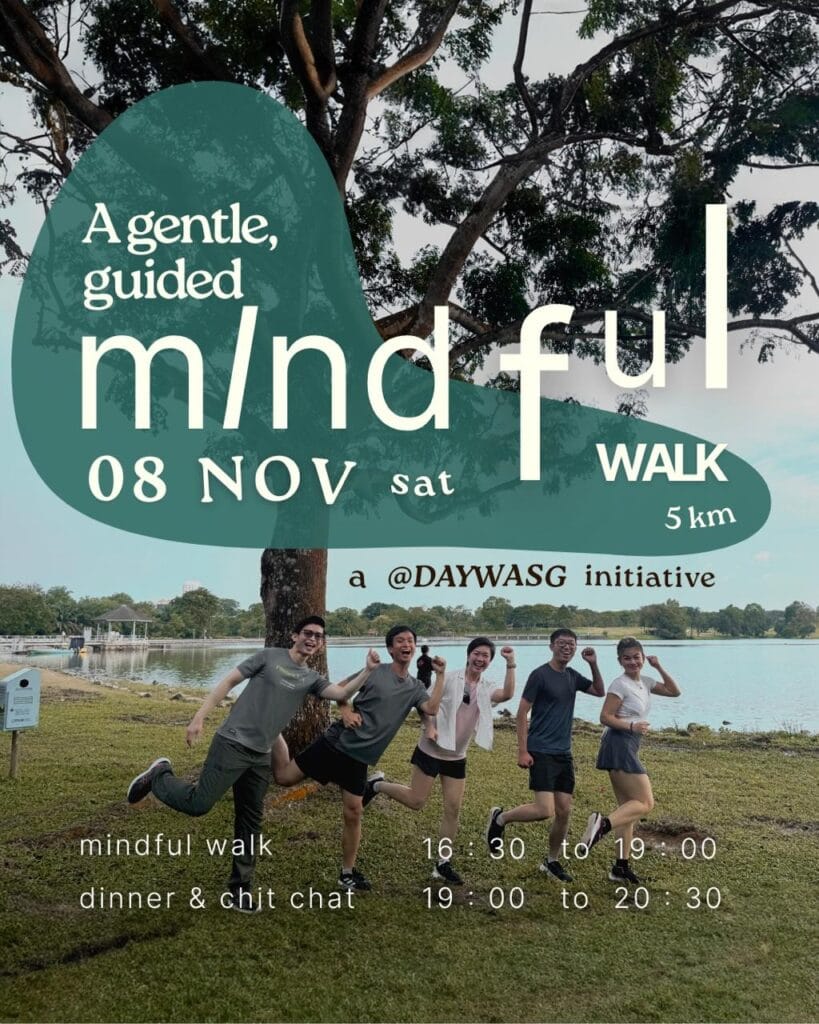
My favourite activity was Mindful Walks. Doing walking meditation in nature helped to calm my mind, and I had a taste of the peace that follows Dhamma practice. At the end of the session, my mind felt like a lazy cat on a sunny afternoon – you couldn’t pull it into chaos even if you tried!
A mindful walk poster
Dhamma Foundation Course (DFC): A Solid Introduction
The DAYWA community also generously introduced me to Buddhist classes and resources. A DAYWA member and HOL contributor, You Shan, encouraged me to attend the Dhamma Foundation Course (DFC) by the Buddhist Fellowship.
I learnt key Buddhist teachings, such as the Four Noble Truths, the Noble Eightfold Path, and how to integrate practice into daily life, which was very helpful for a beginner. The class encouraged discussion between participants, which brought the concepts to life.
I realised that seeing sense objects as permanent and personal had intensified my suffering. In the Buddhist tradition, there are six senses. In addition to the five bodily senses, the mind is the sixth sense, given its importance.
Instead of clinging to sense objects (e.g. sights, sounds, thoughts), that bombard us, we could guard the sense doors, and perceive them as “just a sight”, “just a sound”, “just a taste”, “just a sensation” and “just a thought”. When I saw them clearly as just impermanent sense objects, there was less to cling to, and less to resist.
With fewer stories and judgments, my mind inclined to equanimity and contentment.
Finding the Missing Piece
I realised that my missing piece was the Dhamma and the spiritual community. Given my initial scepticism towards religion, I liked that Buddhism did not call for blind faith, but rather experiential faith. One could simply try out a Buddhist practice for six months and assess whether suffering has decreased. If it does, the gratitude towards the teaching would naturally strengthen one’s faith.
For example, meditation indeed became easier after I observed sila (ethical conduct). By keeping the precepts such as not killing, stealing and lying, the mind was free from guilt and naturally settled into stillness.
Instead of standing still on my own two feet, I could step forward on the path, with kalyāṇa‑mittas (spiritual friends) by my side.
Reflections and Invitation
The wall I had hit in secular mindfulness was not the end of the road, but a signal to make a turn to the Buddhist path, and to find community. As the Buddha said in SN 3.18 Kalyāṇamittasutta, “Good friends, companions, and associates are the whole of the spiritual life.”
If you are reading this and feel similarly stuck, restless, or curious, perhaps this is your sign to check out a spiritual community!
If you are a fellow young working adult aged 20-39, have a look at DAYWA:
Teaches both ethics and meditation, not just hacks for calm.
Has clear safeguarding and practical comms (where, when, who to contact).
Encourages gradual, testable change over hype.
Feels kind in the small things: how they greet latecomers, how they close sessions.
Bonus: For a virtual “kalyāṇa‑mitta”, check out Norbu, an AI chatbot for Buddhist wisdom: https://norbu-ai.org/en/norbu
Conclusion
Meditation apps taught me to pause. The Dhamma gave me a direction and the courage to move forward. If you’ve hit the same wall, don’t download another app or technique. Find a room, find a few good friends, and try out the path for six months. Watch what happens to your speech, your sleep, and the way you respond to the next hard email.
Acknowledgements
I would like to express my heartfelt appreciation to DAYWA and its organisers, such as Heng Xuan and You Shan. Thank you for your hard and heart work, and for being my first kalyāṇa‑mittas!
Wise Steps
Recognise that it is never too late to start (or re-start) your practice.
Find a community of like-minded people to practice together with – it’s more fun, and you’re more likely to continue!
Set aside regular time for practice, e.g. attend Buddhist activities regularly.
Dharma in the City is a series featuring ordinary Buddhists who have spent decades in the practice, and also in service to their communities and beyond.
Most lay Buddhists are multi-hyphenates – wearing the hats of a family member, a professional, a volunteer, a friend, and more. How do we go about the practice in a way that integrates all these different roles that we take up?
The journeys of our interviewees shed light on how Buddhist teachings have influenced and supported their diverse aspirations, roles and occupations, all while cultivating the same path of peace.
The following interview features Yap Ching Wi, a professional in the social services, as well as an activist and advocate in areas such as women’s rights in Singapore, gender equality in Buddhism, and the welfare of community-dwelling sangha in Singapore.
The interview proper
Question:
You’ve worn many hats in your 30+ years career, including those of a social worker, a feminist activist with AWARE, a community builder for Buddhist youth through various organisers, a theatre practitioner with The Necessary Stage, and more which I’m sure I’m missing out.
How have these experiences shaped or transformed your understanding of community work and social justice, and their place in a largely pragmatic and results-oriented city like Singapore?
Answer:
I was brought up by leftist parents so compassion and social justice are like air and water in my family. When I was young, I felt like an outsider in Singapore’s pragmatism. I found myself standing with society’s underdogs and became angry with all the social injustices. Imagine my perplexity when I came across the Dalai Lama’s teaching that anger is never the solution.
“Anger and hatred are our real enemies. These are the forces we most need to confront and defeat, not the temporary enemies who appear intermittently throughout life.”
I have now learned to acknowledge the feeling of anger arising as a motivation but not to grow or hold onto the anger. It is incredibly tough not to get angry as an activist in Singapore. When I became increasingly angry at people who are apathetic, I realised that empowering people is just as important as pushing for policy changes.
Self-awareness engenders courage for honesty and self-growth. Growth requires risk-taking in order to be realised. For this, self-compassion is a crucial grounding. Kindness to self ripples out to kindness to loved ones and to everyone in society. This is how I began to understand the saying that is inspired by Shantideva’s teaching: If you cannot cover the world with leather, cover your feet.
Could you describe that turning point, if there was one? How has this realization impacted the choice of work that you do, or the way in which you engage civil society?
Answer:
The turning point was the year I spent studying social policy in London. With time and space away from Singapore, I ended up contemplating Shantideva’s teaching. As I learned about policy-making and social change in different countries, I realised that universally, working on social change is like a salmon perpetually struggling upstream. Human greed is celebrated and entrenched institutionally. I felt so hopeless and helpless, as if the carpet was pulled from my feet.
So I turned to the Dalai Lama and Thich Nhat Hanh for some peace. I was very glad that I did as I was rewarded with a sense of hope. As I continued to study and practice Buddhism, I began to realise the first two lines of what Master Yinshun taught, that 国家治还乱,器界成复毁… (The state turns from order to chaos, the material world is built and then destroyed…) 究竟皈依处,三宝最吉祥.
It took a second turning point to realise the last two lines of Master Yinshun’s teaching: 究竟皈依处,三宝最吉祥 (…The ultimate refuge is the Triple Gem, the most auspicious). After going for annual retreats for a few years, I fell into a depression. I lost all my confidence and was struggling to stay alive. With medication, counselling, mindfulness practice, and love from family and friends, a version 2.0 of Ching Wi evolved.
My journey parallels the spiritual activism movement. The goal is not only to reform external systems but to challenge root causes like greed, violence, or apathy by healing individuals and society. For me, taking refuge in the Triple Gem and growing towards enlightenment is how I can best serve myself and all sentient beings. Along the way, raising awareness of injustices, encouraging conversations and initiating actions are part of my everyday living.
Practice & Social Services
Question:
Many people still have the impression that dharma practice is just “going into the mountains to meditate” or closing your eyes and wanting to escape the world. That does not seem to be what you are doing.
In fact, you seem to keep yourself rather busily engaged with the ‘world’. Is this frowned upon in the Buddhist community? How does your dharma practice in the Amitabha Pure Land tradition intersect with the sphere of social services?
Answer:
There is a common belief in our Buddhist community that we should mind our own matters and not interfere with society. I think this comes from the attachment to practising the Dharma in a certain way, and also the politico-social conditioning of Singapore.
When I first joined the Buddhist community, I felt alone and wondered if I was too much of a trouble-maker or rebel but hey, Buddha was the OG rebel, wasn’t he? So I found inspiration from socially engaged monastics who are most definitely woke, double pun intended 😉
Service to the community is part of my Amitabha Pure Land practice. The goal of going to the Pure Land is not just for self-liberation but to liberate all sentient beings. A monastic who I deeply respect once taught me that if I aspire to liberate sentient beings, I must first 结善缘 (make wholesome karmic connections) with them. If sentient beings do not like me and won’t even talk to me, how can I ever liberate them?
Doing what I do now puts me out there, connecting and empathizing with people from all ages and walks of life, and from different cultures and faiths. I try to form favourable karmic connections with animals too, by radiating metta and reciting “Amituofo” to the insects, birds, cats and dogs. This is an especially joyful ritual on the way to work in the morning and to wind down after a long day’s work. Would you like to try it too?
Death & Dying: The Roles It Plays
Question:
In more recent years, you’ve transitioned to a part-time role with Aranya Sangha Dana Fellowship, in order to spend more time with your parents. You’ve also conducted several Life Story workshops, guiding participants through their life reviews.
Have these caregiver and facilitator roles impacted your reflections on death and dying, and how so? Do these reflections differ from an earlier time, when these topics (ageing, sickness, death) were more contemplative rather than experiential?
Answer:
I am immensely grateful to care for my parents and honoured to listen to people’s life stories in the workshops that I facilitate.
As I learn from them and experience their being, death and dying has shifted from a conversational catch phrase to an intimate practice.
It is very liberating to settle into the clarity that how I die is how I live. The body can be in pain, the heart can be grieving but the mind need not suffer. This has helped me gain a sense of urgency in my practice. The goal is for a calm and clear mind to focus on Amitabha through the dying process and at the moment of death. The condition of the mind at the last breath is crucial for the consciousness to enter Amitabha’s Pure Land.
If we do not work on our attachments and delusions now, they will continue to grow into old age and become much harder to let go.
It is a lot of work and a long process to let go of guilt, regrets and grievances.
It is also super important to work on keeping the mind open and training for it to stay flexible as one ages. In the face of death and dying, we may double down on some mental habits that cause more suffering for self, loved ones and caregivers.
For those of us who take pride in being self-sufficient, we tend to reject help from others. We will get into trouble with this mindset when we become frail. Can you imagine the myriad of negative emotions — embarrassment, shame, guilt, anger? So let’s start to practise now by gracefully accepting help the next time someone offers. Then we can gratefully dedicate merits to them.
For me, examining my oversized ego and working to tame it forms the basis of my practice. Repentance practice is crucial. I have learned to be patient with myself and accept that habits were formed from endless past lives, so I am always a work in progress. I hope that I will have done enough at the moment of death.
Question:
Looking back on your dharma journey and social services journey, one is certain that you must have encountered challenges to your resolve and inspiration. What is one suggestion or teaching that you would offer to someone who is aspiring towards, or starting on similar paths?
Answer:
At the lowest point of my depression, Venerable Sheng Yen’s teaching saved and healed me. 只要還有一口呼吸在,就有無限的希望,就是最大的財富。 Even with a single breath remaining, hope is unlimited, and that is untold wealth. I literally just focussed on taking one breath at a time as it was the only thing I could do. It was immensely useful in calming racing thoughts, staying afloat in the abyss of dread and connecting with the Triple Gem.
When I get overwhelmed, I recite Shantideva’s The Way of the Bodhisattva. It never fails to connect me with the Triple Gem and reignite my Bodhisattva motivation. There are so many moving verses. Two of them from Chapter 10: ‘Dedication’ are:
…20. May the poor and destitute find wealth, The haggard and the careworn, joy. May those now in despair be whole in mind, Endowed with sterling constancy.
…22. May those who go in dread have no more fear. May captives be unchained and now set free. And may the weak receive their strength. May living beings help each other in kindness.
Thank you for this opportunity to reflect and learn. May all readers and everyone at HOL continue to grow in wisdom and compassion. May all be well and at ease. May all attain the ultimate liberation. Amituofo.
Wise Steps
1. Call to activists – Deepen the practice of loving-kindness towards your own hearts! Self-compassion is an important first step that is easily missed for those concerned with helping others.
2. Practise in a balanced way; Dharma is not a separate practice from our daily lives and actions. Mindfulness helps us to see more clearly the root causes of suffering wherever it arises, and to address them with great compassion. Liberation cannot be found in either fixing external circumstances alone, or becoming completely absorbed in our own struggles.
3. Embracing the reality of death and dying helps us to understand the spiritual urgency of practice. No single person is immune to aging, sickness and death. Cultivating a firm refuge in the Triple Gem can help us to weather this life journey, and move past the physical and psychological obstacles that could stand in the way of seeing clearly, in order to fulfill our spiritual aspirations.
The Sangha, a community of like-minded seekers, was an essential element I had overlooked in my spiritual journey.
Over the years, my solitary approach to spiritual growth underwent a transformative shift.
Today, the observance of Sangha Day signifies the power and importance of a community, marking my transition from walking alone to walking together.
Origins of Sangha Day: A Historical Prelude
Sangha Day’s roots are steeped in a pivotal moment in Buddhist history. It commemorates the spontaneous gathering of 1,250 enlightened disciples, ordained by the Buddha, on the full moon day of the third lunar month. This day, also known as Magha Puja, is when Buddha delivered teachings that would become the bedrock of the Buddhist community:
“To avoid all evil, to cultivate good, to purify one’s mind – This is the teaching of the Buddhas” – Dhammapada verse 183
Sangha Day celebrates the unity and togetherness of spiritual friends: those who strive to uphold this teaching. As the Buddha taught Venerable Ananda on another occasion, Admirable friendship, admirable companionship, and admirable camaraderie make up the whole of the holy life.
However, this understanding eluded me for years… until I met her.
The Scout Camp Retreat: A Doggedly Solitary Pursuit
My journey began at a makeshift retreat center, previously a scout camp nestled away from Singapore’s urban sprawl. The air was drenched with a mix of anticipation and serenity, a striking contrast to the city’s perpetual motion. Seated on my blue cushion, surrounded by fellow practitioners, I embarked on a 10-day silent retreat. I was determined to grit my way through alone, as I always have for most things in my life.
A Fateful Encounter
Yet, it was amid this isolation that an unexpected connection formed. It was on the retreat’s final day, the silence finally broken, that our paths crossed. She was there, her presence a gentle yet undeniable contrast to the camp’s starkness. She was perusing the array of Dhamma books neatly arranged on the bookshelves. Our initial conversation, hesitant yet curious, blossomed into a meaningful exchange about our meditation experiences. Before we left the camp, we exchanged numbers, and long story short, she is my fiancée today.
This serendipitous meeting, much like the unexpected assembly of the Buddha’s disciples, was a turning point, leading me from solitude to the discovery of a spiritual community.
A Gradual Integration: Discovering Community
When we first started dating, pair meditation was a frequent couple activity. Over time, she introduced me to her Buddhist friends, and I began joining group sittings at the Botanic Garden. Gradually, I began to understand that just as the 1,250 arahants found strength in their community, so too was I finding strength in mine. My interactions, initially marked by a guarded nature, slowly transformed as I embraced the communal spirit of these gatherings.
The communal aspects of Buddhism, once foreign to me, began to breathe new life into my practice, revealing the rich tapestry of shared spiritual exploration. These shared practices and discussions, far from diluting my solitary meditation, enhanced it, imbuing my spiritual journey with a collective vigour and purpose.
Group sittings were more than just an accountability device to show up and sit through the hour – the idea that there are others on the path also gave me more spiritual energy. Observing how selflessly the others do dana of food and service also inspired me to give more of myself. And being human, I do still have long periods of low mindfulness, but one plus point of being surrounded by conscientious fellow practitioners is that I catch myself quickly.
Sangha Day Reimagined
Through these experiences, my understanding of Sangha Day evolved.
It transformed from a historical commemoration to a personal celebration of spiritual camaraderie. In this journey, my spiritual exploration expanded to encompass the voices and support of others.
To me, Sangha Day holds a significance far beyond its roots in an ancient assembly. It serves as a symbol of the transformative voyage from solitude to unity, from individual meditation to communal enrichment. This day becomes a living testament to the Buddha’s wisdom that the spiritual path is not only about individual enlightenment but also about shared journeys. The parallel between my transition from a silent retreat participant to an active member of a spiritual community underscores the joy and growth inherent in togetherness.
Sangha Day acts as a poignant reminder that, while the path to enlightenment is personal, it is the spiritual friends (kalyāṇa-mittatā) who illuminate the path and give us strength. They become our guiding lights, bringing us back to the path whenever we falter and infusing our practice with the richness of joy and connectedness.
May the spirit of Sangha Day resonate in our hearts. May this celebration continue to inspire us to walk together on this path of enlightenment.
Wise Steps:
Expand your circle by signing up for a meditation retreat or Buddhist activity! Who knows, beyond making new friends, you might meet THE one 😉
Find your ‘tribe’ to support you in your spiritual journey! You can explore different communities across Singapore here (Click the ‘Community’ tab).
Content warning: This piece describes acts of homophobia and bullying that might be disturbing to some readers.
Since young, Kyle is always confused with how people look at him and why people like to call him names that are demeaning and hurtful. The term “gay” was not common during the ‘80s in Singapore.
A boy behaving femininely did not fit into how society thought a boy should behave Boys in this group are labelled “Ah Kua”. Ah Kua is a derogatory Hokkien term for a transsexual or transvestite.“Maybe something is not right, I have to be more like a boy,” Kyle recollected on his thoughts as a child.
Today, Kyle is a jovial, energetic, creative designer and Buddhist guide who volunteers at a soup kitchen and Buddhist organisations. Though he has gone through a hurtful past, he now recollects his experience with zen and ease.
He hopes that his sharing will spark a conversation about how it is okay to be different and how we can support our LGBTQIA+ friends within the Buddhist communities.
The Challenges of Being Different
Kyle was easily a bully’s target in school as the only boy in the choir. He joined the choir because he loved to sing but yet he was often called a “Sissy” for choosing to do what he loves.
“Every day I am thinking…am I going to be called something else?” Kyle shared. He would find longer routes to his destination to avoid a group of boys who would bully him.
Secondary school was where things escalated.
“If you like boys, then there is something wrong with you,” Kyle recalled. Boys would shame him in public by shouting derogatory names at him or throwing garbage into his bag.
Thankfully, he had four female friends who always defended him from the bullies. They made the pain of insults easier to bear. He recalled taking part in the school’s talentime competition, with the song ‘Hero’ by Mariah Carey. The lyrics inspired him to go up on the stage to express himself and the audience was stunned at his performance. Kyle could reach all the high notes in the song. His performance led to less bullying as people saw his talent in singing.
Kyle felt lucky as the derogatory remarks were instead replaced with the nickname “Mariah”.
Mariah Carey’s “Hero” gave him the courage to be stronger during those tough times. The lyrics and tune provided a space of calm and refuge. “Mariah Carey and Whitney Huston are where my pillars of strength and inspiration came from. “That’s before I came into contact with the Buddha of course!” Kyle chuckled.
The Buddha as his inspiration
“I am not special, if I suffer I am not the only one,” Kyle realised as he found out about the four noble truths.
Learning the noble truths that life is subjected to unsatisfactoriness and there is a way out of it resonated deeply with Kyle. It gave him the empathy that he was not alone.
Bullying followed Kyle even when he was pursuing a diploma at NAFA. He really wanted the bullies to suffer badly. He was thinking about how to seek revenge all the time. However, he realised all the unhappiness and burdens within caused by hatred arose from being attached to his ego.
“At a later stage, I learnt more compassion.” Kyle shared. He drew his source of compassion from a Dhammapada verse on hatred.
“Hatred never ceases through hatred in this world; through love alone they cease. This is an eternal law.”
Responding to hate with hate only tortures oneself with anger, Kyle reasoned.
“Being kind to oneself is not just shopping or buying things for yourself. We always say be kind to yourself. When you are not angry towards others, that is when you are really being kind to yourself”
Kyle’s sharing struck a deep chord within me. In a society that starts talking about self-care, we often talk about the material. Kyle’s sharing nailed it that the emotional aspect is hardly looked at.
“Life without Dharma will be tougher to live on. The loss of my loved ones, the physical suffering from illness, the mental tortures of guilt and hatred. My suffering only I can relate to. No matter how happy one can be, the drum always sounds better when it’s far away.”
Kyle is thankful to be alive in this time where the Dharma still exists. He is constantly inspired by the teachings of Ajahn Buddhadasa, Ajahn Chan, Venerable Hsing Yun, and Thich Nhat Hanh, Without the Buddha’s Dharma, these masters wouldn’t exist.
Kyle has enormous gratitude for how the Dharma has transformed him.
I wondered to myself, “With so many challenges at school, was his experience in the Buddhist community any different?”
Gay + Buddhist?
Although Kyle never had negative experiences from the Buddhist community regarding his sexual orientation, challenges remain. Occasionally, when doing Dhamma volunteer work, he was apprehensive about sharing his sexuality as he was unsure how people would react.
He felt compelled to ‘tone down’ his behaviour when he entered the Buddhist setting.
“Why?”, I wondered.
Kyle shared that it remains a cultural taboo to say, “It is okay to be Buddhist and to be gay”. Something that is not discussed, creates uncertainty. There is a dearth of centres that have Dhamma talks and resources tailored to LGBTQIA+. Hence, there is uncertainty whether LGBTQIA+ members are welcomed.
The compulsion to tone down on his femininity eventually faded as Kyle developed his Dhamma knowledge.
He concluded that being LGBTQIA+ is not a sin. Rather, it is the way that we treat others and ourselves that matters more than our sexuality. Our thoughts, speech, and actions of kindness and wisdom are of utmost importance.
That made me wonder how we can better support our LGBTQIA+ friends.
Community Support
“Be sensitive to what you say as it may make them feel uncomfortable. You may be close but do not take liberty in sharing with others about the person’s sexual orientation.” Kyle advised.
He recalled that some straight friends might accidentally ‘out’ their LGBTQIA+ friends, leaving them in an awkward situation.
“If we are standing up for them, just defend them because everyone deserves kindness and no one wants to be treated harshly,” Kyle advised. He mentioned that is better to avoid ‘out-ing’ LGBTQIA+ friends if they aren’t prepared to share their sexual orientation.
As friends, we also can express skilful speech by not stereotyping a person immediately. Don’t call out someone for ‘straight acting’ if they are gay and expect gay people to have to act a certain way.
In addition, if you suspect that a friend is part of the LGBTQIA+ community, don’t ask them. They might not be ready to share and feel even more stressed.
One Buddhist community that helped Kyle was “RainBodhi” (HYPERLINK), which combined two words “rainbow” and “Bodhi”. It is a LGBTQIA+ friendly community that conducts talks and provides resources to help one another.
How can members of the LGBTQIA+ community develop more compassion towards themselves against a conservative society which may not always be understanding?
“Take your time and explore what is happening. It is always through initial confusion that we gain clarity and wisdom eventually. Once you understand your emotions, you know better about this “Me” and “I”. Pick up a Dhamma book to ground yourself.” Kyle shared.
Kyle added, “If you aren’t religious, then pick up philosophy or inspirational books.”
Remind yourself “There is nothing wrong with you”.
Looking Back
With Kyle developing so much wisdom over time, I wondered what Kyle would tell his younger self.
“Trust your instinct. There is absolutely nothing wrong with the way you are. One day you will know a group of people who truly love who you are. You will meet an amazing teacher, the Buddha. You will come across the Buddha’s teaching and it will transform you. Be kind to people as much as possible. I promise you, that’s the only way that will help you through all the struggles. ” Kyle encouraged.
“Stop obsessing with losing weight and lose the ego instead!” Kyle added in jest.
In the spirit of pride – acceptance and care- Kyle summarised his thoughts by sharing, “Keep giving joy and love to people around you, even when you can’t find it yourself. Because whatever hardship you are going through, all the joy and love you have given would come back to you eventually”