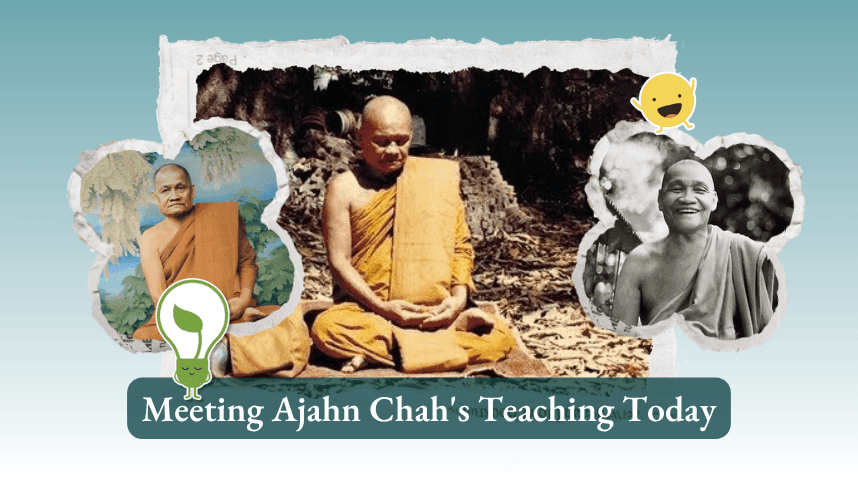
Across 26 – 27 December 2025 in Kuala Lumpur, the Ajahn Chah Remembrance Day (ACRD) 2025 “honours the life and teachings of Venerable Ajahn Chah Subhaddo, a revered Thai Forest Tradition master who passed away on 16 January 1992.”
Four HOL contributors, who had participated in ACRD 2025, were invited to reflect on Ajahn Chah’s and his disciples’ teachings, specifically those that straightened their views and inspired their practices.
In this short anthology, we explore the skillful illustration of simple yet profound Dhamma teachings through using day-to-day analogies. These powerful metaphors imprint understanding of the Dhamma right into the heart. They anchor the mind with a keen awareness of reality, like a kite soaring against the worldly winds of suffering.
Claire
When the Glass Is Already Broken
There have been many teachings from Ajahn Chah that went straight into my heart. I’d like to share with you a small lesson from Luang Por that is particularly memorable for me.
The story goes that one day someone asked Ajahn Chah how genuine happiness is possible in an ever-changing world that is full of loss and suffering. Ajahn Chah smiled, held up the glass he had been drinking from, and said,
“To me, this glass is already broken. I drink from it. It holds my water admirably, sometimes reflecting the sunlight in beautiful patterns. If I tap it, it gives off a lovely ring. But when I set it on a shelf, and the wind knocks it over, or my elbow brushes it off the table, and it shatters on the floor, I say, ‘Of course.’ When I understand that the glass is already broken, every moment with it is precious. Every moment is just as it is, and nothing needs to be otherwise”.
Cherishing What Cannot Last
It’s a precious teaching that encapsulates Anicca, Dukkha and Anatta (impermanence, suffering, and non-self). Our lives are just like this.
For instance, this body that we have can be seen as borrowed.
It will die and decompose eventually. The people that we love will one day leave us for one reason or another.
The list goes on.
I used to cry a lot over matters related to Vibhava-tanha. But now, I just try to cherish everything that comes my way. When one truly knows that nothing lasts, one can treasure and live in the present moment even more.
Ezra
A Glimpse of Total Commitment
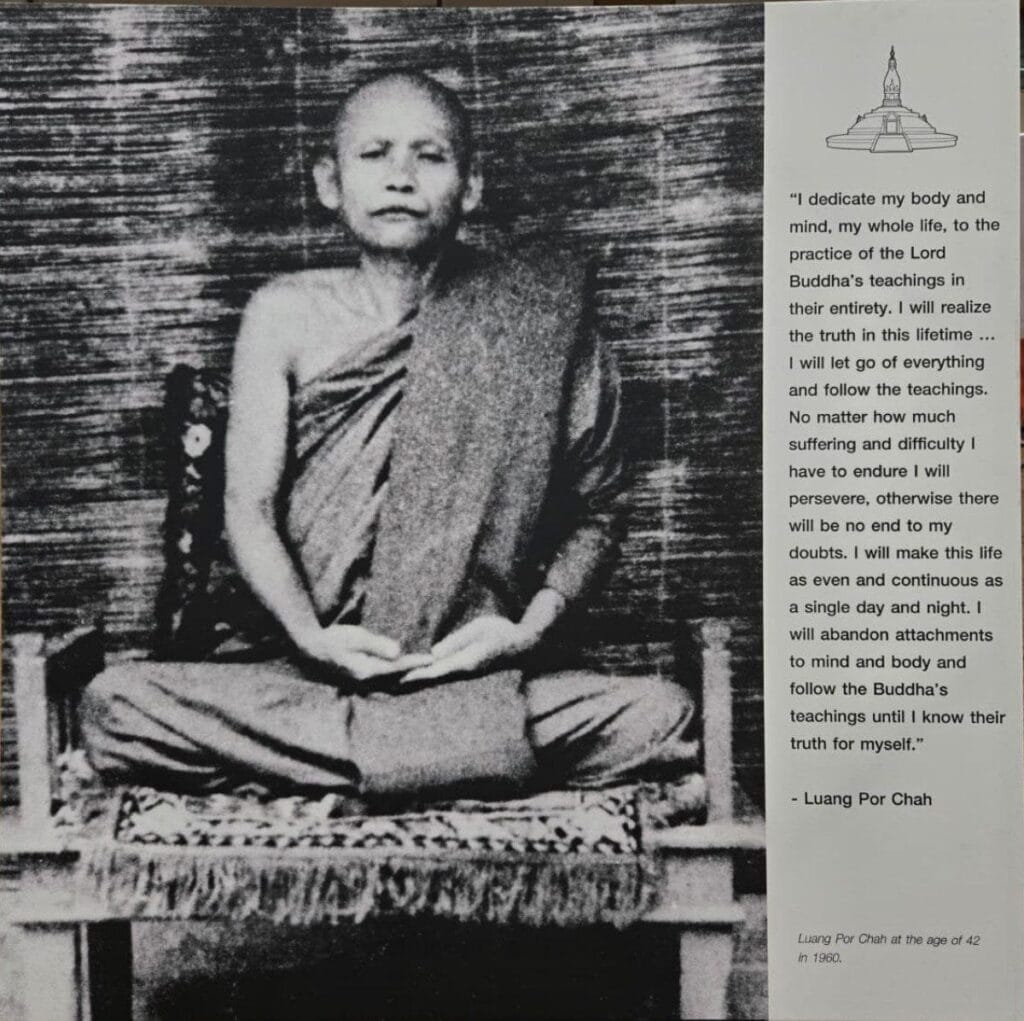
Ajahn Chah’s quote as exhibited in ACRD 2025
“I dedicate my body and mind, my whole life, to the practice of the Lord Buddha’s teachings in their entirety. I will realize the truth in this lifetime … I will let go of everything and follow the teachings. No matter how much suffering and difficulty I have to endure I will persevere, otherwise there will be no end to my doubts. I will make this life as even and continuous as a single day and night. I will abandon attachments to mind and body and follow the Buddha’s teachings until I know their truth for myself.”
It was my first time reading this quote, which was displayed alongside a photo of a younger Ajahn Chah. I didn’t know a lot about Ajahn Chah at that time, but I was very inspired by his commitment and dedication to the practice.
I thought to myself that I would like to have the same level of dedication and commitment.
But how does one let go of everything and abandon all attachments, unless one has decided to live a monastic life?
That being said, the burdens of life are indeed tiring. I look forward to laying everything down to have true freedom one day.
KH Tee
From Concept to Direct Experience
Though I was born after Ajahn Chah’s time, I feel deeply grateful for the blessing of encountering the treasure trove of Ajahn Chah’s teachings through his students, such as Ajahn Brahm and Ajahn Jayasāro.
Since I was exposed to the Dhamma at a young age, I have the tendency to approach the Teachings intellectually. This tendency is occasionally accompanied by attachment and conceptual proliferation, which can be a hindrance to the arising of true Insight.
Ajahn Chah’s masterful and direct way of teaching has softened that attachment. It guides the mind to investigate and verify the Dhamma experientially. I began to see the practice and the liberating insights not as lofty ideals, but as a living path that frees the mind from suffering, accessible in the here and now, when the conditions are ripe.
Stillness, Suffering, and Release
Ajahn Chah’s well-known imagery of A Still Forest Pool is one of the most powerful metaphorical teachings on mindfulness and clear comprehension, which has deeply inspired my practice.
Ajahn taught that when we let things follow their natural course, the mind becomes still like a clear forest pool, unperturbed as it clearly observes and understands the true nature of all conditioned phenomena.
It is such a beautiful invitation to incline the mind towards a happiness arising from inner stillness. One arose simply by allowing things to arise and pass away in their own natural course.
Each time I recollect this teaching, the effort to sit through change without grasping, resisting, or denying arises easefully.
Ajahn Chah’s teachings on the two kinds of suffering — one from clinging to the pleasant and resisting the unpleasant, the other from fully feeling the constant change of experience, be it pleasant or unpleasant — reframed how I relate to suffering. It imbues me with the courage to fully meet reality without flinching, even when it is painful.
By seeing the futility of grasping at what is inherently changing, the mind begins to be interested in the possibility of a path beyond suffering, a path of skillful release. What once felt unbearable becomes manageable, sustaining my patience and reinforcing trust in the workings of kamma.
Rare is the arising of such a wise teacher who teaches the Dhamma-Vinaya so skillfully (AN 3:114), and the opportunity to hear and practice the True Dhamma (Dhp 182).
With deep gratitude towards these rare conditions, may Ajahn Chah’s legacy continue to be a supportive condition for many beings with little dust to encounter the Dhamma, cultivate the Noble Eightfold Path, and realize the highest bliss of Nibbāna.
Si Jing
From Knowing to Living the Dhamma
Like the Buddha, Ajahn Chah taught us through simple metaphors that cut straight to the heart. Over the two days of ACRD, several of these metaphors stayed with me.
I’ve always enjoyed reading the suttas, and it’s easy to mistake reading for practice. One recurring reminder was that the Dhamma isn’t meant for intellectual appreciation alone: it has to be lived.v
Ajahn Chah’s metaphor of the ladle in the soup encapsulates this: you can be fully immersed, yet never taste the true Dhamma.
That got me moving towards a more balanced approach to the teachings.
At a time when I felt that I wasn’t “good enough” nor practising “hard enough,” another teaching landed.
Patience, Humility, and Steady Effort
I held the fixed view that long daily meditation equates to being a good practitioner. This mentality has caused a lot of suffering, as I neither sat frequently nor for long durations.
Luang Por Pasanno offered the following teaching:
“Don’t try to be a ten-wheel truck when you’re just a little wheelbarrow.”
This reminder gave me permission to meet the practice, and myself, where I am at — rather than through self-judgment and criticism.
Finally, the emphasis on being patient continuously changed how I relate to encountering plateaus in the practice.
Ajahn Chah compared practice to rubbing two sticks together to start a fire: often nothing seems to happen, and we stop just before the spark occurs. However, when we rub the sticks consistently without stopping, we may start a fire eventually.
The “earthworm practice” that Luang Por Pasanno described echoed the emphasis on patience-endurance.
Like a blind earthworm, sometimes practising the Dhamma is simply moving forward despite no clear view of the path ahead.
These analogies helped me trust small, consistent effort and to keep at it even when results aren’t obvious.
The metaphors taught reflect Ajahn Chah’s (and his disciples’) wisdom and skill as a teacher. May these teachings inspire and encourage you as they did for me!
Walking the Path Here and Now
Ajahn Chah may no longer be physically present with us, yet his teachings remain vividly alive through the way they are practised.
Across these reflections, a common thread emerges: the Dhamma is not something to be admired from a distance. Dhamma is to be tested, lived, and realised in the conditions of our daily lives.
Whether through patience in uncertainty, letting go of fixed views, or meeting experience with honesty and humility, the path unfolds in gradual, steady shifts of understanding.
Ajahn Chah’s and his disciples’ teachings remind us that sincerity and continuity of practice provide the conditions for spiritual progress. In this way, we may continue to meet Ajahn Chah—not just in memory alone, but in every moment we practise.
TLDR: This is a story of how a rescue dog became my Dhamma guide. She showed me compassion, simplicity, and forgiveness in daily life.
In Her Eyes: A Living Dhamma
When I adopted my ex-breeding dog, Maya, 1.5 years ago, I thought I was rescuing her. Little did I know she would become one of my closest Dhamma teachers. Through our journey together, she has illuminated core Buddhist teachings in ways no book or lecture ever could.
Companionship in Silence
In a world filled with constant noise and distractions, my dog taught me the beauty of noble silence. I discovered that while sitting quietly with her, our breaths, unconsciously synchronised in the stillness, created a language of its own. The language of love as the deepest connections need no words. A gentle glance. A soft sigh. The way she leans her furry head against me. These wordless moments speak volumes about trust and understanding. I found contentment in her eyes, the way she communicates everything through just a look. Happiness. Gratitude. Love. All without uttering a single sound. In those shared quiet moments, she offered me her full attention and I learnt to do the same.
I began to see that these silent exchanges held the same sacred quality I sought in meditation. What the Buddha taught about noble silence and mindful awareness became not just concepts, but a shared stillness between us in the here and now.
Maya leaning her body against me as she sleeps. How fortunate it is to have someone who thinks your space is the safest place in the world.
Contentment in Simplicity
“Just be here with me”—this seems to be her only request. Her joy in my mere presence reflects the Buddha’s teachings on contentment (santuṭṭhi) being the greatest wealth (Dhp 204). While I often catch myself chasing after wants and needs, she demonstrates that true happiness requires very little.
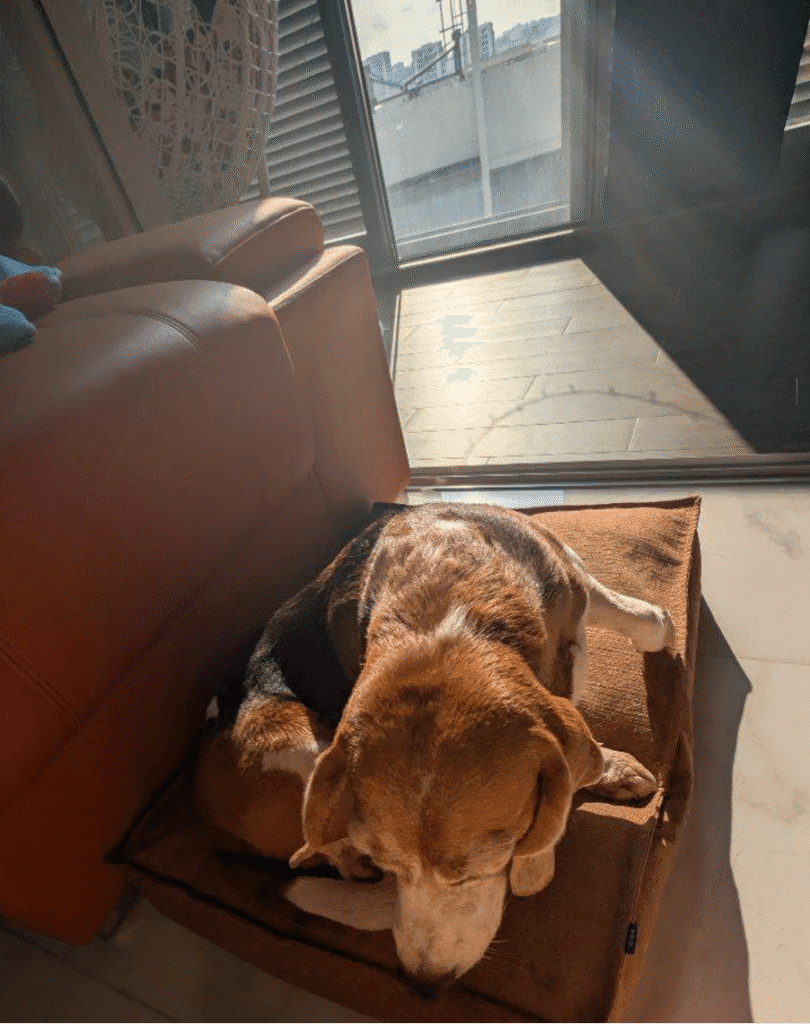
Her contentment with the simplest things: basic necessities—food, shelter, and companionship—mirrors the simplicity that the Buddha advocated. Watching her bask in the sunlight on the sofa or curl up beside me in sleep, I was reminded of the inner peace that arises when we stop chasing and simply rest in what is.
Maya suntanning herself in the morning shines.
Unconditional Forgiveness
Despite her separation anxiety whenever I’m away, she never holds grudges. Each time I return, even after a long day away, she greets me with a wagging tail and excited zoomies, as if saying, “You’re back! That’s all that matters!” Once or twice, she would turn away from me, as if expressing her disappointment that I had left her. But this never lasted longer than a minute before she gave in to her lovely demeanour again and would come to me with kisses, eyes full of affection. This quiet forgiveness aligns with the Buddha’s teaching that hatred cannot be ceased by hatred, but only through love (Dhp 05).
Her natural ability to live in the present moment, free from past hurts, teaches me daily about letting go. She is my living example that it is possible for my heart to remain open and soft, to forgive.
A Lesson in Selfless Protection
One evening while walking at the void deck, an unleashed dog twice her size lunged at her, biting her big floppy ear and circled for a second attack. In that moment, I stepped between them without hesitation. I saw its teeth. I knew the risk. But instinctively, I protected her. Only later did I realise the depth of that moment. That spontaneous act of putting her safety above mine uncovered a motherly sense of protection that I didn’t know I had in me. For a brief instant, the sense of “me” disappeared. What remained was love in its most selfless form.
That moment brought the Buddha’s teaching on anattā (non-self) to life. Compassion had arisen not through effort, but naturally—revealing a truth far deeper than words.
Maya at ease in her fluffy bed.
Finding the Middle Way in Love
Perhaps the most challenging lesson came through learning to manage attachment. I had to slowly navigate learning how to love without clinging. Initially, my attachment to her was overwhelming. Every moment away from her brought worry and distraction. She occupied my thoughts constantly, even when she was by my side. During work, during meals, even during meditation, my monkey mind was flooded with thoughts of her. I was physically present, but emotionally entangled. Through time and awareness, I began to recognise this as a form of craving. One that is way too unhealthy than I’d like to admit. I began to turn to the Buddha’s teaching on the Middle Way. Gradually through time and practice, I learned to maintain loving care while softening my grip. To love her fully, but with freedom. To be present, but not possessed.
In this balance, I discovered equanimity (upekkhā)—not detachment, but a steadiness of heart that allowed love to breathe sustainably. This balance reflects the Buddha’s central teaching of the Middle Way, which disavows extremes, whether of indulgence or austerity.
Maya showing her belly and a silly face
A Living Path
This journey with my rescue dog has brought the Buddha’s teachings to life in unexpected ways. Through her, I’ve experienced:
The peace of silent presence
The wealth of simple contentment
The freedom of unconditional forgiveness
The clarity of selfless compassion
The wisdom of the Middle Way
In her joy, I feel muditā—sympathetic joy. In her pain, I feel karunā—compassion. In our quiet days, I feel mettā—loving-kindness. And in our ever-changing relationship, I learn upekkhā—equanimity.
She didn’t need a meditation hall, a robe, or a chant to teach me the Dhamma. Her lessons were embedded in every shared breath, every quiet look, every act of forgiveness. Through her, I’ve realised what the Buddha meant when he said mindfulness should be brought into every moment: not just while sitting on a cushion, but in the way we care, relate, and respond.
My four-legged furbaby came into my life as a dog in need. And yet, she became my guide on the path to enlightenment. Maya is constantly reminding me, gently and persistently, that the path to awakening is all around us. The living Dhamma shows me that the Buddha’s teachings remain as relevant today as they were 2,600 years ago, manifesting in our everyday experiences and relationships, sometimes in the wagging tail of a grateful dog.
Sensing the world through scents with her beagle nose
Wise Steps:
Take mindful pauses throughout the day. Briefly stop, breathe, and bring your full attention to the present moment, allowing space for awareness to arise amid daily busyness.
Practice forgiveness with an open heart. When someone disappoints or hurts you, respond with understanding rather than resentment, remembering that love can dissolve even the deepest sting. If a dog can do it, so can you!
Notice the Dhamma in everyday interactions. Be attentive to how simple acts, such as caring for a pet or sharing a moment of presence with a loved one, can reflect core Buddhist teachings such as compassion, non-attachment, and equanimity.
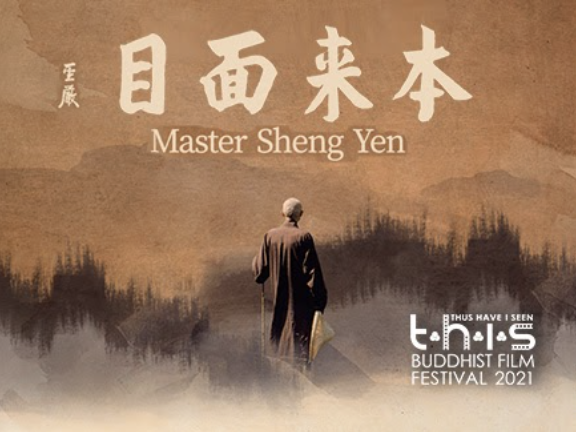
Buddhist Film Reviews is a partnership series between HOL & THIS Buddhist Film Festival 2021 (25 Sept – 8 Oct’21). Themed “Open your mind”, THISBFF 2021 features 15 thought-provoking documentaries and feature films from 12 countries.
TLDR: Paying homage to Master Sheng Yen and his movement to revive Ch’an (禅) Buddhist practice in Taiwan, the United States and around the world, the documentary paints a beautiful portrait of Master’s selfless life a decade after his passing in 2009.
If you had heard of Master Sheng Yen and his teachings, do you know how he came to be?
A saying goes, ‘still water runs deep’. Master Sheng Yen’s life story unfolds into many onerous chapters unknown to most.
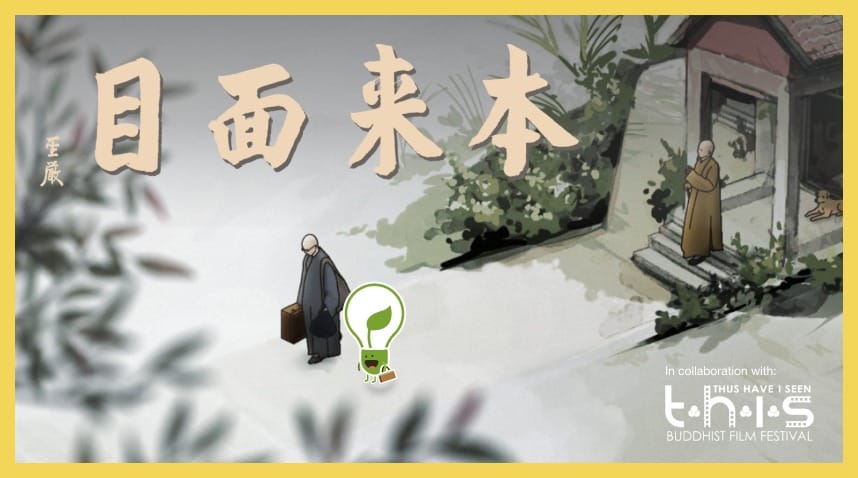
A posthumous biographic documentary, Master Sheng Yen (Chinese title: 本来面目) details his early years of ordination, the peak of his monastic life, its challenges, and his final efforts of serving Buddha’s dispensation.
The title of the documentary alludes to the quote from The Sixth Patriarch Venerable Hui Neng in The Sixth Patriarch Sutra, 「不思善不思恶,正与么时,那个是明上座本来面目?」 This question was posed to Venerable Hui Ming, who realised enlightenment thereafter. It roughly translates to “without considering the good nor the bad, what is your original face?” Master Sheng Yen has used this ko-an to discuss the true nature of one’s heart in his teaching.
To make up for the lack of intimate interviews with Master, the producer reconstructs Master’s personality and demeanour through animation, archival photographs, audio and video recordings, as well as extracts from letters and publications. Interviews of Master Sheng Yen’s disciples and acquaintances help us see Master as a humble teacher and striving monastic from their eyes.
Against the backdrop of socio-political turmoil and modernisation, the documentary tells an impeccable narrative of Master Sheng Yen’s life through the suitable use of black-white historical archives and re-enactments.
Through the documentary, the audience traces the historical forces that shaped Master’s compassionate outlook and disenchantment towards the world. Notwithstanding the school of life, Master Sheng Yen was apprenticed under a lineage of Ch’an and Zen teachers, who were formidable in their practice.
The nuggets of wisdom crystallised from Master Sheng Yen’s life experiences were offered together with pastel motifs of impermanence – albeit their screen times as fleeting as snowflakes. The scenes and delivery of content are ever-changing as with life – no one moment can be repeated like a running stream. Aptly, the cinematography takes on a sense of detachment – observing, looking on to the emptiness beneath.
How did the documentary make me feel?
I felt encouraged about Master Sheng Yen’s tireless efforts to revive Ch’an Buddhism after the purging of religion from the Cultural Revolution.Watching the documentary helped me reflect that I have taken his compassionate teachings for granted.
I was never once bored because of the different types of sources and media used in delivering Master Sheng Yen’s story. At any point in time, I feel immersed in that particular decade with Master Sheng Yen when he was making difficult choices to practice in line with the Dhamma and to benefit sentient beings.
What was the most memorable scene?
It was an interview snippet when Master Sheng Yen reminisced with the founding president of the Buddhist Society of the United States, Mr Shen. The latter drew an analogy where the Master was a field of merits and Mr Shen merely sowed in that field.
Hearing this, Master Sheng Yen broke down into sobs.
It was then that I realised the extent to which Master Sheng Yen had experienced life’s bitterness was one which no one could fathom, yet he remained such a hopeful pillar of support to his disciples.
What did I like about the documentary?
It pieces together a Master Sheng Yen I did not know and it helps me to appreciate what he stood for and the contribution he has made for Ch’an Buddhism.
I grew up learning about Master Sheng Yen’s teachings but I never understood who exactly was the monk who taught them — he was a man of calibre and honourable virtues; and definitely, a man of perseverance.
He was there in front of me throughout the documentary – his presence alive and piercing into my consciousness with light and wisdom.
What did I not like so much about the movie?
There were a few quotes that flew by quite quickly. At the end, there were some text describing the development of Dharma Drum Mountain but the words may have been small and quick to pass over. Perhaps, I am a slow myopic reader and it is time for me to change my spectacles.
Who would I recommend this for?
Anyone who knows Master Sheng Yen and who wants to learn from his life and his life’s works. This is a well-researched documentary – both educating and contemplative.
Liked what our author experienced? Book your tickets right now!