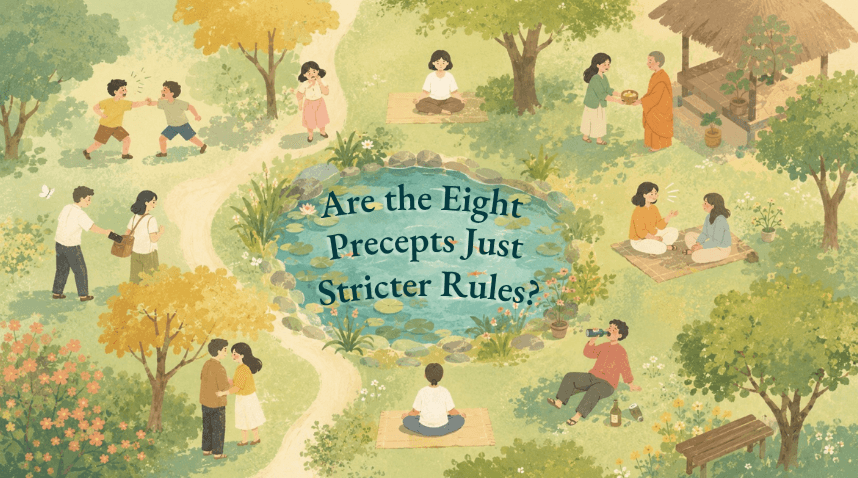
TLDR: The Five Precepts support ethical daily living, while the Eight Precepts create temporary conditions for deeper practice. One helps you live well in the world, the other helps you step back and study the mind.
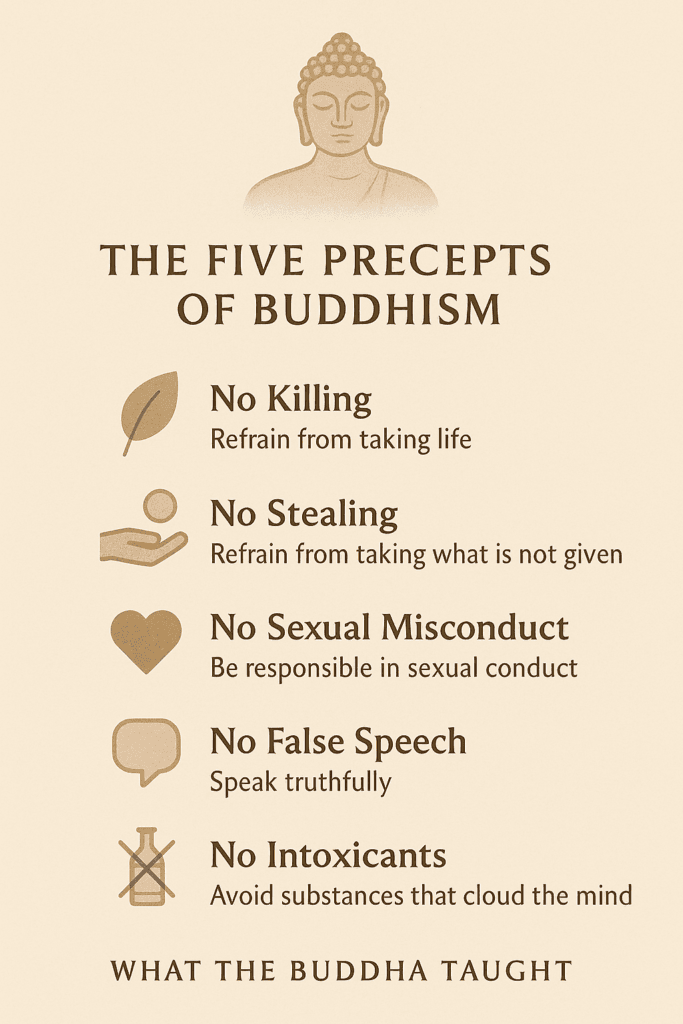
Most Buddhists are familiar with the Five Precepts. They form the basic ground for living well with others. Do not harm. Do not steal. Be honest in speech. No sexual misconduct. Avoid intoxicants.
These rules support a life where trust, respect and peace can grow. It also enables a mind that settles easily into meditation and stillness.
“So, Ānanda, the purpose and benefit of skillful ethics is not having regrets. Joy is the purpose and benefit of not having regrets. Rapture is the purpose and benefit of joy. Tranquility is the purpose and benefit of rapture….. “ Excerpt from AN 11.18
The Eight Precepts feel less familiar. People usually encounter them during retreats or full-moon observance days.
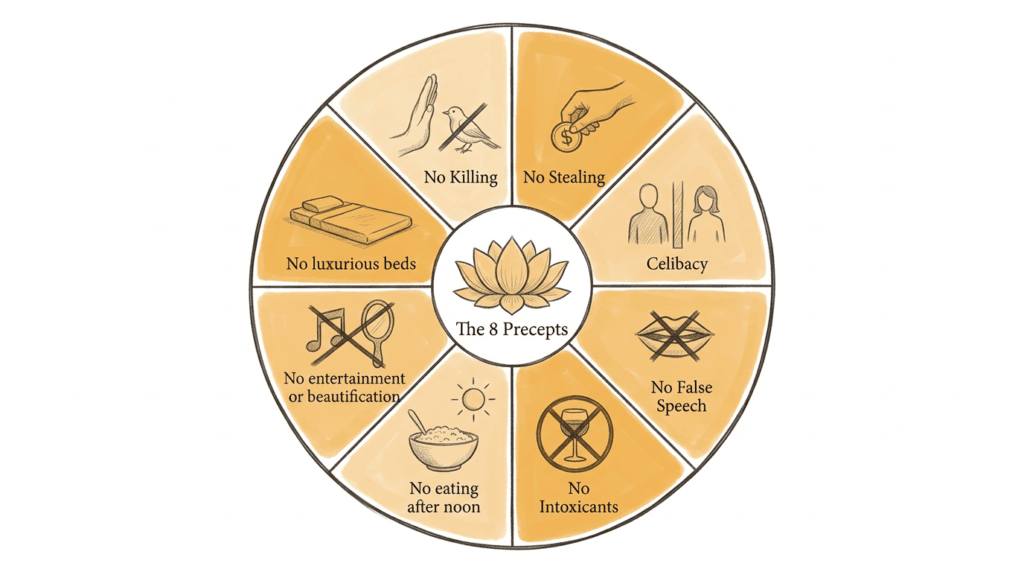
On first glance they look demanding. No dinner. No entertainment. No perfumes or adornments. No sexual activity. A simple place to sleep. For someone juggling work, family and commitments, the list can feel unrealistic.
But the Eight Precepts were never meant to be long-term burdens for the average lay person. They create a temporary environment where the mind stops running after stimulation. The body settles. The day slows down.
Patterns that are usually hidden become clear. They are not stricter versions of the Five. They serve a different function altogether. They give practitioners a chance to live like Arahants (enlightened beings)!
To see the difference, it helps to understand what each set is designed for.
The Five Precepts: Support for everyday life
The Buddha gave the Five Precepts as a foundation for lay life. They keep daily interactions clean and prevent the kind of harm that creates guilt or conflict. Someone who keeps them steadily usually feels fewer complications in relationships and fewer moments where they have to repair the consequences of their actions.
The Five are practical. They help a person move through the world without leaving a trail of regret.
A well-known teaching from the Aṅguttara Nikāya reminds practitioners of how precepts support the mind. The Buddha says that when a person reflects on their ethical restraint and sees no transgression, “joy arises, and from joy, rapture arises” (AN 11.1). This is not theory but a reality. Ethical living makes the mind lighter.
Try meditating after scolding or insulting someone, the chances of a good meditation will be very slim.
Let’s Talk About Sex Before Diving Into The Eight Precepts
The Eight Precepts remove the usual noise that surrounds us. They simplify the body, the senses and the environment. This frees up mental energy for observation, stillness, and insight.
Each precept plays a role.
Under the Eight precepts, the 3rd precept changes from avoiding sexual misconduct to avoiding sexual activities. I funnily recalled a Dhamma friend erroneously saying she can’t take the five precepts as her husband will not be happy because of the third precept.
The third precept, in the context of the five precepts, pushes practitioners to keep loyal relationships and never use sexuality as a weapon. The eight precepts changes that to be chaste for that period of practice.
The Eight Precepts: A change in lifestyle, even if only for a day
Avoiding sexual activities brings the mind away from lust and heavy craving.
Avoiding dinner rests the body (no food coma for evening practice too!) Avoiding entertainment keeps attention from scattering. Avoiding adornments removes the pressure to present an image.
Sleeping simply makes waking up easier and steadier.
The Buddha spoke about this kind of simplicity often. In MN 39, he describes the lifestyle of one who trains to reduce excess: modest clothing, simple food, and a mind that moves away from indulgence. The Eight Precepts follow the same logic. They narrow the stream of stimulation so the mind can see itself without interference.
They are not permanent rules for us, the typical layperson. They are short-term conditions for deeper practice.
Why do people take the Eight at all?
People choose the Eight Precepts for many reasons.
Some want a break from constant activity. Some want to observe their habits without distraction. Some take them during stressful periods to regain balance. Others take them simply because the heart asks for more space than usual.
Ajahn Chah, the famous meditation master, explained this shift well. In No Ajahn Chah, he said, “If you let go a little, you will have a little peace. If you let go a lot, you will have a lot of peace. If you let go completely, you will have complete peace.”
Reducing stimulation is one way of letting go a little. The Eight Precepts provide a structure for that release.
What actually happens when people try the Eight
Before taking them, most people worry about the rules. No dinner sounds intimidating. No entertainment sounds dull. Yet when they try it, the experience tends to be different from what they expected.
Hunger rises, then fades. The mind stops jumping from distraction to distraction. Sleep becomes lighter and more restful. The morning feels clean.
Without entertainment, the mind’s restlessness becomes obvious. Without adornments or performance, the pressure to impress evaporates. What remains is a quieter form of attention.
The Eight Precepts are about seeing what drives us. They reveal our impatience, vanity, cravings and habits not to shame us, but to help us recognise them. The suttas often describe this as the beginning of insight. In MN 19, the Buddha explains how observing the mind’s movements allows unwholesome thoughts to fade and wholesome ones to grow.
People are often surprised by how quickly this happens. A day of the Eight Precepts can feel longer, fuller, and strangely spacious, even though nothing big happens.
How the Five and Eight Precepts relate to each other
The Five Precepts steady the way we behave with others. The Eight help us understand the way we behave with ourselves.
The Five are about restraint in the middle of daily life. The Eight are about stepping back from daily life so we can watch the mind work.
They simply serve different seasons of practice. A person may keep the Five throughout their life and take the Eight once a month, or during retreats, or during challenging periods. Another person may take the Eight only occasionally. Someone else may take them regularly to remind themselves of how simple life can be when cravings ease.
The point is not discipline for its own sake. It is freedom from habits that weigh the mind down.
The Buddha calls the precepts “training rules” (sikkhāpada), not commandments. They are tools. They help us notice and work when taken up willingly.
A way of living more deliberately
For anyone curious about the Eight Precepts, the question is not whether you can do them perfectly. It is whether you want to spend a day living more deliberately than usual. If the answer is yes, the practice will show its benefit.
The Five Precepts make daily life stable. The Eight Precepts show you what the mind does when the world becomes simple.
Both lead toward the same destination described throughout the Nikāyas: the gradual fading of confusion, agitation and regret. When those fall away, the heart becomes light enough to understand the Buddha’s path from the inside.
Wise Steps:
Set aside time to try the Eight Precepts for just one day, because treating them as a temporary training rather than a lifelong burden makes the practice realistic for working adults with family and responsibilities.
Eat simply and stop after the permitted time. Avoiding dinner is not about punishment but about resting the body and seeing how quickly hunger rises and fades.
Cut out entertainment for the day, because once the usual distractions are removed, you can observe just how restless the mind becomes and begin to understand what usually keeps it scattered.
TLDR: Precepts = Restrictions? Kyle explores deep into the third precept on sex and how we can comprehend it more holistically. Using three areas of Consent, Respect, Dignity, he sheds light on little known areas of the precept
Buddhist precepts are often mistaken for rules or restrictions, but they are intended to safeguard and guide individuals. However, the third precept, which concerns sexual misconduct, is frequently perceived as ambiguous. Society’s cultural values often blur the line between personal growth and morality, leading to confusion.
As a Buddhist, you may find the third precept challenging to comprehend. Where should you start?
You may be familiar with the Theravada Buddhist temple where lay Buddhists chant in Pali and recite the precept, “Kamesu micchacara veramani sikkhapadam samadiyami,” which translates to “I undertake the precept to refrain from sexual misconduct.”
However, many of us may have unknowingly taken all five precepts since we were young without fully grasping their meaning.
The Third Precept
It’s important to note that as lay Buddhists, we are not required to adhere to the monastic precepts. As a result, the third precept does not outright forbid the act of having sex.
It does, however, explicitly forbid adultery, rape, or sex with someone who is engaged to another, imprisoned, or ordained.
The matter of sexual misconduct is not as straightforward as it may seem.
In Buddhist teachings, the term kāma in Pali refers to the desire for sensual pleasures in general. However, according to the commentaries, it is more specifically related to sexual relations, an interpretation that is supported by the suttas.
On the other hand, micchācāra in Pali refers to wrong modes of conduct, and in the context of the precept, it prohibits improper or unlawful sexual relations.
In essence, any volition with the sexual intention that takes place through the bodily actions and results in a transgression with an illicit partner is considered misconduct concerning sense pleasures.
In the later period of Buddhist development, texts were written to outline several activities that are considered as sexual misconduct.
Historical scholars of Mahayana Buddhism, such as Shantideva and Aśvaghoṣa, viewed non-traditional sexual practices, like same-sex activity, as improper behaviour. Their beliefs were grounded in teachings from the Saddharma-smrtyupasthana Sutra.
In another significant text, The Great Treatise on the Perfection of Wisdom, Nagarjuna, a Madhyamaka scholar, referred to restrictions on non-traditional sex, viewing it as forced action even within marriage.
Importantly, these traditional stances and teachings continue to strongly influence contemporary Tibetan Buddhism.
The perception of homosexual sex as misconduct in Tibetan Buddhist tradition has resulted in discrepancies with other Buddhist schools. In modern times, Buddhist teachers or monastics tend to view these beliefs as cultural rather than canonical.
Ajahn Brahm has been a vocal supporter of the LGBTQ+ community for several years, both locally in Australia and abroad. In the words of Master Hsin Yun, the head of the Fo Guang Shan international order:
Homosexuality has been a topic of debate for a long time, and while some people may have reservations about it, it is important to understand that it is a natural phenomenon.
From a Buddhist perspective, there is nothing intrinsically wrong. It is not a choice, but rather an inherent aspect of an individual’s identity. Therefore, it is important to be respectful and tolerant of those who identify as homosexual.
Homosexuality is not a new concept. People have been identifying as homosexual throughout history and across cultures. It is important to understand that homosexuality is not a mental disorder or illness. It is simply a different way of expressing one’s sexuality.
While some argue that homosexuality goes against religious or cultural beliefs, it is important to remember that people have the right to their own beliefs and values. It is not our place to judge or impose our beliefs on others as practising Buddhists.
It is crucial to treat all individuals with respect and dignity regardless of their sexual orientation. Discrimination or hatred towards the LGBTQ+ community can have serious negative consequences on mental health and overall well-being.
Ultimately, what matters most is that individuals are not harming others. As long as people are consenting adults who are not causing harm to others, their private lives are their own business. It is important to approach the topic of homosexuality with an open mind and heart and to treat everyone with kindness and respect.
Marriage & Buddhism
Regarding marriage and monogamy, Buddhism does not hold a specific stance.
However, some teachers emphasise the value of committed monogamy concerning the third precept. Polygamy, concubines, and courtesans – all common during the Buddha’s time – have no bearing on today’s practitioners. Additionally, the third precept does not prohibit contraception or family planning.
Although early Buddhist texts remain relevant to us today, certain issues such as workplace harassment, relational power dynamics, and dating apps were not present during the time of the historical Buddha.
As a result, these texts offer limited guidance on such matters, requiring us to rely on traditional restrictions and extrapolation to navigate modern-day challenges.
For instance, let’s take the Buddhist concept of ‘Right Conduct’. This principle is part of the Noble Eightfold Path and entails abiding by moral guidelines encapsulated in Buddhist teachings such as non-harm, honesty, decency, etc.
When we apply this to modern-day issues like climate change or social inequality, Buddhists are encouraged to live in a way that doesn’t harm the environment or other people, promote honesty and integrity, and stand up for justice and fairness.
While traditional restrictions do play a role, Buddhism also promotes interpretations based on the central tenets of compassion, understanding, and mindfulness.
Therefore, followers are armed to extrapolate these principles and apply them to new challenges as society evolves. Essential to remember is the Buddha’s guidance to use personal judgment and adapt teachings to their context, keeping the core values intact while responding effectively to contemporary changes.
Why are we still unaware or uncertain about sexual misconduct?
Ultimately, it boils down to CCN (not to be mistaken as CNN, the news broadcasting channel), rather it is an acronym I coined, Consent, Commitment, and Non-harmful consequences that cause harm to oneself and others.
Consent
Consent is an important aspect of any intimate relationship, and it’s essential to ensure that both parties are in agreement before proceeding. There are several factors to consider in determining whether consent has been given.
For example, is the person of legal age to provide consent? Are they in the right state of mind to make the decision? (It’s important to note that an intoxicated mind is not a sound one, well, that’s another precept we will talk about another day). Is the person being threatened or coerced into giving their consent? All of these factors must be taken into account to ensure that consent is given wholeheartedly.
It’s not always easy to determine whether someone has given their consent, especially if they are not able to vocalize their agreement. In such cases, it’s important to be extra cautious and take steps to obtain affirmative consent.
For instance, if someone appears hesitant, unsure, or uncomfortable, it’s important to ask them directly if they are okay with what is happening. Similarly, if someone has previously given their consent but later changed their mind, it’s essential to respect their wishes and stop immediately.
In addition to obtaining affirmative consent, there are other ways to ensure that both parties are comfortable and on the same page.
Setting clear boundaries: Before engaging in any intimate activity, it’s important to discuss what is and is not okay. This includes discussing what types of touching are acceptable and what areas of the body are off-limits.
Checking in regularly: Throughout any intimate encounter, it’s important to check in with your partner to ensure that they are still comfortable and consenting to what is happening. This can include asking questions like “Is this okay?” or “Do you want me to stop?”
Respecting nonverbal cues: Not everyone feels comfortable vocalizing their consent, so it’s essential to pay attention to nonverbal cues like body language, facial expressions, and sounds of pleasure or discomfort. If your partner appears uncomfortable or in distress, it’s important to stop immediately and check in with them.
Overall, obtaining affirmative consent and respecting boundaries and nonverbal cues are essential to ensuring that all intimate encounters are consensual and enjoyable for both parties. Remember, consent is not just a legal obligation, but a moral one as well.
Commitment
When it comes to dating, understanding your status is crucial to avoid misunderstandings and hurt feelings.
If you are legally tied to another person, such as being married or in a civil partnership, then you are not free to date anyone else. Engaging in romantic or sexual relationships with others while still in a committed relationship is considered cheating and can be very damaging to all parties involved.
If you are not legally tied to anyone but are in a committed relationship, such as being engaged or in a long-term partnership, then you are also not advised to have any sexual relationship with anyone.
Even if you haven’t made any formal vows or signed any legal documents, being committed to someone means that you have made a promise to be faithful and loyal to them.
It’s important to communicate clearly with your potential partners about your status and what you are looking for. If you are not interested in anything serious and just want to have fun, make sure the other party knows that.
Cheating in a committed relationship can cause harm to oneself and others, leading to emotional pain and damage to trust and relationships. It is an unethical behaviour that goes against the values of integrity and fairness. Communication and working together to resolve issues is crucial. Cheating is never the solution and will only lead to more problems in the long run.
Non-harmful consequences
This is tricky as it is determined fully by your intention. Are you doing it as part of a bet with your friends? Is it to get back at someone who previously rejected you? Or are you leading someone on just for fun? Are you drugging someone to make them unconscious?
It’s important to consider the consequences of engaging in sexual activities with ill intent to harm, feeling unsafe afterwards or finding out that the other person had lied about carrying a certain disease.
Let’s gently shed light on the topic of diseases transmitted through sexual activities. While sexually transmitted diseases (STDs) might be the most commonly discussed, it’s crucial to acknowledge that illnesses such as Hepatitis C can also be shared in this manner.
Moreover, our understanding extends compassionately towards those living with HIV. With modern advances in treatment such as Antiretroviral Therapy (ART), individuals can achieve an undetectable viral load, meaning HIV cannot be passed on through sexual activity – a truth eloquently captured in the expression, U=U (Undetectable = Untransmittable).
Recognizing this reality, it becomes clear that stigmatizing someone based on their HIV status can have deeply hurtful implications, often making them feel undeserving. As compassionate beings, it is our duty to foster an environment of understanding and empathy.
The Interplay Between Obsession and Addiction
It’s not just about actions that harm others; sometimes it’s not clear how our actions can be detrimental to ourselves. Obsessions can be difficult to manage, and when they spiral out of control, they can become a harmful force in our lives.
Whether it’s an obsession with a particular person, sex, or porn, the consequences of unbridled obsession can be severe.
In some cases, obsessions can even lead to addiction, which can have long-lasting and devastating effects on our physical and mental health, as well as our relationships with others.
As Buddhists, we understand that desire (Taṇhā) is insatiable, and that seeking satisfaction in samsara is ultimately a futile pursuit. However, this does not mean that we must abandon all worldly pleasures and live a life of asceticism. Rather, it’s important to be mindful of our desires and to cultivate a healthy relationship with them.
To practice mindfulness in the world of sensual pleasures, we must be conscious of the extremes. We must avoid becoming so wrapped up in our desires that we lose sight of the needs of those around us.
And if you do happen to break the precepts, follow what Ajahn Brahm advises by acknowledging it and asking for forgiveness.
It’s understandable if you find this information overwhelming, and I may have already exceeded the given word count for the HOL editor. But this is just the tip of the iceberg regarding the third precept. If you’re interested in learning more, write to us [email protected] perhaps I could write a book on this subject, and readers could donate to HOL to support our collaboration.
Remember, if you’re ever unsure, it’s best not to act.
Wise Steps:
1. Reflect on how you understand and apply the concept of consent in your relationships. Ensure all intimate encounters are fully consensual.
2. Consider whether you are in a committed relationship and communicate clearly about expectations with potential partners to avoid misunderstandings.
3. Learn to manage desires and obsessions in a balanced way without letting them spiral out of control in a harmful manner.
4. If you have any doubts about applying the third precept in a modern context, consult Buddhist teachers to gain a deeper understanding and get clarification on issues.
Editor’s note: It is rare to share about porn addiction so openly, may this piece help those struggling out there. Due to the sensitive nature of the topic, Joshua is not the author’s real name.This is a two-part article. The second part is here.
TLDR: Joshua shares how his porn addiction brought him on the path of the Dhamma and how the four noble truths spoke to him as he began his Dhamma journey.
I have been a porn addict for most of my adult life. It started when I was a teenager, and I would spend hours on the internet watching adult videos. It was like a drug for me, and every time I binged on it, I felt a temporary sense of pleasure and satisfaction. But as soon as the pleasure was over, I was back to feeling empty and unsatisfied, and the cycle would begin again. I felt disgusted at myself after watching it.
Here is my story of how I struggled with porn, how the Dhamma helped me overcome the addiction.
This is not professional advice and is not meant to replace support/help for those who need professional help. Do seek it out if necessary.
When Porn becomes a daily habit
As I grew older, I found that I was spending more and more time watching porn and engaging less time in real-life activities. I would fight for time to be alone so that I could watch it.
I was subsconsciously objectifying my female friends especially if they wore tight fitting clothes. This was unnerving to me. I wasn’t looking at human beings anymore but rather potential mates. I was slowly spiralling out of control.
I tried to understand why I was developing such a crazy tendency for porn. I could not pinpoint any reason as to why I would be hooked on it other than the engulfing lust that hits me from time to time. The search to understand why led me to the Dhamma.
My arrival in Dhamma
I heard about how Buddhism could help people break free from addiction, so I decided to give it a try. At first, I was skeptical.
How could something so ancient and spiritual help me overcome something so modern and destructive? Anyway, I am an ‘educated’ Singaporean who rejects traditions and begrudgingly participates in customs. This was something foreign to me.
However, the paralysing hold porn had on me led me to surrender the prejudices I had against the Buddha/Buddhism. I was tired of the cycles of lust and guilt.
I started by listening to Buddhist talks and the suttas that covered the topics of lust and desire.
I found many parallels with what Addiction Psychologist Gabor Mate, talked about. Gabor shared that addiction is like a cycle where the person is simply trapped like a child that never grew up or matured. We need to ask the right questions, ‘It is not Why the addiction but rather Why the pain?’.
Both the Buddha and modern addiction psychology pushed me to enquire deeper, what pain am I avoiding? My initial ‘failure’ to uncover why I am addicted as mentioned above, was me just scratching the surface and not diving deeper.
The four noble truths and porn
I had to confess to myself that I had an addiction problem because I had a deep feeling of emptiness and dissatisfaction. I wanted to be loved. I was using pornography to fill a void, but it was never going to be enough.
Only by facing and transforming my suffering, could I then address the ‘symptom’ of the problem. The Buddha’s four noble truth stared me in the face.
1. There is suffering (I am suffering from this porn addiction)
2. The cause of suffering is desire (I cling to porn because I desire to be loved and fulfilled)
3. There is an end to suffering (My addiction to porn can end and I can break the cycle)
4. The way out of suffering is the noble 8 fold path (My desire for porn ends when I pursue a moral path capable of making me feel contented without the need for porn)
The realisation felt as if a rock that weighed me down had suddenly started to float. I could break free.
As I read, I started to understand the concept of the “three poisons” – desire, aversion and ignorance. I realised that these were the same forces that kept me trapped in my addiction.
Desire makes you want more and more and like the Buddha said that ‘there is no ocean vast like tanha (craving)’. It is always never enough. Aversion makes you push away things you dislike. The frustration and unhappiness with my feelings of emptiness and not feeling loved, made me push them away by pursuing pleasure. Ignorance is the lacking wisdom and knowledge of the way out. Not being aware of the power one can have over the defilements instead of being led on by them.
Tackling the dangers of sensual desires
I started by tackling the desire and aversion portion of the problem, as I believed that ignorance would slowly fall away as I developed my wisdom. One sutta that really resonated with me was the Bhayasutta.
It states,
“Seeing the danger in grasping,
the origin of birth and death,
the unattached are freed
with the ending of birth and death.”
The danger of grasping onto this habit of pornography to find pleasure in life would ultimately lead me to many rounds of suffering or birth and death.
I started to practice mindfulness and meditation to become more aware of these negative thoughts and feelings. Removing the triggers was key. I started to recognise them for what they were: empty, fleeting states of mind.
Outside of my mind, it also helped to change my environment to support my return to normalcy. I opened my room’s doors at all times so that the fear of shame/being discovered was always there if I decide to surf porn.
In addition, I avoided placing myself in situations where I was exposed to attractive females in close contact. This included giving up drinking and avoiding nightclubs where dancing in close proximity could put my desires into overdrive.
The fifth precept, to not drink and participate in activities with intoxicants, was a struggle. However, I reflected that if mindfulness was already so hard to cultivate in meditation, why was I willingly impairing my mindfulness every Friday night?
Those friends who encouraged me to drink were not helping my recovery and I had to eventually let go of those social circles to build my mindfulness. It was not easy. But it had to be done.
Hanging out with Dhamma friends I made in Buddhist circles helped me transition out of my old friendship circles. Night chats revolved around tea and iced lemon tea, with deep reflections on life. I slowly uncovered that everyone has their own struggles.
Hearing a fellow Dhamma friend share his struggles with womanising made me realise how rare it was to have deep conversations without a need for social lubricants (alcohol or smoking). Being present is all you need. It is amazing how the Dhamma brought us together. Walking the path towards lesser defilements.
I am grateful for how the Dhamma showed me the way out of addiction and into a freer life.
Thanks for reading my story. I will share in the next story 5 practical ways that helped reduced my porn addiction.
Wise Steps:
If there is a bad habit that we wish to quit we need to find changes in the environment and the social circles we keep
Addiction is extremely tough, but with friends, loved ones, and the Dhamma, we can slowly break through our clinging
Seek professional help if your welfare is being compromised severely by addictions like pornography.
Venerable Thubten Damcho is a Buddhist nun residing at Sravasti Abbey, one of the first Tibetan Buddhist training monasteries in the United States. Born and raised in Singapore, she graduated from Princeton University in 2006 and worked as a high school teacher and public policy analyst in the Singapore government before returning to the U.S. to take novice ordination in 2013. She tells her story in The Straits Times Singapore.
Venerable Damcho’s monastic life is rich and varied. She serves as assistant to Sravasti Abbey’s founder, author and well-known Buddhist teacher Venerable Thubten Chodron. Her other responsibilities range from translating Chinese texts into English to removing weeds from Abbey’s 300-acre property. Venerable Damcho has given Dharma talks in Spokane, Idaho, California, India, and Singapore. She was the Chinese-English interpreter at a full ordination program in Taiwan in 2019, and has studied Tibetan through Maitripa College and with other teachers since 2017.
—-
Guest Host Wilson Ng:
Navigating the uncertain waters of love and lust while learning to accept his sexuality, Wilson has learnt a lot from the mistakes made. He is learning to accept himself for his attachment to lust and to see the inherently unsatisfactory nature of sex and lust.
[00:00:00] Cheryl:
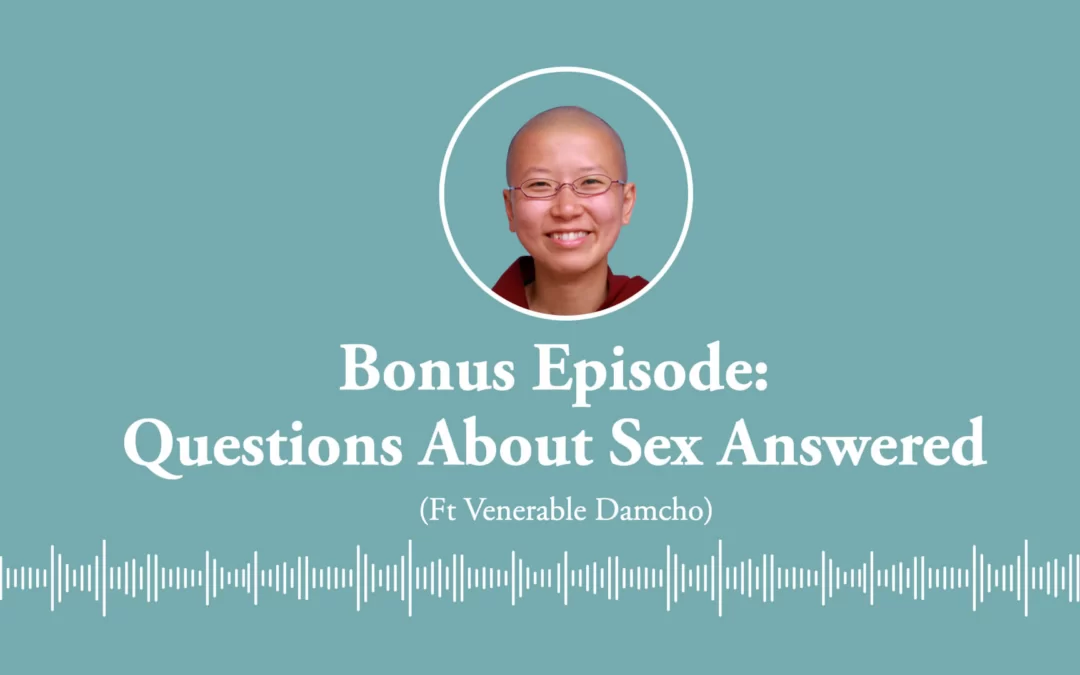
Welcome to the Handful of Leaves bonus episode. My name is Cheryl, your co-host for this episode. In this episode with Venerable Damcho, we will still be talking about sex, but this time it will be the questions that you asked, you rated, and we will get them answered. We cover topics like masturbation, lustful thoughts, monastics’ relationship with their desires, as well as two other questions. So buckle in and enjoy this episode.
[00:00:32] Cheryl:
So the first question is, what does Buddhism say about masturbation for lay people?
[00:00:39] Venerable Damcho:
You know in reflecting on some of these fire round questions, right? It’s very tricky, like people come to a monastic hoping you will make some kind of moral pronouncement, right? Can do, cannot do. Venerable so-and-so says can do. That’s never a helpful position to be in. I’ve seen Venerable Chodron deal with it very skillfully to remind people the purpose of the teachings is for you to work out for yourself what is realistic or beneficial.
So I don’t know if Buddhism says necessarily anything about masturbation per se, if you’re asking for a scriptural reference? That I’m not familiar with. But you can logically work it out for yourself, right? Like what does this do to your body and mind? But, I think this applies to this whole thing of, how does it make you relate to your body? Yeah. What is the effect of that? And it’s gonna be different for different people, you know? Is this helping your mind or not, does this increase your attachment or not? And what’s the effect of that?
So it’s you having to work that out yourself. So I would always come back to that principle for any of these things, like what are you conceptualizing and is it actually true or not true? And is it helpful or not?
[00:01:50] Cheryl:
And I really like how you do not give like a clear yes no answer, but rather questions for people to think about. And I guess that helps them to meet themselves where they’re at as well because[00:02:00] strict yes or no, it just doesn’t work for anybody. Everyone has to, you know, come to the conclusion themselves and fit, I guess, where there are they are in practice as well.
[00:02:08] Venerable Damcho:
Yeah. And maybe people will say, that’s very irresponsible of me as a monastic. I don’t know. Like I’m supposed to give some kind of clear moral pronouncement. But you know, it has to come from you right?
And I do trust that people don’t wanna harm people. Fundamentally. Yeah. Or that, on the basis of suffering or wrong thinking that we harm others. Yeah. So in the long run, you know, work it out. If it’s using up too much of your time or it’s causing you a lot of stress and unrealistic views of self and others, or, you wind up spending hours on porn to do this kind of thing. It’s like, what are you doing with your human life? It’s so precious we don’t have that much time, you know?
[00:02:46] Wilson:
How do monastics relate to their body, or how do they relate to sexual desire? Because desire don’t just magically vanish overnight.
[00:02:55] Venerable Damcho:
Yeah, so in the early years, still now too, we have to keep doing meditation on the nature of the body. So that’s described at length by the Buddha, and there are many ways to do it. So as a monastic, you’ve already thought this through and you’re like, well, you know, I don’t see the benefit of having a lay relationship. I want to focus on spiritual practice. But as you said, all your old conditioning is still there. So these meditations are taught in that context to help you to calm that attachment down and to start seeing the body for what it is, right? So you break it up into parts and you analyze. What is this thing?
Is it as beautiful and pleasurable as I’ve been taught it is? Then you think about what happens to it. It decomposes and so on. And we do this repeatedly. Every year we do a “Exploring Monastic Life” program. We talk about our views and how they’re changing. And then if you need help, you have a mentor who helps you. You’re like, I have a lot of attachment come up. I just need someone else to know this so that I have support to work with it, you know? So it’s not a judgmental environment at all. We know this is what comes up as ordinary sentient beings. Or you can say, oh, I find I’m attracted to someone in the group. I have [00:04:00] to make sure that I don’t get into a situation where this could come up because I want to commit to a monastic way of life. And the community will support you with that. It’s not like, how could you, you have this thought, you must leave now. That’s never the case. Yeah. It’s like, oh, this person is sincere in their training, they came forward to say, I’m working with this. How do we help each other?
[00:04:20] Cheryl:
It is amazing. It’s like how the Buddha always said, spiritual friendship is not half of the path it’s the whole of the path. And just seeing this support to help each other through our sufferings present in the monastic community is wonderful.
[00:04:34] Venerable Damcho:
That’s a whole separate topic about this whole spiritual friend thing. But, I wanna say, you know, as Dhamma friends to each other, even as lay people, right? That’s how we relate, that’s how we help each other as friends. You’re helping someone with their afflictions. You’re trying not to feed them. So, if you have a friend who’s harming themselves or others or having unhealthy relationships, we have to have the courage and skill to find a way to talk about it with them, right? Not in a judgmental, angry way, but to say, Hmm, you know, I noticed you’re in a committed relationship and I noticed that you seem to be developing a relationship with someone outside of that this is going to harm your partner. This is harmful. I just want to raise that as your friend. I don’t want you to see this happen.
I mean, that’s very real, right? I’ve been in that situation and you can’t come to your friend and be like, you’re so bad. It’s like, hey, why are you dating people who are not available to you emotionally? You deserve better. That’s my skillful means. Yeah. I feel that’s important as friends, that we help each other that way as opposed to like, oh yeah, just do what you want. Go ahead.
[00:05:38] Wilson:
Yeah, I’m very appreciative to Cheryl because when I was having those lustful thoughts in the monastery, I texted Cheryl, I was like, Cheryl, how I’m struggling with lust, and she brought me back to Dhamma. Like you mentioned about the contemplation of the body, she was like, Wilson, are you sure you want all these? They are going to decompose! I’m glad I found the right person. And like you said, it’s a skillful manner. She didn’t do it in a way where I felt judged. It’s really like concern for a friend, how can you do better? How can you be better? So that was really nice.
[00:06:07] Cheryl:
I was just mass spamming him like articles about how the body decomposes, the stages of decomposition. Okay, on to our last question is how to deal with lustful thoughts towards an attractive person when I’m already in a relationship?
[00:06:22] Venerable Damcho:
So same things, you know, to even recognize that is the first step. That’s good. You’re not acting on it. And then you gotta ask yourself what is happening behind those thoughts? Are you exaggerating the attractiveness of someone else, something else? I think often if you’re in a committed relationship and attachment to someone else arise, there’s a lot going on there. Why are you dissatisfied with the current relationship?
Are there things you are avoiding talking about to your partner, that you feel you can’t maybe be honest or fully yourself in the existing relationship and you’re imagining some other human is going to be the solution, right? I think that’s how it works. First of all, there’s you and the existing relationship. Some kind of need is not being met there but you are unable to walk away or talk about it or work it out, and then you go project that on another human being thinking that they will solve your problem.
And you gotta ask yourself, is that true or not? Like, why can’t you work it out with the person you’re with first before you move on? Is it fair to that other person? You have this problem and you’re just gonna project it on another one and rope them in. Like, please think about this first okay? Yeah, and there’s some super long ranging consequences to this. It’s a giant mess. This is what causes people to kill each other. Jealousy, you know, they’ll never speak to you again, they sue you. It could get really ugly.
So, you know, before you imagine that some other human being is gonna solve your unmet need in an existing relationship, please think twice and to think deeply, is this a need I can meet formyself maybe, right? And then, yeah, of course you gotta take care of the person you’re in the relationship with.
Why has it come to the point where you don’t care about their feelings? What’s going on there? There’s aversion, I think, right? Or hurt or whatever it is. It’s come to the point where you’re like, I wanna look out of it. So often I think when there’s that kind of looking out of the relationship there’s a lot of escapism happening. You’re not wanting to actually confront what’s happening with yourself and to be kind and fair to the person you’ve been with for a while. So you gotta think very deeply before you break that trust. Yeah, there all kinds of consequences.
[00:08:36] Cheryl:
This hits so deeply. Because a lot of times, when we are in a relationship, it almost seems as though it’s the easiest solution to just find someone else to replace or even to prove something, right? Like if you’re in a relationship and the person doesn’t give you attention, you’re like, I’m still good enough if another person likes me. Or like, how can I get back at you by cheating on you?
Yeah, it hits very deeply because it’s a lot of emotions. I think cheating is not as simple as oh, I’m just lustful. But it’s just a whole baggage of things coming with it as well.
[00:09:08] Venerable Damcho:
Yeah, it just comes back to what we’ve been talking about today, right? It’s all the conceptualization, the emotion that comes with all this, and the first step it’s so important that we become aware of it in ourselves. And to ask ourselves with our own wisdom, what’s realistic, what’s beneficial, what is useful and caring and kind to others.
[00:09:31] Wilson:
So Venerable Damcho, are there any advice or any tips on this topic that we may not have covered in our discussion that you would like to bring up now?
[00:09:39] Venerable Damcho:
Actually, I know there was one question from someone who thought there were asexual. I mean, just on this topic of self-awareness, I think it’s so important to also be aware of the conditioning and the social pressure we face, and as we work out that process to be comfortable with where we are in relationship to our sexuality or gender and things like that.
So you have to sort out the whole baggage from others and then within yourself too. And I say this because, just reading this question, there seems to be so much pressure to define ourselves as sexual beings. And so for some people, this just doesn’t work that way. And to be comfortable with that, to be able to respect that in each other.
Even to identify, oh, I am a gay person, right? But people relate to that label so differently too. I’ve had gay friends who are like, out and proud, and this is who I am, and I’m an activist. And then I have friends who are like, hey, I want to be known as a human being first before the label, so can you relate to me that way?
And I’m like, this applies across all humanity, really. Seeing and hearing people for who they are. So, there’s so much pressure on young people to identify or to express sexuality a certain way. I remember in secondary school, people were like you don’t like boys, you don’t like girls. Are you a plant? I’m just not expressing in the way you want me to, I guess?
It’s like there are other things that are important to me right now. I’m not crazy about dating right now, you know, it’s just not part of my life right now. That’s okay. Yeah. So whoever asked this question, be clear about that. Yeah. Before we identify or solidify an identity around some aspect of our being, remember, we are multifaceted, very complex beings.
[00:11:22] Wilson:
It’s really just one aspect of us, but sometimes I guess there’s too much focus on that, that causes us to overlook the other aspects. And I really like the part that you mentioned just to relate to him or to them like a human being because, I have been told multiple times by some of my friends that I come out at the most unexpected moments where it’s like out of nowhere. You’re just crossing the road with me, we’re carrying an umbrella together and you just suddenly come out to me. It’s like, can you choose a less dangerous timing?
And then after a while they realize that I told them that, it’s just like anything I tell you or any aspect about my life. It’s just something very normal. And the fact that I tell you about my sexuality, it doesn’t change anything. It’s just one aspect of me. You don’t have to see me any differently. I don’t have to act any differently. It helps to make me feel, I guess, a bit more authentic, that I don’t have to hide this certain aspect from you and that’s it. I just wanted to maybe also prove a point that by me telling you about it, it doesn’t change anything. It’s really just another aspect of my life that don’t need any special attention.
[00:12:23] Venerable Damcho:
Right. And that’s how you hold your identity. And it’s gonna be different for different people. Yeah. To hold each other with respect and care in that way.
Cheryl:
And with that, we come to the end of this fire round episode. I hope you enjoy and learn something. For me, the takeaway is that there’s no right or wrong or yes or no answers, but really using these guiding principles to help us to show up in respectful, caring ways to ourselves as well as the people that we are in intimate relationships with.
And as usual, if you enjoyed this episode, feel free to give us five stars on Spotify and share it with a friend, and of course, stay happy and wise till we meet again. Thank you.
Venerable Thubten Damcho is a Buddhist nun residing at Sravasti Abbey, one of the first Tibetan Buddhist training monasteries in the United States. Born and raised in Singapore, she graduated from Princeton University in 2006 and worked as a high school teacher and public policy analyst in the Singapore government before returning to the U.S. to take novice ordination in 2013. She tells her story in The Straits Times Singapore.
Venerable Damcho’s monastic life is rich and varied. She serves as assistant to Sravasti Abbey’s founder, author and well-known Buddhist teacher Venerable Thubten Chodron. Her other responsibilities range from translating Chinese texts into English to removing weeds from Abbey’s 300-acre property. Venerable Damcho has given Dharma talks in Spokane, Idaho, California, India, and Singapore. She was the Chinese-English interpreter at a full ordination program in Taiwan in 2019, and has studied Tibetan through Maitripa College and with other teachers since 2017.
—-
Surprise Guest Host Wilson Ng:
Navigating the uncertain waters of love and lust while learning to accept his sexuality, Wilson has learnt a lot from the mistakes made. He is learning to accept himself for his attachment to lust and to see the inherently unsatisfactory nature of sex and lust.
Transcript
[00:00:01] Cheryl: Welcome to the Handful of Leaves podcast. This is Cheryl, your host for today. Today’s episode is quite special. As you’ll be hearing new voices on the show today. We have Wilson taking the co-host seat and guest speaker, Venerable Damcho, a nun based in Sravasti Abbey in the U S. Together, we’ll be tackling the topic of sex and the Buddhist.
From the hushed discussions of what is right or wrong about sex in the Buddhist context to porn consumption, we will be talking about this topic with no filters. Prior to the recording, Venerable Damcho joked that she would be surprised that people want to hear what a nun has to say about sex. But the unique perspective that vulnerable. brings as a fully celibate Buddhist nun truly expanded my perspective on how sex and sexuality can actually be an extension of our practice of care and compassion to others. So without further ado, let’s get started.
[00:01:08] Wilson: Welcome to the Handful of Leaves Podcast. Hi, I’m Wilson, a gay male who wants to become a monk but struggles with lust.
[00:01:18] Cheryl: Hello, I’m Cheryl. I’m bisexual and I’m very curious about this topic from the Buddhist perspective. And today we have with us our guest Venerable Damcho (and guest host Wilson).
[00:01:27] Venerable Damcho: Hello. Hi, I am a Buddhist nun. I am a no-more-sexual. Everyone declared their sexual orientation at the start. I’ve been living at Sravasti Abbey here in the U.S. for about 10 years now and I was born and raised in Singapore.
[00:01:43] Cheryl: Venerable graduated from Princeton University in 2006 and worked as a high school teacher and public policy analyst in the Singapore government before returning to the U.S. to take novice ordination in 2013. She received the full ordination in 2016 and currently serves as [00:02:00] assistant to Sravasti Abbey’s founder, author and well-known Buddhist teacher, Venerable Thubten Chodron. Her other responsibilities range from translating Chinese text into English to removing weeds from the Abbey’s 300-acre property.
So today’s episode about sex everyone’s curious about it. The media is so obsessed with it, and without sex, all of us wouldn’t be here. But the thing is, nobody’s really talking about it. It’s so taboo. If you ask your parents, they’d rather squirm and disappear, and if you bring it up in the Buddhist community, it’s even worse. It’s like a sin to talk about it. So I’m curious. What’s the difference between sex and eating? They’re both pleasurable, right?
[00:02:44] Venerable Damcho: It’s a sin to talk about sex in the Buddhist community? Really? Okay. We gotta get to that later, maybe.
[00:02:50] Cheryl: It feels like that.
[00:02:51] Venerable Damcho: Ah, okay, okay. We don’t have sin in the Buddhist worldview. I mean, there’s virtue and non-virtue and realistic, not realistic. But, okay. I think that’s a question that comes up later. So, yes. what is the difference between sex and eating? I find this question kind of alarming and also very funny at the same time. I’ll approach it from a slightly technical perspective.
When we think about these activities, they involve our senses. And I would say the primary difference is that the intensity of sensual involvement for sex is just so much greater, right? With eating, it’s primarily the gustatory consciousness. The tongue at this area, and then the olfactory consciousness gets involved. That’s where a lot of the pleasant feelings will arise. But in terms of touch, sight, you want food to look nice. And hearing is not so much involved in eating.
But I would say for sex it’s involving all your sense consciousnesses, and for sure the mental consciousness is engaged in eating too. There’s a lot of conceptualization happening. But I would say your entire body is involved with sex, right? So [00:04:00] there’s a lot of contact with an object and huge feelings arise. I’m talking here just about pleasant, unpleasant, neutral feelings that we experience. And then on that basis the degree of affliction that can arise is also much stronger with sex relative to eating. So my first thought was, with eating you’re less likely to get very attached and jealous and angry as a result, but those are some emotional responses that come up, right? Like, you have sex with someone and it’s like, “oh, suddenly they’re yours.” Or all kinds of imputation occurs. If they reject you, you’re going to get very upset. It leads to people harming themselves and others. Just on that kind of mental consciousness and emotional level a lot more is happening there.
Another thing I thought about was also that, sex involves another human being’s body. I mean eating involves animals’ bodies, if you’re not vegetarian. But that’s a whole separate [00:05:00] topic. There’s another sentient being involved. They have feelings too. There’s the whole question of consent, care. There’s a whole other dimension that’s so different from eating.
And then of course on the more obvious level, heterosexual sex leads to the possibility of conception and another life. And has all kinds of other consequences. And then there’s diseases these days that get spread through sex. So I would think that’s a big piece of what creates a lot of the taboo because of all these consequences. I think it might be society’s way of saying this is a very powerful, intense activity. A lot of disturbing emotions can arise. There can be huge life-changing consequences. If you have an unplanned pregnancy, you wind up having to think about, do you want to keep or take a life? Huge, huge consequences. So I would think some of the taboo is basically handled with care. This is a very powerful action that has huge ramifications for an individual, for the partner, for all of society really. So [00:06:00] there’s a lot of conceptualization around it. The consequences of that will differ in every culture. That’s why it’s a lot easier to go out and buy food and eat and no one’s gonna look at you. But if you had sex in a public place you would be arrested.
[00:06:14] Cheryl: But I guess coming from the perspective like sex, eating, drawing, singing – everyone does it, or to a certain extent, a lot of people do it. But why is it that it becomes so taboo? So I feel like the taboo is making it worse. By not talking about it people get really wrong ideas about what is sex and what’s the right attitude to have about sex.
[00:06:34] Venerable Damcho: I think it’s tied up with so much conception of your identity and personhood and who you are and your culture, ethical values. There’s just all this baggage around it. But I do agree that if it’s very difficult for people to have an honest conversation about it, it doesn’t help.
[00:06:50] Wilson: Like what Venerable mention, there are so many potential consequences to it. It’s such an important thing that people need to learn about. When we talk about food and eating, for example, since young, we have parents teaching us what to eat, what not to eat, how to eat, when to eat. It’s actually a lot of guidance, ideas from a lot of people when it comes to eating or even some of the other activities.
But when it comes to sex, I guess because of the taboo, and maybe because our parents’ generation, they themselves didn’t have such conversations with their own parents, so when it comes to our generation, maybe we just find it hard to find reliable sources to get such information. In the context of Singapore, even in schools, we have difficulties trying to navigate such conversations because everyone seems to have their hands tied. So that’s the challenge.
[00:07:34] Venerable Damcho: I completely resonate with that. As a school teacher back then, because I was a single woman, you have no sex life period. And so you’re not allowed to talk about this with the kids. But you’re right, it was a huge gap in education. My students were exposed to pornography. There were people circulating it on their cell phones. The kind of disciplinarian acts that came up, I would never have worried about this in my time. Also, I went to a girl’s school. People wanna go in and take photos of people showering, that was one thing we had to guard against, or to shame a teacher, they might take photos under someone’s skirt and circulate that. I was like, wow, the school is not talking about this. How do I handle this? It came out in one of my classes where a student was accused of taking photos under a teacher’s skirt, but we couldn’t find the evidence. Then as the form teacher I got involved and I was like, wow, how do you even handle this? I started to just wear pants all the time.
We never had those conversations. And I also saw gender violence between boyfriends, girlfriends, the girls will tell me, my boyfriend is stalking me or he doesn’t let me talk to other people and there’s like no discussion of how to handle that because of course, you’re not supposed to be dating. I think all you’re supposed to do is show up in school and do your homework and pass your exams. Like, wait, no. The kids are here for a whole different reason. And no one wants to talk about it.
[00:08:54] Cheryl: I think the approach in Singapore as well as Malaysia, where I’m from, it’s all about don’t do it, right? So don’t have sex, don’t have a boyfriend, don’t have anything, don’t know about sex, which is so dangerous.
[00:09:04] Venerable Damcho: To be fair, I went to a independent school, maybe cuz it was a girl school, at least from the biological point of view, there was a very thorough discussion and explanation, by including the teacher describing at length her own pregnancy and delivery. At which point you’re like, oh, I don’t wanna do that. She even gave us a whole packet including information about what is an orgasm. It’s like, oh, okay. But it’s like, this is not on the test, but, you know. The discussion in class was, would any of you have premarital sex? One person raised their hand, that was my best friend. Everybody just sat there like, okay, next.
[00:09:36] Cheryl: We talk about taboo in general, in our education system, in society. Maybe let’s talk about how it’s amplified even more in a religious context. I think nobody, as far as I know other than Wilson, talks about their sexual desire or their lust. Is it something bad?
[00:09:53] Venerable Damcho: Oh, this is so interesting. Poor Wilson, you are the sole Buddhist in Singapore who talks about lust?
[00:09:58] Cheryl: Literally? Yes.
[00:09:59] Venerable Damcho: I’m glad you asked this question because for me personally I would say some of the most helpful conversations I’ve had about sex actually happened here at the monastery. Because we have an “Exploring Monastic Life” program. The Sravasti Abbey runs it and it’s three weeks in a year. Anyone of any Buddhist denomination, as long as you’re interested in ordaining, you can sign up for this program. Venerable Chodron tailors the teachings very much to people who are interested in ordaining. So she might say things that she wouldn’t to a introductory lay group. It’s focused on a specific group of people who have taken refuge and precepts, who are seriously thinking about this and are single. So it’s possible. They’re not tied up in a relationship. So, she’ll teach topics related to monastic life and the heart of the program is discussions. And we’ll have very deep discussions in the groups about money, your relationship to family, romance, key issues you have to work out before you ordain, and once enough trust is built up, usually at the very end we talk about sex.
So I just wanna maybe share some of the questions we reflect on that I found very helpful. So she’ll get us to talk about what is the conditioning we have received about sex, whether from our family or from society, so everyone talks about that and what has been the impact of that on our own relationship to sex and our lives, what has that conditioning produced in our behavior? And then also how we’ve enacted that and what are the results of that. Those are some of the preliminary questions. And just that alone I found fascinating because you hear from everyone in the group.
I’m fairly old school, right? I think of sex as associated with love and I just kind of assumed everyone would think that way because my parents have this very stable relationship and so forth. It happens in this context of a loving, caring relationship. So it’s interesting for me to hear there’re people for whom sex represents freedom. They’re like, I grew up in a very conservative environment. So it’s about rebellion. And for some people they talk about how sex is traumatic because they were abused. Some talked about how [00:12:00] it’s just about pleasure. For them it was the highest happiness. So much gets imputed on this activity that goes beyond just the physical aspect, right? There’s a lot going on emotionally, mentally, and then once you have two people with very different views coming into relationship with each other, I think that’s where a lot of the struggle and conflict in relationship happens. But for me as a monastic, it was to see, oh, this is all the stuff I’m imputing on it. Then I sit down and I ask myself, is sex really love? Has that been my experience? To ask those questions, that’s one aspect.
And we also talk a lot about the true cost of a sexual relationship. Ages ago I saw this comedy routine by Chris Rock, where he basically said if a man could have sex with a woman in a cardboard box, he would do that and call it good, right? Then he wouldn’t have to go to work anymore. You just need a box. Great. But no. There’s all this other stuff that needs to happen.
One of the most powerful talks I heard from Venerable Chodron was when she laid out, you have your idea of an ideal partner, they dress a certain way, so then you’ll also need to fit that ideal, be with that group, dress a certain way, work out, you need to get a certain kind of job to attract the partner, you need to have a certain income. All the stuff that comes, you need to do some activities, all for this little bit of pleasure. Your whole life revolves around how to get this partner. She went on for almost, I think 30 minutes. It’s true, I spent so much time, even getting a haircut I hate to keep the partner. Why? Because you want them to be attracted, and yeah, it all boils down to sex. Is it worth it?
So those are some conversations steering towards what does it mean to you and what is it really? What are the causes, the costs and the effects of a sexual relationship. Those are some conversations I found very helpful beyond good, bad. We weren’t looking at it in those terms, it was like, what is realistic and what is beneficial? I think that’s the framework we were coming from.
[00:13:53] Wilson: I mean from the biological perspective, how sex fires the reward sensors in our mind, it’s very different [00:14:00] from other kinds of activities that bring us pleasure and which is why people describe sex as like a very carnal, very primitive desire. Just because we want that little flesh of pleasure, we will do so much for it.
From my perspective as a gay male, for a lot of us, we cannot meet potential partners in a very organic setting, which is why a lot of people in the LGBT community, they actually use apps to meet people where it feels like a safer space. But unfortunately, in a lot of these kind of spaces, sex becomes commoditized. We just shopping for sex. We are just looking at different profiles, looking at maybe how they look like, sometimes maybe even just look at sex as a very transactional thing.
Venerable mentioned that for some other people, they feel like sex and love are very closely intertwined, whereas for some people they just feel like sex is just a biological need that they’re fulfilling and that’s it. There’s nothing wrong with it. So it’s really interesting to hear that there’s just so many different kinds of views when it comes to sex and different kinds of baggages that comes along with it.
[00:14:56] Venerable Damcho: That’s why it gets very tricky because you want to care for another sentient being. I think that’s the baseline piece of this, independent of whatever activity you’re doing, at least that’s one commitment I have. I believe it brings happiness if I come into any relationship with care and love. So like you said, it’s very tricky with sex. People have their own ideas and imputations. It’s the classic one person who thinks it’s just biological meets the person who has a lot of attachment to a romantic ideal, right? It’s like, oh dear, this is not going to go very well. And you see people suffer so much because of that.
That’s why we have precepts and guidelines. So I would think in the religious context, it’s not so much a taboo thing. This whole topic of how do you relate to Buddhist ethical precepts, it’s like also a whole separate thing. It’s not like commandments. It’s not like some higher deity came and said, follow these rules. We take precepts willingly, voluntarily. If you break them, you confess and repent them, but you can also give them back. But it’s something you’ve thought deeply about.
[00:16:00] So for the lay people, it’s not engaging in unwise and unkind sexual behavior. That’s one way to phrase it, or sexual misconduct. But I guess Venerable Chodron always phrases it that way, unwise an unkind sexual behavior. So you’ve thought about it, this is an act that influences me and others deeply. How do I use this kindly? Do I want to see other people as objects, as pieces of flesh, like food, I just use to have some fun. Is that really how I wanna relate to people? Do I feel good about myself? Just the way you describe how that app works, I’m sensing there’s the pleasure piece, but it’s not entirely satisfactory.
So I would say we’re missing out. But I think it’s so important, that’s why that third precept is there.It’s not so much as a value judgment of good, bad, but it’s more of how do we protect ourselves and others? How do we live lives that are at least steered towards non-harm? That’s the baseline, I would say, of Buddhist ethical conduct, not to harm.
[00:16:55] Wilson: Thanks, Venerable. I think that answers quite a bit because many people using these kind of apps, sometimes feel very hollow because there’s something lacking about this kind of interaction that’s unlike a human connection. You have already answered the next question which was, how can we balance between living with our human desires and being Buddhist. With kindness as our intention, I feel that we can learn to live with our desires in a more wholesome way and not harming other people in the process.
[00:17:18] Venerable Damcho: Yeah, it’s about seeing all beings in their wholeness. This is a sentient being. They have minds. They want to be happy. They don’t wanna suffer, just like me. One of Venerable’s teachers named Lama Thubten Yeshe, he said, often when we say, I love you to someone, what we really mean is I want to use you. Every time I’ve heard that, it’s like, wow, really gotta think about this one.
You know, in your meditation you can look at that. What are the ways I use people. Okay, sexual pleasure is one. For me, I use people to boost my reputation, I’m very attached to it. In the past I was like, who do you know, name dropping? Like, oh yeah I’m so-and-so’s friend. Oh yeah, I’ll hook you up, I’ll hook you up. Little things like that, right? It’s like, oh, do I value my friends because of what they do in their work? And they reflect that I am a successful person. Like, oh dear. Not to feel guilty about that, it’s more getting aware of it. This is how my attachment functions. Do I want to see people that way?
So I’ll say one great relief I feel living a celibate life is that I don’t look at people as sex objects anymore. It’s so conditioned. It’s like you go into a room and it’s like, oh, who’s hot? Who’s not? We got limited time here. Who do I wanna talk to? Oh, let’s make sure we leave with that person’s phone number. Or someone’s coming onto you and it’s like, please do not, go away. Right? That’s so much of just how we orient in like a short two hour party or less. Now it’s like, I’m a nun. You wanna talk to me? Sure. Of course, all the questions I get are, someone is dying, how do I help them? I get to hear about all your relationship problems. And that’s cool. I like being able to interact with men this way. In my former life I define as heterosexual, I don’t stress about this stuff anymore. And men know you’re out of bounds. You have a shaved hair you wear a uniform. I’m protected in that way.
[00:19:08] Cheryl: Because we’re very conditioned to, in a way, use other people in a very transactional way. It’s always about what can I get? And less about what can I give? So is there like a process on how we can slowly chip that away? Because these habits are very ingrained and very strong as well, it’s a tendency. Is there like a process on how we can change that mindset?
[00:19:29] Venerable Damcho: In the Tibetan tradition, one thing we focus a lot on is analytic meditation, where you are familiarizing your mind with different perspectives and we meditate a lot on the kindness of others. So just reflecting on the kindness of parents and teachers that they’ve shown us in this life. That’s one way to start kindness of your friends, just really sitting and looking, actually I have received all this. I have enough. So much kindness comes to me on a daily basis. And then also reflecting on kindness of strangers. That one’s a bit harder for people, but it’s like, they didn’t cook the Hawker Center food for you specifically, but thanks to the hawker who got up at three in the morning to set up stall and all that, I can go downstairs and get food. So taking time to just reflect.
So you’re right, you’re familiarizing yourself with this totally opposite view, which is, I have enough, people are so kind to me, versus I don’t have enough, what can you give me? That’s kind of mind behind the transactional, I don’t have enough, I’ve never had enough, I’m never good enough. Give me more. Give me more. Now you’re like, no, I’m surrounded by kindness. I live, I exist because of kindness. And also to think about kindness of people who harm us. That one is the last step. They’re showing us how we can grow. They might be pointing out something we really don’t want to look at or work on if they criticize us. Or they’re helping us purify our negative karma if we know how to work with that. Just try and turn the mind to see, okay, even people who I find very difficult, they’re creating a circumstance that is helpful for my spiritual practice. It feels very artificial at first, but you know, you’re trying to turn your mind to see every single being as kind. Then, we relate to them with a feeling of warmth. I just want to repay your kindness.
Of course it takes a long time. So in a lot of these meditations, you go one person at a time. I think in the traditional loving kindness meditation is that way too. You might start with yourself, or you start with one being. And then another one and another one, and then you just repeat this slowly over time. Or you can do it on the bus just looking around like all these people are kind and think about how that’s the case. No one’s getting up and hitting you. Everyone’s observing good social rules. And just learning to pay attention to that instead of, I don’t have, give me.
[00:21:45] Cheryl: Sometimes I feel like when my mind is lacking energy is just very down. I feel that reflecting on the idea that every single person on this earth has benefited from some form of compassion and generosity of others, even someone who is in very bleak situation, like in the war zone or something. For them to be existing at this current moment, their mother must have given them some breast milk.
So maybe that’s the only generosity that they’ve received. But they have still received something and I think it’s so cool because all of us are able to exist in this moment because of someone else’s goodness. And that brings a lot of comfort and brighten my mind up.
[00:22:21] Venerable Damcho: That’s very powerful. Thanks so much for sharing.
[00:22:23] Cheryl: I actually have a very curious question before we move into the porn theme. So I think that the guideline that you’re sharing with us is that, instead of using other people as objects we can turn sex into almost a very skillful way of giving, caring and loving another person. But at the same time, any sexual activity will need to have that arising of lust, which is in a way, coming from a form of craving and attachment to sensual pleasure. So is that a disconnect or is there a way to balance that lust with the act of loving and caring for another?
[00:23:01] Venerable Damcho: Mm, that’s a very good question. It’s so difficult to tell the difference, and maybe the term I’m more familiar with is attachment, so I’m gonna use that. And, and I don’t mean it in terms of psychological, secular ways of using this term, right? Like there’s the healthy attachment that a parent needs to have with their child to bond.
And when we talk about attachment in a Buddhist context, some people use the word lust, we’re talking about a mind that is exaggerating the good qualities of a person, an object or an experience, or even an idea. Or you are projecting good qualities that are not even there. That’s why you call it an affliction. It’s not realistic. You’re basically hallucinating and you are interfacing with your hallucination, not the actual being, I would argue, or the actual experience.
Simple things you’re attached to, like chocolate, right? And then you have a certain idea of what is supposed to taste like. Just look at this when you’re eating. Come back to that, before you put the food in your mouth. What are all the ideas you have about it and why you think it’s gonna taste so good? And because I ate two just now that tasted so good. So I’m sure number three will taste just as good, but no, it makes you feel sick. Because it’s number three. You know what I mean? So you just watch the mind of attachment has imputed all this stuff on it, or it’s like my mother cooked it, it’s like my favorite thing, blah, blah, blah. All this stuff that comes with it, and then you put it in your mouth.
Does it match all this conceptualization that has come before that? If you just pay attention to that act of chewing or whatever, it’s like, okay, that lasted about a couple of seconds and I swallowed it. When you go on retreat or things like that, you start to see what it is you’re imputing and projecting.
So the tricky thing with any kind of romantic or sexual relationship is that all this is getting imputed on another human being, or an impermanent relationship. Like it or not, the conditioning is like that, so this is gonna last forever. Or simple things like we’re just gonna have the same schedule every day.
When I feel like going somewhere he or she will wanna go there too, right? Oh, sure. They love taking walks just like me, or they’ll love going to the movies. That’s why we got together. And so often that’s just not the case. This is another sentient being with their own afflictions, karma, likes, dislikes, and you’re imputing all this stuff on them. Then people change too, right?
I think one of the first relationship I was in, it was so painful because, we had a good run for maybe about three months. You’re like, oh, this person’s perfect. We fit. And then after three months it was like, there are also a lot of other problems with this. We don’t have the same temperament, but because we’re so blinded by three months was so good.
It was like the rest of the year or so, we are always trying to go back to the three months. And then finally this person graduated. It was so clear. He’s working. He has a whole different life. I’m still at school. I have a different life, but again, we’re still like, no, no. It was so good before, it was so good before we can go back there.
[00:26:00] That is so tragic, right? It’s like we are totally different people. We could not see each other at all. We could not love each other. Do you know what I mean? Because you’re so hung up on some idea of the past or who you want this person to be. I could not see like, yeah, of course he started work. He’s under a lot of stress, right?
No, he cannot pay attention to our relationship in the same way he’s in a different country, in a different place. So if I loved this person, I would be able to hold that view and be considerate and also maybe make the wise decision, like, this is not serving my needs either, so we’ve gotta find a way to end this on good terms.
You never think so clearly when you’re attached. Right? It’s like, he doesn’t love me and he’s so boring. He’s talking about his work all the time. He doesn’t care about me, me, me, me. But it used to be so good. It’s a waste of time. It’s a super waste of time.
So yeah, it takes a lot of work. To tell the difference, like, oh, when am I projecting all kinds of unrealistic things on someone? First I need to identify it in my mind, then I gotta be mature enough to work out what’s going on here, and then find a way to communicate. That’s so hard, right? To be like, Hmm, you’re not meeting my need for respect right now when you don’t talk to me when you come back from work. Is there some way we can figure this out? Yes. And then the sex makes it all complicated. It gets all bound up together, body and your mind.
So yes, sexual relationships take a lot of time. That’s why monastics give that up cause you want to focus on your spiritual life. But for some people monasticism doesn’t fit, it doesn’t bring them joy. You can’t force yourself to do this either. Then, can we find a way to have a respectful, loving relationship.
That takes into consideration each other’s needs. And then that, that, that takes a lot of work. It takes a lot of maturity and communication between two people.
[00:27:50] Wilson: Thanks for sharing, Venerable. I think many people after hearing your podcast, they’ll be like, sure I’ll break up. But interestingly, there are a few things at hand here. Like you mentioned previously, in a relationship, there’s another person involved. And in that case, there’s a lot more factors. But even when we talk about just looking within ourselves, just to see our clinging to expectations, our attachment to the past about how things should be. All these are already so challenging. Which is a great point.
We can actually segue into the next part of the topic where even if it’s not with another person, the topic about porn. It’s not as if you are having an actual interaction with another person. But yet how porn can consume us, it’s also similar. The kind of expectations that we have, how we think sex is gonna be like, all these things are what porn does to us.
So before we actually move into this part of topic, I think we would like to caveat that we are not talking about porn addiction in this part of the podcast, we’re talking about porn consumption. So if porn consumption is actually interfering with your daily life, your daily relationships please do actually consult a professional on this. So from our point of view, we’re actually curious to find out, there have been so many cautionary tales about porn consumption. We’d like to discuss with you, what are some of the drawbacks of it or if even possible, some of the benefits of it.
[00:29:06] Venerable Damcho: Thanks for this very, skillful segue. I just wanna back up a little bit to the point you made about how it’s so important to do this inner work on ourselves first. Maybe not first as in you have to be Buddha before you can engage in relationship or whatever, but at least to work out, to some extent, what’s going on in your own mind? Even if it’s a non-sexual romantic relationship, there’s a lot of projection going on and that can create a lot of difficulty and misery. So to try and have a realistic, balanced view. Very difficult. But yes, so that comes to our point with pornography. Already the mind is so deluded. I just think we live in a time where this most private and intimate of acts is just so public and ubiquitous that you can access it with one click. And something about that is very frightening and shocking to me. It takes all [00:30:00] the privacy out of it. I would say Judith Butler, an American philosopher and well known for being a LGBTQ theorist about gender relations, and I had to read one essay by her for class years ago. Back then, I wasn’t Buddhist, and I was trying to be an open-minded college student. What’s good, what’s bad? Let’s not have these judgments. So reading her essay was very helpful, she said one of the biggest problems with pornography is that it sets up an ideal that you cannot attain, thereby destroying your sex life.
You watch it or read it, thinking it’s gonna bring immediate pleasure, but it’s actually distorting your views. It makes it harder for you to actually interact with another human being. That’s the angle she was coming from. I don’t know if she would entirely agree with that now, people’s views change. But that really struck me. I was like, oh, it’s so ironic, right? Like, I guess there’s some people who would try and say, I’m learning, I’m getting experience watching this. But is it actually distorting how we relate to another person or setting up fantasies and expectations that are totally not fulfillable, then that’s very harmful. That’s one level.
And then as we’ve talked about before, it just reinforces the whole people are objects thing, right? Porn is so bizarre. I used to be an English major, so I’m like, where’s the storyline? It’s like, two people show up, that’s it. Where’s the story? I can’t get behind this. The first time I ever saw explicit porn was on a boyfriend’s computer. Before this, I’ve had friends who read things to me. I live in a very text-based world. So I’m working on this computer and he’s not in the room and I’m trying to find something online and I click on something, I don’t know what it is, and something from his browser history just erupt. And this is the days before popup blocker, and I’m like trying to close all these things, I’m like, what? Where is this coming from? We had to sit down and I was like, is this what you’re looking at? This really disturbs me, back then I remember saying, I find it hard to have this relationship. It’s like there are 2000 other women in this relationship now. I didn’t say that, but I was like, are you expecting this of me? This is really kind of gross and disgusting to me personally. Whatever other people’s views are I’m not judging you as a human being, but I’m saying, I don’t feel like you see me for who I am. And then as a woman, a lot of this imagery is violent. It seems to me to encourage harm toward women. So that’s the part that’s hard for me to witness. You know? It’s like, wait a second. So there’s a lot of aversion on my side to that kind of representation and to ask what does it do to your mind?
But more broadly, I think anytime we pause and think about causes and conditions. This thing that we’re seeing, we click, we think, we see or we eat or whatever, and you think it brings immediate pleasure. It’s produced by so many causes and conditions, so you don’t think about it. They’re human beings involved in the porn industry, right? Why do they get into it? Do they have rights and they protected? One of the films I watched years ago that really shifted how I thought about the whole industry as well, it’s called Boogie Nights. I don’t know if either of you have seen it. It was very critically acclaimed that year. That’s why I watched it. It’s very long and actually quite dry for a movie about the porn industry. But it’s about a young man who kind of gets groomed to be part of it and basically exploit it. It shows you the behind the scenes of it. It’s very boring. It’s work, you know? The damage it does to the lives of the people in the industry, they sometimes can’t get out of it because of the stigma. There’s a lot of drug use. People are in this industry to try and make money quickly and they’re abusing their bodies. So it was really tragic after watching that I was like, how could you consume porn and think it’s not gonna harm anyone?
But this is coming from a vegetarian, right? When you look at factory farming, it’s like, how would I ever eat it again? No, it’s harmful, period. I guess that’s what this film did for me. It was like, wow, this is a very troubling industry. I do not want to have any part in it. I mean, I respect sex workers. I wanna make sure they have their rights and protections, but I do not wanna be part of it as a consumer.
[00:34:01] Cheryl: I think it’s also very concerning because in Singapore, actually, 9 in 10 boys between the ages of 13 and 15 have watched or read sexually explicit materials. And I think this really forms the primary education that boys and of course girls learn about sex. If these are the things that is being conveyed, it further informs how they will treat their partners, further informs how they will treat women in general. So, yeah, it’s very scary.
[00:34:26] Venerable Damcho: I’m just so curious. There must be movements to address this or to figure out how to talk about what pornography is doing to a whole generation for whom it’s so easily accessible. I wanna just raise two movies I saw here at the Abbey actually, they’re documentaries. I wanna see what Wilson thinks as an educator.
We watched this film called The Mask You Live In, and it’s about the construction of manhood and how once you have this idea of, you gotta be a man, you can’t do certain things. It also entails putting women down and it builds violence. But I thought of this film because it showed, what life is like now for a young man. He [00:35:00] sits in front of his computer and he has access to all this whole other universe that is putting all kinds of wrong ideas in the mind. But it’s very well done. When we watched it with the guests here, I would think just about every man in the room was like dumbfounded by the end of it, to see the kind of conditioning they’ve received as men. Some were in tears. They have artistic interest and then the father is like, no you gotta fight, go learn boxing. He’s like, what? To pigeon hole that way. And then of course, the violence on women. Then there’s an interview in that film too with a young man who dated a woman who had experienced sexual violence. He was like, wow, how do I hold my identity as a man in relation to all this?
And then there’s the corollary for the women. It’s called Misrepresentation. So that one looks at media representations of women and also how pornography promotes violence towards women. They’re both made by the same filmmaker. Very powerful. So I would recommend those films for sure as starting points for discussion on this issue.
[00:36:01] Cheryl: Wilson any thoughts as an educator?
[00:36:03] Wilson: As an educator, I feel like there’s a lot of challenges with this job because we are not just talking about the idea of just sex and relationships. And as Venerable rightly pointed out, when we were talking about gender stereotypes or gender roles, about all these different kinds of issues that youth have to struggle with while they are going through all these biological changes in their body, it’s actually a very insane time for the kids. And I would think in a Singapore context where we’re largely a rather conservative society, the challenge we have is, how do we facilitate conversations with the kids and even with parents so that we don’t polarize the issue further?
I find that in recent years, whenever the topic of either sex or sexuality or gender comes about, it always ends up like a battle between two groups, where one group is perceived as very conservative and the other group is perceived as very liberal. By having this label there, a lot of times we can’t have this kind of conversations with the kids because people will just shut off immediately. They were saying like, oh, you’re trying to interfere with what I’m trying to teach my children or my students and things like that, it’s so challenging.
Even in schools we find that times have changed indeed, but there are certain things that don’t change. I previously taught in secondary school. In secondary schools, you’ll find that at some point the girls will start to shut up. Interestingly, maybe in primary schools the girls are more willing to speak up, take on leadership positions and things like that. I can’t really pinpoint saying that it’s any specific people’s fault, because everyone has a part to play. But even as teachers, sometimes maybe of our own conditioning, we also have ideas about how boys should behave, how girls should behave. And as a result, we also perpetuate such stereotypes as the kids grow up and the kids look at us as authority figures to them.
When we talk about pornography consumption, some of these kids, when they look at pornography at their age, they may think that this is the norm. As adults, we [00:38:00] can ponder about our participation as consumers in the porn industry, how it harms people. But for the kids, they’re so innocent, they may not even have value systems to help them see what is right, what is wrong . I was reminded of this article I read back in 2006 or something. There’s this boy who actually killed himself because he thought his genitalia was small. And just the idea that a boy took his own life because of that really saddens me. In our modern life, our inability to have very open and level headed conversations about sex has caused so much delusion, so much pain to especially the young people.
[00:38:38] Venerable Damcho: I wanted to respond to two points here. Sometimes, just having a conversation at all is construed as permissiveness. It’s so taboo. The society has a view of like, there are such clear boundaries or guidelines you shouldn’t even question them. To even have a space to talk about it is risky. You already fall in the liberal camp. I feel that in the school space it’s very fraught like that because every parent has their different views and then you are the teacher. It’s a view of education as you’re filling the empty pail, which is not at all how it works. So that’s one piece.
And then I think too, there’s the whole question of whether we are aware of our own conditioning. And that’s the piece I think I can work on. If I know I’m an authority figure or I’m holding a certain kind of relationship with someone, I need to know what I’m bringing to the table. And I brought that from being educated in the US because here there’s a whole discourse about race and power and gender, and it really got me thinking, as a middle class Chinese woman I inhabit a position of power. Or I have an elite education. And then I was teaching in what you call the neighborhood school. A lot of children from lower income background. The way I speak, race is a big one. What happens when it’s a double minority person, right? And to bring that into the Singapore classroom.
So the way I applied it was just to be mindful. To see, like, it can be very hard for the Malay girls to speak up. That was my experience. How do I create a safe space for them to speak organically without being like, class, you cannot be racist. I mean, come on. And it takes a lot of work, but first I have to model that, right? I pay attention, I’m looking out for the minority in the classroom. The very quiet kids. Why are they not feeling safe speaking up? Yes, the smart Chinese boy, thank you. And to be aware of where my attention goes as a teacher. Do I always call the boys or do I have a lot of judgment about the girl combing her hair repeatedly in the corner and I’m like, stop being this kind of girl. I have other ideas for what you should be. It’s like, you know what, she wants to comb her hair.
So just bringing that kind of awareness of our own biases, our own position of power, I think it’s very important and responsible. When facilitating discussions about difficult topics, I think that’s what we all have to try and bring into the space.
[00:40:51] Cheryl: In a way, it all starts with ourselves, right? The more we know about ourselves, our own biases, then the more we can take care of that and make sure that it’s not projected in a way that [00:41:00] harms other people.
[00:41:00] Venerable Damcho: And we’re willing to be honest about it. And that’s what I really appreciate about both of you.
[00:41:04] Cheryl: Since we can’t solve the problem of asking everyone to stop porn watching tomorrow. And I feel it’s a little bit like a vegetarian idea, right? Like you just close your eyes to what’s happening in the farms. You just close your eyes to how bad the industry is. You just seek it for your own pleasure in a way, very selfish. One question that I want to ask is, what can we do when lust starts to enter or consume our minds? I guess by default a lot of people turn to porn. How can we be skillful with that?
[00:41:32] Venerable Damcho: I think just going back to things like the Satipaṭṭhāna Sutta, I had to give you a scriptural reference on the establishment of mindfulness, right? What’s the Buddha’s instruction? First of all, it’s to learn to even identify that state of mind. That’s already very hard, I know. It’s like one line in the Sutta. This is attachment, this is anger. That is not what I’m thinking when there’s attachment and anger. I’m not identifying it. When I’m angry, I’m thinking I’m right. You are wrong. You gotta change. I’m not thinking this is anger, you know? So same with attachment. Can I have more?
So first of all, it’s just that learning to identify how does this manifest in terms of my thoughts, physical reactions? And then in meditation you can spend time thinking, what does this lead to? That helps you assess how far do we want to go with this? Then you start to look at it with more wisdom. So first of all, it’s identifying and then not judging your states of mind. It does nobody any good to be like, you are so bad and lustful, that’s not the antidote to attachment, judging yourself. Likewise, it’s not the antidote to anger. You’re so bad and angry. That’s just more anger, right? Then you gotta pause and look at this realistically.
So the antidote to any kind of attachment is often impermanence, reflecting, what is this object really like? Is the pleasure or happiness it’s going to bring everlasting? Does engaging in this harm myself and others, and also slowing it down and thinking of all this, taking a long perspective, and that can calm down the attachment, right? Yeah, it was so good, but gosh, it used up hours of my life. Do I really want to spend another eight hours on this? Like video game addiction, right? People who’d just spend all day playing a video game, and then what? You’ve got to find a way to sober that mind. So that comes from thinking impermanence, thinking is this genuinely satisfactory or not? Looking at the causes and conditions and effects that it produces. In relation to part or any kind of attachment you have, I think that’s the way to work with it. You can’t judge yourself for it, but you’ve got to try and grow that wisdom mind. And then you will actually find the right solution for yourself. If you can see very clearly this is not bringing genuine happiness you’re not gonna settle for it. Venerable often says, why are you settling for Grade F happiness? Then you’re like, it’s the only thing I know. All I’ve had is Grade F. What could that Grade A be?
And then your mind’s like, if I have not experienced Jhāna or Grade A, then I cannot move on. It’s like, no, there are sources of happiness outside of things we’re attached to. That’s a positive side. Just having a conversation with someone I care about. To bring an honest conversation. Oh, it’s so much more pleasurable than lying to each other. Let’s move on with life in this way.
[00:44:13] Cheryl: There was this saying from a Thai monk, Ajahn Achalo, and he was saying that craving is never satisfied by fulfilling it. When you fulfill your craving, you just want more and more and something else.
[00:44:25] Venerable Damcho: So that’s reflecting on the disadvantages, it’s like drinking salt water basically ? Oh, you just keep getting thirsty.
And to do that when your mind does not have attachment. It’s reflecting on this when your mind’s kind of calm and sober, that’s why people have a daily meditation practice, so that when the thing actually happens, you’re like, wait a second, we have thought about this. Let’s pause, pause, pause. Let’s make a wise decision before we jump.
[00:44:48] Wilson: Wow. I feel like whatever Venerable shared was very helpful because reflecting on my own experience that happened recently, I was staying at a monastery for three weeks. And I realized with no distractions from the external world, distractions from the internal world were insane. Which is why I thought about what to do when lust start to enter our mind because I realized that it was so crazy. But like what Venerable shared, the moment when it appears, to be kind to ourselves, to not judge it and to allow ourselves to know that it’s a gradual training, and slowly as we find out the higher grades of happiness, we will not be satisfied with just this Grade F happiness.
And I did find that along the way in the stay in the monastery, as I meditated and as I started to find better levels of joy inside. Of course, I cannot profess to say I’ve had Grade A joy because I am just a guy still struggling with all these desires. But I realize that if I don’t judge myself, I’m kind to myself and I allow myself to rely on my daily practice, when the days are good, when your mind is clear and when you reflect upon it, that’s where it builds in the support for when things are not going so smooth. Then we can fall back on this practice. Yeah, I found that it was really helpful.
The part about not judging was so helpful because in my three weeks stay, I was telling myself, first two weeks was lust, the last week was anger. When I started to let go and be kind to myself, just asked myself, what benefits would it bring me if I were to indulge in all these? It is ultimately unsatisfactory, that helped a lot.
[00:46:12] Venerable Damcho: They way you’re describing is you came to that conclusion yourself. That’s what the Buddha always said, you’ve got to check my teachings for yourself. No external power came and told you, Wilson, this is unsatisfactory, you should not do it, all the more you’re gonna do it. So that’s totally not the approach in Buddhism. And I would say the experience you had, that was a very successful retreat because you started to see how your afflictions work. I think people don’t expect that. Like you go into retreat, this is attachment, you’re gonna go in and it’s gonna be so perfect and blissful. You already think you are some very advanced practitioner. You’re gonna be floating on clouds. It’s not like that. For ordinary sentient beings, what are you gonna see in your mind? The causes of suffering, your afflictions. And to see them is the key, then you can clean them up. There’s a saying in the stagesof the path to awakening. It says, what’s the difference between a wise person and a fool? The wise person knows they’re foolish. The fool doesn’t. That’s the tricky piece. So you’ve grown in wisdom and that’s really wonderful.
[00:47:14] Cheryl: Sādhu.
[00:47:16] Wilson: Thank you. Wow.
[00:47:18] Cheryl: I think this episode is really wonderful. Just to summarize, I came in thinking we’re just gonna talk all about sex and only about sex, but I realize that this goes way beyond sex.
It goes into understanding our relationship with ourselves, understanding how we can show up and be kind, be caring and be wise in terms of how we treat other people as well. There’s no definite answer in terms of this is what you should do or you should not do. But really there are principles that can help you guide yourself in making decisions that will reduce the harm that you create for yourself and for other people. So thank you, Venerable Damcho, and thank you Wilson for coming on and tackling this really interesting topic, and I hope all our listeners here will benefit and stay happy and wise.
Buddhist Youth Network, Lim Soon Kiat, Alvin Chan, Tan Key Seng, Soh Hwee Hoon, Geraldine Tay, Venerable You Guang, Wilson Ng, Diga, Joyce, Tan Jia Yee, Joanne, Suñña, Shuo Mei