TLDR: Learning to see life in death requires courage. It is a great reminder to live life well and see joy even in the downs of life
We all know that our loved ones and ourselves will pass away someday. For the majority of us, however, this isn’t something we normally bring to mind – that is until circumstances make this a reality in our lives.
For me, this reality came in late-2017 when my close uncle (Tiuo Tiuo) passed away from Leukemia. Tiuo Tiuo was almost like a 2nd dad to me, and he was by my side through my various life milestones all the way until university. From Tiuo Tiuo, I learnt many life lessons – and the lessons continued even until his last days and beyond.
Helping Others
“There will come a year when we will have 1 less person (at Chinese New Year) compared to the previous year. It will be really sad and the memories of that person and his presence will certainly be missed. I also felt sad looking at Ah Ma’s picture on the wall. It is the first time I see a familiar face of someone on a wall like that…”
29-01-2017 (Chinese New Year)
Tiuo Tiuo was someone who enjoyed the simple pleasures in life! One of his greatest pleasures was to pluck in his earphones and immerse himself in the music on his handphone. However, he was never good with technology and often required help loading up or accessing his music. The job to troubleshoot his phone when it malfunctioned often fell to me – and honestly, it wasn’t something I enjoyed all the time (especially after a long day at school)!
“So Tiuo Tiuo’s leg has been troubling him these past 2 months, but more acutely these past 2 weeks. Old age and sickness indeed.”
11-10-2017
Looking back, however, memories of these small acts of service give me the greatest joy. There is little regret in my heart, knowing that I overcame my laziness to help bring minor conveniences and joy to Tiuo Tiuo. Since then, I made it a personal principle never to turn down requests from my loved ones as far as possible – we never know when that might be the last time we can help.
From Tiuo Tiuo, I learnt that being of service is a blessing.
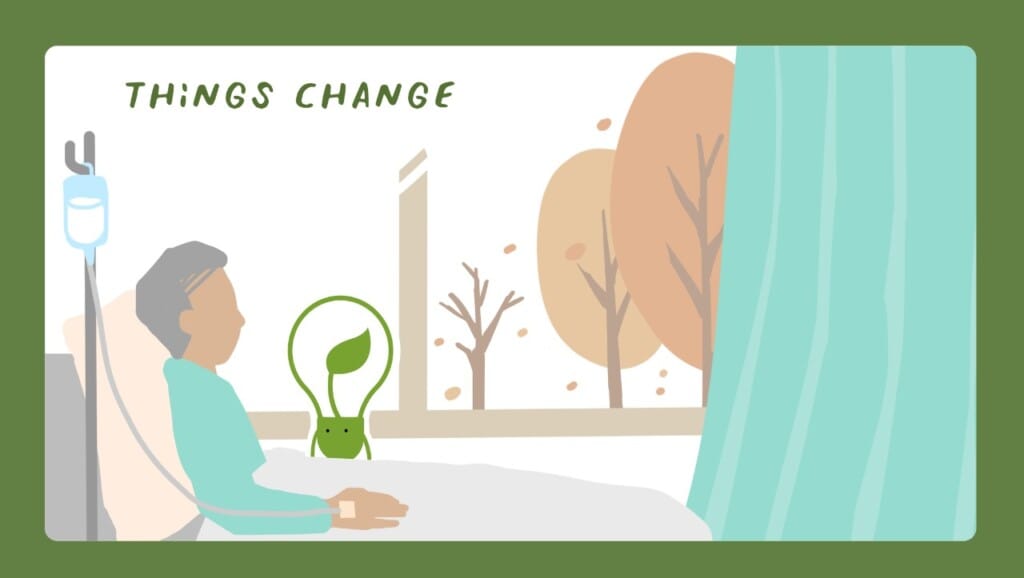
Things Change
“I brought Tiuo Tiuo to A&E for his full body check up… Was informed that he was diagnosed with Leukemia, which is essentially cancer… It is hard looking at Tiuo Tiuo suffering – not just his physical pain, but his mental expectations that this would be a short one.”
21-11-2017
Aside from listening to music, Tiuo Tiuo also loved to catch up on the latest news around the world! One of the common interests that we shared was to follow the latest English Premier League football highlights. As Tiuo Tiuo became weaker, however, these joys became harder to attain as his world turned more inwards.
“Tiuo Tiuo started his first chemo today… There is a chance Tiuo Tiuo will face many complications for his health and get more sick; or he might be on this long and gradual road to recovery and this state will hence linger for a few years. It is so uncertain.”
30-11-2017
Being by Tiuo Tiuo’s side as he journeyed through his last days, I saw that pleasures in life are not evenly distributed throughout. Many of the more enjoyable and sensually delightful experiences are often front-loaded in our youth and early adulthood. The less pleasant parts of ageing, sickness, the dulling of our senses, and the gradual losing of things we hold dear – these come slowly, but inevitably.
From Tiuo Tiuo, I learnt that conditions go their natural way.
How We Live
“Tiuo Tiuo has been admitted to the ICU and intubated and unable to speak, and the prognosis isn’t good… But what’s for sure is that he is suffering much now, and I don’t know how to ease his suffering.”
13-12-2017
As Tiuo Tiuo became weaker, he could not enjoy the things he used to enjoy. Instead, he sought a simpler solace from the companionship provided by our entire extended family who banded together to support him. Tiuo Tiuo lived his life in service of others. Through the decades, his humble 4-room flat played host to many of my Malaysian cousins working in Singapore who required accommodation.
As one of the respected elders in the family, he always rejoiced in our successes, and was quietly supportive in our times of struggles – even financially at times. As Tiuo Tiuo gradually grew weaker, he rested at peace with memories of a life well-lived and in the companionship of family.
From Tiuo Tiuo, I learnt that how we live, is how we pass.
“Thursday, the doctor said the falling BP and oxygen levels were signs that Tiuo Tiuo was passing away soon … I stood outside the glass door for an extended period sending metta (loving-kindness). That was the last time I saw Tiuo Tiuo alive… I went in and ma ma and mum were reassuring him that it is ok to pass; the rest were kneeling down, sis was crying badly. I did not cry. Sent metta to Tiuo and wished for him to be well and happy.”
24-12-2017
It has been almost 3 years since Tiuo Tiuo passed away. With time, the deep feelings of loss and sadness have given way to a more subtle appreciation of the values he represented. As I pay respects to Tiuo Tiuo at his altar daily, the lessons he taught also continue to inspire me to live each day fruitfully in service of others.
While Tiuo Tiuo may no longer be around, in many ways, he lives through the lives of many around him whom he had touched. Our loved ones and ourselves will indeed pass away someday, and we do not need to wait for this to be a reality before we learn the lessons that death and dying presents.
By realising our mortality, may we learn to be less intoxicated with youth, health and life. By learning the preciousness of our human life, may we allow mindfulness and wisdom to guide us on the path towards truer and more lasting forms of happiness.
Wise Steps:
Learn to see the bright sparks in the bleakest of time, as every moment is an opportunity to find sparks
Knowing that separation is inevitable, fruitfully serve those around you
Resources to help in death (and life) contemplation:
TLDR: As religious or spiritual people, we can sometimes get unknowingly self-righteous, giving unsolicited advice. It’s much more skillful to respond to the needs of the person we are speaking to with equanimity, mindfulness and a sense of “right timing”.
A type of question I often hear during Q&A sessions with Dhamma teachers goes like this:
“How should I advise this person about this thing they are doing that seems problematic?”
“How should I advise my friend /family member to be more [insert good quality]?”
This is interesting because from how the question is framed, it sounds like the asker is less concerned about what their friend/ family member should do about their situation than how to advise (or persuade) them in a way that makes them want to take up their advice.
This can seem like it comes from a good place – but actually, what is the intention here?
Are you collaboratively helping that person to work out their issue, or are you trying to “correct” them based on your opinion of what they should be doing?
Sometimes the desire to fix other people’s problems can come from righteousness and judgement – aka the ego. But in fact, they might not need (or want) your advice.
Am I doing this for them or for me?
Something I’ve noticed in myself and other Buddhists is that we can sometimes become quite deluded, clinging to a “Buddhist identity” that we’ve fabricated over time.
We can be quite self-righteous, thinking we have all the answers and if only they knew better, if only they did this thing that the Buddha said, they would be so much happier. So, we go around advising our friends and family, trying to “fix” everyone’s suffering.
If we’re honest with ourselves, we may find that this is less about them and more about us, compelled by a neurotic desire to fix someone’s problem as a projection of our own ideals. A telltale sign is when we feel a strong desire for the other person to take up our suggestion and a sense of agitation when they are not willing – that disappointment comes from an expectation.
Probably another defining quality of unsolicited advice is when it is given at the wrong time. You could very well be right about what the other person needs to do about their situation, but they might not be ready to receive it just yet.
What you are saying might be true, but if you say it at the wrong time or in the wrong circumstances, it becomes “wrong”. This is because we are not being receptive to the needs of the other person; our words are not in line with the way things are right now.
Instead, we are strongly attached to our views about the situation and are more concerned about getting them across and validated.
We want our thoughts and speech to be thought of as right and true.
That validation gives us a nice ego boost, making us feel that our opinions are right and true – which is a very nice and lofty way to perceive ourselves.
I am a wholesome and good Buddhist.
I am someone who helps improve the lives of those around me.
This sounds wonderful, of course. Better than being a murderer.
But if we begin to cling to that image of ourselves, then our actions become less about generosity and goodness for their own sake and more about egoistic self-interest. More importantly, we may not be not truly serving the other person at all.
Drop the preacher mentality
I used to have a strong tendency to go around preaching about Buddhism until I met people like my Ajahn – a very unsuspecting monk of the Thai forest tradition.
He always keeps a low profile but sometimes drops these mind-blowing nuggets of wisdom when the situation calls for it. Even though he’s in robes, he doesn’t go around preaching to every person he speaks to – which is ironic because he’s probably one of the most qualified people to do so.
He mainly just listens and only gives advice when asked or makes comments at the appropriate time.
I think this is a sign of true humility (and Right Speech) – as opposed to when you feel like you have the right to “teach” or “correct” others, which automatically comes from a place of superiority.
You’re trying to fix others, change them, make the world a better place – all according to your ideals, which are really just ego projections. Again – true but not right, right but not true.
Observing Ajahn’s behaviour, it’s apparent that despite his many years of diligent practice, experience and knowledge, he never really views himself as a “teacher” and therefore never puts himself in that position. He’s not on a profound mission to create world peace or save humanity or spread Buddhism.
He just wants to live out his life as a simple monk practising the Dhamma.
The irony of that is that turning inwards and focusing on ourselves is often the most impactful or inspiring thing for other people. Watching the skillful conduct of Dhamma friends like Ajahn has been the most effective thing for me in changing my behaviour and views for the better – they didn’t have to push or persuade me.
This doesn’t mean that we shouldn’t lend our support to our friends and family when they need it – it would definitely be good if we did. But there’s a difference between supporting someone appropriate to their needs, and being generous for our benefit.
It’s the same principle behind donating tons of food to an established food bank that has an oversupply of food, rather than donating to a lesser-known one that is really in need. The former may make us feel good for being generous, while the latter is generosity with attentiveness to the recipient and their needs, which is more beneficial and truly “self”-less.
Returning inwards
I think another important lesson to learn is that we can’t change people (and it’s not our business to anyway) – we can only support or encourage them. I believe people change on their own accord when they have their insights, and those definitely cannot be rushed or forced.
When we understand this, we realise that trying to fix others is a waste of time and energy. We become more equanimous and in turn focus more on ourselves – which is where we can truly bring about change.
Wise Steps:
Focus on yourself. Most of what the Buddha taught was aimed at going inwards and cultivating wholesome qualities and abandoning unwholesome qualities within. If we realise this, there would be fewer problems to “fix” in the world.
If you’re not sure what your friend or family member needs, ask how you can best support them. Do they need advice, encouragement, or just empathy, etc.?
Be supportive, not compulsive. If you feel the impulse to give advice, ask yourself if it is appropriate for the other person right now and check if you’re just doing this to satisfy your ego. Agitation is a sign that the ego is at play.
TLDR: Set your boundaries, learn how to self regulate, and listen with openness
Does family = sacrifice?
Being born in a typical Asian family, I have always been expected to excel in everything that I do. Honestly, as long as what my parents expect of me is reasonable, I do not really mind that. I know that they have done so much for me and doing well in life is just one way I can repay them. Besides, having them push me forward will help me grow as a person.
The problem is what happens if what they expect of me is way too demanding and I fail to achieve those goals that they have set for me. They will be so upset and disappointed in me. Being a generally filial daughter, I do not want that to happen. I love them and I want them to be happy.
However, the continuous chasing after those ambitions can sometimes be suffocating, that it jeopardises my wellbeing. The questions then, does familial love really have to be sacrificial? Can we not find a middle ground where we both can be happy?
The answer is of course we can. I have been to two extremes from rebelling against their words to following everything that they want. As you might have guessed, both methods did not work. I did not feel happy doing them. The Buddha taught the Middle Way and we can use the concept to balance parental expectations and what we want in life.
Tips for juggling with parental expectations:
(disclaimer: these are what work for me. If you find that any of the tips below do not apply to you, you may choose to ignore it.)
1. Build a relationship with your parents that is based on open communication
Communication is key in any relationship. If you want to build a harmonious relationship with them, make sure you spend time with them. Having time together allows you to understand one another on a deeper level which makes communication easier. In that way, you know what kind of attitude and tone to adopt when discussing your concerns with them.
For example, if your parents expect you to take an engineering course in the university, but you know that your passion is not that and you will dread your decision if you simply follow what they want you to do, then, talk to them in a way that you both can reach a conclusion.
While you acknowledge their concerns (e.g. stable career), you explain to them why engineering is not suitable for you and why choosing another course of your choice will be better in a long run (e.g fulfilling career). I am sure that if you talk to them logically with realistic reasoning, they will eventually understand you.
Also, when explaining our concerns, we can practise the five factors of right speech taught by the Buddha (AN 5.198). The five factors are that a statement must be spoken at the right time, spoken in truth, spoken gently, spoken beneficially, and out of goodwill.
It is also important to understand that communication is a two-way process. Just like you, your parents also want their opinions to be heard. A lot of conflicts arise not because we think that we are right and the other person is wrong, or vice versa, but because we feel that we do not get the respect that we deserve. Hence, it is important to practise effective listening if we want communication to occur smoothly.
It is important to understand that you are not an extension of your parents’ ambition.
As much as you want to pay back your parents’ kindness, you need to understand that you are not perfect.
There are times when you fail and that is alright. In fact, it is great that you experience failure. In that way, you know where you are lacking and where you can improve on. You do not need to feel guilty for not achieving something. Be kind to yourself and thank yourself for doing the best you can.
Also, instead of always asking what your parents want you to do, start asking what you really want to do. Because you are the pilot of your own life, not your parents. There is a difference between repaying your parents and living all your life for your parents. Understanding that, you will not be stuck with the oppressive feeling of guilt for not living up to your parents’ expectations.
3. RELAX (breathe in, breathe out, repeat)
I know that it is not easy and extremely unnatural to be relaxed when you are expected to be the best all the time, outdoing everyone else. However, being tense will only result in you underperforming because instead of focusing on what you need to do, you pay attention to your negative emotions. Then, you feel guilty for being negative which makes you even more negative and this vicious cycle continues.
The thing is, my dear friends, when you are relaxed, you can face problems with a clearer state of mind. With a clear state of mind, you can better understand your parents and why they expect certain things from you. When you are calmer, you can also perform to your fullest potential, thereby achieving your goals and meeting your parents’ expectations.
A few ways to relax are:
a. Practising mindfulness through meditation.
There are many benefits of meditation including feeling less stressed as your stress hormone, cortisol, decreases. When you are not as stressed and anxious, the condition becomes more conducive for you to relax. One mobile app that I use to keep my meditation practice in check is insight timer. There are many guided meditations if you are new to meditation 🙂 You may consider using it too!
b. Changing your perspective.
Rather than expecting tasks to be accomplished to see tasks as adventures to experience. Inducing some form of fun can also help you to calm down.
c. Reflect.
Jotting down your emotions in a form of journal, music, or poetry. Externalisation of your emotion can uplift your mood and alleviate your emotional burden.
In conclusion, I believe that when parents expect something from us, it is usually out of goodwill. It is just that when they fail to see things from our perspectives, their expectations become overwhelmingly unrealistic and difficult to achieve.
Know that you are not alone in this and a lot of us experience the same thing. I hope that this short sharing can be of some help to you and I hope that you can better juggle with your parents’ and your own expectations. Jia you!
With Metta,
Selvie
Wise Steps:
Find a routine that increases your mindfulness and centres you
Practise holding multiple perspectives, you do not have all the right answers