TLDR: Ever bought something you had to have, only for the joy to fade right after? Ophelia reflects on her struggles with impulse spending and how Buddhist mindfulness has slowly helped her make more intentional choices. Spoiler: She still wants things, but now she pauses and listens to her wise mind first.
Impulse spending. We’ve all been there, haven’t we? That irresistible urge to buy something on the spot, believing in that moment it’s exactly what we need to plug that blackhole within our hearts.
The Traps of Greed
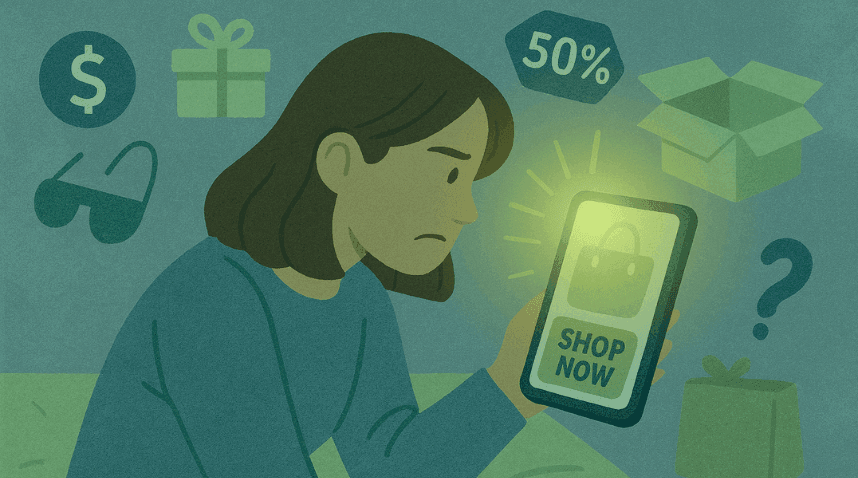
Remember the last time you scroll mindlessly to a sponsored Instagram post, you notice something novel/cute/pretty/quirky/productive, and feel that little tug? A whisper says you need this <ad product> right now. And you clicked “Shop Now”.
The item that just popped up on your screen promises a better life, a more put-together, more fulfilled version of you. Not just one item, but every item you browse holds endless possibilities. You want that future to happen.
With just a press of “Buy it Now”, Google auto-fills your credit card details and your shipping address because it is such a helpful personal assistant. Within nanoseconds of authorising that transaction, you’ve got mail: Yay! We are preparing your order. Delivery within 3-5 working days. Track your shipment here.
You heaved a sigh of relief. Life can only be better after you receive the parcel. You check the shipment progress in anticipation. Can’t wait for good things to happen.
Or maybe that last time happened within a physical store of a major retailer: you remember seeing “50% off” cards hanging from every other corner.
Everyone else has something in their hands, browsing for more. Unconsciously, you ran your hands through the aisles for something. Anything. You want to be like them. You just got your salary today; you know you can treat yourself for slogging a month at work. You deserve better.
You’d bring that “promise-of-a-better-life” home. Head light, hands full. You feel a flicker of joy.
Within days, sometimes hours, that fickle light fades out like the moment a sparkling wand dies. The exact moment you set the new trophy down, you notice the older purchases still on the coffee table. Shopping bags and cardboard boxes litter the living room. So do your guilt and emptiness.
Then, the next craving would come. You want to experience that joy of waving the sparkly wand of consumerism again. A harmless pen. A sheet of stickers. An inspiring notebook. Another shirt, different in colour than the ones you had. Cleaning supplies. Gradually, the trophy becomes more costly.
That’s the thing with craving, a loose translation of tanha. It never ends. You got some and you want more.
What I’ve described was an older self. She’s still here in her own ways now.
In the Dhammapada (verse 251), the Buddha puts it plainly:
“There is no fire like passion… no river like craving.”
This fire burned through my bank account. This river flooded my apartment with things and left me wondering, why do I keep doing this to myself?
Painting Instead of Possessing
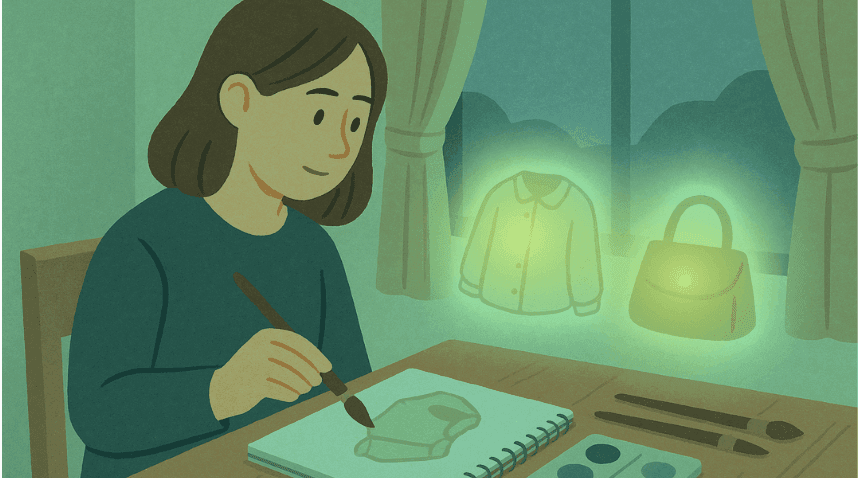
One day, I came across a story on Instagram. A woman who’d paint things she wanted to buy instead of purchasing them. A luxury handbag. A designer couch. A beautiful blouse. She’d record her wants visually, write down why she liked it, and that was it. No checkout. Just observation.
I haven’t tried this hack yet, but something about it stuck with me. It reminded me of what the Buddha often nudged us towards: not rejecting beauty, but seeing their nature clearly. We can appreciate things without clinging. Enjoy presence without owning.
Maybe by capturing beauty on paper, we can acknowledge the desire that arises at that moment and recognise it as distinct from the choice of not acting on greed. We can then let go before the purchase, not just after feeling the regret.
My Online Shopping Cart = My Mirror
Here’s one thing I have been doing. Whenever I see something I want online, I add it to my cart and then I walk away. No checkout. No commitment.
Days pass. A week, sometimes more.
If I return to the cart, I usually find that I may not want those things anymore. The dopamine’s gone. I’ve forgotten why I wanted them in the first place. That pause becomes a mirror. One that shows me the impermanence of my own wanting.
I think of the space as a little mindfulness bell. Every time I feel that surge of “I must have this thing now,* it’s not about saying no. It’s about watching the arising and ceasing of feelings. Letting the wave rise and fall without getting swept up.
Physical Shops = Sensory Overload
Walking into a store? A whole different story. The lights, the smells, the textures of fabric between your fingers, they’re all designed to seduce.
So I came up with a tiny hack. I don’t carry a shopping basket if I’m alone. No trolley either. Just two bare hands.
It might sound silly, but it works to mitigate damage when impulse takes over the steering wheel. If I can’t carry, I can’t buy. This constraint forces me to think, Why do I really want this, or am I just blindly grabbing clutter in another moment of craving?
Choosing with my hands means choosing with my awareness. That’s become a kind of training ground for restraint against the cruising desire.
Bring a Friend, Save Your Wallet
Sometimes, the timeliest wisdom comes from someone beside you. For example, an admirable friend who gently calls out your patterns.
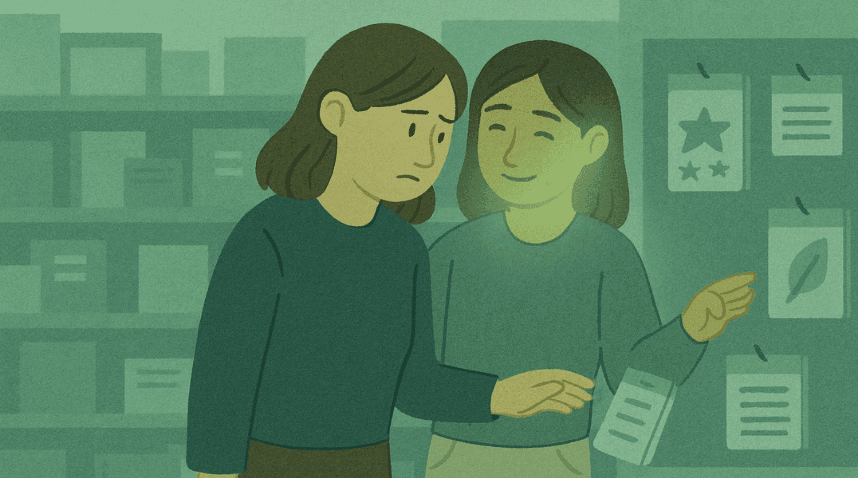
Not long ago, I was eyeing yet another sticker pack. My friend, who’s seen me go through all this before, asked simply, do you really need them, or is it just a passing desire?
She didn’t shame me. Just reminded me to pause. In that moment, the grip of craving loosened. I managed to walk away.
Here’s the thing: the mindfulness practice is not about never buying anything ever again. It’s about asking, Why do I want this? What need is the item trying to fill? And most importantly, will that need be truly satisfied with buying?
Not long ago, after weeks of waiting, I finally bought a set of black fine markers. I’d thought about it. Waited. Reflected. They are inseparable from my sketchbook filled with zentangle patterns doodles.
Now, every time I draw with the fine markers, I feel joy. Not because it’s fancy, but because I chose it with care. It feels earned. Not by money, but by attention. Maybe I’ll start drawing and painting all my desired possessions with these markers.
That’s a shift. I don’t want to live at the mercy of every craving. I want to choose my actions. Live simply. Spend wisely. Cherish what I have. Keep using them, repairing them.
Because in the end, most cravings are just visitors to your mind. And like guests who show up uninvited at your home, if you give them space, attend to their needs with a cup of tea and listen to their musings with presence, they’ll leave you in due time.
Wise Steps:
Delay checkout by at least seven days so desire meets impermanence, as seen when I left items in my online cart and returned to find I no longer wanted most of them.
Shop with empty hands so your body sets a boundary, like skipping baskets and trolleys which forced me to ask if I truly needed what I grabbed.
Invite a mindful friend to be your mirror and agree on a gentle question, as when my friend asked if the sticker pack was a passing desire and the urge eased.
TLDR: With porn so prevalent to all of us, what is the Buddhist take on porn. How can we sustain the practice in a digitally saturated world?
Disclaimer: This article discusses the topic of pornography viewing and may be uncomfortable to some. Please proceed at your discretion.
In the modern world’s frenetic chaos, the Buddha’s teachings on letting go of craving and attachment can seem like ancient whispers easily drowned out by society’s loud siren calls for gratification.
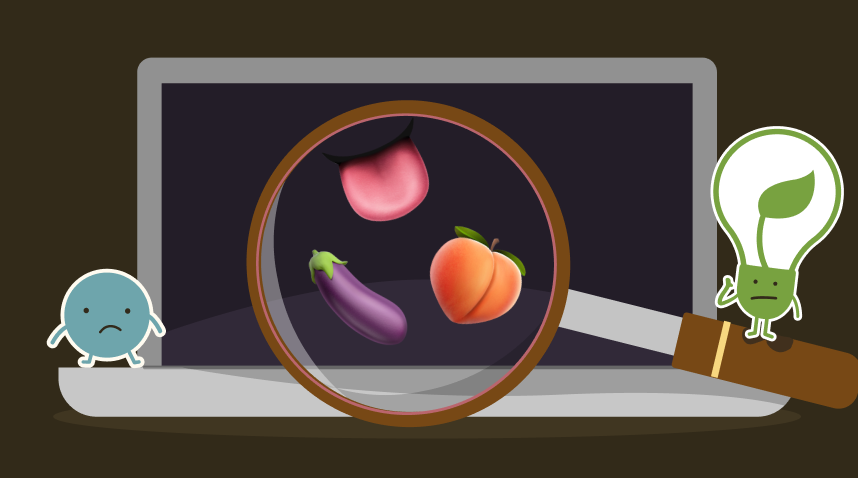
Nowhere is this tension more apparent than the omnipresent pornography that has seeped into our collective consciousness, and at an increasingly young age too. In Singapore, 9 out of 10 boys aged 13 to 15 have watched or read sexually explicit materials.
For Buddhists navigating this dizzying digital era, the issue sparks a moral paradox – to indulge these carnal cravings through pornography’s vivid lens, or to abstain.
The Buddhist Perspective on Sensual Pleasure
On the surface, pornography embodies the very attachments Buddhism cautions against. The Buddha was explicit that sensual pleasures are fundamentally unsatisfying.
The Buddha described sensual pleasures as “a chain of bones” (in the Alagaddupama Sutta) – with little satisfaction, much stress, much despair, and ensnaring us in a perpetual cycle of dissatisfactory craving.
Similarly, in the Avassuta Pariyaya Sutta, the Buddha warns that one being “mastered” by sights, sounds, tastes and sensations leads to the growth of defilements like lust, resulting in future rebirth and suffering. Through this view, pornography, with its fictional displays intended to arouse, represents the apex of delusion, conjuring an artificial reality to satiate base desires.
The Pragmatic Approach
And yet, Buddhism teaches us to meet reality’s circumstances with pragmatism and an open mind, not dogmatic rigidity. Sexual desire is innate to the human experience, not something to be rashly suppressed or shamed.
Some argue that pornography may provide a safe, private way for individuals to explore their sexual curiosities and fantasies without risk of sexually transmitted infections or unwanted pregnancies. It is also asserted that it may offer an accessible avenue for releasing pent-up desires that might otherwise lead to misconduct from desperation.
For those with unconventional desires and orientations, it also allows secure examination of their eroticism behind closed doors.
But is this a skillful means for Buddhists interested in living an ethical life and purifying their minds? Do individuals know when it is enough and when they are addicted to it? The lines are more blurred than some would think.
The Nature of Pornography
Informing this debate is the very nature of pornography itself. Pornography, by design, perpetuates defilements the Buddha cautioned against.
There are 16 defilements (upakilesa) that cloud the mind. The Thai saying, “Kilesa is the engine of sadness,” aptly captures this notion. Pornographic scenes hijack the brain’s dopamine reward system, and according to Gary Wilson (Tedx Glassgow speaker), the dopamine hit can lead to two things: it signals to the brain that it has reached a dopamine peak, and it activates delta FosB, which triggers binge mechanisms and leads to more craving, creating a cycle.
This can cause brain changes similar to those found in all addicts, leading to a numbed pleasure response where only the addict finds porn exciting and everything else becomes boring.
This addictive feedback loop also means increasingly extreme material (more graphic violence, more risque, more illegal or elusive content) is required to feel aroused. Combined with the accessibility to this content, the viewer’s willpower erodes.
What may begin as a “harmless” pleasure or a stress-release activity can increasingly darken the mind.
Ajahn Achalo shares his perspective on pornography here, that by embracing and familiarizing one’s mind with darkness, the mind gets dark, and further darkens as it feeds on more darkness.
The Ethical Concerns
Research has also shown that 88% of the most popular porn scenes contain acts of sexual physical aggression, and 96% of scenes portray women as enjoying violence (Bridges et al., 2010) – and this belief that women subjected to sexual violence is acceptable can become internalised by impressionable viewers.
The coercive underbelly of the industry, rife with exploitation and trafficking of real human beings, the majority being children, also cannot be ignored.
Stories recounted by former performers frequently include instances where they tried to back out of the scene or even the industry altogether and were threatened with legal action.
Other stories include threats from industry agents for performers to do scenes that were not agreed upon beforehand. As Buddhists, are we perpetuating this abuse merely by partaking as consumers?
Undoubtedly, for monastics who have renounced sensual indulgence, engaging in pornography and sexual acts is a clear violation of vows and precepts.
But for the householder still entrenched in worldly life, how can one relate skillfully to the natural urges of sexual desires?
Raga, or lust, is one of the most powerful desires – a finding well supported by neurobiology. Contrary to the modern belief that unbridled expressions of desire are a form of liberation, the Buddha considers desire as a form of slavery: when you have a desire, if you must and are compelled to follow it, these darken and cloud the mind.
Instead, liberation in the Buddhist sense, points to a mind that is free from the deluding and darkening forces of desire, attachment and ignorance. It thus becomes radiant, free and peaceful. Most importantly, all of us have the potential to be awakened to this nature.
Can Watch Or Not Watch?
Thus, the question of whether one can or cannot watch pornography, should be extended to consider how we can cultivate self-compassion amidst these potent forces of desires that cloud the clear, radiant nature of the mind. Furthermore, how we can we journey towards liberation from suffering with ethics, concentration and wisdom.
We can turn to the Handful of Leaves Podcast with Ven Damcho on the topic of sex for some enlightening insights.
One key takeaway is to be brutally honest with where we are at, not shaming ourselves for having these natural urges or even, secretive impulsive habits of pornography and trying to pretend to be a saintly celibate “Buddhist”, whatever that means.
Accepting where we are at in this journey, and acknowledging that the Buddha’s teachings are a gradual path of relinquishing our cravings is the first step towards happiness.
Whether you watch porn or don’t, there is no Godly being that will condemn you, but really, if you feel empty, unhappy and lost as a result, the purpose of the teachings is for us to work out what is realistic or beneficial to our happiness, and taking committed actions towards that.
And to ask ourselves with our own wisdom, what’s realistic, what’s beneficial, what is useful and caring and kind to others.
Start where you’re at
One of the most effective techniques according to psychiatrist Dr K. for resisting the urge to view pornography is called “urge surfing.”
This paradoxical approach recognises that directly fighting pornography cravings is often counterproductive, as the brain learns to intensify the urges when you resist and fail. Instead, urge surfing involves riding out the craving wave for 15-30 minutes without giving in.
During this timeframe, the brain’s homeostatic tolerance mechanisms will kick in, allowing the intensity of the urge to subside on its own. To facilitate urge surfing, avoid fighting any battles you’re likely to lose against intense cravings. This reinforces a sense of powerlessness.
Instead, try to strategically “pick your battles” by scheduling specific windows when pornography viewing is allowed.
This makes it easier to surf through cravings that arise outside of those designated times. With practice, you can strengthen your ability to mindfully experience urges without unconsciously acting on them or creating an irresistible struggle.
From objectification to connection
Cultivating healthy intimate relationships grounded in genuine care, respect and compassionate communication allows sexuality to naturally blossom as an expression of profound human connection – rather than objectification or personal gratification.
Lama Thubten Yeshe has an inspiring quote that always makes me pause, he said, “Often when we say, I love you to someone, what we really mean is I want to use you.”
A key practice to developing real connections with others is to regularly reflect with wisdom and honesty: Am I being wise and kind to myself and others?
Do I want to perpetuate sex as a commodity, viewing others as mere objects, as pieces of flesh to be consumed for fleeting pleasure, like food to satiate a craving?
Is this how I wish to relate to those I care for and to myself? By staying committed to wisdom and kindness, we can be open to intimacy and sex as an acceptance of the wholeness of another, rather than just pursuing personal gratification that inevitably breeds emptiness.
Why are you dissatisfied with your current life?
Similar to people who have an addiction to alcohol and drugs, porn is often used as an unhealthy coping mechanism, especially to get away from their thoughts of loneliness.
It is thus critical to address the root causes driving the behaviour of porn consumption, by building up alternative emotional regulation techniques.
This could include mindfulness practices, exercising, gratitude journaling, seeking counselling, or visiting the Handful of Leaves Directory that promotes wholesome communities providing a sense of purpose and fulfilment.
Establishment of mindfulness
In the podcast, Ven Damcho also suggests referencing the Buddha’s Satipaṭṭhāna Sutta on the establishment of mindfulness. First of all, we learn to identify our own states of mindminds of suffering, such as loneliness, emptiness or even attachment.
Frankly, that’s not easy. When we’re in suffering, we are not identifying it. We are reacting.
When we’re stuck in attachment, our immediate thought is often “I want more. How do I have more of this pleasure?” However, this stance fails to recognize the attachment itself.
By learning to identify the physical manifestations of our thoughts and emotions through meditation, we can cultivate a deeper understanding of their origins and implications.
Adopting this introspective stance allows us to discern the consequences of our thoughts and emotions, guiding us towards wiser choices. Crucially, this process involves refraining from harsh self-criticism, as condemning ourselves for perceived shortcomings only perpetuates negative patterns.
Judging ourselves as “bad and lustful” or “bad and angry” is not the antidote to attachment or anger; it only breeds more negativity.
Contemplating impermanence
The antidote to any kind of attachment is often contemplating impermanence – reflecting on whether the desired object can bring everlasting pleasure or happiness, and considering if engaging with it harms ourselves and others.
Slowing down and taking a long-term perspective can calm attachment. Instead of judging ourselves, we must cultivate wisdom by examining the causes, conditions, and effects our attachments produce.
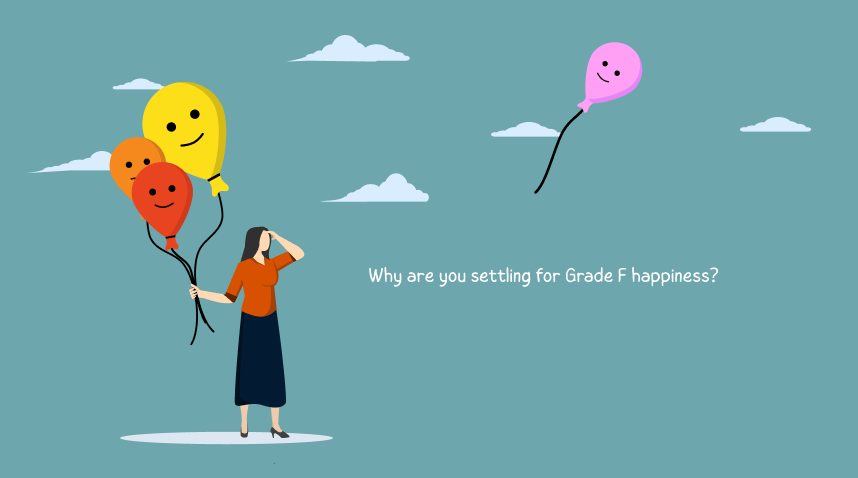
If we can clearly see that something is not bringing genuine happiness, we won’t settle for it. Venerable Thubten Chodron often says, “Why are you settling for Grade F happiness?” Our minds may protest, “It’s the only thing I know,” but there are sources of happiness outside of our attachments, like having an honest conversation with someone we care about.
The key is moving forward in a way that brings more pleasure than lies or attachments ever could. In summary, choose wisely.
Wise Steps:
Evaluate the facts around pornography, and reflect if it is something that you want to further imprint your mind with. Every action and perception, whether wholesome or unwholesome, that we actively consume leaves an imprint on our mind, and the more we do it, the deeper those grooves will get. So, what are we choosing to stain our minds with?
If you wish to change, take a gradual and multi-pronged approach addressing root causes, and always with kindness and compassion to oneself. Good luck!