TLDR: Getting a job can be tedious and gut-wrenching. You are not alone. Your job search has similarities to a video game! Both have an end goal (getting a job), limited resources (time and financial pressures), and mini-bosses (rounds of interviews).
The Job Search Video Game
Treating the job search as a video game helps you see it from a different perspective. Why a video game?
Well, here are some similarities: here is the end goal (getting a job); there is time pressure (e.g., financial pressures from that home loan); there are the mini-bosses (interviews) that you need to get through; and you are constantly experimenting and changing tactics from unsuccessful tries till you succeed (get the job).
Background:
A change in management and corporate objectives resulted in a toxic work environment. I was placed on a performance improvement plan due to a disagreement with upper management.
It took me six months to get a job offer, four months of which I continued working at the company while applying and 2 months stressing without a job. Note that my experience comes from an Australian context, so feel free to adjust it to suit your situation 😊
How I played this game:
Step 1: Mapping (Understanding) the environment
The I.T. market has been challenging, with significant layoffs from companies like Meta and Google, as well as large consulting companies like PWC and Deloitte.
This has resulted in an increased workforce supply in the tech market. To understand the lay of the land, I researched core drivers such as the average salary and relevant skill sets required for the jobs I was applying for.
I also meditated and chanted regularly to have clarity of mind, allowing me to see my situation clearly before deciding to leave the toxic work environment.
I asked myself three questions: 1) Did I want to quit because I was lazy or could not handle work pressure? 2) Was there a way the situation could be improved? 3) Was the management trying to help me improve or push me out?
When I got my answers, I set up a rough action plan and started the ball rolling.
Step 2: Check on your Gold (finances)
The general rule of thumb for spending, recommended by the Buddha, is that 1/4 should be enjoyed, 2/4 should be invested in the business, and 1/4 should be set aside against future misfortunes. (D.N. 31, Sigalovada Sutta: The Buddha’s Advice to Sigalaka)
I used part of the last component to fund this period as I searched for a job.
I discussed my financial situation with my wife, who was wholeheartedly supportive throughout this ordeal.
With my final payout from the company, I immediately paid off three months of home loans and expenses to see my finances with a clearer lens and prevent overspending.
This also gave me a clear runway for how long I had to find a job, adding a sense of time pressure.
Step 3: The Golden Resume(s)
Like a game, you collect skill points and talents along the way. I was applying for two types of jobs and had a specific tailored resume for each.
In the age of A.I., keywords are crucial, especially if recruiters are using A.I. engines to screen resumes.
I optimised my resume with ChatGPT (e.g., search: Key Skills a Technical Business Analyst should have) and added the relevant skills to my resume. I also used ChatGPT for cover letters (e.g., search: Please combine the <Paste Job Description> and <My work experience> to write me a Cover Letter in British English that fits on a page).
Note: Make sure it is in British English, and rewrite it if it is too formal or rigid.
Review your resume every 1 to 2 weeks to improve. For example, I was in the top 3 for an E.V. charging company but did not get the job.
I followed up with the Talent Acquisition team, which mentioned that I lacked data skills compared to the other two candidates. To rectify that, I started to do a Microsoft-endorsed PowerBI course and added the skills to my resume.
Step 4: The warrior monk discipline
To deal with setbacks, I was fortunate to have a strong support structure. My wife was supportive and encouraged me to visit the monastery to change my environment and perspective.
Practising Caga (generosity) by gardening in the monastery and doing good deeds in daily life helped to put me in a positive mindset and lighten my mind.
My parents would send me YouTube Dhamma talks when I was unsuccessful at getting some jobs #AsianParentLove
Going to the gym 4 to 5 times a week helped to keep the endorphins flowing and maintain my motivation.
I set my own KPI of 5 to 6 job applications daily (adjust yourself accordingly, but remember, quality over quantity) and took weekends off. I was flexible but tried to stay as close to the goal as possible.
Step 5: The Bard’s Sitar
Remember to be kind to yourself!
A sitar player who had difficulty in his meditative practice asked the Buddha for advice.
The Buddha and he agreed that if the instrument were too tight, the string would snap; if it were too loose, no sound would come out. But a tuneful sound comes when it is not too tight or loose. (AN 6.55)
Getting a job is hard work, but remember to reward yourself too. If finances allow, have short trips in between. Remember that this is a period that you do not need to take leave for vacations. Silver linings, my friends! 😊
Step 6: The Network Web
Make sure you are in contact with multiple recruiters (I was working with 6). Keep in mind that they have to look at numerous resumes daily and may have a bit of a “goldfish memory: I would call or contact them weekly to stay at the top of their mind for potential opportunities.
Reach out to close friends and family to leverage their networks to connect you with potential job opportunities.
Make sure your referees are aware that someone might contact them. For example, I was blindsided when an old staff member of mine put me as a referee without informing me, and I thought it was a scam call.
Prepare your referees with a list of dot points on your projects together so they can reference it at a moment’s notice.
Step 7: It’s never GAME OVER.
I would reach the top 2 or 3 in interviews and kick myself when I did not get the job. Getting to such a position is an indication you are almost there.
Remind yourself to trust the process and update your learnings along the way.
I finally secured a job at the same company where I was unsuccessful for another role. I kept in touch with Talent Acquisition, and he recommended me to his colleague.
A few interviews later, I got the job! Luck is where hard work and opportunity intersect. Find different ways to source opportunities. Finding a job is one of the situations where you do not take “no” as an answer.
Some Game Stats:
143 Applications
6 Recruiters
5 Interviews with different companies
Wise Steps:
Network Cultivation: Stay in regular contact with multiple recruiters and leverage your personal network. Prepare your referees with relevant information about your shared work experiences.
Balanced Effort: Remember the Buddha’s advice on the “middle way” – don’t be too rigid or too lax in your job search. Take time to reward yourself and maintain work-life balance.
Financial Dharma: Apply the Buddha’s 1/4 spending rule to your finances. Create a clear financial runway to understand your job search timeframe.
Resilience and Persistence: View each interview as progress, even if you don’t get the job. Trust the process and continually update your approach based on feedback and experiences.
TLDR: Losing one’s job is a rite of passage for modern corporate employees. Here’s how Loving-Kindness, Compassion, and Forgiveness can help us ease the pain of job loss.
Layoff news continues to shake the corporate world. Companies do this to control spending and boost profits for shareholders. News of ChatGPT taking over white-collar jobs of those made redundant instilled more fear in people’s minds.
All these remind me of one of the core teachings of Buddhism – everything is impermanent. How do we manage the fear and pain of job loss, if we find ourselves in the firing range of unemployment?
Loving-Kindness (Love) – Be kind to ourselves and others
Our sense of self is often entwined with our job titles. We prioritise our job responsibilities over ourselves. During the COVID-19 pandemic, I delayed my visit home despite the Singapore-Malaysia border re-opening. I stayed back at work because we were understaffed, and I waited for the students to finish their exams.
Is this the practice of the Boddhisattva? Putting the needs of others before myself? Is this self-care if I fail to prioritise my physical, mental, and emotional health?
One blessing of long unemployment is having more time with my family. I spent 5 weeks in Malacca – before, during, and after the 2024 Dragon Year Chinese New Year! I felt like a young kid again, on a long school holiday.
Given a choice, please choose to be kind. When we suffer, we may lash out in anger and frustration, at ourselves and others. Getting messages about job opportunities, words of concern, dinner treats, or even a simple “How are you?” from friends and ex-colleagues can be triggering when we feel anxious and depressed.
I am fortunate to have good friends who care for me. Regardless of my employment status, I can be kind and generous with my words, thoughts, and actions.
“One who refrains from causing harm by way of body, speech or mind, can be called a worthy being.” ~ Dhammapada Verse 391
Embodying the spirit and act of Loving-Kindness and Generosity does not require money.
Focusing on our careers, have we taken the time to take stock of what is important? If you are an employee, you spend time annually discussing your Performance Review with your manager. How about doing a “Review of your Life Goals”, once a year? As we age, our time with our ageing parents may be limited.
Similarly, our friends or even ourselves may struggle with health challenges – we may delay health check-ups. We will stay single if we do not prioritise time to meet potential mates. Focusing on other aspects of our lives, outside of careers, is an act of kindness to ourselves.
Compassion – Be gentle with my pain and suffering
As a counsellor, it was easy to extend compassion toward my clients. Self-compassion, it is a different story. Zen teacher, John Tarrant wrote, It would be a pity to waste a good crisis. This unfortunate job loss presents itself as a “wonderful” opportunity for me to practice self-compassion, again and again.
Self-compassion does not remove the financial pain of losing one’s job or the challenge of paying bills. But, it does reduce the sting of guilt of why I am still jobless after 10+ months and counting.
We have to be wise and prudent in managing our finances to meet our worldly needs. In the Sigalovada Sutta, the Buddha advised a young layman named Sigalaka, to divide his wealth into four parts: “One part he may enjoy at will, two parts he should put to work and the fourth part he should set aside as a reserve in times of need.”
Thankfully, as the Buddha advised, I have saved some money for rainy days. Financial planning and having an emergency fund are important.
While I have yet to master self-compassion, I realized how I have been unkind to myself. The practice of love and compassion is incomplete if we exclude ourselves.
I am reminded of a story from the book, Loving-Kindness – The Art of Revolutionary Happiness (1995) by Sharon Salzberg, a popular Western meditation teacher. Her teacher presented her with a challenge: If she were travelling with a group of friends and strangers, and if they encountered some bandits who demanded that she sacrifice one person to save the others, whom would she choose to “sacrifice”?
She found it hard to justify surrendering anyone. Not her enemy, friends, benefactors, and not even herself because then it would not be a kind act. And that is the right answer, when one’s heart is full of Loving-Kindness and Compassion, we do not exclude anyone, even ourselves.
As highlighted in the Karaniya Mettā Sutta (the Buddha’s Words on Loving-Kindness), one should cherish all living beings (which includes us naturally):
“Just as a mother would protect her son, her only son, with her own life,
So one should develop towards all beings a state of mind without boundaries.”
Karaniya Metta Sutta, Suttanipāta 1.8
Forgiveness – Let go of the guilt and blame game
We have little control over our external work circumstances. Stories of toxic bosses and colleagues, companies that prioritise profits over employees’ well-being, etc. are things that we have little control over.
However, human beings tend to seek meaning in situations. We blame ourselves for “failing” to meet certain standards, instead of accepting that we are just “unlucky” to be laid off.
This is a great opportunity to contemplate the Buddha’s 1st Noble Truth, “There is Suffering.” At one Career Talk, I heard the term – “being delulu is the only solulu” – a Gen Z phrase that means “beingdelusional is the solution,” in other words, you may achieve your wildest dreams if you focus on it with positive intent. I prefer the Buddha’s approach, where you see the suffering clearly for what it is. Suffering can spur us to understand its nature and the end of its cause – leading us to practice the Noble 8-fold path.
Spending time feeling guilty, blaming ourselves or others, being anxious and depressed, takes time and energy away from finding a new job! We are responsible for taking the right action to be employable again.
There is hope after a layoff and the lessons that come with it. A HOL podcast by Livia Lee – “Being laid off & the life after (Ft Livia, Former Employee @Meta)”, gave me hope and inspiration on what to do during this challenging period. You may also find this article by Livia – “9 things you can do for someone you know who got laid off recently,” on getting the help you need – such as asking for LinkedIn testimonials from ex-colleagues to be useful advice. I am glad I asked for it, and I am elated with the kind words my colleagues shared about my work.
We can also reflect on what is important at our next workplace. It might be the people, the work, or the culture. I find PJ Teh’s article – Applying Buddhist Principles at the Workplace, a useful read.
I am grateful for the wonderful people that I worked with in my past jobs. The people we work with can make a challenging workplace more bearable indeed. If we cannot find helpful people at work, we can be the ones who help others, just like how the Buddha lights the path for us.
I recalled Ajahn Brahm’s story about a person who stepped out of their car, into a pile of dog poo. Instead of bemoaning the now ruined new shoe, the person decided to take the dog poo home and add it to the compost pile to use as fertilizer for his mango tree. It is a good story of making lemonade out of lemons.
I had the good fortune of attending Ajahn Brahmali’s meditation retreat in Batam, Indonesia, in December 2023, thanks to the kindness of a benefactor who gave me his spot at the retreat. I asked Ajahn how to better cope with unemployment. Ajahn reminded me to be kind and compassionate to myself, and that it is not my fault for being unemployed.
Further reflecting on Ajahn’s words, I realised I held on to so much guilt and blamed myself for being jobless. I did my best at my job and supported my colleagues well.
However, my contract was not renewed. I am grateful for this period of unemployment. I reflected on what’s right and wrong in my life, to improve my life holistically.
The heart practices of Loving-Kindness, Compassion, and Forgiveness hold a special place in my heart. Dhamma is everywhere, and the lessons I am learning are useful for my professional and personal life. I am grateful.
Wise Steps:
Find hobbies that make you happy. You’ve been neglecting your needs, to care for others. It is time to take care of your needs again. I re-discovered my love for writing. What is yours?
Find support in your family and friends. They can hear you out, encourage you, or even give you financial aid to tide you over during the unemployment.
Listen to wise elders, friends, mentors, or Sangha members. They will give you a better understanding and balanced view of what you are going through now.
Note: A special shoutout to DhammaWorks by Kinrara Metta Buddhist Society in Malaysia for offering structured workshops on incorporating Dhamma at work. I was lucky to sign up for the DhammaWorks 8 (2021) when it was offered online during the COVID-19 pandemic. The program inspired me to constantly reflect on how the Dhamma can aid us in our work life.
When the layoffs started, I thought I was untouchable. As a high performing recruiter at one of tech’s biggest firms, I had it all – a comfortable life, the travel, and the premium free food. My career was a large part of my identity.
Then the dreaded town hall happened. “We have to make some difficult decisions…” my boss announced grimly at 12am. Turns out I wasn’t so untouchable after all. Getting laid off at 27 felt like a scathing breakup text from someone you thought you’d marry.
Those first few months were rough. With no job routine to cling to, I zamboni’d between the fridge and doomscrolling Linkedin day after day (who does that, right??) , wallowing in self-pity . Who even was I without the prestigious job title and firm’s colourful T-shirts? A nobody, that’s who.
But as the weeks drifted by, something shifted. Buddhism teaches that nothing is permanent – all phenomena, including our careers and identities, are constantly changing. With no emails pouring in at all hours, I started rediscovering hobbies that gave me joy simply for joy’s sake – talking long walks at 9am on a weekday, going on long meditation retreats, and having catchup with the old and new mates I’d been too “busy” to see.
The Buddha emphasized the importance of spiritual friendship and community for our well-being. Freed from the golden handcuffs of constant performance, I reconnected with my true, non-office bredren who reminded me of my humanity beyond my job description. We laughed, reminisced, and soaked up all the wholesome inklings I’d been quashing.
That’s when it hit me – my career had become an all-consuming, cruchy cage without me even realizing it. Like many Singaporeans, I had succumbed to the toxic view that my career is my identity. By fixating intensely on my career, I’d neglected the very delights that nourish the soul – close friendships, playful passions, and savouring small joys. No wonder I’d been numbing myself with endless grunt hours and gallons of overpriced flat whites!
Buddhist teachings, like those shared on the Handful of Leaves podcast, remind us that clinging to any temporary state causes suffering. As the guest Amy shared, it’s crucial to find joy and purpose in your work itself – not just chase external success metrics. I had lost sight of my deeper “why” amid the rat race.
Don’t get me wrong, I’m stoked to be gainfully employed again. (Rent don’t pay itself, amirite?) But getting laid off unshackled me from the toxic workplace I’d imprisoned myself in. These days, in line with the Kalama Sutta’s advice, I rely on my own discernment rather than society’s career fixations. I no longer rigidly self-identify as just “XXX, techie .” I’m exploring different roles and companies that align with my values for long-term fulfillment, not just for a fancy performance review.
If you’re stuck in that same toxic grind, here are 3 wise steps:
Prioritize purpose over promotions. Nurture playful inklings and community interests beyond corporate ladder-climbing.
Invest in nourishing friendships, as the Buddha taught. Surround yourself with people who remind you of your multidimensional humanity.
Regularly pause and realign. Reflect on whether your current role aligns with your core values and allows space for continued learning and growth. Be willing to pivot if not.
Now, I’m not saying you need to totally disengage from your career either. For many of us, our work is a key part of how we contribute to society and find a sense of purpose. There’s value in applying ourselves diligently to our professional callings when it aligns with our interests and values.
The CEO of a social enterprise improving education access for underprivileged kids may rightfully view their career as integral to their life’s mission. A passionate surgeon might find profound meaning in honing their craft to save more lives. If your career allows you to have a positive impact in an area you care about, by all means, lean into it!
The key is to avoid letting your job totally subsume your identity to the point of spiritual stagnation. Make sure you’re still nurturing other areas of life like family, friends, hobbies and personal growth. But if your work itself is a positive force that energizes you, embrace that too in balance.
At the end of the day, our sense of self-worth should stem from our full, enriching life experiences – not just our job titles or salaries. My layoff was an abrupt yet invaluable wake-up call to stop deriving my entire identity solely from my career persona.
Sure, I’m back in the daily grind. But this time I’m consciously allowing space for the people, passions and simple joys that make life feel purposeful beyond any office role. Getting laid off allowed me to realign my priorities with Buddhist wisdom – and ultimately craft a more sustainable, fulfilling existence that positively impacts the world while nourishing my whole self.
Our careers are What We Do, not Who We Are. The layoff was a Buddhist wake-up call – a reminder to realign my self-worth with my deepest values beyond any office role. Sure, I’m back hustling now. But this time, it’s a more purposeful pursuit allowing space for life’s true treasures outside of just my job.
TLDR: Can networking take a refreshing turn? (Especially in the Buddhist world?) Salvi shares her experiences on how walking and talking without the usual formalities, fosters genuine connections on the move.
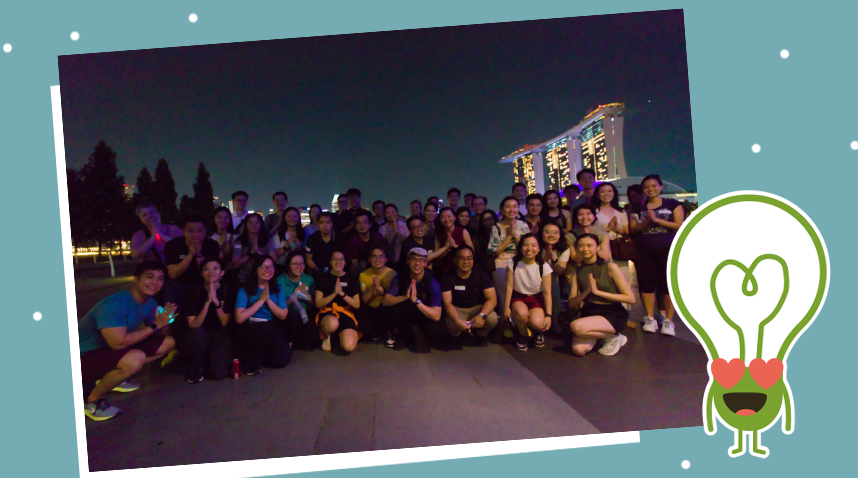
This reflection is on a recent Buddhist Net-walking session for 20-40 years professionals that started in Nov 2023. Follow the community updates right here. Or join the next session here.
When we think of networking events, it’s often a mental slideshow of stiff suits, formal nods, and those awkward card exchanges.
But imagine if networking threw away the rulebook, embracing movement, fresh air, and an active spirit. That’s precisely what unfolded at a recent event—an innovative networking & walking session. At first, I was intrigued yet slightly skeptical about this dynamic approach to connecting.
The not-so-awkward session
Initially, the concept of networking on the move seemed akin to rubbing your belly while patting your head—daunting and perhaps a tad clumsy.
I envisioned a parade of professionals awkwardly navigating conversations, fearing stumbling—both verbally and literally. But the reality was far more exhilarating than I anticipated.
As we gathered at the starting point, anticipation mingled with skepticism. Could coherent conversations coexist with walking strides? Would I fumble my words? Who knows? But it was a challenge I was eager to embrace.
Walking & the lack of name cards.
The commencement of our networking journey felt like embarking on a quest for connections in a vibrant dimension.
Here, there were no static tables or uncomfortable glances—our canvas was the landscape, and our pace synchronized with the rhythm of our steps.
Conversations were a whirlwind of interactions, akin to a puzzle constantly rearranging itself. Groups formed and dissolved seamlessly, creating an environment where any corporate nomad would feel at home.
It dawned on me that this wasn’t just about superficial chitchat or exchanging “business cards” (since none of us had any). It was a moving fiesta of networking in its truest form!
Deep conversations
Amid this whirlwind of connections, there was one conversation that stood out—a tête-à-tête about Buddhism within our group and their exposure to its different traditions in Singapore versus other countries was both eye-opening and comforting.
We delved into the nuances of Buddhism, discussing how in Singapore, with its rich cultural tapestry, the various traditions coexist harmoniously.
My conversation partners shared their journey of exploring different branches of Buddhism and the comforting realisation that it’s common not to know which specific tradition one identifies with, especially in a multicultural context like Singapore.
This dialogue illuminated the beauty of embracing diverse traditions and finding peace in shared experiences within a complex spiritual journey. It was a gentle reminder that in a world of multifaceted identities, it’s absolutely fine not to have all the answers.
During the stroll, I unexpectedly met a fellow countrywoman whose mother is in the same industry as me in a different country. It was a serendipitous moment—never did I imagine forming a new business connection while casually walking.
Treasure maps & Diversity
Reflecting on this unconventional networking experience, it was more than just polite exchanges; it was a space for sharing perspectives, learning from diverse experiences, and discovering common ground.This unique networking affair felt like uncovering a treasure map to genuine connections. It was beyond the mere exchange of contact details, evolving into a platform for sharing ideas, stories, and the occasional amusing anecdote—all while accumulating steps that would rival any Fitbit enthusiast’s count.
The End Comes Quick
The only downside was that the stroll ended too soon. However, with the evening still young, some of us extended the networking over dinner—a perfect conclusion to an enriching day.
Here’s to networking with a twist—where conversations walk, talks wander, and “business cards” change hands as naturally as the passing scenery. Who knew networking could be as liberating as a leisurely stroll in the park?
As I bid adieu to this innovative networking escapade, I couldn’t help but cherish the idea that connections, like life, flourish when you’re on the move—exploring, engaging, and occasionally evading a wayward pigeon or two.
Next time you gear up for a networking event, consider swapping the stuffy conference room for comfy sneakers. Who knows, amidst the twists and turns of a networking trail, you might stumble upon your next big idea.
Ready for Buddhist netwalking for professionals 20-40 years? Sign up now
TLDR: Join Sharon in mastering the SBI framework infused with Dhamma wisdom for delivering feedback, fostering understanding, and resolving differences mindfully.
Career Journey Checkpoints
As a leadership coach, I have been seeing clients who are anxious about the year-end performance reviews.
It is common for both the individual contributors and the managers to feel anxiety, nervousness, confusion, wariness etc.
“How can I ask for a salary increment? A promotion?”
“How can I talk about my achievements without sounding boastful?”
“How can I give negative feedback to my direct report?”
These are questions that we can tackle from a Dhamma perspective.
Often, there are some HR guidelines to prepare one for the 1-1 performance reviews. For the individual contributor, it involves self-reflection, listing your achievements of the year, strengths you have applied to good effect, areas of development for next year, any career progression desire etc.
I recommend giving yourself proper quiet time to do this reflection. Instead of feeling the burden of an official performance review, an official writeup, we might use this opportunity to check in with ourselves with compassion.
Try not to be overly attached to the negatives, especially if there is “constructive feedback” from a 360 report.
We might turn attention back to our bodies, noticing the tension arising, breath quickening, as we encounter some triggers and perhaps self-judgment.
“When agitation and worry are present, he knows with understanding: ‘I have agitation and worry,’ or when agitation and worry are not present, he knows with understanding: ‘I have no agitation and worry.’
He understands how the arising of non-arisen agitation and worry comes to be; and he understands how the abandoning of the arisen agitation and worry comes to be; and he understands how the non-arising in the future of the abandoned agitation and worry comes to be.”
We might reframe this one-time performance review as a single check-point in our broader career journey. It is not the final destination, nor a permanent verdict.
We might notice the agitation and worry, but choose not to be attached to it.
How the Dhamma can help you get promoted!
I had a client who wanted to ask her manager for a promotion with a change of title and salary increment.
She felt that it was long overdue, having taken up projects outside her scope of work, always being proactive to help others out, showcasing her strengths and skills in the process.
“Why do you spend extra time and energy taking up all these new projects?”
She answered, “Because I see the gaps and where I can contribute with my skills and knowledge.”
“What is the Impact of you doing all these?”
She answered, “The team feels more confident to move forward quickly, we all felt a sense of accomplishment when the project is completed successfully! We then celebrate with good food and drinks together…I feel happy my ideas are accepted, and that I made a positive impact on the team.”
“What is your current role, and how do you see yourself instead?”
She took a long pause, “Currently I am just an Admin executive, but I have in fact been playing the role of a Project Manager.”
She knows her value, her contributions and her impact on the team and the organization. She had to first update her self-narrative in her mind, and find the words to articulate her intention to her manager.
It kick-started the development conversation, eventually it got escalated by her manager to HR, who then mapped her to a new title and grade.
She was successful not by using hard negotiation skills or trickery, but by speaking with clarity, from a place larger than her Self. Here are some tips to get you started:
Use words and phrases that convey your point clearly and with confidence. Use “I want”, “I would like to”, “I can”, “I have successfully done…”, “I am confident to…”. Avoid words and phrases that take power away from you, or project self-doubt. Stay clear of phrases such as “I guess…”, “At least I might…”, “I am just a…”
Articulate the value you bring to the team and organization. Cite quantifiable evidence of the value and impact of your work. Be ready with your performance data, feedback collected, success stories, anything else that would support your claim for promotion. This is the ammunition that you can provide to your manager for him/her to justify your promotion to the management (if applicable).
If you still feel the jitters, speak to a trusted mentor or wise friend. Get some advice from her/him, especially if she/he has navigated similar situations skillfully.
Some of my clients put in extra time to rehearse, or role play the conversation with someone. If you do not have a coach, a partner or a trusted friend, pets or stuffed animals would work too. If it helps, strike a power pose (think superman or wonderwoman), or put on imaginary armour (think ironman). This does not work for everyone though, but it is always worth a shot. I would be curious to know what worked for you!
Of course, we know life is not perfect, there will be a dozen unsuccessful cases that come with each success story. There are simply other factors outside of our control.
Arrows at work and in the heart
During or after the performance review, we may feel wronged, agitated, angry at the unfairness of it all.
There’s a story about suffering in theSallatha Sutta, one of the oldest Buddhist texts. The story is often retold(with a touch of humour) like this:
The Buddha once asked a student, “If a person is struck by an arrow, is it painful?” The student said duh. He then asked, ”If the person is struck by a second arrow, is it even more painful?” Again, the student said yes, Duh!
The Buddha then explained, “In life, we can’t always control the first arrow. However, the second arrow is our reaction to the first. This second arrow is optional.”
With mindfulness, we can become aware of the second arrow. I have a client who literally feels the impact of the second arrow in his body. It starts with tension in the neck, then shoulders, followed by a heaviness pressing on his chest. No, he did not have a heart attack, but he has clearly felt the self-amplified, paralysing weight of the second arrow.
The awareness that this is a second arrow means he has a choice now. He can choose how he wants to react to the first arrow. In his case it is usually an urgent notification escalating an issue at work, demanding his immediate attention and disrupting his work day.
Instead of immediately feeling stressed, he realised he can pause, discern the urgency of the escalation, and choose whether he needs to attend to it immediately.
He started to feel that he can decide what to prioritise, and how he wants to react. Sometimes he physically stands up, stretches out his chest and arms, intentionally taking a deep breath, before reading the escalation email in detail again.
Becoming a better manager
If you are a manager (or one day might become one), the challenge might be to deliver negative feedback to your direct report.
In official leadership training to new managers, I often teach the SBI framework – Situation, Behaviour, Impact.
This is a great framework to give specific, actionable feedback for future improvement. I suggest to add a touch of Dhamma to it!
In the Pasadika Sutta – “Resolving Differences in Opinion”, the teaching suggests “neither dismissing nor disparaging him, without dismissing him, without disparaging him, you should, with careful attention, make him comprehend only those wordings.” You can find a wonderful Sutta discussion on this by Venerable Canda on Youtube.
The Sutta mentions there can be Disagreements on the Meaning, Disagreements on the Wording, or both. The key is to be mindful of our intention, and approach these differences with compassion.
Our own mindset and emotions will already set the tone of the discussion. The words we use can be triggers for the other person, triggering strong emotions.
When we hold on strongly to our views, it is almost like a verdict with no room for discussion and clarification, much less exploration or co-creation.
Instead of going into a tough conversation trying to “win over” the other person, we might ask open-ended questions to engage in discussion.
Sometimes simply asking “How can I support you?” or “What do you need from me?” would work. We have to be mindful that strong words or phrases can trigger negative emotions. Try to stay objective and avoid attacking the person with “You are always so rude/lazy/slow” etc.
Corporate & Compassion?
In the corporate setting we sometimes feel limited by unspoken boundaries. Do we share emotions? Talk about our fears? Say out loud the narratives or assumptions in our heads?
Do we have the courage and skills to hold space for the person sharing these? Do we have the emotional vocabulary to label the emotion we are feeling?
It is often a process to self-reflect, learn and experiment as we go along this journey. My ask of you is to meet people where they are, regardless of what stage they are at, with compassion for a fellow Sentient Being.
Once you have internalized these suttas & ways to approach tough conversations, performance reviews will feel more like a walk in the park.
Wise Steps:
Block time for self-reflection, update your self-narrative in your mind, and find the words to articulate your intention to your manager.
Stop stabbing yourself with the second arrow. Talk to a wise mentor or Kalyāṇa-mittatā (virtuous friend or admirable friend).
Meet people where they are, regardless of what stage they are at, with compassion for a fellow Sentient Being (Being that has senses).