
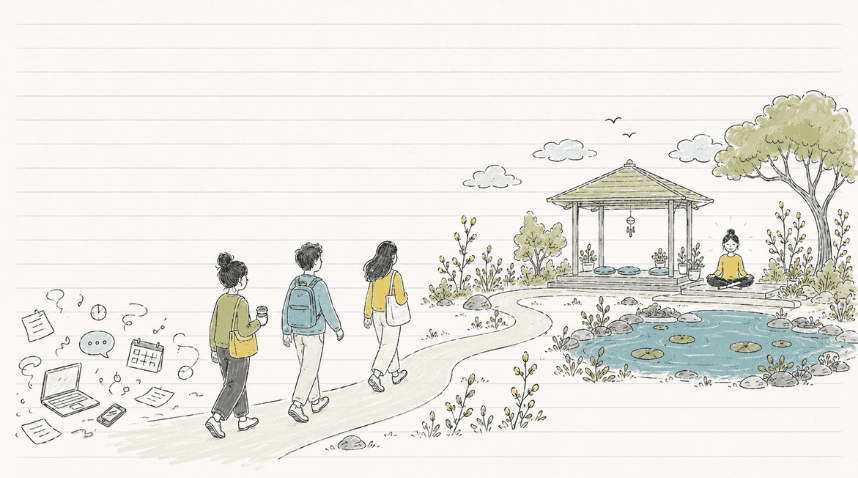
TLDR: Most of us don’t realise how restless our minds are until we step away from everyday busyness. Through meditation, sutta study, and honest reflection, DAYWA retreats offer young adults a rare space to slow down, deepen their practice, and reconnect with what truly matters.
Editor’s note: This article was kindly contributed by Fang Huey, Johnson, Hong Jiayi, and Tan Pei Shan
Most of us don’t realise how loud our minds are until we finally get space from our day-to-day tasks.
Once or twice a year, DAYWA (Dhamma Assembly of Young Working Adults) organises a retreat for young Buddhist adults who want to do exactly that: step away, slow down, and spend a few days actually practising the Dhamma rather than just reading about it.
This is what that looks like in practice.
The retreat is designed to provide a peaceful and conducive environment to learn and contemplate on the teachings of the Buddha. They are also able to pressure-test their understanding through exchanges and in-depth interviews with other participants.
How Your Starting Journey Looks Like
Mornings begin with meditation. Then sutta study with Sis Sylvia Bay, who has a way of making centuries-old teachings feel immediately relevant to the kind of life a working adult in Singapore actually lives. Afternoons are for personal practice, sitting or walking, at whatever pace suits you. There are group and individual interviews with teachers, where you can bring your actual questions, the ones you didn’t know you had until you were sitting quietly long enough to notice them.
Evenings close with puja, Q&A, and sharing of merits.
It sounds simple. It is, and that’s the point.
There is only one DAYWA retreat in 2026. If you’ve been thinking about going, this is the one.
Sample schedule (subject to changes)
| 06:30 AM | Group guided meditation / Self-practice |
| 07:30 AM | Breakfast |
| 08:30 AM | Sutta study |
| 11:45 AM | Lunch (Noble Silence) & Rest |
| 01:30 PM | Sutta studyGroup interviews / Self Practice* |
| 05:30 PM | Rest / Tea break / Dinner (optional) |
| 07:00 PM | Evening pujaQ&ASharing of merits |
| 09:00 PM | Rest / Self-practice |
A Supportive Space for Learning and Practice
Designed for both beginners and experienced practitioners, the retreat provides a supportive environment for participants to deepen their understanding of the Dhamma and cultivate their practice at their own pace.
Sutta Study
Each morning begins with sutta study led by Sis Sylvia Bay. Through clear explanations and relatable examples, she breaks down Buddhist concepts and terminology in a way that is easy to understand, even for those who are new to Buddhism.
What stood out to me was how relevant the teachings are to our daily lives, and how the discussions helped bridge the gap between learning the Dhamma and applying it in practice. Participants also engage in small group discussions, providing an opportunity to hear different perspectives and learn from one another’s experiences.
Self-practice: Sitting and Walking Meditation
Throughout the retreat, participants are given time for their own practice, where they can choose between sitting and walking meditation. Experienced meditators may choose to undertake longer meditation sessions, while those newer to practice can adjust the duration into shorter sessions according to their comfort level. I initially felt intimidated by the thought of spending long hours meditating, but appreciated the flexibility to practise.
Interviews with Teachers
Another unique aspect of the retreat is the opportunity for both group and individual interviews. These sessions allow participants to seek clarification on meditation experiences, Dhamma concepts, or challenges encountered during practice. Beyond having our questions answered, it is insightful to hear the experiences and perspectives of fellow retreatants.
One aspect I particularly appreciated was the opportunity to step away from the busyness of everyday life. Without the usual distractions and demands, the retreat created space to simply slow down, be present, and reconnect with the Dhamma and our own minds.
Our Key Takeaways From Past Retreats
Reflection as organising team members DAYWA Retreat Sept 2025 (Hong Jiayi):
Serving on a retreat is its own kind of practice. Even while organising, the worry and the planning mind don’t switch off. Should I let people talk to the teachers now, or hold back? And that’s exactly the point.
It becomes a safe space to practice, to watch the defilements arise and then watch them wash away. The first time I ever joined a retreat was with DAYWA, and this time, I’m serving with the people who make it happen. Back then, everything felt like “wow, so inspiring.” Now I’m more often the bad cop, seeing the behind-the-scenes of holding both the retreatants’ experience and the teachers’ energy. What surprised me was a new kind of joy in watching other people learn and grow. It’s empowering, and I’d encourage anyone to try serving for themselves.
This time, I’m also practising alongside everyone, and there’s always something new to learn, even though it’s the same Four Noble Truths we’ve heard before. Revision is its own gift, a reminder of the wisdom you already hold but keep forgetting. The one-on-ones, especially, where the advice is tailored to exactly where you are. When we leave this place and go back to our lives, the peacefulness will probably fade, and the old defilements will resurface — that’s normal. But the sutta we learnt reminds us not to give up. Just keep showing up. You’ll feel better after that.
Reflection as a participant (Pei Shan):
My first Buddhist retreat was with DAYWA in August 2024, and I felt really grateful as that retreat kick-started my meditation journey. When I attended the September 2025 retreat, I decided to ask my sister along.
Here are some doodles I drew to consolidate my reflections.
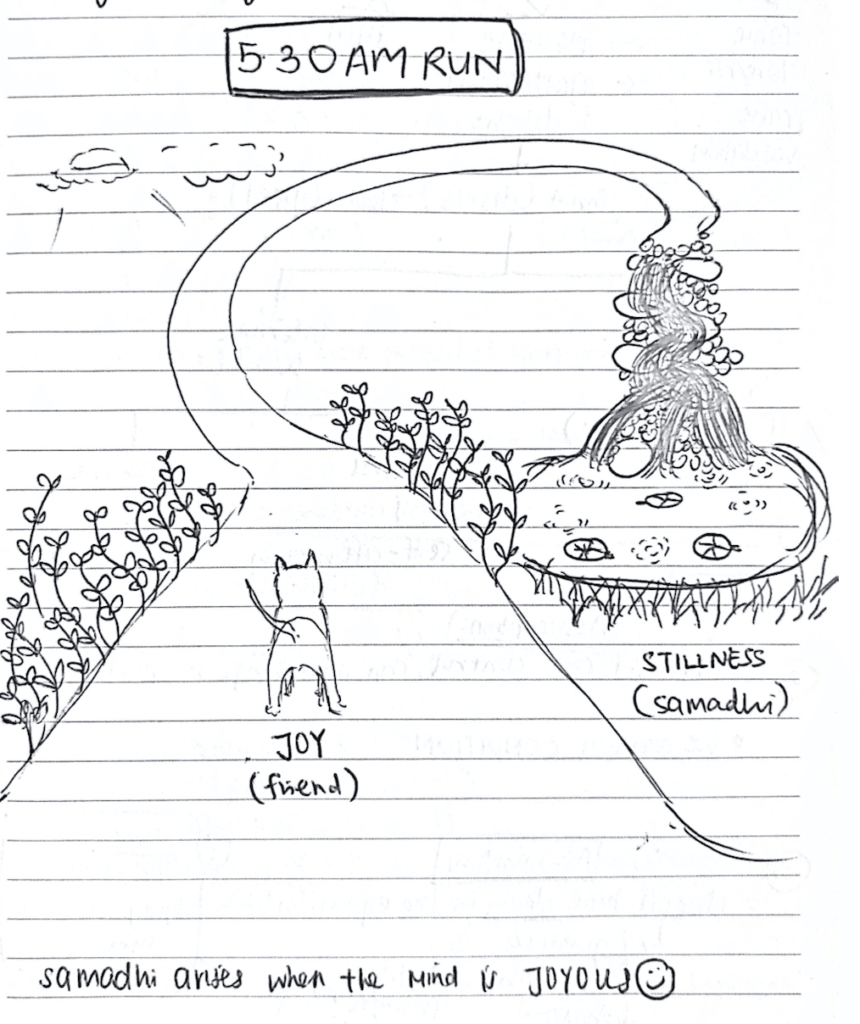
During the retreat, some of us would wake up at 5 am to run around the retreat centre. A resident dog would often join us and run happily alongside us. Somehow, it made the run more joyful, even though waking up early to run can feel arduous. It reminded me of Sister Sylvia’s teaching that samadhi arises when the mind is joyful.
I noticed that when my mind is light and peaceful, stillness arises more naturally as compared to when my mind is caught in sloth and torpor or restlessness. This is similar to running: when I approach the run with gratitude and a joyful heart, there’s a sense of ease and flow. Yet when my mind is tired or caught up in unwholesome states, every step feels heavier.
Joy is not merely the result of stillness, but one of the conditions that allows stillness to arise. Like the happy dog that accompanied us on our morning runs, joy may be the quiet companion that guides us along the path towards samadhi.
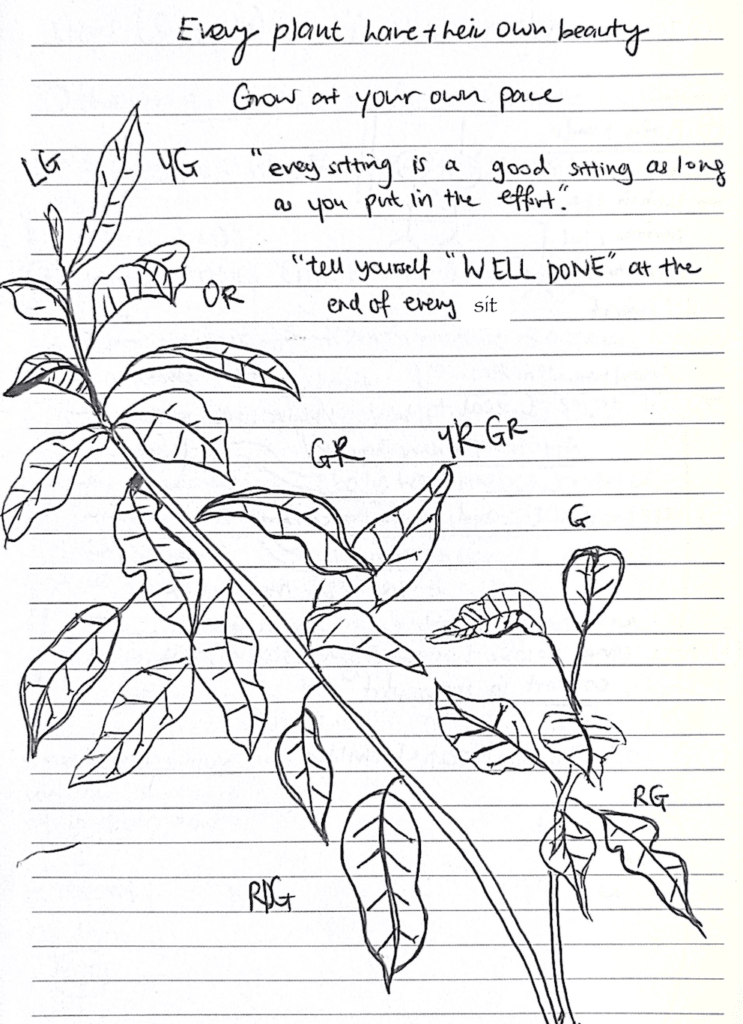
In my practice, I noticed my tendency to want to let go of suffering quickly. In the beginning, I felt slightly frustrated when I didn’t have a “good sit,” or when unwholesome states arose.
One day, during walking meditation, I noticed a plant with leaves of different shades- light green, yellow, orange, and red. Each leaf was unique, expressing its own stage of growth.
I recalled a participant asking Brother Chye a question about feeling frustrated with our meditation practice. His response was simple but powerful: we can tell ourselves “well done” after every sit, because every sit is a good sit when effort has been put in.
Together, these experiences shifted my perspective. Just like the leaves, everyone has different conditions and grows at their own pace. We don’t need to hold the expectation of becoming a “meditation guru” after one retreat, or compare ourselves with others. Instead, we can gently release expectations and rejoice in our own effort and the sincerity we bring to each sit.
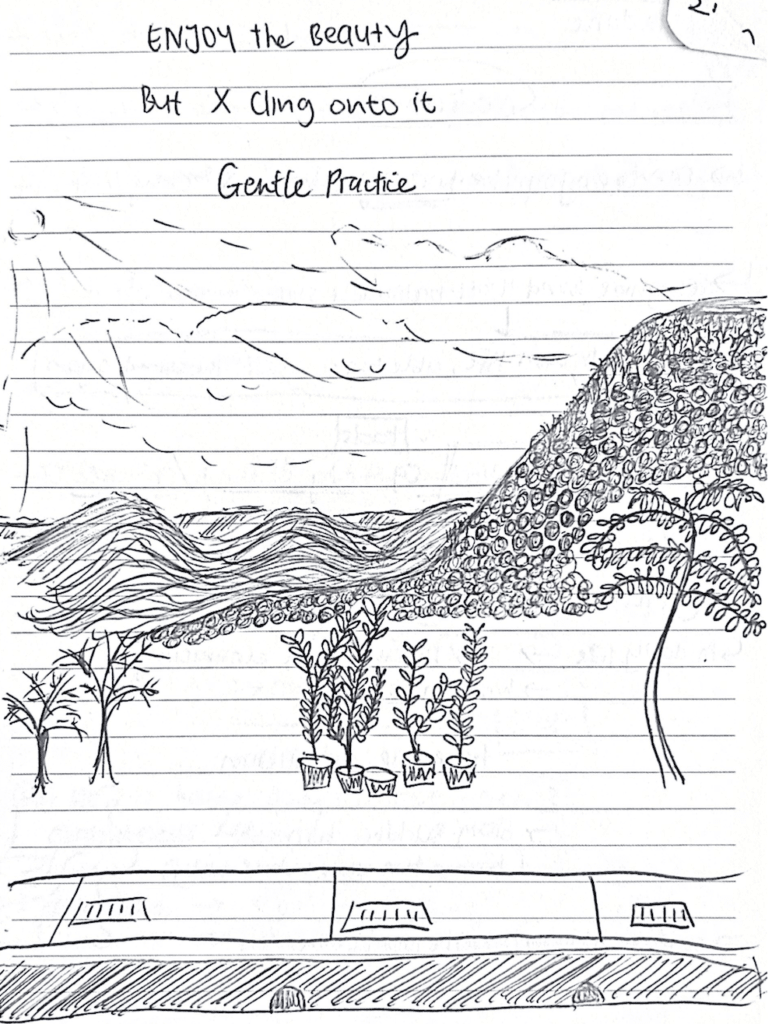
I’ve always loved nature, and being surrounded by it during the retreat felt deeply restful and nourishing. At the same time, one of the key teachings we learned was the Second Noble Truth — that suffering arises from craving. This led me to wonder: Is it wrong to love and enjoy nature?
During one of the sharings, I heard a perspective that stayed with me: it is perfectly fine to enjoy the beauty of nature, but we are encouraged to be mindful not to cling to it. This applies not only to nature, but to all aspects of life: our loved ones, our careers, and what we cherish. We can learn to fully appreciate these experiences while gently letting go of our attachment.
Looking Ahead: 2026 Batam Retreat
We warmly welcome young working adults (ages 20–39) to join us for Opening the Heart: A Brahmavihāras Retreat, a 5D4N retreat centred on the cultivation of loving-kindness (mettā), compassion (karuṇā), appreciative joy (muditā), and equanimity (upekkhā).
Participants will deepen their understanding of these Four Immeasurables and explore how to bring them into daily life. Whether you are new to meditation or an experienced practitioner, all are welcome.
The retreat will take place from 12–16 September 2026 in Batam, Indonesia, and will be the only DAYWA retreat held in 2026.
Retreat Details:
- Dates: 12–16 September 2026
- Location: Batam, Indonesia
- Leave Required: 3 days
- Registration Closing Date: 31 July 2026
Fees:
- Twin Sharing: $380
- Single Room: $500
All prices include ferry, accommodation, breakfast, and lunch.
To register: https://forms.gle/2ZfJ3fUn1d1zkwmW7
Hope to see you there!
Wise steps:
Join us for the upcoming DAYWA retreat!
