
Summary
What happens when you follow the path everyone tells you will lead to happiness, only to arrive and feel strangely empty?
For Venerable Damcho, Buddhism did not begin as a childhood faith or family tradition. She was not born into a Buddhist family. In fact, she had little interest in religion at all. Like many Singaporeans, she followed the familiar route of studying hard, doing well, and trying to build a life that looked successful from the outside.
But during university, heartbreak, anxiety, and a deep sense of disappointment made her question what she had been chasing. Meditation first entered her life almost by accident, through yoga and a campus Buddhist group. What began as three minutes of watching the breath slowly became something much deeper: a way to understand fear, reactivity, dissatisfaction, and the restless search for happiness.
In this episode, Cheryl speaks with Venerable Damcho about her unexpected journey into the Dhamma, from her first encounter with Buddhist practice, to making aspirations at Bright Hill Temple, to a short-term novitiate in Lumbini that changed how she understood happiness.
She also shares honestly about the realities of monastic life, including the doubts, hard work, service, and inner resistance that came with training at Sravasti Abbey. Far from the romantic idea of floating on clouds in peaceful meditation, her path involved cleaning toilets, shovelling concrete, leaving a relationship, and learning to face the afflictions of the mind directly.
This conversation is for anyone who has ever wondered why external success does not always bring peace, or whether a different kind of life is possible when we begin to take our deepest aspirations seriously.
About the Speaker
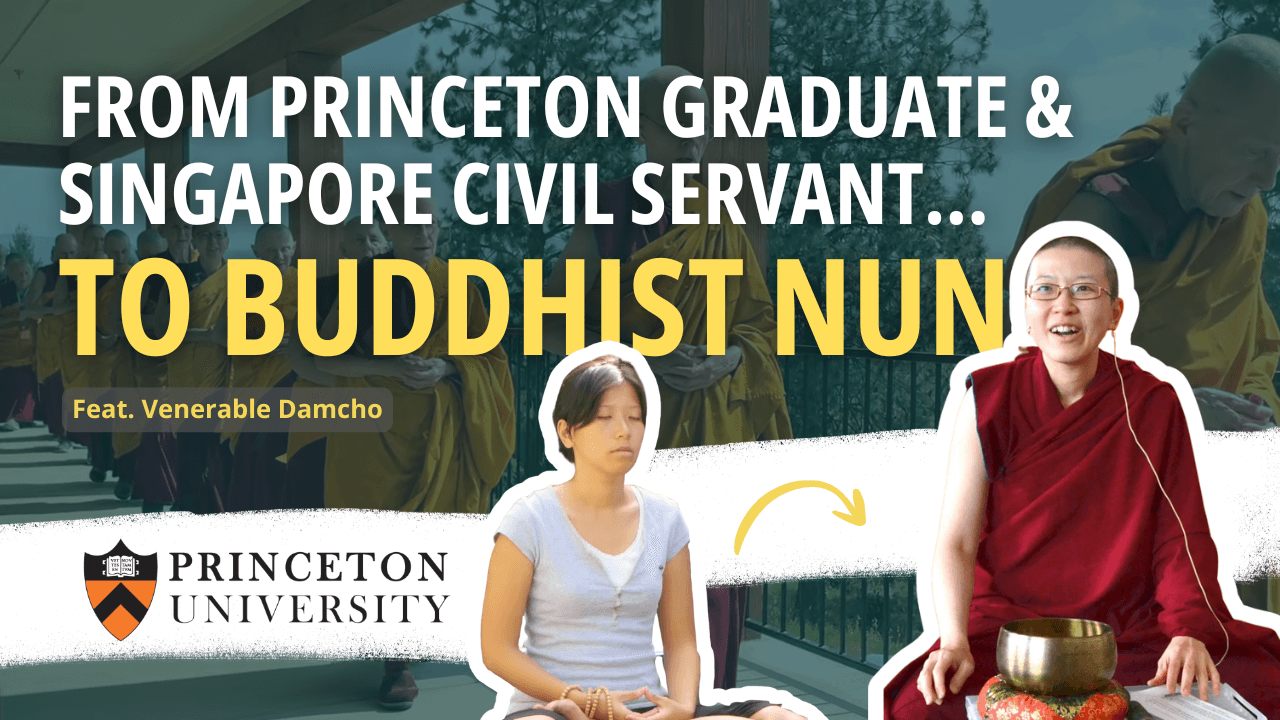
👤 Venerable Thubten Damcho is a Buddhist nun residing at Sravasti Abbey, one of the first Tibetan Buddhist training monasteries in the United States. Born and raised in Singapore, she graduated from Princeton University in 2006 and worked as a high school teacher and public policy analyst in the Singapore government before returning to the U.S. to take novice ordination in 2013. She tells her story in The Straits Times Singapore.
Venerable Damcho’s monastic life is rich and varied. She serves as assistant to Sravasti Abbey’s founder, author and well-known Buddhist teacher Venerable Thubten Chodron. Her other responsibilities range from translating Chinese texts into English to removing weeds from the Abbey’s 300-acre property. Venerable Damcho has given Dharma talks in Spokane, Idaho, California, India, and Singapore. She was the Chinese-English interpreter at a full ordination program in Taiwan in 2019, and has studied Tibetan through Maitripa College and with other teachers since 2017.
Key Takeaways
🧭 I just felt like I had been cheated
A raw reflection on chasing the life we are told will make us happy, only to ask: and then what?
🧘 My happiness is not dependent on all these external things
A short-term novitiate showed her that peace could arise even while waking early, wearing simple robes, and cleaning toilets.
🔥 It’s very difficult to identify the afflictions because I think they are true
A practical reminder that anger, self-pity, and fear often feel logical until we learn to see them clearly.
Transcript
Full Transcript
[00:00:00] Venerable Damcho: So I just followed the typical Singapore path right go to schools that are supposedly successful. Felt I did everything my parents told me to do I did things I wanted to do. And it was like and then what I I just felt like I had been cheated. So by the end of that trip uh I had bought an air ticket to the US. And I came back and I told my boyfriend we’re we’re breaking up we’re sleeping on mats on the ground. And this temple that’s in partial construction we have we’re sharing the same little squat toilet. That we clean in the mornings you know you’re getting up at five in the morning. And I was so happy I really wish I could do this but I can’t do this in this life. May I be able to ordain in my next life and what’s weird is that I was doing this prayer at the age of 22.
[00:01:20] Cheryl: How did you first meet with Buddhism?
[00:01:20] Venerable Damcho: Um I was not born into a Buddhist family. And I had zero interest in any kind of religion and my family is just not religious maybe. My sister converted to Christianity in her teens and you know I went with her to church with a few times. Just to kind of check out what community she had joined and while it seemed like she had met very nice people. She gained a lot of self confidence um I just didn’t feel it was a good fit for me religion wise either. So that that was just out of curiosity and I had other friends who were all Christian. You know I went to a certain kind of school where the people yeah it seemed like majority of my friends were Christian. Or not religious at all and so I just followed the typical Singapore path right. Go to schools that are supposedly successful and try and do something successful with your life externally. Um but when I was in my third year at college I really hit um. I guess a big shift in my life um all these things that I was trying to. You know you’re trying to line up all your ducks in a row and they just were not getting into a row. You know I was dumped by my boyfriend I was just confused upset and one of the things that was happening on college campus. Was a meditation class I was very anxious it was third year of university there was just so much going on. Yes I was heartbroken so doing yoga help everyday help me to just feel grounded. Calm down and at the end of the yoga class there would be a short meditation. Maybe just three minutes and I would fall asleep.
[00:03:46] Cheryl: Was it the one where you’re lying down in the corpse pose?
[00:03:57] Venerable Damcho: No no that’s that’s ya corpse pose but she you know this instructor would have us sit and then watch our breath. And then do Om or something I’m like what’s going on but I would fall asleep and I thought huh. You know how come I can’t even sit for three minutes so I got very curious about what this thing called meditation was. And then there was a Buddhist meditation group on campus so I joined the group um. And it was led by a PhD student who had been a monk before at Dharma Drum yeah. But he disrobed and then and then became um yeah a graduate student and so he led the group. And then we would just chant the Heart Sutra which again I thought was very weird I’m like. What is this wooden thing that they’re hitting and chanting but okay and then we would sit. And I found the breathing meditation really helpful I don’t know I just really connected with that practice. Just to sit count the breath um it helped me to be a lot less reactive. Um and I saw the results in that there was a period where I felt sick uh. On when I was far away from home right and um instead of worrying or getting distressed or thinking like oh. What am I gonna tell my mother she’s going to freak out I thought okay. Let’s just sit you know just breathe and I could see like okay I’m having this kind of anxious response. But it has nothing to do with reality I don’t have any test results I don’t actually know what’s going on. So why freak out right just yeah take one day at a time and so the practice helped me in that way to just not be so reactive. And eventually there was nothing actually very serious so I was thought oh you know if I had spent all that time getting worried and freaking out. Um that would have been a waste of energy and it wouldn’t have helped the situation. So things like that started to help me see like oh meditation while it calms my mind in that moment. Has a real impact on my day to day life dealing with illness um less reactive in my relationships with people. Then I got very interested in the teachings behind that you know like huh who taught this method uh. Why the breath yeah what’s actually going on and then um the graduate student who led the group. Was able to answer a lot of questions he took us on a beginner’s retreat led by Dharma Drum. So that was my entry point.
[00:07:36] Cheryl: And how did that lead you to the monastic life?
[00:07:44] Venerable Damcho: Oh okay it’s kind of a long progression like slow progression you know it doesn’t happen overnight. But one of the things that was really helpful was um when I came back to Singapore again. I was looking for a place to keep connected to a practice of some kind. I wouldn’t say I was Buddhist yet you know I had gone for I had sat with the Buddhist group. Um went for one short retreat I read a book by his holiness you know so interested in the ideas. But again I was like organized religion I don’t know you know it’s just not me. And I’m like super into the arts and everyone’s kind of going off the wall. Or doing whatever they want to do so organized religion just seem very off putting. But the key was a good friend of mine who had worked in the arts. Was working at Bright Hill Temple at the time and uh she was the one who reached out and said oh um. I’m working at the temple now are you interested in coming and at the time I was like what. You left the theatre to work at a temple what are you thinking and then you’re doing such important work for. Like community theatre reaching out to youth what’s going on so I went really just to see her and be like. Why did you leave you know what are you doing at a temple um so that was my first time ever stepping into a temple. And that was Bright Hill Temple yeah again I would never have stepped into some kind of big religious. Old school Chinese temple building right it’s like oh it’s the place you go and to pay respect to your deceased. Relatives twice a year that’s it you know go only because your parents made you. So going of my own free will to see this friend working in a temple. Like okay and then she told me about how there was a young monk who was teaching. But very low key not advertising it was just like a small youth group and she said you know. If you’re interested come by and so that I said okay you know I know her. I’m kind of curious like is this the same as the group I sat with at college. So I showed up and uh the group it was a really nice setup yeah there maybe just nine or 10 of us and uh. This venerable had just come back from ordaining after five years so also kind of young. Close to our age and we could ask him anything and we were reading the book what Buddhists believe. Just slowly and then with a little bit of explanation Q&A so I’ve yeah so I found that very rich. Yeah so I started to come to that group once a week yeah and that really benefited me. And I was walking around the temple on a break time with a friend and a young man. We were all volunteering together and this young man you know had long hair and he was like uh. I’m just not feeling so great you know my girlfriend dumped me maybe I should become a monk. And then my friend who had been Buddhist for a longer time said oh that’s a very virtuous aspiration. Yeah and then we happen to see our teacher of the youth group coming and she said he’s come. Why don’t we ask him how to become a monk then this young man is like mm okay. And in my heart I was like oh actually I’m really curious how to become monk or nun. I was like hmm but don’t tell anyone right so we go out and then we asked him like. Oh you know this young man has my friend said oh this young man he has an aspiration to ordain. What should he do and our our teacher said oh you know it’s very virtuous to have such thoughts. And said this is Vesak um I guess the energy is very good you should now go before all the Buddhas here and make this aspiration. Um request to meet a good spiritual mentor and have all your obstacles cleared and at that moment I just had this feeling like oh. That’s what I wanna do yeah so I went everywhere all around the temple the three of us started going everywhere to make these aspirations. I mean I don’t know what aspirations the other two made but I started to like yeah please. You know I’m so tired um of my working life I’m just really really tired no. The pyramid was I’m too old to do this it’s too late I really wish I could do this. But I can’t do this in this life may I be able to ordain in my next life. And what’s weird is that I was doing this prayer at the age of 22. Oh it was very young yeah correct I was so so in some ways I thought who. Maybe someone in the past continuum must have made that prayer you know it was too late for that person. Yeah and they made it happen in the next life yeah so I just went everywhere making these prayers. Not really understanding why yeah and then at the very end of that evening it was very quiet and I had the thought. Maybe it was very noisy maybe the Buddha didn’t hear me I should try again quite alone quietly. So I went and I I stayed behind all the youth had left I was carrying this big bag. And I went to the door one of the halls and the door was closed. And I remember putting my bag down and just feeling like again oh I came too late the temple is closed. You know but let’s just make the aspiration and then my teacher showed up at the time. And he saw and I talked to him and and you know I said I’m back here to make this aspiration again. And that’s how he found out I had this aspiration so that was kind of the starting point. Uh yeah he just said to me this is your past virtuous roots ripening善根发绰you know. And I was like what’s that what are virtuous fruits what is Fatiha but you know. Basically like you’ve made such an aspiration in the past or whatever and causes and conditions are coming together. To inspire that aspiration to arise again about how the causes and conditions will come together in this life. Whether or not it leads to ordination and then that’s a whole different journey like the whole process of ordaining is a slow one. So you have to get to know the community you know you offer service there. They observe your behaviour yeah it’s not like you show up and fill up with application form. And it’s like okay tomorrow come back for interview so we went there we met the nun. One of the nuns who kind of got to know chatted with us and basically she said oh. You know the three of you I think there were three of us are very young in the drama. She said you should study hard first keep uh develop a daily practice and just keep going you know. And see how causes and conditions come together for this aspiration and then she said to go to this website. Thubten Chodron.org and there you will find a lot of information on monastic life and you can take your time to read it. So that’s how I found Venerable Children’s website and so like that nonsense I did read up more and yeah. And I found it a very helpful resource and I started to think oh how can I meet this teacher. You know because she lives in the US she’s so far away yeah so that’s one piece um. At the same time my fellow friends from that little group you know we went to the Chinese nunnery together. Um one of them was going on a novice a short term novitiate program in the Theravada tradition. And she said oh you know do you want to come yeah and I said ya. Of course ya to experience what it could be like.
[00:19:06] Cheryl: At that point you were still exploring all the different traditions?
[00:19:16] Venerable Damcho: Yeah and I would say you know in Singapore we just get exposed to so many different traditions I. I never thought of it as even having to search or explore it was just like oh. You go to the temple there was a Theravada teacher teaching at Bright Hill at the time. Meditation class I would attend his class the another teacher I studied with Chinese tradition yeah. So it all just seem very natural yeah to I didn’t even really think too much about the. Is there a difference or yeah so when she said okay we’re doing this novitiate program. Like okay I don’t know the teacher leading it I don’t know anyone except you. But I just want the novitiate experience and it was happening at Lumbini so. You know at the Buddha’s birthplace so I just jumped feet first so I do. And uh yeah so we went on this novitiate program and I think that was a really impactful experience. The idea was to do a novitiate at all the four holy sites uh but I only went for the first one. Um yeah and that was my first experience you know wearing the the women couldn’t do the. The ordination itself right so I think we took the eight anagarika precepts um but we didn’t handle money either. And then it was optional whether we wanted to shave our heads or not the men took the 10 novice precepts. So they shaved their heads they wore the brown robes and then for the women we. We could shave or not and then we wore the white like the Meiji outfit I guess yeah. So um I chose to shave my head so yeah it was just a impactful experience. Just wearing the some kind of robe having head shaved and what really hit me was. You know I was in this room with four other women I didn’t know oh. Except with my friend we’re sleeping on mats on the ground in this temple that’s in partial construction. We have we are sharing the same little squat toilet that we clean in the mornings. You know you’re getting up at five in the morning and I was so happy wow. It was really weird I would like go in the morning clean the toilet and be like I’m so happy. Yeah on the beach you know doing meditation yeah and for a moment I was like how I’ve lived my life up to this point. Chasing after all these things that I thought would make me happy externally and I’ve not felt this level of peace and happiness. You know just chasing after all these external things yeah the external success when I got it I was surprised how unfulfilling it was. Yeah that’s one reason why I started to explore an internal path as well when I graduated from university. You know I felt I did everything my parents told me to do I did things I wanted to do. And it was like and then what you know like where where where does this go I. I just felt like I had been cheated in this weird way like I ran this very long race. The other told people told me it was good to run I’m like okay I got to the finish point then. And I was like okay and you got a medal then then you know I was very disappointed angry at some very deep level. Yeah and that’s what made me wonder like could the cause of happiness come from something inside. And in some weird way this um novitiate program answered the question that way. It’s like I’m wearing weird clothes I’m bald I’m waking up very early in the morning. I’m cleaning a toilet so happy like why yeah so of course you know someone just told me I was just good karma ripening. But it helped me see like yeah the my happiness is not dependent on all these external things. That other people tell me are success or that I imagine are success or will bring happiness. It’s something else altogether it’s a sense of internal peace and contentment and yeah internal fulfillment. So so that’s that was very impactful on that retreat um also it was through this retreat that was led by a Theravada monk. That I met the Tibetan tradition so he was also studying with a Tibetan teacher. And during the the time uh we were on the novice retreat they taught us mantras in the Tibetan tradition. And after that I met friends uh who were studying with this uh Bhante Mahinda. Some of his students were also studying with the Kagyu Centre in Singapore so they were like oh. Do you want to come to Kagyu Centre that’s how I met the Tibetan tradition. Through the Theravada monks yeah correct so I like that’s why I appreciate so much about um. Places like Singapore and also the US I think immigrant societies where you have all the different traditions coming together. You know intermingling you study with different teachers that’s okay but of course we try and focus on one group practice. Yeah so through them I met um the Tibetan practice and I Learned how to do the Chenresi practice.
[00:26:32] Cheryl: What is that?
[00:26:32] Venerable Damcho: To visualize thousand arm Chenresi um the embodiment of compassion in the Tibetan tradition. You know has thousand arms with a eye in the middle of each palm thousand arms thousand eyes. Kind of reaching out to benefit all beings um and I love that practice and I started to want to learn more about it. And Venerable Chodron had written a book about it so that was the first book I read by her. And learning how the meditation practices in the Tibetan tradition just really resonated with me on.
On that retreat yeah Bhante Mahinda told us at all these holy sites to again make strong aspirations. Is it you know in front of these uh in these very virtuous places make strong spiritual aspirations. And one of those that I made was oh I really hope I get to meet Venerable Chodron. You know I’ve gone to her website I think she seems like a very good teacher. You know but she lives in the US I’m never going to see her please please please. And then the funny thing is at the end of that pilgrimage um someone I. A new friend I met said oh my teacher is coming to Singapore soon would you like to meet my teacher. I said who’s your teacher and she said Venerable Thubten Chodron no way I’m like huh. And she’s like yeah I’ve been volunteering with her for many years she comes to teach in Singapore every year. And then I’m like yeah serious no way I’m like yes of course I’m coming wow. So that’s when I started to attend her talks you know develop a relationship with the Abby. And then eventually one of the nuns from the Abby who came to Singapore met with me. And she said yeah come come and explore you know come when at a time when there’s no. No big activities at the monastery so you can see what the day to day life is like. Yeah so I took her advice and that’s when I went to visit the Abbey. Yeah so I went there for two weeks and I totally freaked out after that.
Yeah because it was not at all what I expected you know and I think often that’s the case. People expect oh you’re ordained in some monastery you’re gonna spend all your time meditating. Like floating on a cloud it’s very peaceful and you know the Abbey at the time and still. It’s a monastery that is was starting up you know it’s a very young monastery. And everyone’s involved in building and offering service and I mean and and most monasteries actually have a good amount of service. Yeah because especially the Mahayana ones right the whole point is to outreach and serve and. You know so you’re going to do a fair amount of things that just are about service right. It’s not about your own practice in a room feeling calm you know it’s like oh. Gotta work with a lot of people I don’t know I may not agree with doing things that I am not trained in. Feel like very incompetent confused yeah so you get to watch your mind deal with all that. Yeah and that’s part of the practice yeah but straight up you know you coming in hoping for quiet meditation. Floating on clouds like oh we’re going to work in the forest to clear brush to prevent fires. Okay worst of all we’re going to shovel concrete because we’re building a teacher’s cabin. And now we’re going to shovel these rocks to fill the pit that we dug. Like this is not what I expected it’s too hard they’re working too hard I don’t want to do this so I left the monastery with a lot of doubt.
Actually and on the way I thought maybe maybe after I quit my job I knew by then I definitely wanted to quit my job. I was working for the government yeah that the government Singapore government very kindly paid for my education. You know as you know you go on a scholarship they paid for my education. And then in return you have to serve a bond right and it was a fulfilling career. I worked in a high I taught secondary school I worked in public policy for education for Ministry of manpower. So doing things that were very very meaningful I wanted to be of benefit as far as possible.
To whoever I have the opportunity to benefit maybe that sounds very idealistic like whatever. So that’s why I wanted to leave like just to do something that was based on. That was more in line with my own personal values and ideals so I knew then I was gonna quit my job. Yeah so anyway while leaving the monastery after my little freak out I thought maybe I’ll just move to Indonesia and write a book. Indonesia somewhere where the cost of living is lower you can like rent a little house and just write book or whatever. That was my little fantasy and anyway after I left then my mind did a big U turn. I met a very nice Buddhist man you know I went the whole hog and explored the other. And two of us were like oh maybe we should start a business yeah so I was in all that when suddenly um. I was still in touch with the monastery of a Shravasti Abbey of course I still have my own practice. You know but of course like very minimal lah like volunteer on the weekend meditate 20 minutes if good. NPS 10 less some days no meditation whatever you know you’re in your busy lay life um. And then one of the nuns wrote to me and said oh Venerable Chodron is going on pilgrimage. Do you want to help her out no she’s no she’s teaching in Indonesia for the first time. And part of it is a pilgrimage to Borobudur do you want to support and help that event. Um you know so I and yeah and I thought oh Indonesia I love Indonesia sure. And so I went with my boyfriend uh we went surfing and whatever you know party. And then I’m like okay bye I’m gonna go surf my teacher and when I was at you know. Kind of up close seeing how Venerable Chodron lives her life what a monastic does. She’s constantly just trying to benefit whoever is in front of her I just thought hmm. I think I’m wasting my life like oh I really need to take this aspiration I’ve had for. For some years now quite seriously I need to take time out and and focus on this so by the end of that trip uh.
I had bought an air ticket to the US and I came back and I told my boyfriend we’re. We’re breaking up oh and I’m going to go to the monastery and do the Exploring Monastic Life program. And that did not land very well he’s like what weren’t we just on holiday. And you came back and this is what happened have you gone insane so you know that was its own process. But I just felt like I mean I was 29 and so you’re at the age where you’re making big decisions right. Like you don’t want to get into like a marriage or whatever without being able to commit or having thought through.
These are the aspirations yeah so I thought it’s only fair that yeah we take a break now yeah. So we broke up and then I went to the to the US and I went to the Exploring Monastic Life program. And that’s what helped me to see that that that program helped me to work out a lot of my own questions. But that’s when I also got to know the community better because back then we were quite small. The Abbey was still small enough where the whole community would participate so you got to know all the monastics and hear their backgrounds and. Yeah and from that experience I thought I think this is a good fit for me. In terms of someone who’s fairly westernized studied in the US I would say I subscribe to more progressive values. Um yeah so that’s one piece I believed in the vision of the place I felt very connected to Venerable Chodron as a teacher. And so I thought okay I’ll stay on and just keep following the training process. So at the Abbey you go for exploring monastic life and try and stay on for another two months. Spend the first three just spend three months then leave and reflect on your experience. And if you are interested then you can request to return for a longer period of training. So some people do that in a few phases depending where they are in life.
I had quit my job so I said yeah I went back came back to Singapore. Tied up loose ends and I said I’m coming back for the one year lay training. So you take the eight anagarika precepts you know you train as a lay person. And for some people it’s more than one year some less you know depending again. But I requested ordination after about six months of that and um yeah so causes and conditions came together. And I ordained as a novice with what we call like the special trainings to prepare for full ordination. And then after that I went to Taiwan for the full ordination after two and a half years of training at the monastery. Yeah.
[00:39:50] Cheryl: And what is a teaching that um you find very inspiring?
[00:39:50] Venerable Damcho: I feel to say. Um you know I wouldn’t say it’s a specific teaching um I mean the heart of what we study in our tradition. Is the stages of the path to awakening it’s also known as the Lamrim where all these different teachings in sutas and sutras. Right it’s it can be difficult to know as you read a suta or sutra. Like how does this fit in with all the other teachings so the great what’s so amazing about this Lamrim.
The stages of the path to awakening this genre of teachings is that they’ve been arranged in a step by step method. Starting from beings like people who want just a good rebirth up to people who are striving for renunciation. And liberation from Samsara and up to the wish to become fully awakened as a Buddha. And attain Buddhahood so it’s kind of a step by step procedure and that’s what we study and cycle through again and again. Relying on especially the texts of Lama Tsongkhapa that’s his his kind of elucidation of the stages of the path is what we study. And there are many many different authors many but you know the structure is the same. And I find that extremely extremely helpful and that’s the core of what I study and practice. Because it helps me understand you know any teaching that I hear it’s like where does this fit. You know and what’s the motivation here uh when we hear this kind of teaching. What what’s the impact uh supposed to be on my mind yeah so that’s one aspect we also study a lot.
The thought transformation teachings um so you called it’s called Lojong so here you’re learning to turn your mind. Instead of responding with anger and aversion and distress to difficult situations how do we see them as opportunities to practice. How do we shift the way we think and transform that so that genre is very rich as well. Cause it’s something you can do day to day and but I will say what I enjoy most and what inspires me most. Is the way Venerable Chodron delivers these traditional teachings and very often she will perform our afflictions. So you know what how the angry mind sounds right she’ll or how the self doubt uh. Pity mind sounds and she will kind of give examples from her own life or her own experience of what that sounds like.
You know and perform it in the Dharma teaching and sometimes people are very shocked by this and they’re like huh. I mean first of all you know how come this nun is so dramatic but they’re like ooh it’s. It’s exactly how I think yeah but here she is displaying the affliction full force in front of me. Yeah sometimes people are like is she making fun of me right you know but I find that so helpful because it helps me to see oh. My mind works like that it’s so ridiculous I think the same way or I can be like oh.
How do I find that in myself because I don’t know about you but it’s very difficult to identify the afflictions. Because I think they are true as you know when my mind is afflicted I’m thinking oh. This is totally logical yes this person harm me they’re an idiot we have to find some way to harm them back. It’s like this is logic you know this is what we think is logic you’re like no. It’s affliction yeah so that’s what and sometimes it’s so helpful to have someone kind of perform that. Or play that out you know or like yeah I can’t do anything right and she always does the self pity one.
I’m just I just so lousy everybody’s better and when you’re in that mind you think it’s true right. So yeah I’m so lousy I suck let’s forget it let’s not get out of bed. And she’s like really come on you have to question those thoughts they’re not logical that’s an affliction. You’re caught in self pity you’re stuck time to apply antidotes yeah so that I find very practical. Yeah kind of the delivery where you know you can read the definition in the text like oh. Anger is a mind that exaggerates the negative qualities of something yeah yeah okay then here’s your teacher showing you what it could sound like. Or what it looks like and how it plays out I’m like oh that’s something I can take into my meditation. How does anger work in my mind and then when I can identify that then I can test out all the different antidotes.
Special thanks to our sponsors:
Buddhist Youth Network, Lim Soon Kiat, Alvin Chan, Tan Key Seng, Soh Hwee Hoon, Geraldine Tay, Venerable You Guang, Wilson Ng, Diga, Joyce, Tan Jia Yee, Joanne, Suñña, Shuo Mei, Arif, Bernice, Wee Teck, Andrew Yam, Kan Rong Hui, Wei Li Quek, Shirley Shen, Ezra, Joanne Chan, Hsien Li Siaw, Gillian Ang, Wang Shiow Mei, Ong Chye Chye, Melvin, Yoke Kuen, Nai Kai Lee, Amelia Toh, Hannah Law, Shin Hui Chong, Dennis Lee, Kayliam, Darren
🙏 Sponsor us: https://handfulofleaves.life/support/
Editors and Transcribers of this episode:
Azraf Mahir, Tan Si Jing, Ng Yah Tyng, Cheryl Cheah
Visual and Sound Effects
Anton Thorne, Tan Pei Shan, Ang You Shan