Summary
How do we prepare ourselves for losing someone we love? And when the moment comes, how do we find the strength to face it?
We all know that death is an inevitable part of life. We hear about impermanence, understand that nothing lasts forever, and remind ourselves that one day we will have to part with everyone and everything we hold dear. Yet, when the possibility of losing someone we love becomes real, the truth can be difficult to accept.
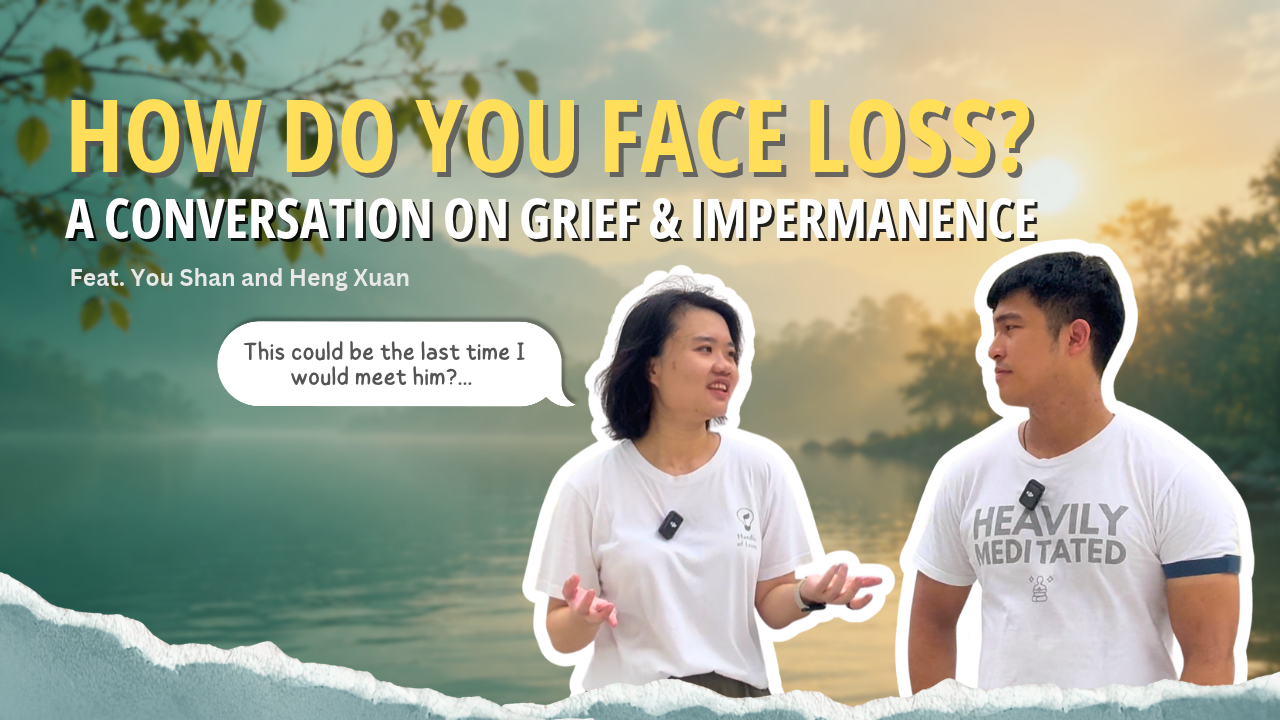
In this heartfelt conversation, You Shan shares her personal experience of encountering loss and the fear of separation. When her paternal grandmother passed away while she was still in university, it became an early reminder that everyone we love, including ourselves, will eventually have to leave. Years later, her grandfather’s sudden stroke brought that reality even closer. Despite having learned about impermanence through Buddhist teachings, she realised that knowing something intellectually does not necessarily mean we are emotionally prepared to face it.
Together with Heng Xuan, You Shan reflects on how Buddhist practice can help us navigate these difficult moments. They explore the difference between understanding impermanence in theory and truly accepting it in our daily lives, the role of death contemplation, and how the Buddha’s teachings can offer guidance when we are confronted with grief and uncertainty.
One particularly meaningful reflection is that even when we cannot cure someone who is ill, we can still care for them. Rather than allowing fear of loss to overwhelm us, we can learn to be present, offer our love and cherish the time we have together.
The conversation also reminds us that impermanence is not limited to death. It is present in our relationships, work, health and everyday experiences. By reflecting on this truth, we can gradually learn to meet life’s changes with greater wisdom, compassion and appreciation.
Perhaps contemplating death is not about becoming afraid of life, but about learning to live it more fully — while we still have the chance.
About the Speaker
👤 Ang You Shan
A designer and tech nerd. She strives to live intentionally, and apply Buddhist wisdom in daily life!
👤Teo Heng Xuan
A venture capitalist, and stoic Buddhist nerd who loves vegetables and reading books. Tries his best to meditate daily.
Key Takeaways
🌱 How do we make impermanence real?
A raw reflection on chasing the life we are told will make us happy, only to ask: and then what?
🤲 You may not be able to cure them, but you can care for them.
We may not have the power to change the outcome of a loved one’s illness, but we can still offer our presence, kindness and care.
🕯️ Each visit could be the last
Contemplating death is not about living in fear. It is a reminder to cherish the time we have, express our love and make each moment count.
Transcript
Full Transcript
[00:00:00] You Shan: It just shocked me that, oh, okay, like I’m gonna lose someone that has been around me for a good 20-plus years.
[00:00:06] Heng Xuan: How do we make impermanence real?
[00:00:08] You Shan: Oh shit, I’m still not prepared for it.
[00:00:14] Heng Xuan: Hi, everyone. Welcome to this special Handful of Leaves video podcast, and we are in the middle of Thailand. Today, we have You Shan here to just chit-chat. Oftentimes, we talk about death in this, especially Chinese culture, Asian culture, that it’s really something to be shunned upon.
[00:00:31] Heng Xuan: How do we as Buddhists navigate loss? Have you experienced separation from loved ones, and how has that changed over the years as you started walking the Dhamma path?
[00:00:39] You Shan: Before I started the Dhamma path, I think the closest experience to separation was my paternal grandmother. That was when I was in uni, but at that point in time, I wasn’t into the Dhamma path yet, so it was just like a regular.
[00:00:54] You Shan: Like, I know she’s aging, she’s gonna pass on. Also, it was a very, very gradual thing. It just shocked me that, oh, okay, like I’m gonna lose someone that has been around me for a good 20-plus years. And that’s it. I mean, you’re crying at the funeral.
[00:01:11] You Shan: But it was a very stark reminder that, like, everyone around me one day will leave, including myself. But you kind of assume that, okay, la, because of age, you’re gonna live forever. Yeah, I’m gonna live longer than them. They will leave us, more like that way. But yeah, I think that was a stark reminder that, okay, okay, I need to start living.
[00:01:32] You Shan: I started having this quote where I need to live intentionally every day. That was because you don’t know when the last day will come. So it was a personal motto that I used throughout uni, all the way to job search. And then slowly, slowly, I came across Buddhism.
[00:01:48] You Shan: Right? Yeah. And I started to practice. I think the next big change that happened was around last year when my grandfather had a very sudden stroke. Nobody knew what was gonna happen when he was in the hospital. It was very critical. He might maybe pass on anytime.
[00:02:04] You Shan: Fortunately, now he’s stable. He actually survived the episode. I think that reminder was like, oh shit, I’m still not prepared for it. Because, like, so unexpected. I remember I was going to work that day. There was some Christmas party at work, and that day, that morning, I was told that he was in the hospital. I didn’t know what to do at first.
[00:02:23] You Shan: So I go to the office or what? Cause I’m quite close to him and my maternal grandparents, so the impact was even greater. And maybe when you’re older, you feel more impacted by this kind of stuff?
[00:02:35] Heng Xuan: Mm-hmm.
[00:02:35] Heng Xuan: It’s also the idea that the more years that you live, the more attachments you build. And therefore, separation gets really more painful. Because you’re just so familiar throughout your whole life, you see this person, and this person one day is on the verge of going.
[00:02:49] You Shan: Right?
[00:02:49] You Shan: I think it was just the unexpectedness of it happening.
[00:02:53] Heng Xuan: I can imagine the contrast. You go to a Christmas party, supposed to be something really joyful, and then you contrast that with something close to death.
[00:03:00] You Shan: Yeah.
[00:03:00] Heng Xuan: Which is the most extreme, like one can see, right?
[00:03:05] Heng Xuan: But at the same time, that is Dhamma, right? Dhamma is about seeing things as they truly are, to not see these two as joy and fear, but rather to just see them as process. And then once we’re able to see them as process, then, you know, we get less shocked about these cycles of impermanence.
[00:03:23] Heng Xuan: And then once we see the contrast, then we have the ability to navigate that and find the middle way through.
[00:03:29] You Shan: And even that period, like after he was hospitalized, I think what really helped was the Dhamma talks that I listened to too. There was a couple of them. One that I really remember, and I was sending it to friends whenever they go through a similar thing, is Ajahn Brahm’s video on how you are not at the hospital to cure a patient, or in this case, your loved ones.
[00:03:47] You Shan: The only thing sometimes you can really do is just to care for them. And that’s all. But I was very thankful that I have a lot of mentors, Dhamma friends, that helped me in the process, send me very useful tips, videos to cope out with that situation. Yeah, that few days, and nowadays, when I have friends who also go through similar situations, I am better able to send across resources.
[00:04:14] You Shan: Yeah.
[00:04:15] Heng Xuan: We often talk about recognizing impermanence on a day-to-day basis. That’s very good in theory, but when it hits us, wow. Damn, it’s difficult. There’s the theory and the practical. We can pass with flying colours on the theory, but the practical part, a bit difficult.
[00:04:31] Heng Xuan: What would you advise or share with someone? By having gone through this close loss of a loved one and loss of loved one, how do we make impermanence real?
[00:04:41] You Shan: This is pretty, pretty personal. Every time I visit my grandfather now, before I even reach his bedside, in my head, I really think, okay, this could be the last time I would meet him, because I try to visit him almost every weekend ’cause of work.
[00:04:56] You Shan: And it’s like death contemplation. So every day, you just contemplate on that to kind of psycho yourself into the practice.
[00:05:06] Heng Xuan: It reminds me of Buddhist teachers’ advice, the five frequent recollections. I’m subjected to aging. I’m subjected to sickness. I’m subjected to death. All that is my beloved and pleasing will become otherwise. Yeah.
[00:05:20] Heng Xuan: Will become separated from me. And whatever I should do, karma will be the heir. So I think, like, these five frequent recollections is what the Buddha also taught for us to build that mental muscle. It’s a bit like going to the gym and just keep doing it, right? Daily.
[00:05:34] Heng Xuan: Yeah. And then one day, when the crisis hits, it’s like a process, a tape that we just play.
[00:05:43] Heng Xuan: It’s not about avoiding grief, right? But it’s about being able to face it. Yeah. Yeah. So I think it’s not about trying to dial down your human emotions, but really about seeing things as they truly are.
[00:05:55] Heng Xuan: Yes, the pain will hit, but the clinging onto it will not take that long to wither away.
[00:06:01] You Shan: Yeah. I completely agree. It’s like a training every day. The fact that I can come here, a lot of things have to align as well, like nothing happening at home, at work, because you never know when it will happen.
[00:06:13] You Shan: And even, like, it’s not just death, even work. Or one day, this work or this boss that I have would leave, or I would leave. So we cannot expect it to last forever. Yeah, it’s impermanent. So when colleagues leave, when bosses leave, or reorg happens, sometimes people tend to a very big hoo-ha about it.
[00:06:33] You Shan: Whereas with this practice, I’m a bit more chill. Okay, it has happened. What can I do? What’s the next step?
[00:06:39] Heng Xuan: Your ability to surf through the waves of life—
[00:06:42] You Shan: Goes ups—
[00:06:43] Heng Xuan: And down, ’cause you have a good surfboard, like the Buddha Dhamma.
[00:06:46] You Shan: I really like that analogy. Yeah. Because it can apply in everywhere, even in health.
[00:06:53] You Shan: Health is also not permanent.
[00:06:55] Heng Xuan: The Buddha talks about the different intoxicants that the youth would face, and one of them is the intoxication of health. So oftentimes, we think about the intoxicants as just drinking, but the Buddha lengthened it more. And the idea is that we’re intoxicated by youth, thinking that we will live very long, but actually, it’s not sure.
[00:07:16] Heng Xuan: No one really knows. Yeah. So that wraps up our little chat on navigating death of loved ones, navigating loss, and how we can look from it from a Buddhist lens. So thank you for listening to this podcast, and we’ll see you in the next one. Stay happy and wise.
Special thanks to our sponsors:
Buddhist Youth Network, Lim Soon Kiat, Alvin Chan, Tan Key Seng, Soh Hwee Hoon, Geraldine Tay, Venerable You Guang, Wilson Ng, Diga, Joyce, Tan Jia Yee, Joanne, Suñña, Shuo Mei, Arif, Bernice, Wee Teck, Andrew Yam, Kan Rong Hui, Wei Li Quek, Shirley Shen, Ezra, Joanne Chan, Hsien Li Siaw, Gillian Ang, Wang Shiow Mei, Ong Chye Chye, Melvin, Yoke Kuen, Nai Kai Lee, Amelia Toh, Hannah Law, Shin Hui Chong, Dennis Lee, Kayliam, Darren
🙏 Sponsor us: https://handfulofleaves.life/support/
Editors and Transcribers of this episode:
Brian Toh, Ng Yah Tyng, Cheryl Cheah
Visual and Sound Effects
Anton Thorne, Tan Pei Shan, Ang You Shan