
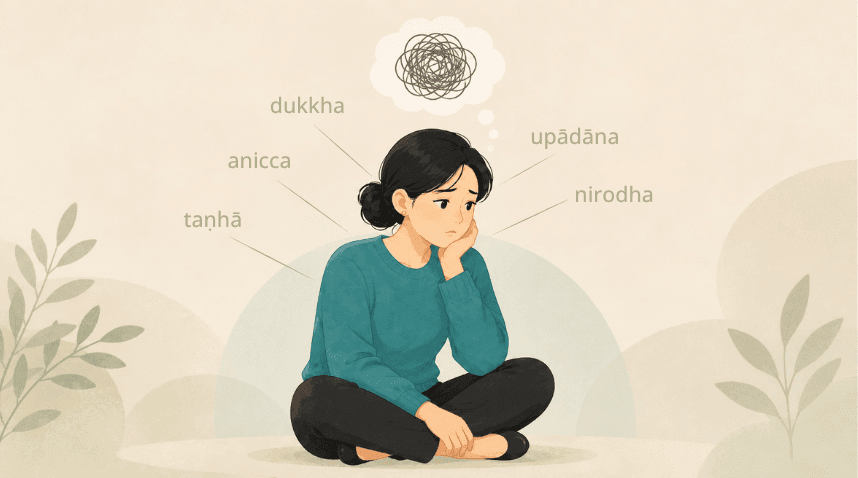
TLDR: Pāli words like dukkha, anicca, taṇhā, upādāna, and nirodha help us see suffering as a normal part of life, not something “wrong” with us. Instead of fighting pain, we learn to understand it, notice change, and loosen our grip a little.
Suffering is often viewed as something to be fixed or eliminated as quickly as possible. When pain sticks around, we usually assume something has gone wrong.
Buddhist teachings take a different approach. Instead of just focusing on how to eliminate suffering, Buddhism asks what is actually happening. This change in perspective alone can alter how we perceive and relate to pain.
Much of this perspective comes from Pāli, the language used to record the early Buddhist texts. Some Pāli words don’t just describe suffering. They change how we understand it. Here are five Pāli words that still matter today.
Pāli is the language used to preserve the earliest Buddhist teachings and is closely related to the dialects spoken in the Buddha’s time.
Originally, the word Pāli referred to the sacred texts themselves, not a spoken language, and only later came to describe the language in which those teachings were written. The Buddha’s words were passed down orally for centuries before being written down around the first century BCE, making Pāli one of the closest surviving records of how his teachings were originally taught and remembered.
Dukkha: Suffering, Unsatisfactoriness

Even on days when everything seems fine, I sometimes notice a low-level restlessness, scrolling on my phone or wanting something more. Nothing is wrong, but there’s still a quiet sense of “this isn’t quite enough”.
This is Dukkha: often translated as suffering, but it refers more broadly to the sense of unease that runs through life, even during pleasant moments. It is not only about obvious pain like illness or loss, but also includes subtle discomfort, like restlessness. The sense that something is missing even when life looks fine.
This matters because it reframes suffering as normal and something that everyone experiences. Life feels uneasy, not because we are failing, but because we expect lasting satisfaction from things that can’t provide it. Seeing dukkha this way shifts suffering reframes it from something “wrong” with us to something part of ordinary experience.
Anicca: Impermanence

Anicca points to the fact that everything changes: emotions, relationships, bodies, identities, and circumstances.
I’ve noticed how quickly moods change. A good day can turn heavy for no clear reason, and a difficult day can soften unexpectedly, reminding me that nothing, good or bad, stays fixed for long.
Suffering comes from resisting this. We want pleasant things to stay and difficult ones to leave. When reality does neither, tension appears. Suffering is often the result of wanting stability where none exists. Recognising Anicca doesn’t make loss painless, but it helps explain why resisting change creates so much strain.
Tanhā: Craving, Thirst

Taṇhā means craving or thirst, especially the urge to hold on to pleasure, avoid discomfort, or become something more than we are.
This word moves attention away from events and toward reaction. What hurts is not only what happens, but the demand layered on top of it. The insistence that life follow our expectations.
When I catch myself thinking, “I really want this” or “I need this to go my way”, the tension immediately grows. The pain isn’t just the situation, but my insistence that reality follow my preferences.
In Buddhism, suffering intensifies not because things change, but because we cling to how we want them to be. This reframes suffering as a habit of grasping, not a punishment or moral flaw.
Upādāna: Clinging, Grasping

Upādāna refers to clinging or attachment, especially the tendency to hold tightly to views, identities, habits, and expectations.
In Buddhist thought, suffering deepens not just because we crave, but because we grip what we crave and resist letting it change or go.
This perspective helps explain why some suffering lasts long after the event itself. We are no longer responding to what happened. We are holding onto an identity built around it.
I notice that long after something has ended, I sometimes replay it in my head, holding onto who I thought I was or how things should have turned out. The suffering continues, not because of the event itself, but because I keep gripping the story around it.
Nirodha: Cessation

Nirodha means cessation, or the ending of dukka and taṇhā, when craving and clinging are no longer being fed.
It does not suggest that life becomes perfect or painless, but that suffering eases when the compulsive need to grasp, resist, or control falls away.
When craving weakens, clinging loosens. When clinging loosens, suffering fades. When I stop arguing with what’s happening or accept a non-ideal situation, even briefly, everything feels lighter. Nothing changes on the outside, but the struggle drops away, and the mind feels quietly at ease.
Rather than something to be achieved, nirodha points to what becomes possible when the conditions for suffering are no longer present.
Why these words matter
Together, these ideas form a simple map.
- Dukkha names the experience.
- Anicca explains why it happens.
- Tanhā shows what fuels it.
- Upādāna explains why it sticks.
- Nirodha points to release.
When suffering is understood, it no longer needs to be fought. This approach of looking at suffering does not ask us to suppress pain or replace it with positive thinking. Rather, it asks us to look more closely.
Why Language Matters When We Talk About Suffering
The words we use to describe suffering affect how heavy it feels. When suffering is described only as something to fix or get rid of, people often turn it inward and blame themselves. Using Pāli terms do something different: they give simple names to common experiences like craving, clinging, and change, which helps people recognise what’s happening without judgement.
Naming these patterns clearly allows suffering to become easier to understand and less personal. Instead of asking what is wrong with us, the focus shifts to what is happening in the moment. This shift alone can make difficult experiences feel more manageable.
Wise Steps
- Gently name the experience: when discomfort arises, label it as dukkha and notice it as a shared human condition rather than a personal failure.
- Reflect on change in real time: during strong emotions, remind yourself “anicca” and observe how sensations rise and pass instead of trying to freeze or push them away.
- Loosen the grip, not the situation: notice moments of craving or clinging (taṇhā, upādāna) and soften the need to control outcomes, allowing small glimpses of ease (nirodha) to appear.
