TLDR: Right Speech is more difficult to practise than silence because speech is directly connected to our thoughts and mental habits. By avoiding false, harsh, idle, and divisive speech, we cultivate both ethical conduct and inner truthfulness.
In March 2026, Ajahn Yiu, a Hong Kong-based Thai Forest (Theravadin) monastic, graced our shores. This was his second year visiting Singapore on a teaching tour, and it was a fruitful six days of sharing the Dhamma with the young and the young-at-heart around Singapore.
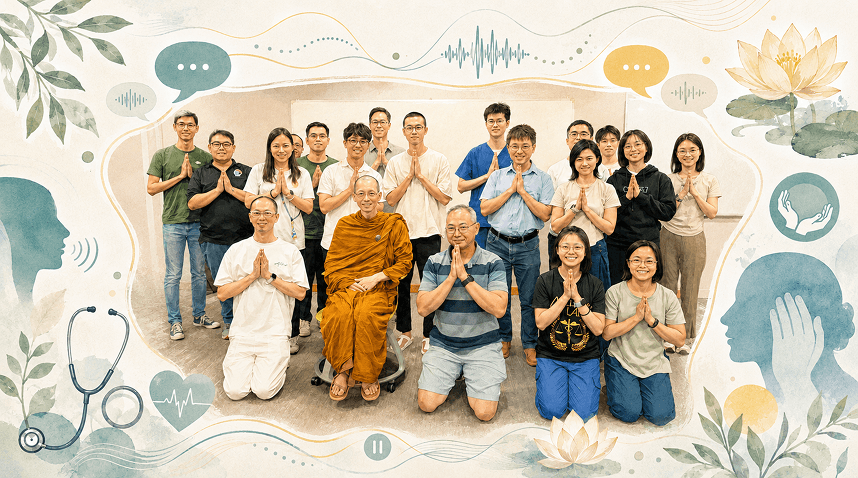
One of the evening talks was delivered to the Medical Dhamma Circle at the National University of Singapore (NUS) – during which Ajahn Yiu shared reflections on the topic: Right Speech even when it’s difficult.
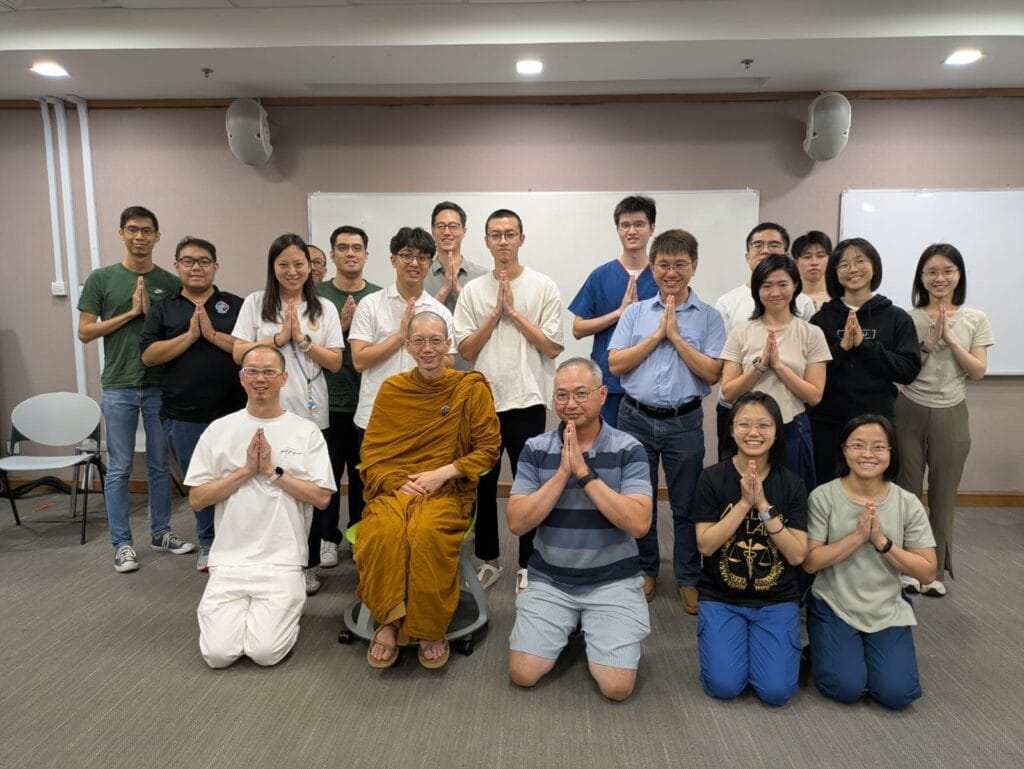
We proposed this topic because healthcare professionals commonly face difficult situations on the front lines.
As Buddhist practitioners, we hope that those serving the community would be able to benefit from Ajahn Yiu’s recommendations on how to maintain the practice of Right Speech – even when faced with misunderstandings, time pressure, long hours, and perhaps even harsh speech from patients.
Well then, what did Ajahn Yiu say?
It is easier to practise and maintain Noble Silence than to practise Right Speech.
This may sound fairly intimidating, but why is this the case? Let’s explore a few key insights from Ajahn’s teaching that evening.
Speech is directly connected to Thought
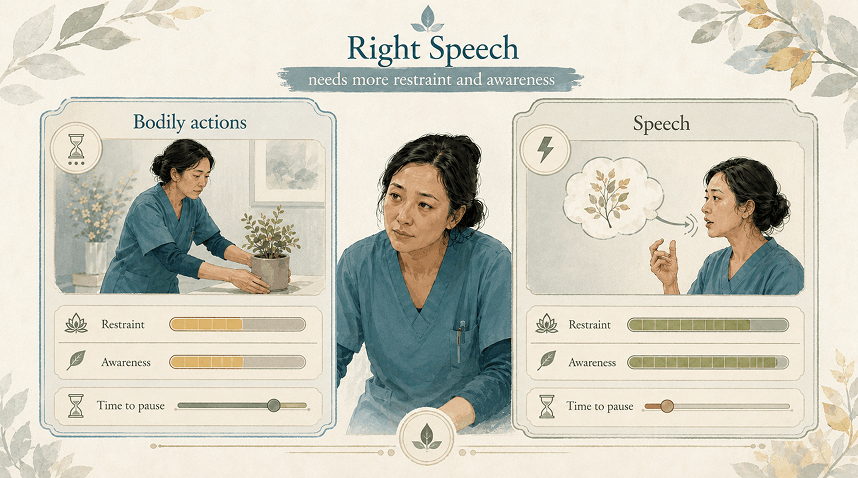
Ajahn Yiu first pointed out that, of the Five Precepts, just one Precept (the Fourth Precept) is related to speaking. The other four Precepts pertain to bodily actions, and they are: to refrain from killing, stealing, sexual misconduct, and taking intoxicants.
These bodily actions, which are coarse in nature, are typically slower than speech or thought. As coarser objects tend to be more apparent in our awareness, we typically have a greater chance of exercising restraint.
Speech, however, is directly connected to our mind, its thinking and proliferation. As a result, there is less opportunity to slow down, especially when mindfulness is lacking. This makes it more tricky for us to keep our speech aligned to ‘Right Speech’ – the third of the eight path factors in the Noble Eightfold Path.
Ever blurted out something you wish you hadn’t said? That is the force of habit at work (habit is one way to understand kamma), especially when one is without mindfulness and reflection. And that is also why it is easy to reinforce bad habits (and ‘make’ bad kamma) when one is not cultivating mindfulness.
Dear reader, are you perhaps reconsidering the practice of Noble Silence at this point?
The Four Aspects of Right Speech
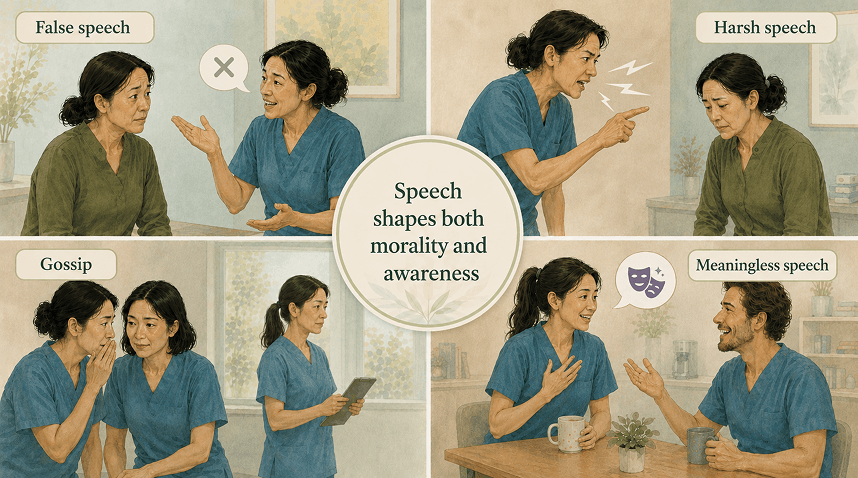
After highlighting the difficulty of practising Right Speech, Ajahn Yiu dove deeper into explaining its four aspects.
The first aspect of Right Speech is not lying.
The second aspect is not speaking harsh words.
The third aspect is not gossiping.
And the fourth aspect is meaningless speech.
One who is able to abandon these aspects is practising Right Speech as shared in the Vibhangasutta (SN 45.8).
What struck me about Ajahn Yiu’s teaching was his emphasis that these four aspects are problems not only related to the practice of morality (sila), but also a problem directly affecting our cultivation of awareness (bhavana).
In other words, Right Speech is not merely about being polite or maintaining good interpersonal relations; When we forget to observe these four aspects of Right Speech, we are trudging in the wrong direction with our practice.
Wrong Speech as Self-sabotage

When we can avoid meaningless speech (the fourth aspect of Right Speech), for example, we are strengthening our practice of Appropriate attention or Wise reflection (Yoniso manasikāra). One way of understanding Appropriate attention is being able to distinguish the things that are important from the things that are not.
Some people disagree and feel that frivolous speech is the basis for many of their friendships. Whether it is talking about shopping, travelling, material things, or chasing new trends, for many, this has been conditioned as the default mode of social connection.
Ajahn Yiu encourages us to reflect on the fact that such conversations contain rather surface-level reflections. If we stopped to look a little deeper, we might find that we could be wasting a lot of our precious time and energy discussing very transient and ephemeral aspects of life.
When our friendships and company are built on shallow talk and surface-level concerns, we end up becoming all too familiar with this way of relating to our own human experience.
That is also to say, we end up connecting to ourselves in a very shallow way.
If we ever sense a quiet unease that we may not be living deeply and looking truthfully at life, we can always look at what company we choose and what we tend to speak about. Our speech is also a reflection of the quality of our inner life and reflections.
Right Speech as a foundation for inner truthfulness
What stuck with me the most about Ajahn Yiu’s teaching was his description of how lying or untruthful speech directly impacts our own dhamma practice and truthful reflection:
Lying to others is the same as lying to yourself
When we lie and convince someone to accept a non-truth, it’s as if we are training our own mind to be loose and dull in its observation of reality.
Our minds are not so different in the way that it relates to another person, and in the way it relates to our ‘self’. Both ‘the other person’ and ‘the self’ are objects and reference points.
Over time, as the practice of lying to others becomes habitual, your mind will also begin to lie to you subconsciously, since it has already been trained to accept half-truths and non-truths. This lack of truthfulness becomes an obstacle to self-inquiry and one’s own Dhamma practice.
Therefore, maintaining truthful speech is not only beneficial in the sense of helping us to build strong interpersonal relations and being a trustworthy friend – it also helps us to maintain a truthful attitude in our practice.
When we are humble, truthful and honest with ourselves, then we become our own wise friend (kalyanamitta).
Ajahn Yiu added that observing the aspect of truthful speech is actually an important criterion for the practice of insight meditation (vipassana).
Wise Steps
- Pause before speaking: Recognise that speech arises quickly from thought. Create space with mindfulness before responding, especially in difficult moments.
- Filter your words through the four aspects: Ask yourself: Is it true? Is it kind? Is it necessary? Is it meaningful? If not, consider silence.
- Treat speech as part of your inner practice: See every conversation as training the mind. Truthful and mindful speech strengthens clarity, while careless speech conditions inappropriate attention and self-deception.
What I’ve shared above is just a brief summary and reflection of what was shared during one of Ajahn Yiu’s teachings. There are many more gems that you can access in the full teaching and Q&A recorded here: Link
For the more visually inclined, you may also want to watch the recordings of two of Ajahn Yiu’s talks:
- 正念正知与正确人生观 (Right View, Right Knowing, and the Right Outlook on Life – this talk is given in Mandarin Chinese)
- Do the Precepts make us more constrained, or more free?
- With thanks to Poh Ming Tse Temple https://www.youtube.com/live/VLI-iXQDAnU
We’d like to thank Br Rong Hui and family, as well as all devotees, sponsors, hosts and beings that made Ajahn Yiu’s 2026 Dhammaduta possible. Sadhu anumodana! All mistakes in the above article and reflections are my own.
Are you keen to learn more from Ajahn Yiu’s dhamma teachings? Here are a few ways to stay connected
- Join the WhatsApp broadcasts
- For Dhamma talks in Chinese / Cantonese: bit.ly/tfp-CNHK
- For Dhamma talks in English: bit.ly/tfp-EN
- Read the latest publications
- Q&A Part 1: bit.ly/tfp-QA1
- Q&A Part 2: bit.ly/tfp-QA2
Ajahn Yiu offers weekly guided meditations with Q&A online
- Wednesday evenings 7.30pm – 9.30pm (HKT) in English (with Korean translation)
- Saturday morning 8am – 10am (HKT) in Chinese 国语
- Saturday afternoon 5pm – 7pm (HKT) in Cantonese 粤语
For more about Ajahn Yiu (耀师父), you may refer to a short introduction on the page of the Hong Kong Theravada Meditation Society.