
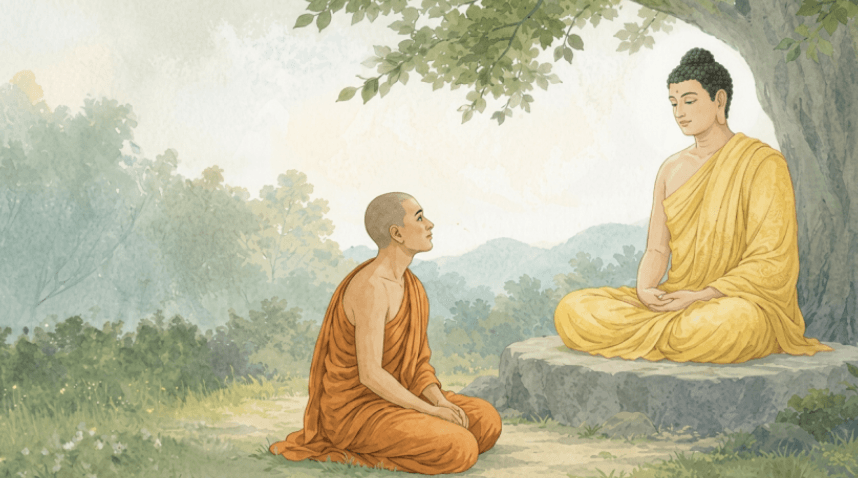
The Monk who Couldn’t Take His Eyes Off the Buddha
TLDR: Vakkali’s story is about a monk whose devotion becomes a desperate need to see the Buddha – and what happens when that longing is refused. Read alongside Buddhaghosa’s retelling, it becomes a startling account of how being “met” where we are can open the door to liberation.
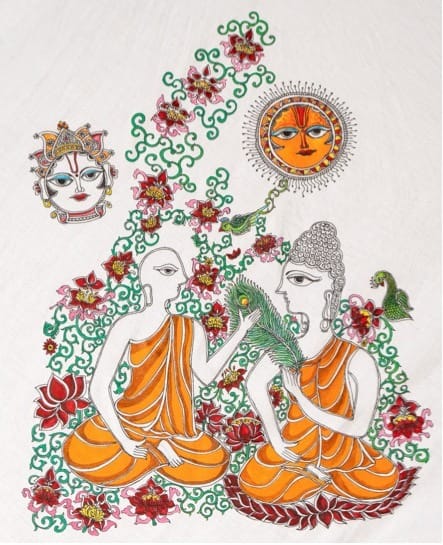
I cried the first time I read about Vakkali, and the recollection of that still surprises me. I hadn’t expected to feel so close to a monk from the Buddha’s lifetime. I’d expected the usual sort of difficulty that Buddhist stories sometimes present: a doctrinal knot, an ethical puzzle, a footnote that sends you hunting for more footnotes.
Instead, the story got under my skin because it begins with something uncomfortably ordinary: a man who wants to look at another man, and cannot stop looking.
The Pali tradition gives us Vakkali in more than one narrative.[1] One is the Vakkali Sutta in the Saṃyutta Nikāya (SN 22.87), an austere, severe story centred on an ill monk and a deathbed visit. The other comes through the later commentarial tradition, shaped most influentially by the 5th-century CE Pali commentator, Buddhaghosa. In his commentary on the Dhammapada, Buddhagosa draws out Vakkali’s longing more openly and the ending is significantly transformed.[2]
It’s easier to start with that later portrait, because it makes Vakkali’s desire plain.
Vakkali is remembered as a brahmin from Sāvatthī, trained in the Vedas, formed inside a world where you learn how to carry yourself and how to speak correctly. Then he sees the Buddha once and something in him breaks open. He follows the Buddha about, hungry for the sight of him. He ordains as a monk because proximity is the only solution he can imagine.
We’re told that he spends almost all his time — apart from eating and bathing — absorbed in contemplating the Buddha’s external appearance, as though looking were the only way he knew to stay alive. It’s hard to read this as anything other than fixation: Vakkali had become besotted with the Buddha’s form, and he can’t seem to stop himself.
The Buddha responds with a rebuke that has become famous:
“Enough, Vakkali! Why do you want to see this foul body?
One who sees the Dhamma sees me;
One who sees me sees the Dhamma.”
There’s no gentleness in the phrasing. The Buddha refuses to let his physical body become the refuge Vakkali is trying to build for himself. If Vakkali wants refuge, he will have to find it somewhere other than bodily form.
Now for the sutta version. In SN 22.87, Vakkali appears as a very ill monk. The Buddha comes to visit him and asks him a sequence of questions that feels almost like a careful diagnosis: is the pain easing or worsening; is there restlessness or regret; is there any reason for self-reproach in his virtue? Vakkali says his conduct is blameless. So far so good. But then he reveals that what troubles him is not guilt. What troubles him is that he hasn’t been able to see the Buddha as much as he wanted. The Buddha replies with the famous rebuke and the “seeing Dhamma” line, directly in response to that longing.
In the sutta, the Buddha then leads him through contemplation of the aggregates, pushing Vakkali toward the kind of seeing that loosens clinging at its root.
Then comes the part that makes readers stop short. After the Buddha leaves, Vakkali takes his own life. The Buddha later declares that Māra, the deva who personifies death and temptation, cannot trace his consciousness — this is an old way of saying he has passed into final Nibbāna (often rendered “Nirvana” in English). This is why modern readers talk about the “Vakkali problem.” The first puzzle is ethical: how could self-killing possibly be justified, given the precepts and the tradition’s deep unease around taking life? That puzzle is real. It requires restraint in how we handle and interpret it.
But the second question is the one that gripped me: the Buddha visits Vakkali, teaches him, reassures him — and Vakkali still kills himself. What makes that sequence make sense?
Many readers treat the answer as simple: illness, pain, despair. Vakkali’s fixation on seeing the Buddha can look excessive, even embarrassing, and it’s easy to assume Vakkali’s wish to end his life arose solely from physical suffering.
For a gay reader, the emotional logic can feel clearer. I’m not suggesting Vakkali is “secretly gay,” and I’m not trying to sexualise the Buddha’s beauty.
The recognition is simpler: what it feels like when longing is met with refusal, when the wish to look is also the wish to be near, and that nearness is denied.
Many gay people learn early that desire can make you visible. It starts very small: a face you keep turning back to, a look that lingers, and then somebody notices. The correction often arrives as ordinary “help” — don’t stare, don’t be weird, don’t give people the wrong idea, you better be careful — said jokingly, but landing hard. After a while you begin to anticipate the shift in temperature before it happens, and you train your eyes accordingly.
Bring that experience to Vakkali and the sequence makes more sense. His devotion is organised around seeing the Buddha. The Buddha calls the body “foul” and denies Vakkali the comfort of clinging to his physical form.
When that comfort is taken away and nothing has yet taken its place, it can feel like the abrupt ending of a love affair — disorienting, unmooring, and edged with panic.
In Buddhaghosa’s version, the rains retreat is approaching and the Buddha is leaving Sāvatthī for Rājagaha. Vakkali wants to follow him into retreat but the Buddha tells him not to. Devastated, he goes to Vulture Peak intending to throw himself off. His distress centres on not being able to see the Buddha, and on being sent away from him.
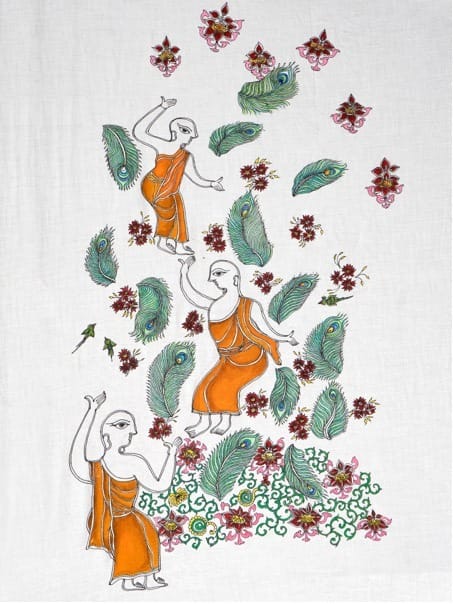
And then Buddhaghosa resolves the story in a completely unexpected way.
Sensing that Vakkali is about to throw himself off the cliff edge, the Buddha is moved by compassion. The narrative says the Buddha sends forth a radiant image of himself for Vakkali to see. Then,
The moment the monk saw the Teacher, the weight of sorrow that had oppressed him vanished.
Then the Teacher, as though filling the dry bed of a lake with a flood of water, caused great zest and joy to arise in the monk, and pronounced the following stanza:
Full of joy and faith in the Buddha’s teaching, the monk will reach the place of peace, the happiness of the stilling of the formations.
Having pronounced this Stanza, the Teacher stretched forth his hand to the elder Vakkali and said,
Come, Vakkali! Fear not, look at the Tathāgata! I will lift you up like (one lifting) an elephant sunk in the mire.
Come, Vakkali! Fear not, look at the Tathāgata! I will free you just as the (eclipsed) sun is freed from Rāhu’s maw.
Come, Vakkali! Fear not, Vakkali! Look at the Tathāgata! I will free you just as the (eclipsed) moon is freed from Rāhu’s maw.
I’ve quoted the Dhammapada Commentary at some length because the passage has real poetic force. Earlier, Vakkali is told that the Buddha’s body is “foul” and that looking is useless. Here, the Buddha does the opposite: he invites Vakkali to look at him. Vakkali’s sorrow drops away, joy and faith surge, and he leaps; liberation is said to occur before he reaches the ground.
This does not undo the sutta’s point. The body cannot be the final refuge; “seeing the Dhamma” still matters more than seeing a person. What changes is how the story handles the human problem that has been driving Vakkali toward the edge. Buddhaghosa treats the gaze and the pull of the Buddha’s beauty as a force that has to be addressed, not simply dismissed.
The invitation to look becomes the turning point that lets Vakkali move toward liberation — without giving him permission to cling.
For gay Buddhists, that matters. So much of our formation involves learning to mistrust longing, and Buddhist language about craving can either free the mind or quietly reinforce shame, depending on the experiences that we’ve had. Vakkali’s story refuses easy answers. It shows longing in its most inconvenient form — obsessive looking, rebuke, separation, despair — and it also shows, at least in Buddhaghosa’s retelling, a moment where that longing is met without humiliation, long enough for liberation to become possible.
That is why I cried. Buddhaghosa’s retelling offered an ending I didn’t expect: neither indulgence nor a cold demand to “get over it,” but the Buddha compassionately appearing before Vakkali as he stood at the edge. It names a truth which many of us learn the hard way: sometimes you can neither let go nor move forward until you’ve been met. Vakkali is met through the very thing that had once been refused — his looking — and from that foothold the story finally lets him step toward liberation.
Bibliography
Saṃyutta Nikāya 22.87: Vakkali Sutta. Translated by Bhikkhu Bodhi. Accessed January 8,
2026. SuttaCentral. https://suttacentral.net/sn22.87/en/bodhi.
Tan, Piya. 2023. Vakkali Sutta: The Discourse on Vakkali (SN 22.87). SuttaDiscovery 8.8.
Accessed January 8, 2026. https://www.themindingcentre.org/dharmafarer/wp-content/uploads/8.8-Vakkali-S-s22.87-piya.pdf.
Picture Links
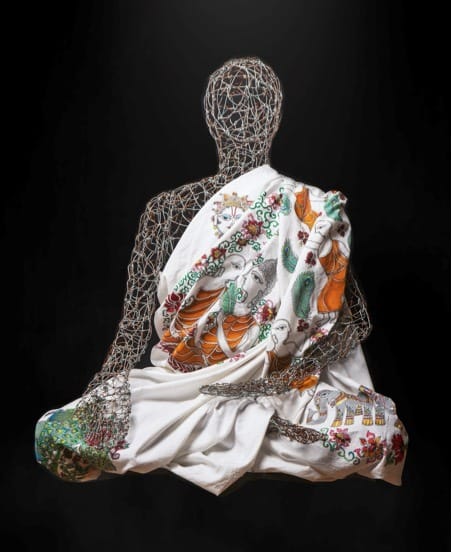
- ‘Visions of Vakkali’ (2020), a collaborative artwork between Ajit Sah, Bishowmber Basnyat and Dominic Chua: https://drive.google.com/drive/folders/1YM7M2APSWhrP3NxCWD4o8aw427cndW4t?usp=sharing
- Explanation of the artwork: https://loving-woodwind-86d.notion.site/Visions-of-Vakkali-a29506e6fd174073ab7d871ba8ecae43
[1] Piya Tan floats the possibility of “two Vakkalis” to account for differences between the Vakkali Sutta and Buddhaghosa’s later commentarial versions. Here, I treat them as two retellings of one story: later tradition keeps the same core tension (Vakkali’s need to see the Buddha) while reshaping the ending into a more teachable, less ethically jagged resolution.
[2] Buddhaghosa (traditionally dated to the 5th century CE) is arguably the most influential commentator in the Theravāda tradition, best known for systematising doctrine and meditation in works like the Visuddhimagga (The Path of Purification) and for shaping how later generations would read the Pali Canon. For many Theravādin Buddhists, his interpretations have become a standard lens for understanding the suttas. That matters here because the more dramatic Vakkali story comes to us through this commentarial stream, rather than from the early sutta collections alone. Reading Buddhaghosa alongside SN 22.87 shows how a later, highly influential Theravāda interpreter identified the story’s emotional and doctrinal stress points, and then shaped a resolution that he thought could carry the reader through them.