Wrestling with Karma, Illness, and the Buddhist Truth of Rebirth
TLDR: What if rebirth isn’t just about a next life but something we’re already living through in every moment? This reflection explores how karma, suffering, and impermanence shape not only our bodies and stories but also the deeper questions of who we are and who keeps being reborn.
Last Wednesday, after facilitating our Care and Share session with Rainbodhi Singapore, someone in the group said something that really made me pause. He shared that he’s a Buddhist, but doesn’t believe in rebirth. I wasn’t offended or eager to debate; it just genuinely made me stop and reflect, questioning something I’d long taken for granted in my own understanding.
Caught in the loop: The endless cycle of cause and effect
Buddhism, at its heart, speaks of cause and effect — karma shaping the contours of our lives, even beyond this single breath of existence. Rebirth isn’t just a doctrine. It’s a thread that runs through the entire fabric of Buddhist teaching. So how can one hold the identity of a Buddhist and yet not hold this belief? The contradiction made me pause.
I began to share, not as a teacher but as a fellow Buddhist. From what I’ve read, studied, and wrestled with, I’ve come to believe that this life right here, right now isn’t the full picture. It’s one of the chapters, not the whole book. It is samsāra (cycle of existence).
I began to explore the idea of rebirth by asking myself.
“Why are some born into privilege and others into poverty? Why are some born in India, others in Singapore? Why do some enter the world with illnesses or disabilities, despite their parents’ clean bill of genetic health? Why do some stumble upon the Dharma, while others are born far from it, wrapped in entirely different belief systems?”
Yes, some might explain it all away as nature versus nurture. But even nature raises its own quiet mysteries.
Why this body, this gender, this face, this skin, this sexual preference? Why do we cross paths with certain people, out of billions in the world, as if drawn by some invisible thread? It makes me wonder: isn’t there something deeper at work behind it all?
The late Dr. Ian Stevenson, a psychiatrist from the University of Virginia, documented thousands of cases where children recounted past lives with uncanny accuracy with names, places, events they couldn’t possibly have known. Are these simply coincidences? Or are they fingerprints left behind by previous lives?
But we don’t even have to leap into the afterlife to see rebirth at play. Think about last week, today, and the week ahead. How each choice, each moment, leaves ripples in the river of our life. Or look further back: would your 10-year-old self recognize the person you are today? Would a passport photo from that time prove your identity now? We die and are reborn constantly, in our bodies, in our beliefs, in our stories.
To me, that’s the quiet miracle of Dharma. It doesn’t ask for blind faith. It asks for presence. It asks us to look at suffering. Not to deny it, but to understand it. And that understanding leads us to awakening and far away from ignorance.
When Karma Speaks Through This Body
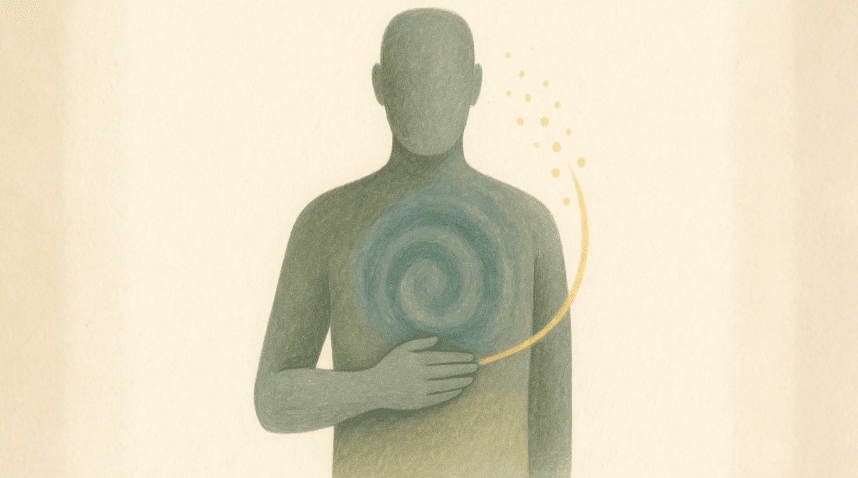
There are days when I feel so helpless about getting through the same day every day, unplugging the PEG tube, not being able to eat, sleeping with a tube attached to the stomach. Once the body was strong, effortless, full of thoughtless motion.
Now, every movement is a negotiation, every breath a pact between fragility and perseverance.
I’m 46, or close enough, and as a queer gay man, suffering comes all too naturally for me. As a cancer survivor, I’ve carried it through my bloodstream, through the ache of radiation, and through the contamination of chemotherapy. Even after 12 years of remission, I still carry it in the scars and in the silent complications. The PEG tube nestled in my abdomen is one of them, a constant reminder of the threat of aspiration risking my health. This isn’t survival in the triumphalist sense. This is endurance, raw and intimate.
Even speaking takes effort, the neck stiff with tension, muscles strained and unforgiving. I speak too loudly and garishly, as I can’t hear the tone of my voice, echoing back to me. That voice now becomes a soft memory of the one that once sang, shouted, laughed.
I used to think of sickness as something that happened to others—distant and abstract. Cancer shattered that illusion with brutal intimacy 12 years ago.
The deterioration came slow, then all at once. The body that once danced, laughed, ate with joy, slowly deteriorated and turned into a battlefield.
I remember the taste of metal in my mouth from chemo, the sheer exhaustion that felt like gravity had doubled. And then, after all the treatments had been done, a new challenge: I could no longer eat safely. I had to learn to feed myself through a tube. It felt dehumanizing at first, but with time, it became part of me—part of my strange, new survival.
There’s a saying that always stays with me: ‘If you ever feel upset about having no shoes, just turn around: you might see someone struggling to walk without feet.’
I’m not saying this to compare struggles, but to remind myself how lucky I am just to have my two legs. Every step I take is a gift I don’t want to take for granted.
Coming face-to-face with death not once, but over and over reshapes the very architecture of my beliefs. It’s like watching the walls of everything you thought you knew slowly crumble, leaving behind only what truly matters.
Seeking Answer, Not Comfort, in the Dharma
In those moments of stark clarity, I didn’t turn to the Dharma seeking comfort or cosmic rewards. I turned to it for understanding. Buddhism never promised me miracles. It didn’t hand me hope wrapped in illusions. What it gave me was something far more profound: a language for suffering, and a path that points to its end.
And that idea, the possibility of awakening stirs something deep in me.
Because let’s be honest: we’re all marked by the imprints of our karma.
I started seeing life through the lens of samsāra. Birth, aging, sickness, death. Not as poetic notions, but as lived truth. The relentless spinning of existence. And it made me ask: who is it, exactly, that keeps being born into this? In the Dhammapada, it is written:
The more I studied, the more I practiced, the quieter my world became. I noticed things I never had before, the exact texture of silence, the moment before a thought arises, the softness of a kind intention. The PEG tube, once a symbol of brokenness, became a reminder of impermanence.
My suffering was not unique. My body, my pain, even my thoughts, they were all passing clouds. Buddhism gave me a language for this. It gave me refuge.
But this is not detachment in the cold sense. I feel everything more deeply now. I cry more often. I laugh more honestly. I love more fiercely. And understanding karma better now, the question haunts me: Who is asking to be born, again?
When you’ve brushed against death, you can no longer pretend life is permanent. You see through the facade. You see people scrambling to hold onto illusions, and you want to whisper to them: it won’t last. None of it. And yet, there’s beauty in that. There’s freedom. Because when nothing is solid, everything can be fluid.
These days, I don’t look for a future without pain. I look for presence within it. I try to meet each moment fully, however it comes—through a feeding tube, through breathlessness, through gratitude. And in those moments, I sometimes feel it: a stillness, a clarity, a knowing that maybe, just maybe, the one asking to be born again… doesn’t need to be born at all.
Maybe the question itself is the answer.
And maybe that is enough.
Wise Steps:
Recognize patterns in your life as reflections of past actions. Karma is not punishment, but a mirror showing what still needs to be understood.
Use suffering as a teacher, allowing pain and challenges to deepen your wisdom, compassion, and awareness of impermanence.
Live with mindful intention, planting seeds through your thoughts, words, and actions that lead to peace and liberation.
TLDR: The Brahmavihārāare more accessible than you realise. Read on to find ideas on how to practice them in your daily life. Learn more about the author’s first-hand experience of the LGBTQIA+ Buddhist community, Rainbodhi Singapore.
When we think of the Brahmavihārā, or the Divine Abodes, we may think of this heavenly state of mind, as something that exists only when you are able to achieve the elusive and hard-to-attain states of mind called Jhāna.
As human beings, we naturally crave happiness and shun suffering, hence I too have been chasing the elusive happy state of mind. While on a meditation retreat, I chanced upon the practices of the Brahmavihārā, and I was able to achieve a taste of the pleasant states of mind, which has been alluded to as living like Heaven on Earth.
Who would not want that experience?
The practice of the Brahmavihārā can also help us better manage our emotions when dealing with the 8 worldly concerns in our daily life. And you can have a taste of the Brahmavihārā without going through an intensive meditation retreat.
Here, I would like to share my experience, of encountering the 4 Brahmavihārā of Mettā – Lovingkindness; Karuṇā – Compassion; Muditā – Appreciative Joy; and Upekkhā – Equanimity, in the Rainbodhi Singapore* community here. And, how you can practice the 4 Brahmavihārā in your own daily life.
I faced anxiety and dread in my first meeting with the Rainbodhi Singapore community, as discrimination and judgment can sadly occur even within the LGBTQIA+ community.
Internalised homophobia hurt members of the LGBTQIA+ community. As a minority, an outsider, and a non-local, I face challenges in finding a safe space across communities. Fortunately, my experience with the Rainbodhi Singapore community is different.
Mettā – Lovingkindness:
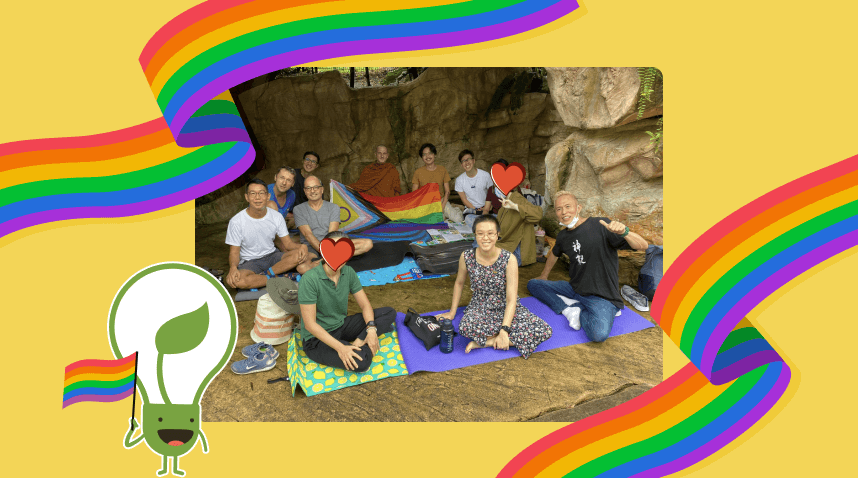
As I walked and panted up the steps at Fort Canning Park for Rainbodhi Singapore’s first monthly picnic, I kept wondering to myself if I should turn away. As this could be a potentially socially awkward event for the shy, introverted me.
Yet, I told myself that, I already came so far, and I should just show up. Showing up is half the battle won, I often remind my friends, that I should practice what I preach.
As I inch closer to the picnic site, from afar, I saw the smiley and happy face of Kyle Neo, the founder of Rainbodhi Singapore, waving his welcoming hands at me.
Kyle’s face radiated so much lovingkindness and friendliness that it melted away my fear and doubt about this meeting.
It was still early and there was just another person, Koh An Ding, at the picnic, but seeing her smile and nod happily as I approached the picnic mats further welcomed me into this new community for me.
What did I learn from these simple gestures from two relative strangers? Lovingkindness can manifest itself in a friendly smile or nod, making a world of difference to those around you. We can spread Mettā around us, getting on the bus, a smile, or a nod at the bus driver. If you try, this can enormously impact everyone’s life.
Karuna– Compassion:
Continuing my picnic story, being part of a community is key.
We self-identify as members of the Rainbow community. This shared identity allows us to understand and connect with one another easily, even if it is our first meeting.
And this allowed me to open up about the challenging work experience that I was going through at that moment in time. Being heard and being seen by my new friends, I felt the wave of compassion washing over me, not because I am part of the minority group, but because I am a fellow human being, who is experiencing pain and suffering in life, at the workplace.
Compassion – bearing witness to another suffering, does not take away their pain, but it strengthens the bond of humanity when we recognize the 1stNoble Truth – that “There is Suffering”, and that we are not alone in the broad theme of “Sufferings of the World.” You can relieve the suffering of important people or even strangers, by just lending your listening ear.
Muditā– Appreciative Joy:
The repeal of Section 377A in Singapore, the law that criminalises sex between men, was officially repealed in November 2022, and I witnessed much joy and appreciation within the Rainbodhi Singapore community.
However, there is much left wanting by the community in terms of freedom and understanding from broader society. At times, some members of the community feel it is up against an ongoing slew of oppressive expectations and stereotypes.
Nevertheless, this does not stop one from rejoicing in the success and freedom of any groups within the rainbow community.
Living our life on a hedonic treadmill, we feel that we must constantly chase after happiness, to constantly get the dopamine kick, the feel-good chemical spark in our brain. And that can be a challenging thing to happen in our life.
Just like playing your favourite mobile game, levelling up to the Beginner’s level is so much easier and faster than trying to level up to the Expert’s level instead.
Hence, trying to seek happiness and joy to happen in our life would be frustrating, because it would be further and fewer in between.
How about trying this instead?
How about in our daily life, you choose to rejoice in others’ happiness, and you can multiply the joys in your life much easier and faster.
This provides an ongoing stream of happiness, joy, and gratitude to come into our life, not dependent on good news happening to us alone, but also builds upon the goodness that showers on others.
I always wonder if this is one of the secrets of the happy monks and nuns that we see in temples and monasteries when they are constantly rejoicing in laypeople and fellow monastic goodness, that they can stay perpetually happy.
Upekkhā– Equanimity:
While there is a win for LGBTQIA+ rights with the repeal of Section 377A, it also comes with the news of the amendment to the Constitution with the intent to protect the definition of marriage, to narrowly define it between the marriage of a man and a woman.
It creates the split feeling of a win (with the repeal of Section 377A), yet a loss (with the greater restrictions of the marriage definition), banning the possibility of same-sex marriage in Singapore, for now.
Some members of the Rainbodhi SG community encourage calm and patience, in securing greater gains for the LGBTQIA+ community, over time.
To me, it is a good example and portrayal of Equanimity, in the face of the mixed wins and losses in life. Trying to stay balanced amid the salad mix of emotions is what the practice of Equanimity calls for.
In our life, we may be shocked and overjoyed with the different ranges of emotions that may come up, when faced with different life events. And given enough time, we find that the initial emotions usually wear down and become less intense.
Hence, I would say that we all have practised Equanimity in our life, more than we realised. Just give it time, for time will heal all wounds. Khanti (Patience) is one of the 10 Pāramī (Perfections) that are encouraged to be developed after all.
Conclusion:
June is typically celebrated as Pride Month. Finding Rainbodhi’s community has been a joyful experience. I hope this inspires more LGBTQIA+ Buddhists and allies to learn and join Rainbodhi Singapore’s activities. Do explores your own ideas on how you can further practice the Brahmavihārā in a practical way in your daily life.
Wish to find out more? You can visit the Rainbodhi Singapore website here or join the Telegram group for event updates here.
Wise Steps:
You can be creative and innovative in practising Loving-kindness, Compassion, Appreciative Joy, and Equanimity in your daily life.
You can deepen your practice of Lovingkindness and Compassion towards the under-represented community in Singapore, such as the LGBTQIA+ community in this Pride month and beyond.
Note:
* For those unfamiliar with Rainbodhi Singapore, this is the community of Buddhist practitioners in Singapore, who also identify as members or allies of the LGBTQIA+ community.
Wholesome Wednesdays (WW): Bringing you curated positive content on Wednesdays to uplift your hump day.
Pink Dot, an event that supports people’s right to love, comes and goes every year. This year is back to a physical event with many hugs exchanged and photos taken. Beyond the event, how can we show support and compassion to our LGBTQ+ friends?
1. To foster harmony and understanding, we first must drop the need to be right all the time. Here’s how
2. The ultimate guide to inclusivity in organisations (Buddhist ones included!)
To foster harmony and understanding, we first must drop the need to be right all the time. Here’s how
Unsplash
What’s going on here
The author shares how we can establish harmony between the divides in society. Staying silent about discrimination can make us part of the problem too. Understanding our and others’ fears can bridge the gap.
Why we like it & the key takeaway
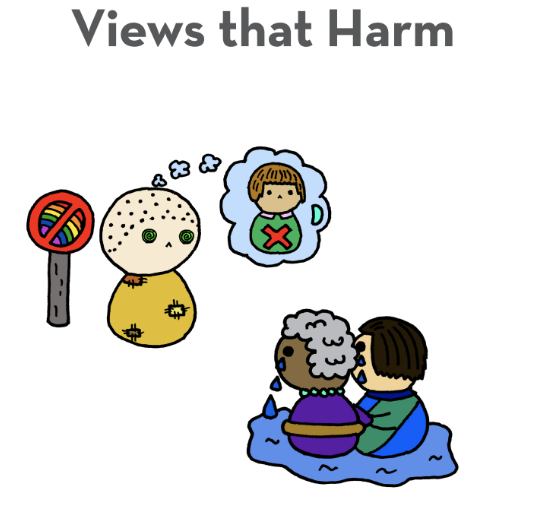
The author gives super nice graphics on how we can react in different situations. For example, if a colleague is uncomfortable with another colleague’s sexual orientation. Or in other cases, a colleague feels discriminated against because of their sexual orientation.
“A constructive approach is to educate ourselves about the opposing views in hopes that our perspectives can be shifted, and that misconceptions can be cleared. “
The ultimate guide to inclusivity in organisations (Buddhist ones included!)
Screen capture from Rainbodhi’s Manual
What’s going on here
Rainbodhi, a spiritual friendship group for LGBTQIA+ Buddhists and an advocate for more inclusion and diversity in the broader Buddhist community, shares a simple manual for boosting inclusivity in Buddhist groups and more!
Why we like it & key takeaways
The cute comic strip helps the reader navigate the dos and don’ts in creating an inclusive practitioner circle for all. More importantly, the manual also shares perspectives on the link between Anatta & sexual identity. We love the manual as it is comprehensive in building a more inclusive organisation.
“Some Buddhists use the concept of not-self to shut down LGBTQIA+ people talking about issues that affect them, or the very real suffering that they experience.”