Welcome to the Handful of Leaves podcast. My name is Cheryl, and today we are back with another episode. I am here with Alvin, a friend who has experienced and struggled with drug addictions in the past. He’s here today to share a little bit more about his learnings, and his journey. He wanted to give back to society after seeing how the Dhamma really helped him in his journey.
[00:00:27] Alvin:
Hi, Cheryl. Hi, guys.
[00:00:29] Cheryl:
I’m very curious about how you started getting into drugs.
[00:00:34] Alvin:
So, an ex-friend actually introduced me to drugs. When we were in primary school, they told us to stay away from drugs, right? They told us we’d get hooked easily. I guess at that point, I was just curious. Oh, is it really true that a few puffs will really get us hooked? So I went ahead and tried it, which is a very bad idea.
[00:00:51] Cheryl:
Right. Curiosity killed the cat, but in this case, curiosity got you hooked. I see. And what happened after that?
[00:00:59] Alvin:
Your work, your health, your relationships friends, actually everything got affected. Because almost every moment I was thinking about drugs. In a way, deep down a part of me also feels guilty. I know this is wrong but, I just can’t help it. The addiction basically just takes over. To be honest, I broke all the precepts except for the first one, the killing of another human being.
Because I was using crystal meth, the whole time I was feeling like I was no different from an animal or maybe a ghost? Basically, I was always craving for drugs. It increases your sexual desire, you are impulsive, and you have frequent mood swings. Because I have a bit of anxiety, it actually increases the anxiety attacks.
[00:01:44] Cheryl:
I see. What was the turning point to get out of your addiction?
[00:01:48] Alvin:
I mean, I feel like I’m a being from the lower realm. When I look at my friends, I basically feel that something is actually wrong with me and I need to change. That is when I started to do my own research on the Dhamma and modern psychology to help myself get out of the addiction. Basically, abusers will glorify the highs you can get from the substance, and they don’t look at the negative effects on your mind and body.
I watched videos on human anatomy created by healthcare professionals, to watch what it does to your organs, your brain, everything. In that process, I listened to Dhamma teachings. I make the effort to go for meditation, sign up for retreats, speak to Bhantes, and share my problems with them. Going through all these Dhamma activities, I also made Dhamma friends. I also share my problems with them. All of them gave me advice and helped me.
And because of meditation, I looked inwards, and I realized that being in addiction, my behaviour, my thinking, everything was distorted. It’s really like beings from a lower realm. I must just keep making the effort to replace negative habits with refined habits and negative thoughts with refined thoughts.
[00:03:00] Cheryl:
That is actually very similar to what the Buddha said of Right Effort and Right Intention. The Buddha shared that essentially when you have wholesome, skillful states of mind, you make the effort to make it more abundant. If it has not yet arisen, you also plant the seeds so that it will arise. Then on the other side if it’s unwholesome things, if it has not arisen, you try to make sure that it doesn’t arise. But if it has already arisen, you make the effort to cut it, abandon it, and don’t indulge too much in it. That sounded very similar to what you shared as well.
Just in reference to what you said about feeling like a being from the hungry ghost realm, I think it’s a perfect simile because they are usually depicted as creatures with scrawny necks, and small mouths, and their limbs are very thin and very emaciated. At the same time, they have very large, bloated, empty bellies. In the domain of addiction, when we constantly seek something outside ourselves to curb that insatiable yearning for happiness, relief, or fulfillment, we will always feel empty inside because these substances, these objects, these pursuits, we hope that it will help us to be happy, but it will never give us the happiness that we need. And we will haunt our lives without ever being fully present.
[00:04:27] Alvin:
Like beings of the lower realm, there’s no way we can create merits because our views are distorted. Even though we think that we are doing something virtuous, actually it’s not.
[00:04:37] Cheryl:
Can you share an example?
[00:04:38] Alvin:
I have a friend who introduced me to drugs. After every session, he will share some so-called TCM with fellow drug users to help them to relieve the symptoms. He thinks that he is actually doing something virtuous to help people, but actually, he’s not.
You can’t blame him, but indirectly he’s actually giving people the wrong idea that you can actually remove the toxins from drugs using TCM after you use them. But they didn’t know actually crystal meth affects your brain immediately when you take them. So what he’s doing is actually relieving the symptoms after the drugs which actually doesn’t help to remove the damage to the brain.
[00:05:13] Cheryl:
Interesting. So he himself probably has that wrong belief as well, that it’s the right thing. And he goes on to perpetuate that. And I think that is the danger of not having Right View, right? When you don’t have Right View, you firmly believe that what you’re doing is actually going to give you happiness and you follow it. The result of that is obviously suffering to yourself and suffering to others as well. These are very painful consequences. Were there any relapses in your journey to recovery?
[00:05:44] Alvin:
If let’s say after you stopped using for three months, you suddenly go and take a puff, it’s considered a lapse and not a relapse. A lapse is just a slip. I have a few lapses here and there. If I remember it’s around maybe three. After every lapse, I will feel extremely guilty. Oh no, I actually took a puff. I’m such a terrible person. I thought I made the motivation to stay clean. How could I do something like that? After feeling guilty, I have to maybe look back and see what causes the slip. Is there anything I missed out? Maybe some context I didn’t delete or maybe the triggers. So after every lapse, if you make the effort to learn from it, it will prevent the next lapse from happening. It’s basically like riding a bicycle. If you fall, you get up and then you continue riding. If you fall and you just give up, then you won’t be able to ride a bicycle.
[00:06:33] Cheryl:
But what gave you the motivation to come back up again? It’s so tiring, right? You are literally fighting a battle that is very hard to win because it has already affected your neural connections. So what gave you that strong drive?
[00:06:46] Alvin:
I relate to beings of the lower realm, right? If I don’t want to get out of the addiction, I’ll always be a being of a lower realm. I’ll always be stuck there and the worst thing is in this life and in my future life. So yeah, that gave me the motivation. Also because I did some meditation, I have to be mindful that actually I’m fighting the defilements. It’s the defilement that keeps pulling me back. I stick a note on my wall to remind myself that thoughts are thoughts, memories are memories. Just come back to your breath. So whenever thoughts try to trigger me to pick up the substance. I just remind myself that, that’s not me. That’s just my past habit. So after a while, usually after a few minutes, the thought will go away. So you just have to keep fighting it.
[00:07:32] Cheryl:
You have to endure it within the few minutes when it comes on strongly. Alvin, I must really say that I really admire how much wisdom you have. This wisdom of seeing things clearly in the sense of seeing the drawbacks of being in this lower realm. First, you compare yourself with your friends, you’re lagging behind because of this addiction. Second, realizing the drawbacks of how rare this human birth is, but at the same time being stuck in the lower realm, traps you into not being able to do any goodness, any merits. With that wisdom, that really pushes you through all the difficulties, even though there were lapses in your process of learning how to ride the bike.
The Buddha shared the second of the Eightfold Path, which is the idea of Right Intention. Being firm on this idea of renunciation, letting go of ill-will, keeping yourself in goodwill, keeping yourselves in loving kindness. Being firm and resolved on the idea of harmlessness to yourself as well as harmlessness to other people. This is called right resolve or right intention in which you set your mind firmly to move on into more wholesome activities, more wholesome bodily actions as well.
[00:08:50] Alvin:
I’d also like to add that every time I go for Dhamma activities, the Bhante or the Luang Por will make us retake the Five Precepts. So every time I retake the five precepts, it reinforces the motivation to stay away from all these substances. Every time I go to these Dhamma events, I see my Dhamma friends there. I shared with them my addiction and they are like my safety net. So every time I meet up with them, they will ask me, how are you? Indirectly, they will check in on me. I also made promises to Ajahn and Luang Por. Every time they see me, they’ll also ask me. It gives you the additional protection. It’s quite helpful. Maybe those who are actually struggling with addiction can apply it to themselves.
[00:09:29] Cheryl:
Thank you so much for sharing. You’re very, very lucky to have this supportive community of spiritual friends and more importantly, spiritual teachers that you respect. When you make aspirations in front of people that you respect highly, I think you’ll take that more seriously as well. Your defilements will be a bit scared of it as well. And what are the biggest changes in your Dhamma practice in these two and a half years?
[00:09:55] Alvin:
I will say that my mindfulness has increased. I have more opportunities to create merits, go on retreat, and do things that truly benefit myself and other sentient beings. It’s a big gain. I will use a simile right now, I feel like I’m a human being. And I’d kind of go further into maybe Deva?
[00:10:13] Cheryl:
For all our listeners who have not heard of this term, Deva usually refers to the higher beings. It could be something like deities, angels, or beings of the higher realm that are in a way superior to the human realm. And I guess that is also the path, right? In a way, we start off as puthujjanas, which means that we are not really wise, we break the precepts, and we are a bit heedless here and there. And then as we do more goodness, we start to practice generosity, then that’s where we become kalyanajanas, meaning good people or good beings. Then as we continue on the path and practice, cultivate, and purify our minds, hopefully, we can be Ariya-puggalas, which basically refers to noble beings where our minds are purified as far as possible from the grasping of greed, hatred, and delusions. And Alvin, I just wonder, are you happy now?
[00:11:10] Alvin:
Basically, in the past, every weekend, long weekend was the time when I met my friends for drugs. But right now, I have the time to listen to teachings and really spend time with my loved ones. I feel that really benefits myself and other sentient beings. The happiness is different from the happiness you get from drugs. Drug-induced pleasure is basically short-lived, just for that few hours you feel good, but after that when the effect wears off, everything starts crashing down. Whereas the happiness I feel from creating merits, listening to teachings could last for up to a few days. So every time I do something good on Sunday, I listen to a teaching, and attend Dhamma activities, every time I recollect that memory, it actually brings out happiness.
[00:11:51] Cheryl:
It’s actually referring to merit arising. It’s the idea that when you perform meritorious deeds, you can constantly recollect to bring up joy in your mind as well. You can also recollect your merits in times of sadness or depression. You remember the good that you did and that joy can continue to sustain you. And this kind of joy is very different from the pleasures of drugs or even the pleasures of shopping. You go and shop or you’re going to eat good food after a while you’re like, I’m hungry again. I need the newest bag. I need another car. It’s unsustainable.
It’s very interesting because a lot of people don’t understand that this kind of craving is not sustainable and if you just look into material society, everyone is running around for the bigger paycheck, the next big thing to buy, the next thing to own. “Encircled by craving, people just hop around and around like a rabbit caught in a snare. Tied with all these fetters, all this attachment, you go on to suffer again and again for a long, long time.”(Dhammapada 342) And this is actually in one of the Suttas as well. Then the Buddha says, don’t be like that rabbit. “Anyone on the path should dispel that craving and should aspire to dispassion for this endless craving for oneself”.(Dhammapada 343)
What Buddhist teachings inspire you the most these days?
[00:13:17] Alvin:
I’d say the Four Noble Truths. From my own experience, I find the suffering of being addicted actually gives me the motivation to seek a path out of that suffering. In the process, when you look inward, you realize that the problem is not from the outside, but from the inside. So once we are able to fulfill our internal needs by looking inward and also relating to our own experience, then we realize that actually, the pleasures of the material world can only give us temporary happiness. It isn’t sustainable. Nowadays, I find that doing my meditation, it’s actually able to give me that happiness that material pleasures can’t fulfill.
[00:13:56] Cheryl:
I’m wondering what was it that you were craving that you hoped drugs were able to give you.
[00:14:03] Alvin:
It was the loneliness inside and also trying to find the quick and easy way out to fulfill the internal needs. Unfortunately, it could only make things worse.
[00:14:16] Cheryl:
Yeah, unfortunately, it just worsens and perpetuates your suffering, the very suffering that you wanted to run away from initially. Wow. That’s powerful. I’m very glad, that you also have the right conditions to go back to the Buddhist teachings. A lot of people, once they go into drugs as strong as crystal meth, it’s a one-way road down to deterioration and you’re able to still turn back.
[00:14:40] Alvin:
Yeah. Basically, that is also what I told myself because I keep asking myself, I have the condition, my life is actually good, and I don’t have any problems with my family, or my friends at work. Why am I doing this to destroy my own life? This gives me the motivation to want to stop the addiction. If you don’t have any meditation background, you can look for a teacher and learn meditation. When you start looking inward, you realize that we have the choice to change our future. So it’s actually really up to us. We can’t rely on external things to make us feel better.
[00:15:14] Cheryl:
You have to only rely on your own efforts, to persevere through and then you’re able to find inner happiness, but we’re also very lucky at the same time that we have the Buddha who taught the Dhamma and have a wonderful community of Sangha to show us how to practice well this path so that we only have to put in the effort to go through this practice.
And as you wrap up that chapter of your life, there were definitely some things that you have remorse for. How do you deal with that remorse and regrets of the past, the people that you’ve hurt, and perhaps even your loved ones?
[00:16:00] Alvin:
I just use the simile, it’s something that I did in my so-called past life. I can’t go back and change the past, but what I can do is I can change the present. So I just do well right now and I can create a better future for myself and the people around me.
[00:16:17] Cheryl:
Just focusing on the present. With the faith that what you’re doing in the present is good, the future will ripen with good seeds as well. In the Buddha’s time, there was this serial murderer, Angulimala who killed 99 people to get their fingers. Then the last one he wanted to kill was his mother. But the Buddha, out of his compassion, saw that Angulimala was going to do a very, very big offense. So he went there to try to stop Angulimala and Angulimala wanted to kill the Buddha instead. He’s like, huh? Okay. I don’t kill my mother. I kill the Buddha. But then of course the Buddha cannot be killed. So using his psychic powers he kind of floated away while Angulimala was trying to chase after him. Then after a while, Angulimala got really tired and he was like, Stop running, Buddha, please.I’m tired. Then the Buddha said, Oh, I have stopped for a long time.
In that passage, what he’s referring to is actually not about the running, it’s about the craving. He has stopped all these cravings for a very, very long time. Then of course, with the Buddha’s amazing ability to teach the Dhamma according to everyone’s conditionings, Angulimala became one of the Buddha’s disciples and eventually became an Arahant as well. He even made the blessing chant that after becoming the Buddha’s disciple, I had not killed anybody before. By the power of that truth, may this protect anyone who’s going through difficulties in giving birth or in labor. So it speaks to the potential of all of us regardless of what bad deeds we’ve done or whatever foolishness that we have committed in our past that there is hope to change ourselves as long as we put in the effort. As long as we are able to find the Dhamma which corrects our Right View and to walk on diligently, then we can attain to the Path.
And I guess addiction, there’s a lot of forms, right? Eating disorders, sexual addiction, porn, even video games, gambling, social media. What advice would you give to someone who is struggling with any form of addiction?
[00:18:30] Alvin:
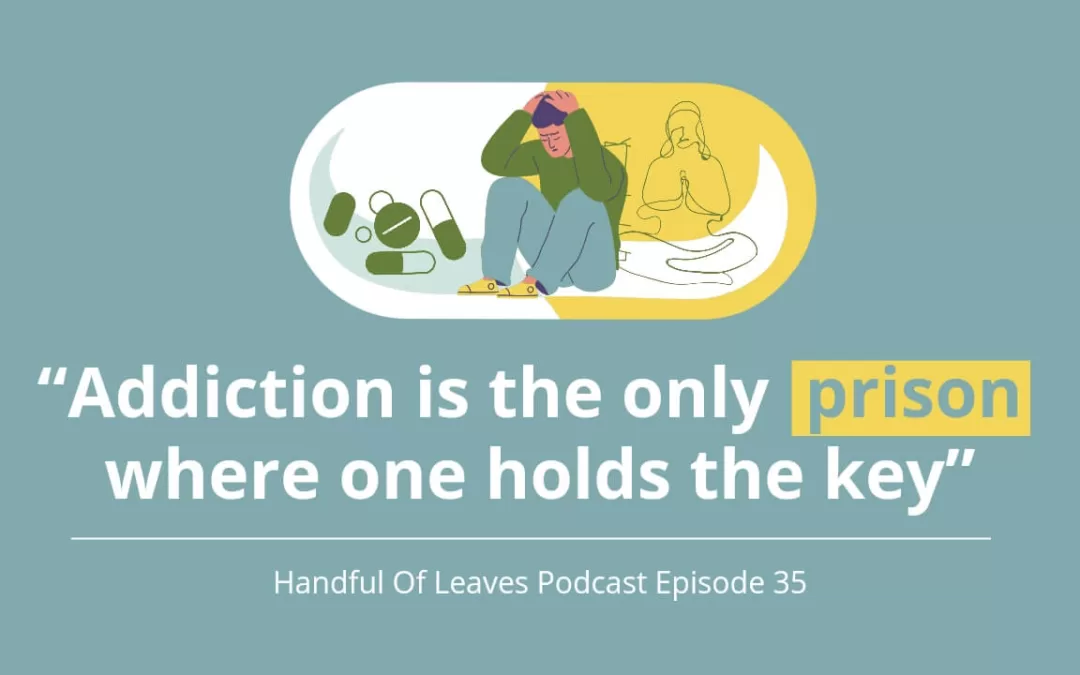
I came across this quote that actually motivates me. Addiction is the only prison in the world where one holds the key. For someone who is in deep addiction, who wants to get out they might feel a bit helpless, it’s like, what do you mean I hold the key? It’s very difficult for me right now. Yeah. So actually I would encourage people to just get professional help if they really need it. It’s okay, it takes courage to admit that you have a problem. Get help if you really need it.
[00:18:56] Cheryl:
And I find it very interesting because, in your own journey of recovery, you actually didn’t seek professional help, right? You were kind of DIY, do it yourself. So it’s interesting that you gave the advice that it’s okay to look for help. Why do you give this advice?
[00:19:13] Alvin:
Although I didn’t get professional help, I did talk to Ajahn. It took me quite a while to get out of that remorse state. We can expect everybody to use the Dhamma to help them. Some people might need professional help. So there’s no one-size-fits-all method for everybody.
[00:19:29] Cheryl:
You have to find what is suitable for you at that point in time. And at different times, you will require different things as well. Yes. You were saying it took you quite a while to get out of that remorse state. But eventually, in retrospect, what you realize is that… There’s no point in clinging to the past and the present and the future is more important. Okay. What was the turning point, which gave you that aha moment?
[00:19:58] Alvin:
I heard this teaching from Luang Por. Every time we recollect something virtuous,it’s like we are doing that virtuous action again. Similarly, if we keep thinking about the negative things we do, we are actually indirectly doing that negative action again. So I have to tell myself whatever is done is done, just move on. If I really want to benefit myself and all sentient beings, I have to move on.
[00:20:21] Cheryl:
That is very powerful. I really love that. Thanks for sharing. Amazing. Is there any last thing that you want to share from your experience with struggling with drug addiction?
[00:20:32] Alvin:
There’s this method which I find quite helpful. Perhaps you can use something of higher value to overcome the addiction. So something that fits your principles and your personal values. In the past, I’ve always wanted to be a fitness instructor. So actually I also make use of fitness, like going to the gym, taking out new sports to overcome the addiction, and using that drive to help me get out of the addiction and also to pursue my dreams.
[00:20:59] Cheryl:
What if someone doesn’t have any other value and the value is just seeking happiness? Drugs give me the highest happiness, they can say.
[00:21:07] Alvin:
It’s still a form of wanting to seek happiness. To me, it’s still a value. You could actually replace that addiction with something positive. Get a friend to help you to try something different, learn a new hobby, et cetera. Then you can compare and contrast. To see that actually, there’s something that could be even a higher form of happiness compared to the substance I’m attached to. Just try to take the first step.
[00:21:31] Cheryl:
Yes. The first step might sound extremely scary, and difficult. But always know that there are alternatives to the drugs that you’re taking which harm your body in very severe ways and there are other ways to obtain happiness that actually continues to contribute to your long-term happiness as well. That could be a better option as well. And I’m actually very curious. You say that you have already cut off the friends who did drugs with you, I guess the dealer as well. Have you forgiven them?
[00:22:04] Alvin:
To be frank, for a period of time, I was blaming them. But I realized that actually I also have a part to play. So just see everything as due to causes and conditions. So just move on. Cause if you keep dwelling, having anger towards them, then you’re actually still trapping yourself in the past.Just have compassion for them as well, because they don’t have the Right View. They don’t have the merits to encounter the Buddha’s teaching. That’s why they are actually doing something that they think is right, but actually it’s wrong. In the future, they have to bear the consequences of their actions as well. So they deserve compassion and empathy more than anger.
[00:22:43] Cheryl:
That’s very wise words as well, because at the end of the day, no matter how people manifest in their actions, no matter how evil, how selfish, or how unpleasant it is, everyone is really just seeking happiness in the ways that they know how. It’s unfortunate that people sometimes seek this happiness through ways that cause them more harm because Kamma is the action and intention and the results of this action and intention will always be by your side. You will always be related to this Kamma. You always be associated with this Kamma. You always be with this Kamma. Whether it’s good or bad, you have to bear its results. So in a way, you’re right, they deserve compassion a lot more than they deserve anger. It’s very, very wise of you and very compassionate of you to be able to notice that, and I rejoice with your wisdom.
We’ve come to the end of this episode. Thank you so much for sharing on a topic that not many have experienced, but yet also relating to. I guess that’s the humanness of all of us, the suffering that all of us share together in wanting to be happy, and trying to find the best ways to be happy as well.
To our listeners, I hope you’ve learned a thing or two and you’re able to apply some of these gems of wisdom and compassion in your own lives. If you enjoyed this episode, please give us a five-star rating on Spotify and share this with your friends. Until the next episode, stay happy and wise.
Resources:
Special thanks to our sponsors:
Buddhist Youth Network, Lim Soon Kiat, Alvin Chan, Tan Key Seng, Soh Hwee Hoon, Geraldine Tay, Venerable You Guang, Wilson Ng, Diga, Joyce, Tan Jia Yee, Joanne, Suñña, Shuo Mei, Arif, Bernice, Wee Teck, Andrew Yam, Kan Rong Hui, Wei Li Quek, Shirley Shen, Ezra, Joanne Chan, Hsien Li Siaw, Gillian Ang, Wang Shiow Mei.
Editor and transcriber of this episode: Cheryl Cheah, Susara Ng, Ke Hui Tee
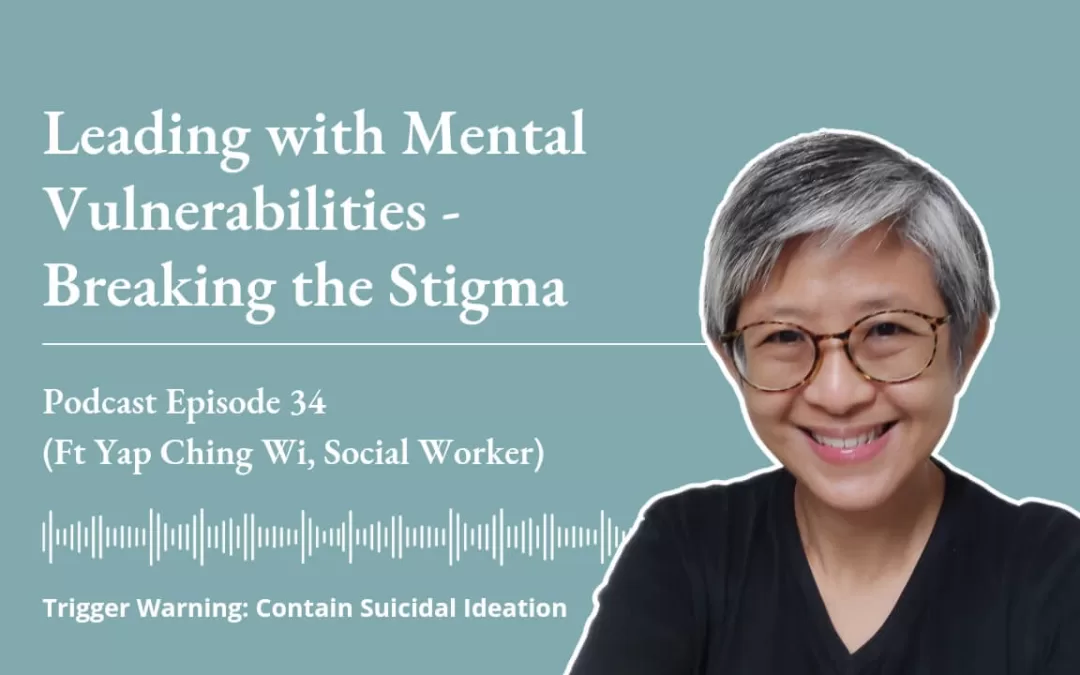
Welcome to the Handful of Leaves podcasts. Today’s episode is very interesting because we will be talking about Buddhist leaders and mental illness. The aim of this podcast today is to shed light on the challenges and lived experiences of our friends with mental illness, especially on the unique challenges faced as leaders in the Buddhist scene.
Today we have a guest who will bring in a very unique perspective to this topic as she has personally navigated mental illness while also holding leadership roles. So let’s welcome Sister Ching Wi.
[00:00:35] Sis Ching Wi:
Hi everyone. Hi Cheryl. Thanks for having me.
[00:00:38] Cheryl:
Hi. Sister Ching Wi is a social worker with Aranya Sangha Dana Fellowship, a nonprofit that helps Buddhist monks and nuns, especially those living in the community. She’s also a facilitator who designed the Life Story Workshop for seniors and graduated from the London School of Economics and the National University of Singapore.
Can you share more about your personal journey with mental illness and how it has intersected with your leadership or volunteering roles?
[00:01:07] Sis Ching Wi:
Hi, Cheryl. I’ve been a social worker and because I benefited a lot from practicing the Dhamma, so I also try and serve the Buddhist community in any way that I can. This is actually the 10th year of my depression. It’s a very, very long journey. It started with me taking a break from work, I was just doing nothing. I happily thought that I was just going on a holiday, but then I didn’t realize that not doing anything made me have a lot of time to ruminate. Then I found myself starting to worry. You’re so used to working every month and seeing the paycheck in your bank account. So, these worries become bigger and bigger worries.
And then lo and behold, I was just spending my days on the sofa watching TV. It got so bad that even when I had to go to the toilet, I just couldn’t get out of the sofa at all. I just felt like it was so difficult to move my body. Sometimes people say, your body feels as heavy as a mountain, it really felt like that. I really had to force myself. So every day it’s very tiring mentally because it’s not like I’m just sitting there stoning away. My mind was super hyperactive. I couldn’t take care of myself. And I really had to force myself. But I still tell myself, okay, maybe being a social worker, this is just burnout. You just need to rest more.
So it went on for a few weeks and then one day I was just standing at my window.Suddenly I just caught myself thinking,most of us live in HDB Flats, when I looked down, suddenly the thought came, “Oh, actually it’s very easy to just drop down.”Then the next thought was, so how do you do that?Well, I guess I can push myself off my ledge and then I lose balance and I fall, or I can maybe just find a stool or a chair and step on it.Finding a chair will be easier. My chair is in the kitchen, so I turned and I walked towards the kitchen.
[00:02:54] Cheryl:
It was quite a serious thought in the sense that there was the intention of executing it as well.
[00:03:00] Sis Ching Wi:
There was even a plan. So after a few steps of walking into the kitchen, I realized that it was a suicidal thought. So that’s when I figured, okay, I can’t do this on my own. I went to see a psychiatrist and a counselor at the same time. And I started my healing journey from then on. But it wasn’t smooth at all because of my personality of being a perfectionist and a workaholic and all that, I would ask a psychiatrist, okay, so how long will I take this medication before I’m up again? Should we give it three months?
[00:03:30] Cheryl:
It almost seems naive like you’re thinking three months, but actually now in retrospect, it takes 10 years.
[00:03:36] Sis Ching Wi:
Exactly right. A good way of understanding depression, I like the model of BPSS, which is biological, physical, and psychosocial. I like this model because the focus is not just on taking medication and getting better, but I also have to look into the psychological aspects and social aspects. This helped me a lot. I had to figure out how to manage stress.
This is where mindfulness comes in and as a Buddhist already meditating, not a lot, but enough to help myself a little bit. It really made me see how I have some unhealthy thought patterns being a perfectionist. It came from wanting to do the best that I can. It’s fine to do the best that you can, but you’re not a machine. Where did doing the best that I can come from? So it gave me a chance to really investigate. It came from a sense of being responsible. Again, being responsible is a very good virtue, but to balance it, to be healthy, you must know how to draw boundaries.
You must have the wisdom of knowing at what stage I have fulfilled my responsibility, when I should let go and not blindly be responsible 100% all the way. In these 10 years, I had a chance to really look at my thought patterns, my mental habits, trial and error and figure out. It’s like moving into OS 2.0 from OS 1.0 that totally failed. And along the way it’s 1.2, 1.3. So it’s not just about curing my chemical imbalance in my head, about managing my emotions, taking good care of myself in terms of health, but also really examining, throwing away what doesn’t work for me in terms of my thought patterns and adopting and practicing good mental habits.
[00:05:35] Cheryl:
Almost like the mental hygiene, cleaning up the unhealthy ones, learning and relearning. Like you mentioned, you don’t get it right the first time. It’s like 1.1, version 1.2.
[00:05:44] Sis Ching Wi:
In a fun way I tell myself, okay, so now this is a game of how many times do you want to continue to run into the wall? Because I would have high expectations of myself to get better. Okay, the medication is working. So now, I’m eating better. Maybe in two months’ time, I can take on more work. Actually, I have experienced, whether I wanted it or not, different ways of letting go. And I think this is so precious as a Buddhist. It’s very easy to say, I want to let go of my troubles.
[00:06:15] Cheryl:
But how do you do it exactly. Yeah. So let’s delve into that a little bit deeper, it’s almost as though there are a lot of conflicting parts of your personality, because there is the part of perfectionism wanting to get everything right. But on the other hand, when you are facing a depressive episode, you will be on the side where you can’t even move yourself to do the most basic things like going to the toilet. When you’re a leader, all of these tendencies would come into play. So, how has it intersected for you personally, between having this mental illness with your leadership?
[00:06:49] Sis Ching Wi:
There are a few layers. It’s my inner work, and then of course, working with the team or the project. I remember right at the beginning I would get overwhelmed to the extent of not showing up. And this is so out of character, right? I try so hard. I just couldn’t. It’s a combination of dread, being very scared, being very weak. Basically, I just couldn’t get out of the house. And then I will look at the time, the meeting has started and I’ll be missing it. And then after that, I’ll feel so bad. The guilt, the shame and I eventually retreated to just not showing up at all, not answering phone calls. As long as my handphone has battery and there’s a blinking light, when I see the blinking light, I will break into cold sweat. So I just want the battery to be off. I was just like isolating myself.
But then I still continue to feel bad actively, because I know, tomorrow there’s this thing, and three days’ time there’s this thing and all that. But of course, friends and fellow workers, everyone was very understanding and people got really, really worried. And then I know people will get worried and that set me off into another spiral. Of course, in the midst of all these, friends couldn’t get hold of me. They started contacting my husband, my sisters and close friends. Then, people knew that I had depression.
[00:08:03] Cheryl:
So at that point, it was not public information yet.
[00:08:05] Sis Ching Wi:
Yeah, it wasn’t. Then people started passing messages back, to send me loving kindness, tell me not to worry. It made me more relieved. So I told the psychiatrist, you know what I discovered? When I went off the radar, the world did not collapse.
[00:08:20] Cheryl:
Wow.
[00:08:21] Sis Ching Wi:
And after I said that, I felt so relieved. I felt so relieved. So it’s not that I’m so egotistical, like the world revolves around me. But I was feeling so bad and I think I must have been beating myself up for so long, for not being able to perform all my duties.
So this term of being a leader, well, I guess you take on more responsibility. Part of the responsibility, at least for me, I always try to be hands-on. So then there’s this added responsibility of letting more people down. That was horrendous. Yeah.
[00:08:52] Cheryl:
Yeah. I think a lot of times leaders, especially in the Buddhist scene as well, people define leadership as basically being the person that is doing everything, doing the most. That can sometimes be a very heavy burden to lift, especially if you are already going through a very difficult moment in your life. But what you just shared is very powerful in the sense that sometimes leadership can be viewed as a shared responsibility amongst the communities, not just on your own shoulders. You are there, but also there are people supporting you there.
[00:09:30] Sis Ching Wi:
Definitely. In fact, I was already very blessed. One of my biggest takeaways was, thank goodness I didn’t have to do a lot of hands-on. So it wasn’t like I was the one who had the key to the Dhamma center, and then because I wasn’t there that night, people couldn’t attend the Dhamma talk. So it’s more at the planning level and all that. If we communicated enough and if we do proper planning, so what if somebody is down? The team just goes on and work gets done.
It really brought in the point that no one is indispensable. The leader must immediately think about leadership succession. It’s like day one of anything that you do,this notion of letting go is extremely important. It’s not just letting go of the duties. It’s not about being irresponsible, but it’s about can we find someone to shadow you? Can we work as a pair? Can we work as a team? And then somebody else can learn, the newer ones can learn, and the senior ones, can work themselves out of a job and go to the mountain and meditate.
[00:10:36] Cheryl:
So I’m curious, how do you juggle between a sense of responsibility versus a sense of shared community?
[00:10:44] Sis Ching Wi:
I think it’s mostly in our mental attitude. The responsibility and the job scope, you have to fulfill. But how can I try to be mindful of my attachment to the task at hand? If I’ve done it, I’ve done it. I don’t need to go back and be a perfectionist and ruminate. Can I let that go? Okay, I can. It’s an exercise in letting go. If this organization that I volunteer in or this project that I do, if we cannot achieve the objectives, then how? So, I’ve developed this habit of anticipating impermanence. There will be changes. And just being very clear to myself, okay what can I accept? Is there anything else that I can do?And that’s it.
I’ve gone through a rehearsal in my mind of the possible disasters. And when things happen I’m not caught off guard. In these rehearsals, it’s a chance for me to contemplate, how much do I personally, selfishly want this or am I seeing it too narrowly?
[00:11:39] Cheryl:
Yeah, that’s very wonderful. Thanks for sharing your reflections on this. What I take away is if someone is a leader who is struggling with mental illness, first is having that kind of self-awareness that this is my bandwidth, this is my capacity. And contrary to our ideas of taking on the whole world, on your shoulders, you can also understand that these are your boundaries. These are what you’re capable of and plan for how you can share these responsibilities. How can you give other people maybe an earlier heads up as well, so then you don’t have to feel so burdened by everything.
Then the second piece is that, where you’re possibly responsible for the task at hand, do your best and try to let go of whatever outcomes if you have already done your best and be at peace with whether the thing turns out good or bad knowing that you have already given it your all.
[00:12:33] Sis Ching Wi:
Thank you for the summary. I think a very important point comes to mind and that is the sense of ownership. I am not saying that I’m doing it fantastically well, but I know that it’s always important and I always try to do it right. If the sense of ownership is truly felt by most of us in the team, then it’s an organic thing. If the leader is out of action, everyone still has a shared vision, everyone still knows where we are going. So it becomes co-creation. It means that everyone brings in what is it that they want rather than it’s just a vision or goal by one or two people. Along the way, more or less we will achieve our outcome, especially being Singaporeans.
But the process is so important, whether we learn and we grow, whether we help each other to be more mindful, whether we are supportive of each other’s emotions. When you have disagreements and when people get hurt, do we as a team want to talk about it? It’s a way of supporting each other. The process is so important, especially if we are looking at voluntary projects, even if you’re paid nothing. I think a lot of times the stress comes from people misunderstanding us, miscommunication, not being able to share our passion, and not being able to contribute. So all this is about just the process of how can we help each other to achieve our own individual objectives as well as our collective team objectives.
[00:14:06] Cheryl:
And I think when individual contributors on the team are empowered, then that’s where we see more proactivity as well. That’s how the team grows in a more positive direction as well. With all the challenges you mentioned just now, how has that shaped your perspective on leadership? Do you find that it influenced the way you approach any positions that you hold?
[00:14:31] Sis Ching Wi:
Oh, definitely. The biggest lesson is in empathizing and respecting people I work with. Most people wouldn’t tell you they have had a hard day. They’re dealing with whatever that is happening in their lives. Most people are just responsible and they just wanna give their best.
So if we are not sensitive enough to catch people, these are the small little things, but extremely important things that we can do right by just checking in on people, making it a point to really get to know the people I work with. If there’s a change in their behavior or their energy, I can sense it. And developing a real relationship, just being authentic about it. We allow each other to offer support and even to take care of each other. That’s a huge thing that I’ve learned.
[00:15:20] Cheryl:
It seems that it empowered you to really be more compassionate to the people around you, especially in terms of building that personal, genuine relationship, seeing them as humans rather than just a person to get something done.
I’m also reflecting on the four Brahmavihārās that the Buddha taught us. One is loving kindness where you spread unconditional loving kindness to the people around us whom we are working with. Secondly, it is to have that sense of compassion to want to reduce their suffering.
I think these two things, in particular, are quite neglected sometimes when we are in the rush of getting projects done perfectly, or by a certain deadline. Sometimes we can forget these two pieces. It’s so important to always anchor ourselves that the person in front of us here is a human being, and we should wish for their happiness and to reduce their suffering as well.
[00:16:16] Sis Ching Wi:
Yeah. One point that I really wanna share is that the very basics of practicing Buddhism is to avoid wrongdoings, do good and purify our mind. So this notion of doing good, I used to not be able to understand. In Chinese Mahayana there is this 普贤菩萨十大行原品. It’s Samantabhadra Bodhisattva’s Ten Great Action Vows. One of it is 恒顺众生. It literally means to serve and to support all sentient beings, to help them as much as possible.
So then now that I think about doing good, in the course of us having the responsibility to get the job done, we have limited time. Sometimes we feel that it’s not so important to ask how everyone is feeling. Or if somebody doesn’t know how to be the administrator of Zoom, instead of taking the time to teach, you find somebody else who can.
But then if we were to look into doing good, if I take a bit of time to teach this person, then this person would learn something. This is such an important skill and this person can do a lot more, not just for the project or for the organization, but for his or her life. So it is about enabling and empowering people. So I’ll get smart next time. When I am planning the next project, let’s plan in time. Let’s plan this in as a task, so that we have the bandwidth. A project is a project, but you can build in small little tasks and goals along the way that we all can practice, we all can help each other to grow.
[00:17:56] Cheryl:
I really love that.
[00:17:58] Sis Ching Wi:
Yes, do good.
[00:17:59] Cheryl:
Yes. And it’s almost like if you set your mind on doing good, you’re intent on it, you would be able to find ways. You’re so smart in incorporating that into the project plan, empower this person, teach this person, put that as part of the to-do list. It’s so beautiful because then you are also helping another person. We help to nurture them to their highest potential and that creates a whole ripple of positive effects onto the community. Thanks for sharing.
[00:18:27] Sis Ching Wi:
Welcome, Cheryl. I really invite everyone to just try one small little initiative like that and when the project is done, everyone’s heart is closer to each other because I’m also rejoicing and celebrating your success. Not just in the final step of that project. Along the way the logistics person has to do this, the marketing person has to do that, but then I know I was journeying with you a lot more. So all the interconnection and all the rejoicing, it’s so beautiful. So please try it. Everyone just try it.
[00:18:58] Cheryl:
Yes. Let’s try doing that. For all the leaders who are listening here, try to intentionally put in an action step that you could do to help enable another person to learn to grow or to be nurtured. You mentioned rejoice as well, and I thought is so appropriate that rejoicing is the third Brahmavihārā . I shared the first two just now. The first being loving kindness. The second being compassion to reduce people’s suffering. And the third one is to rejoice to feel appreciation for other people’s success, joy and growth. The fourth one is the idea of equanimity. If everything fails, we practice that sense of equanimity, to see things as it is, that it is what it is. That’s the Four Brahmavihārās as well.
[00:19:41] Sis Ching Wi:
You frame my sharing in such a way that I think it comes across as so smart.
[00:19:45] Cheryl:
What you share is very valuable.
[00:19:48] Sis Ching Wi:
I think a lot of times equanimity, we related to letting go. The way that I eventually come to experience it is dynamic. It is not dead silence. It’s a dynamic process, there is also a timeline involved. There’s a duration involved. So equanimity as a state of mind, I can be mini equanimous and I can be super zen-out equanimous.
[00:20:14] Cheryl:
It is like a spectrum.
[00:20:15] Sis Ching Wi:
It is a spectrum. Earlier on I was talking to my husband and I said, I have to practice mindfulness to literally save my life because I need to catch all these illogical suicidal thoughts when they come up. It is quite similar to Cognitive Behavioral Therapy. When your eyes see something, it goes into your brain. It will be linked to a certain thought or a certain memory. Then, you will create a story in your head. And when the story is created, it seems so real. Sometimes certain feelings will come up and you may even want to do something about it.
Let’s say someone may see my very short hairstyle, which is my lack of mindfulness in communicating with the hairdresser. Somebody may think, I also want to have that hairstyle, maybe next time I can go and get that hairstyle. So from seeing me, you develop thinking,
[00:21:03] Cheryl:
…proliferations.
[00:21:04] Sis Ching Wi:
Yes. It may even lead to emotions and actions, I like this, or I don’t like this, and I wanna do something about it. So back to mindfulness and being equanimous. I realized that I have to be mindful and I have to manage myself in such a way that I don’t become too crazy high and I don’t become too depressingly low. For me, this is kind of like being equanimous. I just have to stay within a range of emotions. And in order to do that, I have to constantly be mindful. Then I realized that actually, this is a very good skill to have as I go about life, when I’m stressed, when I am in a hurry. I found my zone, I have to just keep on practicing to be in that zone. As a result, I’m more grounded, my mind is clearer. Whatever work I do, I can just be more attuned. I have more space to observe people, to be more considerate of how they are doing, to pick up if they are feeling low, things like that. This is my own interpretation and working model of equanimity. This is how I apply and I understand the Four Brahmavihārās.
[00:22:13] Cheryl:
Can you share what are some practical trainings or reflections that you do to help keep you within that healthy boundary?
[00:22:23] Sis Ching Wi:
Being a workaholic and a perfectionist, I had to try very hard to convince myself that I have to take it easy. After convincing myself to take it easy, I have to put it into an action plan.
[00:22:34] Cheryl:
The take-it-easy action plan.
[00:22:38] Sis Ching Wi:
Oxymoron. So how many percent of your action plan have you completed in taking it easy? Yeah. I’ve learned to just tell myself it’s okay that I don’t get it right all the time. Finally, I think what worked was to have a sense of fun and adventure. Let’s treat it as a game. If I can catch a negative thought, yay! What do I reward myself with? So there are a lot of constant opportunities to reframe and to practice self-compassion. When I decided to see this as a fun thing, I finally took off. I finally started to really incorporate a lot in my life. Yeah.
[00:23:16] Cheryl:
So in the Take it Easy action plan, there are some guidelines if anyone wants to build up their own action plan. Reframe. So if your habitual tendency is to get angry, allow yourself to think of alternative ways about this. What can I do other than get angry? What are some other things that I can put in instead?
Second is to make it fun. Try to catch yourself. Try to notice how many times you have a negative thought or how many times you go into unhealthy coping behaviors. And third is to practice self-compassion. Occasionally indulge in a healthy amount of potato chips or whatever else, not indulge until you get a stomachache. But get some form of harmless fun to your life.
[00:23:56] Sis Ching Wi:
Along the way, I think small little victories, I celebrate. Neuroscience theories will tell you, if you celebrate, you’re developing your neural pathway, you are growing it. So if I pay attention to good things, then the good neural pathways will grow. If I pay attention to bad things, then I’m just sabotaging myself. So then celebrating becomes very important to seal it in. I went on this whole spiel about, look, you’re a responsible person. You are Buddhist, so you don’t celebrate in an indulgent way. Don’t be so frivolous and all that. Hey, wait a minute. Oh yeah, hey, I caught it! In this ongoing process, I’ve also gotten to know myself a lot better.
I’ve also gotten to see my ego. We all have this vanity, of wanting to present the best of ourselves. After I try this and that, and bang my head against the wall, there comes a point where I go like, oh, I forget it. This is just too tiring. I just let go. So I keep letting go, I don’t care how people think of me anymore. This is a healthy kind of adjustment. The whole idea is you become more and more relaxed. You wanna take it easy. Eventually, I got somewhere after years, and When I saw people behaving in a certain way that I used to behave, that empathy and compassion came out. But then I quickly remind myself, Hey, remember you’re a social worker, it means that there’s a tendency for you to not respect your own boundary and go and help save the whole world. Right? Anyway, these thoughts we’ll always have in our heads, but we don’t have to entertain them. But then I’m able to see people struggling, and it just makes it so much easier to connect. The empathy of just wishing somebody well, just smiling at that person.
I will admit that it’s really not easy, just bravely seeing yourself for who you are, but it results in a lot of beautiful things in my life now for myself and for people around me. So it’s totally worth it. I’m sure even for friends listening who are not diagnosed with depression. All of us have got bad days and all that. But just keep on working on ourselves. It will come to a stage where we become better and when we are better, we become more attuned to people around us and we can start to help people around us. Then it just becomes a cycle that goes on and on. Yeah.
[00:26:03] Cheryl:
And like Thich Nhat Hanh always says, the more we are in touch with our own suffering, then the more we can be in touch with other people’s suffering. That’s where true compassion can spring up. Because we understand it for ourselves, we truly know how unpleasant it is. When we touch the core of it, then we are also able to see it in everyone. And in that sense, we see, despite our colors, our perspectives, our views, underlying all of these things, we are one and the same in terms of our quest for happiness, our quest to be free from suffering in our own ways.
[00:26:41] Sis Ching Wi:
So beautifully said.
[00:26:45] Cheryl:
And Sis Ching Wi, I really want to thank you for coming on this show. It’s very brave of you because there are a lot of people out there suffering from diagnosed mental illness or even mental illness to a lesser degree, but still struggling. And I think that by you coming up here today to speak, you’re also speaking for all of them and of course everyone else who’s keen to understand a little bit more. Would there be one message or word of encouragement that you would like to share with the people who may be listening and struggling silently?
[00:27:18] Sis Ching Wi:
For all of us who are struggling, just keep trying. Even if it’s just about managing to get a glass of water for yourself. It’s not about always having progress all the time or to achieve big milestones. As long as we don’t give up, we are trying, as long as we are breathing, we are trying. So as long as I just tell myself I will keep trying, that’s it. That’s my project.
I would like to invite everyone out there, be it you are a leader or team member, to see if we can hold space for each other. Very simply put, if you can see that somebody is struggling, then there are some little acts of kindness that we can do. Holding space also means, if we see some toxic behavior, then we should call it out. If a leader is too demanding, then can we communicate more with each other so that at the end of the day, we don’t end up creating more harm to each other as an operating principle. And I’m sure there’s a lot of different context and all that. So calling out toxic behavior may be the more intense kind of action. But if we see it as a spectrum, if we see unkindness, are there ways that we can try again and do it in a different way?
If we can all try and put this at the back of our mind, to always hold space for each other and to always make sure that we take care of each other, just as how you want to take care of yourself, this will have a very good outcome for ourselves and for people around us.
[00:28:55] Cheryl:
And like the Buddha said in the Karaniyametta Sutta, like a mother loving their only child, that’s how you should cherish other people as well and view them as precious or treat them with that form of kindness and gentleness. Thank you so much, Sister Ching Wi.
And for all of our listeners here, I hope you enjoyed listening to our conversation. If you like this podcast, please like, give us five stars and stay happy and wise. See you in the next episode. Thank you.
Resources:
Special thanks to our sponsors:
Buddhist Youth Network, Lim Soon Kiat, Alvin Chan, Tan Key Seng, Soh Hwee Hoon, Geraldine Tay, Venerable You Guang, Wilson Ng, Diga, Joyce, Tan Jia Yee, Joanne, Suñña, Shuo Mei, Arif, Bernice, Wee Teck, Andrew Yam, Kan Rong Hui, Wei Li Quek, Shirley Shen, Ezra, Joanne Chan, Hsien Li Siaw, Gillian Ang, Wang Shiow Mei.
Editor and transcriber of this episode: Cheryl Cheah, Susara Ng, Ke Hui Tee
We’re experimenting with a visual format for podcast. As we’re still bootstrapping, we’ve not upgraded to a studio yet. Let us know what you think about this new format. Join the conversation via Telegram.
About Our Guest
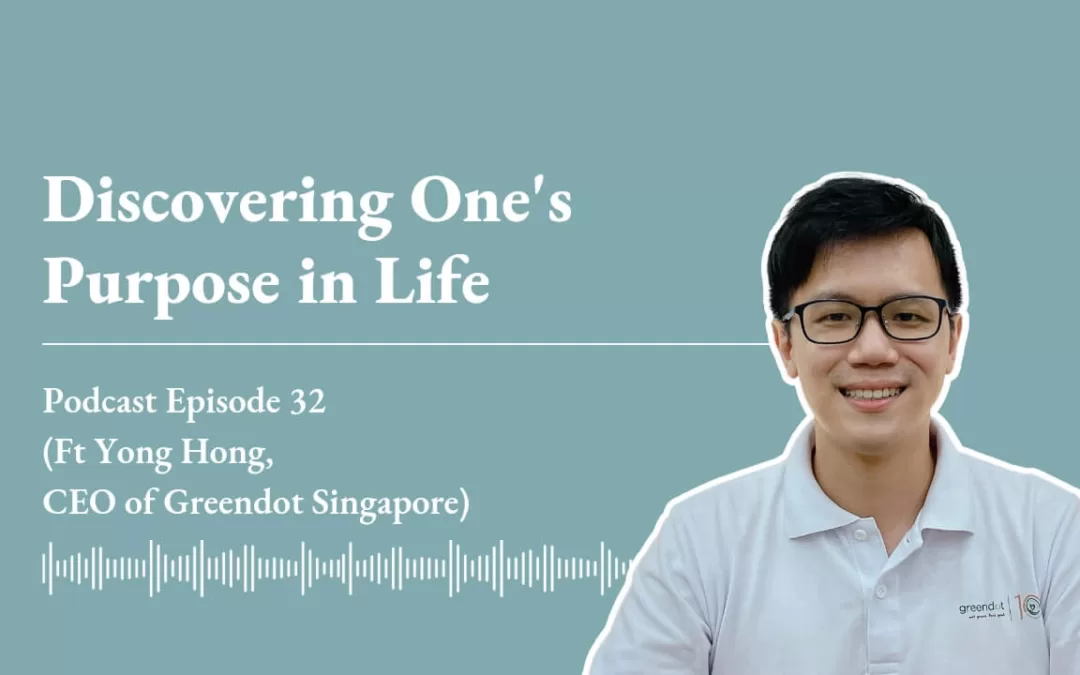
Yong Hong is an ordinary young entrepreneur, he started Greendot at the age of 22 with his good friend Justin. Green Dot was started with the thought to help professional women to stay healthy and love themselves. With this as motivation, it has grown from a small vegetarian stall to a vegan food restaurant chain in Singapore.
As a young CEO at age 33, Yong Hong currently manages a team of 200 staff. He is responsible for Green Dot 15 stores, including 12 Green Dot outlets Lotus Heart Vegetarian Chinese Restaurant, Greendot Patisserie, and a central kitchen. To him, work is a journey to cultivate himself and an opportunity to find insights within. Yong Hong has a great passion for yoga and music. He hopes to learn n grow with the people he meets.
Transcript
[00:00:00] Cheryl:
Welcome to the Handful of Leaves podcasts. Hi, Yong Hong.
[00:00:03] Yong Hong:
Hello!
[00:00:03] Cheryl:
Welcome. So today we have an interview with the CEO of Singapore’s largest meat-free chain, Green Dot, and I’m very happy to speak to him today because I would love to know about his reflections on his entrepreneurship journey, his reflections on his growth in Buddhism. And recently Yong Hong became a father of a beautiful four-month-old baby girl. So we will also be speaking to learn about his insights and what parenthood has taught him. So, Yong Hong, to get things started, for those who do not know you or who have not heard of Green Dot before, can you share more about your entrepreneurial journey with Green Dot?
[00:00:45] Yong Hong:
Sure. Thank you so much, Cheryl, for this opportunity to be here and to share my experiences with the audience. So I started Green Dot about 12 years ago when I was at NUS, National University of Singapore, during Year Two of my studies. I was studying Business back then. It was one of the toughest periods of my life. I remember I have to pack my modules into two days and for the rest of the days, I have to work at the outlet.
So, how Green Dot started was because I didn’t think so much. If I think so much about how tough entrepreneurship is, then probably I wouldn’t have started Green Dot, especially in food and beverage. So, I started Green Dot because my business partner Justin, he’s a vegetarian since he was a baby. Back then I was in Chung Cheng High School. I knew him since Secondary One. And back then it was not easy being a vegetarian in school because you have no vegetarian store.
So he has to bring his own food, or he has to ask the aunties, and uncles in the canteen store to cook special meals for him. He felt that being a vegetarian is a lifestyle choice or a personal choice. Why do we have to have so much inconvenience? He thought that having a vegetarian store and having quality food in school maybe will help to make the younger generations who are vegetarians like us feel proud of being a vegetarian because there’s an option. So that was how it started. We didn’t think so much and then we started our first store at Temasek Poly.
[00:02:20] Cheryl:
What about Justin that makes you want to go into a partnership with him?
[00:02:24] Yong Hong:
They call it fate. We got along well. I think it’s a very interesting thing. I’m the CEO of Green Dot, one of the largest chains of vegetarian restaurants in Singapore, but I wasn’t born a vegetarian. So when I was younger, I’m a meat lover. No meat, no happiness. When I eat a McDonald’s burger, I must remove the…
[00:02:43] Cheryl:
Take away the vegetables.
[00:02:46] Yong Hong:
So I don’t like vegetables at all. Even till I founded Green Dot.
[00:02:50] Cheryl:
Yeah. It’s like me. I hate vegetables last time and I’m actually a vegetarian now.
[00:02:54] Yong Hong:
That’s why I think sometimes it’s just fate that you walk this path. Like Steve Jobs always say, you only can connect the dots when you look back. I just have a voice within asking me to try.
[00:03:06] Cheryl:
That’s very courageous, and also I would say a bit impulsive, not thinking too much, and just jumping into trying this thing out, which then eventually turned into something bigger than you ever imagined 12 years later.
[00:03:19] Yong Hong:
Of course, I always wanted Green Dot to do well. Because to me, Green Dot is not just a vegetarian chain because you look at your grandparents, your uncle, and your aunties around you, and as they age you’ll see that the diet actually changes. Less meat and more balanced meals, more vegetables. So I feel that this change of diet will come but you want it to come later in your life or earlier in your life. I have friends around me who are in their late thirties but they have gout because of seafood, beer, and alcohol. Their diet is impacting their lives.
Because of Green Dot, I was exposed to a plant-based diet. I realized that, hey, actually, brown rice can be very nice, vege can be very nice. This journey of Green Dot also changed my diet and impacted me to change earlier in my life. I hope that Green Dot can not only be a place where we serve quality plant-based meals but also be a channel where we can help more people start their more balanced meal diet earlier in their life. It’s not to fully convert you first, but at least 21 meals a week. Maybe you can try 3 meals a week. Change can start earlier.
[00:04:29] Cheryl:
It’s so beautiful how an entrepreneurship that was just part of your hustle became something that actually changed your perception about diet, lifestyle, about keeping healthy. I’m curious if there were any other changes that you experienced when working and growing with Green Dot, for example, in spirituality.
[00:04:51] Yong Hong:
Yeah. Actually, it’s been 12 years. There are a lot of things that I’ve been through, all the highs and lows. Looking back, I feel that this journey has really changed me. I’ve been through three stages of Green Dot. It wasn’t all happy and smooth sailing. It was really very tough. During my first few years of Green Dot, every day I wake up, I go and cook at the store, I feel like giving up. Every night I tell myself, I think this is the last day. I tell Justin, I think you’ll continue. So the first three to four years of my initial startup phase, I treated Green Dot as work. I find no meaning in it because I have no F&B experience before this. I don’t like F&B. I never stepped in the kitchen before. So even before I start going, I don’t know how to cut broccoli or cook rice. I remember on the first day the uncle say, Yong Hong, go and cook some rice. I said, how to cook the rice, how to measure the water, put in the water? So overall, the first three to four years, it was work for me.
[00:05:49] Cheryl:
Even the way you describe it sounds like a chore already.
[00:05:52] Yong Hong:
I hated to go, but because I chose this path, so ego kept me going. But for the second phase, after I started Green, it grew to a few outlets. Then NUS also gave me a fund because they also acknowledged me as a young entrepreneur. Finally, some acknowledgement. From then on, it became a career for me because I was being packaged as a young entrepreneur from NUS. I was driven by results. I wanted to grow Green Dot and do well, and to show that I’m a successful young entrepreneur.
So I was driven by that. That’s where I also faced a lot of problems. Although my business grew to many outlets, but it wasn’t making money. There were a lot of people problems because I’m raw in management. Then I wasn’t happy. I broke up with my other half. My health was in bad shape because I was working every day. I wasn’t happy. My life’s all about work and I wasn’t earning a lot of money because it’s in a growth period. So the only thing driving me is because I’m a young entrepreneur. I was in my career stage where I just work every day. So I achieved some success on the surface, but I wasn’t happy.
It was about five years ago that I had to find answers to change this. One morning, I was YouTubing, and I saw Venerable Jing Kong’s (淨空法師). At that moment, I felt that there was actually another way of looking at life. That was when I start to have more balance in my life. I got a personal trainer. I start to go for music. Then I realized that although I don’t work as long, I have a bit of balance, but my business got better. At that moment I start to really go deeper into understanding what is vegetarianism about. And that’s where it became a mission for me. And that’s where Green Dot started to get better and better. Three phases, from work to a career to seeing as a mission.
People say there’s an aha moment, but sometimes it’s an accumulation of a few things. Change isn’t one moment. People sometimes oversimplify change. Change is like 1%, 1% every day. Not everybody can, *snap* then this moment. So I think it’s being oversimplified. I always tell people learning is not always about learning new things. Actually, the biggest and most important learning is learning about the toxic in yourself. Life is about removing all the toxic in you. Like for example, when we are babies, we are very pure. As we grow up, we start to have disappointment, frustration, anger, and jealousy. So all these are within us. So as we grow up, and we start to understand this, our journey starts to take out all this toxic one by one. Jealousy maybe, it’s at level 10. But today you can take out one level, so left nine. So you keep taking them out. So I feel that change is not that moment, but it’s just that, oh, we realize and you do it day by day. It’s not that today you read and you will change. It just starts you on the journey. Every day you remove something.
[00:08:38] Cheryl:
Incrementally build up that sense of self-awareness. And with that self-awareness, then you put in the patience, the effort to remove it, as you say, take out the toxins and then become purer and purer in heart and body.
Because you mentioned jealousy as well, I think jealousy is something that is so deeply rooted in all of us. It’s almost deeply rooted in our conditionings. From a young age, when we are in school, jealousy is almost a thing that drives us to excel, ’cause you see that someone else is doing better, someone is scoring more, President of CCA, then you push yourself to do. But what that accumulates is all of us become young adults that are so insecure. They are so fearful and lack the courage to try something new. So it is very, very toxic in a way.
So back to the three phases that you shared in the mission phase, it sounds that everything in your life started to become better. You were finding balance, you’re becoming happier. And ironically, because you found that happiness, that drive, that energy, your Green Dot started to see more success as well, right?
[00:09:44] Yong Hong:
Yeah, it’s all about the mindset. Looking back, I know why I wasn’t so happy when I was starting a business. Because of one mindset, I always tell myself 创业要很辛苦. It means entrepreneurship must be tough. That’s why my mind is really tuned to make my life very tough already. I realize that if I don’t feel that my life is a mess or very miserable, I don’t feel that I’m going through entrepreneurship. That’s when I realized that all the actions I do I subconsciously make my life miserable.
[00:10:15] Cheryl:
Because you need to be hustling and you need to feel awful.
[00:10:18] Yong Hong:
The second mindset, they always say 赚钱很难, earn money very tough. That’s why I always use very tough ways to earn money. I mean, of course, money is not everything, but money is important. But I realize that money is a byproduct of excellence in the things you do. If you are not earning money, it means you are not so good at the things that are doing yet, money is not attracted to you yet. That’s when I realized that a lot of mindsets make me very, very miserable in the earlier stage of my life.
And I think that Buddhism always talk about in life there’s a lot of suffering but there are actually causes. Buddhism helped me understand what are the causes of my suffering. I start to go deeper into phasing all the internal reasons that lead to my unhappiness. Then that sparked a change in me.
[00:11:06] Cheryl:
Yes. And in the Four Noble Truths, the reason why we are facing so much suffering, so much disappointment is always because we are clinging to something that we wanna be, refusing to accept the way things are. And I think the most beautiful thing about Buddhism is not that it tells you that there is suffering, but it actually tells you there is a way out of suffering and that gives us so much hope to put in the effort to free ourselves from this misery. Can you share maybe one of the biggest challenges that you faced in the mission phase of your career and your life, and if relevant, how did Buddhism specifically help you overcome it?
[00:11:45] Yong Hong:
The biggest challenge was deciding to become a vegetarian honestly, ’cause my whole family is not vegetarian. It’s not difficult for me to be a vegetarian because of my work. My chef always R&D new dishes for me to try. But one of the challenges is my parents. Well, I remember one weekend I told my mom, I want to become a full vegetarian because it’s something that I really believe in.
So my mom says no as usual. She says, ah, why? You don’t eat well, not enough nutrients. I said, but let me try to decide what I want, respect my decision. And then she said, okay. Then the next weekend, because it used to be a habit, every Sunday, they will buy Nasi Lemak or Roti Prata for me. Sunday I woke up. I open up the breakfast. Then it was Nasi Lemak.
[00:12:27] Cheryl:
Oh no, cannot eat.
[00:12:29] Yong Hong:
Yeah. How? Should I eat or should I not eat? To me, it was not a point where I become vegetarian. I tell myself my family, my mother’s belief and respect are still very important. I asked myself as a wise person or wise monk in my situation, what will you do? The key is not to be angry at my mom or parents for not understanding. But the key is becoming a better person after becoming a vegetarian in that I must prove to my mom that, after I become a vegetarian, I’m still her good child that she loves and I want to become a better person. Of course, she starts to accept my decision. But at the initial stage, she was very embarrassed to share with my relative that I’m a vegetarian. Two to three years later, they started to prepare vegetarian options for me. I realized that, ah, finally…
[00:13:15] Cheryl: Getting more acceptance.
[00:13:16] Yong Hong:
So this journey is like that. Buddhism has helped me in practical aspects in facing challenges like that and not be angry or be embarrassed or doubt my own decisions. It’s all about changing your mindset and it’s all about changing yourself. The change can always start with yourself.
[00:13:30] Cheryl:
I think it’s very, very wise of you. Because what you’re doing is that you’re not attaching solely to your view that I am vegetarian now, I must only eat veggies. Everyone must approve. But rather it is being respectful and considerate about other people, yes, and making sure that it’s convenient to them, it doesn’t make them feel slighted that you don’t eat their food. So it’s very wise of you.
[00:13:52] Yong Hong:
It was not easy, but change it’s not immediate. Some things can be immediate. Sometimes know that things take time and patience. Talking about patience, looking back on my entrepreneurship journey. I was from NUS Business School. In school, I have many driven classmates, very intelligent classmates very resourceful classmates. After 10 years, why am I here and getting some results? I realized the key difference is patience.
We wanna believe that if we put in the effort today, we wanna get results tomorrow. But you realize that all these things take time. And I think the biggest, biggest quality that young people need to have is patience. Patience to put in the hard work and live in the moment. When you are working, you enjoy your work. When you are at home watching TV, you enjoy the TV. When you’re in the podcast, you enjoy the podcast. You know that the result will come, but it’s not immediate.
[00:14:48] Cheryl:
But I guess a lot of people do not have patience or lose patience because they do not have faith that the result will come. Any advice that you may have for that?
[00:14:57] Yong Hong: In this world, we need to be more optimistic. As a CEO people always ask, what is your five-year plan, three-year plan, or 10-year plan? Honestly, it’s very hard to plan for a very long term in the context where the word changes very fast. Aim to become a better person every day and become better in what you do. I think that’s the key and the most important thing is being present. I also don’t have a way to tell you to believe that the goal will happen. I think enjoying the moment is more important.
[00:15:29] Cheryl:
Enjoy the process, that’s the outcome. Not the final destination that is the outcome. Because I think when you adopt that kind of approach as well to life, then you allow yourself to open up to the possibility that life could give you, maybe it’s not what exactly you plan for, but it could be something even more beautiful.
[00:15:47] Yong Hong:
Yeah. Because the goal is what we believe is beautiful. But maybe when you reach there, you realize that not necessarily as beautiful as you think it is. But it’s the moment that we open our minds up to awareness, up to what’s happening around us and grab the opportunities, maybe that will be the best journey for us. The goal is what we think is the best for us, but it might not be. When you move forward and open up, then you realize the opportunities change.
[00:16:13] Cheryl:
Wonderful. So stepping a little bit back from the business perspective, the CEO perspective, you have recently become a parent of a beautiful girl and congrats on that.
[00:16:24] Yong Hong:
Yeah. Thank you.
[00:16:25] Cheryl:
I also wanted to ask you on a more personal level, how did becoming a parent change your perspective on mission, meaning and priorities in life?
[00:16:37] Yong Hong:
It is a huge change for me and a very meaningful experience for me because becoming a father. When you look at your child, it makes you feel that whenever you have any problems in your life and work problems, you look at her and all your problems will fade away. It made me realize what’s important in life as well. After I have my baby, of course (some) aspects of my life slowed down. Last time, I used to go to yoga six times a week. Now, one time a week is really a bonus to me. My life is all about work and going home to accompany her. So I realized that it’s about finding a balance. Life cannot be in full throttle in all aspects. So you need to know that sometimes this thing is faster, sometimes this thing is lower and there’s nothing wrong.
Sometimes people get frustrated, ah, because of my child, I have to give up so much. But you have to understand that this is part and parcel of life and instead of thinking that you have to give up, why do you think that this is a happy time for you being with your children? I’m thankful that she’s a happy baby and a healthy baby.
[00:17:42] Cheryl:
That’s wonderful. And even just seeing you speaking about her, I can already see the joy in your eyes, that smile that you have when you’re speaking. It’s so wonderful. And I wonder what’s your aspirations for her when she grows up?
[00:17:55] Yong Hong:
To become a person of good character. Confucius’ teaching has four modules. The first module they learn is always the values. What is the right value? What are the right principles? Second, they learn the way you speak, the way you act. Third, they learn about their culture and history. And last, they learn more about their profession. During my time, we are more focused on studying science to become a doctor or earning a relevant degree to take on a certain profession. In Singapore, what I feel can be even better is values teaching. The most important thing we can do for our children is to let them learn the right values. What I can do is focus on myself, and become a person of good values, so that she will also be inspired to become a good person in the future.
[00:18:39] Cheryl:
In a way, walking the talk, being the role modelfor her. She learns from seeing, from admiring how you behave, how you treat others, your wife and the employees that you have as well. So you were saying just now that all aspects of your life cannot be in full throttle all at the same time. You’ll only go crazy like that. So at this point, it seems like family is taking the forefront. Then how are you balancing or how are you managing the stakeholders at work? What are the aspects of that? Do you tell them like, okay guys, I’m clocking out at five?
[00:19:12] Yong Hong:
So I always believe in knowing your priorities. I believe there are four pillars of life.
The first pillar of life is 身心健康, inner and physical health.
The second thing is family happiness.
The third thing is 助人致富, earning money through helping people.
Lastly, 广结善缘, making meaningful interaction with people and helping others, giving back.
These four pillars, I think maybe a lot of people understand, but the key is that there’s a priority. You must build upon this in the right order. When you’re very young, some people say, oh, I need a lot of networking. Then you spend a lot of time networking. But all this networking is pointless if you don’t have the first three. See, let’s say you don’t have a career yet. You go and network, but when you network, you are asking people for help. You don’t have the experience and even the resources to help people. Or let’s say you have a very good career but you don’t have a family to fall back on, or you don’t have health to fall back on, that’s where you become empty.
Career will always be very, very tough. Why? Because you take a salary. You must exchange it with your hard work. So if you ever find a work that doesn’t need hard work and gives you a salary, call me. There will always be hard work, which means there will always be disappointment and frustration. It’s okay. Because when you have frustration, then you go home. If you have a wife or husband or mother, you tell your mother, Mommy, today my work was very tough, my boss scolded me. She’ll say, never mind, ok, good girl. That’s where you’ll have a good night’s sleep and you go out and try. Then let’s say you have a hobby, then you fall back on the hobby. You see, your work is very tough, you fall back, you go up again, fall back and go up again. This constant way of falling back and going back again makes you rise up in your career because the two foundations stop you from falling all the way down, keep you there and keep you going up.
[00:21:07] Cheryl:
It’s almost like a bouncing net of resilience. It keeps you bouncing and you bounce higher after that.
[00:21:13] Yong Hong:
That’s why I think that it’s very important to build the pillars of your life. That’s how I make my decisions in life. It’s about priorities. I exercise maybe two or three times a week but that’s the most important for me, I will allocate time to do that, but work and family still take up the majority of my time. It just means your priority, you make time for that. You tell your wife, hey I need to go for this one-hour training. Can you please step in for me? My wife will say, okay, please. We all agree. We know that health is very important.
[00:21:43] Cheryl:
And when you communicate these priorities as well, then it becomes the non-negotiable for you and you’re able to take care of yourself and take care of others. Because when you take care of yourself, you show up better as well to other people. Treat them nicer, and don’t get angry so fast.
[00:21:58] Yong Hong:
That’s how we balance that. And my wife also agrees and we encourage each other, we cover for each other. When we go for our hobbies, our exercise, and things that we need to do to serve the family and our work better.
[00:22:11] Cheryl:
For 身心健康, taking care of the physical and the internal mental hygiene I think Buddhism has a lot to contribute there. Some useful exercises that people can do would be a short meditation, daily practice, end-of-day journaling or even starting your day with gratitude and contentment. Just wake up and find two to three things that you’re thankful for to be alive at this moment. Yes. And that can definitely help keep a very, very healthy mood and well-being. Any other tips, Yong Hong?
[00:22:42] Yong Hong:
I think reading. Reading has been a huge part of my life. If you don’t like reading, you can do audiobooks. I spend a lot of time on the road, I spend a lot of resources on reading and learning. I think it’s very important. So many things are happening in the world, and we tend to be FOMO, fear of missing out. But Buddhism has taught me that actually the key is not to be so worried about things that keep happening, but rather learn a lot more about the right values, and the right principle. This will guide you to make decisions even without knowing what’s happening all around the world. We need to be updated on the news but don’t feel like we miss out a lot or you feel very nervous because we don’t know a lot of things happening. It’s more about understanding the values, principles that help you make better decisions.
And of course, I feel that learning is also learning about yourself and growing a lot more by learning about the bad things about yourself. Looking at cycles in your life, like for example, you used to argue with a friend in this company. You say, oh my friends are very bad, always bad mouth me. You change to another company, but things still happen and you say, this company is not good. The culture is not good, the boss is not good. Then you change. Then after you change again, you argue again, ah, the cleaner auntie is not good. That’s why I argue. So I realize that the problem is who?
[00:23:55] Cheryl:
You! You’re the only constant in those, those environments.
[00:24:00] Yong Hong:
Look at the bad cycles in our life and jump out of bad cycles, that’s how you always improve in different aspects of life, just reflect. It’s one of the very useful ways in improving your life.
[00:24:12] Cheryl:
Yeah, and that really reminds me of a quote, the problem never goes away until you learn from it. Then that’s how you solve it and resolve it, and then it will go away on its own. I think we’ve had a really long, wonderful conversation. Talking about your entrepreneurial journey, talking about your learnings and growth from the Buddhism aspect. I see that it’s really peppered in your life principles, in even some of the decisions that you make as well. Touching a little bit about how having a daughter really brings to the forefront what is important, while at the same time balancing the other pillars of your life.
So if you were to end on one piece of advice to young adults out there who are trying to find purpose, what is that one piece of advice that you’d share with them?
[00:24:57] Yong Hong:
Of course, the first thing is, what is your definition of success? There’s no right or wrong. I think this success changes according to age and what you’ve been through. So you define what is success to you at this moment in time and the next three to five years. Even if you say at this moment I wanna have a lot of money, okay, it can also be so, but just be happy doing it. When you face challenges in trying to go for a goal, just accept it because it’s what you define as success.
The second thing, after you define, it’s good to focus on who you are becoming rather than what you are accumulating. Cause what you are accumulating is attracted to you. It’s not that you chase after them. So focus on who you are becoming. If you become a person of good values, good quality, good leadership, or you have good skills, good things follow you, and good people will follow you.
[00:25:45] Cheryl:
Thanks for sharing and thanks for your time throughout this entire podcast. Thanks, everybody and I hope you continue to stay happy and wise. If you like this episode, please give us a five-star review on Spotify. Thank you. Bye…
Buddhist Youth Network, Lim Soon Kiat, Alvin Chan, Tan Key Seng, Soh Hwee Hoon, Geraldine Tay, Venerable You Guang, Wilson Ng, Diga, Joyce, Tan Jia Yee, Joanne, Suñña, Shuo Mei, Arif, Bernice, Wee Teck, Andrew Yam, Kan Rong Hui, Wei Li Quek, Shirley Shen, Ezra, Joanne Chan, Hsien Li Siaw, Gillian Ang
Editor and transcriber of this episode: Tee Ke Hui, Cheryl Cheah, Koh Kai Xin
Jason* is a pseudonym as this topic is very sensitive and involves many other people’s stories. Jason wants to be mindful and avoid implicating the people involved in the past relationships, and thus an altered voice and pseudonym are used.
Transcript
[00:00:00] Cheryl:
Welcome to the Handful of Leaves podcast. My name is Cheryl, and I’m your host today. We will be talking about the topic of cheating and can leopards ever change their spots? We have a very interesting guest who has courageously come up to share his experiences of being cheated on as well as cheating on his partners.
So I invite you to listen with an open mind as we delve into his past, to understand why people cheat, as well as to explore the question of whether someone who has cheated should be forgiven.
Can they be forgiven? Can they ever change? This episode will be enjoyed best with earphones because we will be altering the voice of this person and using a pseudonym*. So with that, let’s get started.
Hi Jason*, thanks for coming to this episode to speak to us today on the condition of anonymity. So I think first off, I would love to understand what’s your definition of cheating.
[00:01:06] Jason:
I think generally most people talk about cheating in two forms, emotional cheating, and physical cheating. Physical cheating would be engaging in sexual behaviour with someone else apart from my partner. To make it clear, in this case, it’s not just sexual behaviour, but nonconsensual sexual behaviour.
[00:01:25] Cheryl:
Thanks for clarifying that for us. And maybe you can also share with us your experiences of cheating.
[00:01:32] Jason:
For my experience of being cheated on, it’s very interesting. I think till today, I have no clarity on whether it actually happened. Before the time of smartphones and dating apps, we had to use IRC Chats to get to know people. I, later on, found out that even though we were together, he went out to the IRC channels to meet other people with the intent of dating. So that to me felt like it should be cheating already. But that was my first relationship. I went through many years trying to think whether that counts as cheating or not.
[00:02:07] Cheryl:
Well, it must have been very confusing for you because it’s also your first experience and what did you feel?
[00:02:14] Jason:
The initial reaction was shock, then came, is it true? Could it be someone else impersonating my boyfriend? So when I actually tried to clarify he gave many reasons. I was just like, am I being cheated on? What’s happening? What am I supposed to do? It’s just very overwhelming.
[00:02:35] Cheryl:
I see. And I think that is really inflicting a lot of pain inside you as well, where you have to doubt yourself, doubt whether your partner is lying to you or not, or are they actually telling the truth.
Putting into the context of Buddhism. So Buddhism doesn’t really have the connotation of sin or whether things are right or wrong, but rather, sexual misconduct where cheating is actually viewed as unskillful and unwholesome because it causes a lot of pain to other people. It harms other people. In the context of cause and effect, when you do something bad, you’re really planting the seeds for something bad to happen in the future whenever that ripens. I think you really brought out the point that it just causes a lot of unwholesome states of mind to arise within yourself as well.
[00:03:30] Jason:
Cheating as a behaviour itself causes a lot of harm. At the same time, I feel that it indicates that generally there’s a deeper issue at hand. This might be a precursor to even more unskillful behaviour that may happen later down the road. So some people may think that it seems like a very small, innocuous action but the effects are quite severe.
[00:03:53] Cheryl:
And tell us a little bit more. So how did that manifest in yourself? And in a way, how did that experience of cheating kind of lead you down this vicious cycle of hurt where you eventually then became someone who cheated on others at some point in your life?
[00:04:09] Jason:
My ex-partner and I, we both hurt each other a lot. At one point, I was threatened with suicide and a lot of emotional manipulation. It’s not unfair to say that I was traumatised by the first relationship, and I didn’t know how to recover from it. So I started dating very serially, rebound partner after partner. Even if I didn’t feel like I was in love with the person, I just kinda crave another person.
Eventually when I realised that I wanted to end the relationship, but I didn’t know how, subconsciously what happened was, I cheated in order to get out of the relationship. Yeah, in hindsight it’s really horrible, but I look back and I realised that at that point in time, I had no idea what I was doing. That sounds like I’m probably trying to find excuses for the cheating but that felt like what was happening.
[00:05:01] Cheryl:
And how do you come to that realisation then?
[00:04:57] Jason:
It took many years. It took a few relationships and very unfortunately, that was not the only time I cheated. After the death of a loved one, I decided that I wanted to see a therapist. With the therapist, I worked through a lot of different issues about grief, about relationships, about the cheating behaviour. At one point, there was a question that was always on my mind. Since I have cheated before, does that mean that I’m a cheater and I will always be a cheater? It took me many years of therapy and a lot of work on myself to discover that I cannot define myself by my behaviours.
[00:05:31] Cheryl:
Yeah, I think that’s a tricky one, right? I know people who have been cheated on before, and they will be in that dilemma where, can I trust my partner again? Or am I just being stupid? Because in a way, a leopard never changes its spots. Right? What can I do once this trust is broken?
But as you mentioned, a lot of things, the actions, the behaviours are really just the superficial layer and there are always underlying reasons or root causes behind them. Not to say that the behaviour is correct. I mean it causes harm, causes hurt. You can’t deny that. But if we go deeper, we can really see that there are a lot of root causes there.
I’m just curious, for yourself it was because you experienced a hurt very deep from all the trauma from your first relationship, and it was kind of like your defense mechanism to then hurt your future partners, is it?
[00:06:33] Jason:
Yes. I think you put it very well. It was a defense mechanism, to hurt before I get hurt. It’s quite sad and looking back the amount of hurt I inflicted on my ex-partner was very unfortunate. The person had no hand in whatever trauma I received. But looking back, this behaviour caused so much hurt to my ex-partner, an innocent party, for no good reason.
[00:06:55] Cheryl:
I see. Because it’s very complicated, right? When you were in the moment, you really didn’t know what you want. I guess all you felt was just a desire to go on the app to find someone else, but you can’t really pinpoint what’s happening as well. So how can we avoid even putting ourselves in these situations where we may lose control? How can we better create conditions to not hurt other people so much?
[00:07:21] Jason:
That’s a difficult question and I’m glad I’ve gone through sufficient therapy and worked on myself and I have my spiritual practice to support me on that. How to stop? Should I not put myself in situations where it is likely that this behaviour will happen? If it’s subconscious, are you sure that you can stop it? Cheating is never just that one spur-of-the-moment decision. What we see is that action. What we don’t see is what happens behind that led to that action. Maybe there’s some unhappiness in the relationship or there is something that the person doesn’t want to handle within themselves.
So for me, I didn’t want to handle the hurt from the previous relationship. So, I just diverted my attention outwards. And when some additional trauma comes in internally, then I think it spills over, and whatever external measures I put in, it’ll all be pointless. So what I realized is that we must always work on ourselves. Whether you’re in a relationship or not, make sure that you’re a person who can live a wholesome life so that you don’t bring your personal problems into a relationship, or you don’t cause the relationship problems to be unable to be resolved because your own personal issues are standing in the way.
[00:08:37] Cheryl:
Yeah, it does make sense and it really gives me a different light because a lot of times people are very quick to judge or condemn people who cheat, and straight away criticize and judge and put a lot of labels. But then as you share, I realize that there’s so much suffering within one person to bring them to that action of cheating and of course all the steps that it takes to reach that behavior. They cannot contain it anymore and then it just spills over. Sadly, with this spilling over, it burns them as well.
Any practical tips that you think could be helpful? Maybe stop using the apps when you’re in a relationship or don’t look at people who walk around with blinders.
[00:09:12] Jason:
Practical tips? My response to what you said about not installing the apps. I thought that would work. I honestly tell you, I’ve tried it. But the horrifying thing is that, when the intention is there, whatever you want to make happen, you probably can. So, a practical tip I would say is to get in touch with your inner self whether it’s through meditation, or through other means available for you. Find out what are the areas of your life that may cause you problems when you’re in a relationship. A lot of people like to use this term, oh I’ve already found my better half, or my other half. My own personal belief is that we need to be whole before we go and meet another person so that we are two people who are whole that come together in a relationship that is healthy and they both grow.
[00:09:55] Cheryl:
You’ve brought up a very important point thatthe mind is the forerunner of all things. If you don’t take care of your mind, you don’t prioritize mental hygiene, then you know that uncleanliness will spill out one form or the other, and no external thing, no people will be able to fix you for you, you gotta fix you for yourself. But of course, we can always lean on others but not a hundred percent, and throw our problems at them.
[00:10:22] Jason:
To allow my mind to be less likely to tend towards such things, the Buddhist principle of morality is very important. And it’s something for us to practice on a daily basis. Tend your mind towards wholesome thoughts, wholesome behaviours, and actions, so that the imprint on your mind will be more wholesome and that it slowly grows with time, and we let go of the more unwholesome behaviour, which goes back to the Noble Eightfold Path, Right Effort in this case.
[00:10:50] Cheryl:
Indeed. Really plus one to that because I feel like the undercurrents of greed, hatred, ill-will or delusion is very, very strong. And for me, sometimes I find it very fascinating that it can come out so strongly. Generally, I’m a normal person. I don’t have very crazy thoughts. I don’t indulge too much in violence, but when I feel either very hurt or I feel betrayed or if I don’t get something that I really want, the thoughts of anger, of wanting to hurt people can come up very strongly. As you said, if we practice inclining our minds towards wholesome states, towards skillfulness, then that restraint really helps to protect us to actually turn all of those thoughts into action.
I think we can also segue into moving beyond the identity of both being cheated on and all the connotations that you may hold about that, as well as someone who has done these actions. What was your journey in forgiving others and forgiving yourself?
[00:11:54] Jason:
Forgiving others turns out to be easier than forgiving myself.
[00:11:57] Cheryl:
Oh, interesting.
[00:11:59] Jason:
I think what helped was realizing that this person was very hurt and therefore might have acted without being fully conscious about what he was doing.
It feels like cheating is like trauma and like how intergenerational trauma works. If a person has been hurt so much and is unable to process that hurt and let go of that hurt, that person will go on to hurt other people.
I think forgiving that person came a lot easier when I realised to have compassion for the other person, knowing that this person doesn’t have the intent to hurt. And to be fair, I think nobody on Earth has a true intention to hurt. I believe that. But if somebody is hurting, there must be some reason that the person is unaware of.
But forgiving myself, that was a whole different ball game. The question about, will I always be a cheater? haunted my mind so much. I had a friend who told me, my principle is I’ll never make friends with cheaters. But you, Jason, you’re my good friend and I understand what happened. Her forgiveness might have helped me to also see that she hates the behaviour, but she doesn’t hate the person. That made me realize that at some point, I need to separate the behaviour from the sense of me. I cannot keep latching on to that behaviour, identifying with that behaviour.
[00:13:24] Cheryl:
Where you’re able to see the entirety of yourself as bigger than the acts that you have committed.
[00:13:34] Jason:
I think that was why the first time I encountered a teaching by Ajahn Brahm, one of his famous stories, it’s about the two bad bricks in the wall. He misaligned two bricks and all he could see was that these two bricks were just so horrible that they ruin the whole wall. Until one day he realized that there are so many other beautiful bricks there.
He used that story to explain that when he went to a prison to teach, he didn’t see prisoners, he didn’t see rapists. He saw people who murdered, people who raped. But apart from looking at just this behaviour, there’re so many other aspects of this person that we can look at. That teaching touched me deeply. It made me realize that there are so many other aspects of myself. Even though, yes, I made a mistake, it’s a really horrible mistake, I made it more than once. But that doesn’t mean that I’m a person who is incorrigible.
[00:14:23] Cheryl:
Yeah, Sadhu. Very good to see that you’ve come around to this. I think it’s important to not let yourself be burdened by all of this guilt as well because if you keep carrying that burden of I’m not a good person and berating yourself, it just causes you to be in a very unwholesome mindset state. When you’re in an unwholesome mindset state, when you’re not thinking clearly, habitual tendencies can arise more quickly. So when you are moving away into a lighter mind state where you are at least abiding in forgiveness, in self-love, in mettā, unconditional loving kindness, then the clarity of mind is there to inform you to make wiser decisions the next time you’re in difficult situations as well.
[00:15:08] Jason:
Yeah, and it feels like common sense but it actually took me a while to grasp the fact that I need metta for myself, so that once I can sort out all the hurt from the past, then I can have the capacity to go and stop harming others, be kind to others. If I want to be kind to others, I must first start with myself. By being kind to myself, I stop holding on to the past and let the past hold me back.
[00:15:36] Cheryl:
Very beautiful. I’m just curious, I don’t know if you have had any closure with that person. But if he were to listen in and you were able to share with him something, what would you say?
[00:15:45] Jason:
I would say, thank you for the good times we had. As much as we’ve both hurt each other a lot, I think now looking back, I’ve tried to find things I’m thankful for, things that I’ve learned in the relationship. And I forgive you because it’s what is not easy to do. Made me realize that we all are hurting in this world. I hope that you’re having a good life and that all of us can take good care of ourselves and stop hurting others.
That’s a great question. I feel like I’m in some therapy session. That was an amazing question.
[00:16:24] Cheryl:
I’m sure a lot of our listeners will feel deeply touched by you really acknowledging the suffering and the capacity for us to continue to love, and continue to be kind. And what would you say to Jason in the past?
[00:16:38] Jason:
I would say, you tried your best. There were times when you didn’t know what you were doing. You were hurt so deeply, by so many things in life. Maybe you hope that you could have done better, that you shouldn’t have done all this and you’re probably scolding yourself for being such a messed up person, for hurting other people and everything.
I just wanna tell you, it’s okay. Let go of all these. Don’t have to hold on to it. It really hurts a lot to hold on to all these. It may cause you to hurt even more people later on. If you can just let that go, I assure you that you’ll become a really beautiful person down the road.
[00:17:16] Cheryl:
Wow. I think that was not just for Jason. It really goes into all of our hearts because we’ve all done things that we’re not very proud of, big or small. I’m sure there are some things that we still hold against ourselves, but allowing ourselves to let go and forgive. That’s a very, very beautiful way to end our episode today.
We covered a little bit about cheating, the experiences of Jason being cheated on, and how that hurt propelled him into a really dark place in life, where hurting others and cheating multiple times was almost his only way of finding happiness at that point. We talked about how we forgive ourselves and not define ourselves as just the bad acts that we do, but also look into all the 98 other beautiful bricks that we have within ourselves. That gives us more confidence, gives us more strength to love others, love ourselves, and create less harm in this world.
[00:18:18] Jason:
Wow. What a beautiful way to end this and I just want to say thank you for making this podcast a lot less difficult than I thought. I’m very thankful to you for all the really great questions. Going through this podcast has helped me to learn a lot and to reinforce the message for me to be even kinder to myself.
[00:18:35] Cheryl:
Sadhu Sadhu. I hope all of our listeners will also take away something and continue to stay happy and wise and see you in the next episode.
Special thanks to our sponsors:
Buddhist Youth Network, Lim Soon Kiat, Alvin Chan, Tan Key Seng, Soh Hwee Hoon, Geraldine Tay, Venerable You Guang, Wilson Ng, Diga, Joyce, Tan Jia Yee, Joanne, Suñña, Shuo Mei, Arif, Bernice, Wee Teck, Andrew Yam, Kan Rong Hui, Wei Li Quek, Shirley Shen, Ezra, Joanne Chan, Hsien Li Siaw, Gillian Ang, Loo Tiong Ngee
Editor and transcriber of this episode: Tee Ke Hui, Cheryl Cheah, Koh Kai Xin
Venerable Thubten Damcho is a Buddhist nun residing at Sravasti Abbey, one of the first Tibetan Buddhist training monasteries in the United States. Born and raised in Singapore, she graduated from Princeton University in 2006 and worked as a high school teacher and public policy analyst in the Singapore government before returning to the U.S. to take novice ordination in 2013. She tells her story in The Straits Times Singapore.
Venerable Damcho’s monastic life is rich and varied. She serves as assistant to Sravasti Abbey’s founder, author and well-known Buddhist teacher Venerable Thubten Chodron. Her other responsibilities range from translating Chinese texts into English to removing weeds from the Abbey’s 300-acre property. Venerable Damcho has given Dharma talks in Spokane, Idaho, California, India, and Singapore. She was the Chinese-English interpreter at a full ordination program in Taiwan in 2019, and has studied Tibetan through Maitripa College and with other teachers since 2017.
Transcript
[00:00:00] Kai Xin:
Hi everyone, it’s me again. Welcome to the Handful of Leaves podcast where we bring you practical Buddhist wisdom for a happier life. I’m Kai Xin. I started a business at the age of 19.
[00:00:12] Cheryl:
Hi, I am Cheryl. I started my anxiety, which is my best achievement from the age of 15.
[00:00:19] Venerable Damcho:
Hi, I’m Thubten Damcho and I graduated from Princeton on a Public Service Commission scholarship.
[00:00:27] Kai Xin:
And today we are gonna talk about the overachiever mindset, hence the introduction. We are gonna share more of our overachievements in this episode and how to balance that with our Buddhist practice. Venerable, for listeners who haven’t heard of you or listened to the previous episode, which was fantastic on sex and the Buddhist, can you share with our listeners a little bit of your background?
[00:00:53] Venerable Damcho:
So I was born and raised in Singapore. I went overseas on scholarship and I was on track to have a very good career in civil service. But along the way I met the Buddha Dhamma and that really got me questioning my priorities in life. And eventually, I ordained here at Shravasti Abbey.
I live in Newport, Washington, in the U.S. We’re on the West Coast and I’ve lived here for 10 years now. I received my novice ordination in 2013, and then I received higher ordination in Taiwan in 2016. So it’s always a delight to reconnect with everyone in Singapore. So thank you for having me here again.
[00:01:26] Kai Xin:
Thank you for being back. On the topic on overachievers, I just wanna ask all of you, do you consider yourself an overachiever?
[00:01:35] Cheryl:
I think so. From young, I’ve always had that mindset that I need to be the best at what I do. When I went to school, I got a scholarship to Singapore. I’m from Malaysia. And when I went to Singapore, I had to go to the best school, the most elite school. I won’t name it, but it’s one of the top elite schools. When I went to uni, it had to be the best in some sort of field. When I start work, it had to be the best in some industry. When I have my anxiety, I need to have the worst critic, the most overachieving critic to beat myself up. So yes, overachieving in all different senses. What about you, Venerable Damcho?
[00:02:09] Venerable Damcho:
I love this question because I’ve never thought of myself as an overachiever because I’m always number two. I’m just never good enough. So how could I be a real overachiever? I think for me, underneath that need to achieve is a strong sense of I’m just never good enough.
The first time I ever heard someone call me an overachiever was Brother PJ. He was actually my next-door neighbor, and we reconnected after I came back from the U.S. and so did he, and he was just casually saying, “This is how overachievers behave”. I was like, that’s not me. What are you talking about? So it’s actually been a slow revelation of what these behaviors mean because to me it seemed very normal or I guess I was placed into student groups where everybody behaved that way, so it seemed very normal.
And then your whole idea of what is success or failure is so skewed. I remember for the mock PSLE in my class, I got 91, which is still A* and I felt very proud of myself because my math is very poor and the class average I think was 94. So, 91 was below average. So because of that, I don’t see myself as an overachiever. And some of that is a lack of self-cognizance, self-awareness, I think.
[00:03:22] Kai Xin:
It’s interesting you say that because I can relate. I am also not number one, but somehow people call me an overachiever, so I scratch my head just like, yeah I’m quite average, right? I mean, I didn’t go to elite school. I didn’t even finish or pursue any further studies or get a degree. My highest education is a diploma in Business Studies. I think it’s maybe the accolades or track record that I’m associated with, that people say, “Kai Xin, you’re so smart, you’ve achieved so many things”. But deep down inside, I’m just struggling. If I were to look back, I did exhibit overachieving behaviors and mindsets. I have to study really hard, get good grades and just keep being very restless in striving and striving. So, I literally can’t sit still. I have to go for electives, CCA, partake in competition, win some medals. I have all these things on my shelf and I still don’t feel really good about myself. There’s still this imposter syndrome that’s like, am I really good?
There’s just never an end to the chase until I met the Dhamma, which brings us to another part of this conversation. I think the whole mode of striving, if it’s kind of misdirected, it can be unhealthy and not very conducive to the practice. So I’m actually quite curious to know, Venerable, when you became a nun, do you see any of these tendencies change?
[00:04:47] Venerable Damcho:
Yeah, slowly over time. I think first of all to even recognize the tendency. I moved here 10 years ago. The first time I sat a long three-month winter retreat, I had some goals. What are you gonna do with yourself if you don’t have goals to achieve? We’re talking about realistic goals, so Stream Entry, right? I wrote it out. So I was like, okay, let’s be real. Stream Entry can be done. Name what those things are. I actually really had a thought, maybe by the end of three months I will be able to walk through a wall. Yes, that’s how deluded I was. I was like, it’s possible. You just have to put the effort in. That’s how it’s been your whole life.
We have the Nine Stages of Sustained Attention or something like Nine Stages to Cultivating Serenity. Sometimes in the Tibetan Thangka’s you see a person with an elephant and a monkey. And it’s all symbolic of the stages of moving towards Samādhi. Then you have to combine that with insight. The first time I read this, I was like, oh, there are these nine steps. Now with clear instructions, sometimes you find the object, sometimes you are able to stay on it longer and longer and then you lose it.
Throughout the retreat, I was constantly asking what stage am I at? Is this stage one? Is this stage two? After a certain part I was like, oh, I think it’s really hard to even get to stage three, which is more sustained attention on the breath or whatever object it is. And I just really started to push. I would sit extra long sessions. I was so disappointed somewhere in the middle of the retreat, realizing I’m not gonna get past stage three or you’re gonna be stuck here. Even stage three itself is amazing to accomplish. But then I didn’t see that as an affliction at the time. It’s just how I’ve lived my whole life. So at the end of retreat, I realized, this is how I approach everything, with a lot of, let’s just push and make it through.
So just that slow recognition and then to see that repeat in so many areas of my life here at the monastery. I think it’s just having that space where I start to recognize these things. So, the next year I thought, okay, we’re not gonna push a retreat. Then I found myself distracted and I created some huge projects outside of the retreat. I’m sitting five sessions a day and then I’m gonna go and translate this very complex thing in all my breaks. I’m not gonna achieve it in the retreats, I’m gonna achieve it somewhere else, again, and again and again.
Venerable Chodron was instrumental in helping to point out these habits to me. She’s my teacher and the Abbess of the monastery. These are some habits and they don’t serve me. I really have to rethink how I approach my life. So, yeah, it’s been a slow process.
[00:07:17] Cheryl:
Two things that are particularly interesting to me. One is that you didn’t realize the afflictions that you were in. I think that’s the problem that a lot of us have. We just don’t know that we are in pain or we don’t know that we are suffering, and then we just continue with the same lifestyle until one day, either you have a terrible breakdown or your body just stops functioning. Then you’re like, I’ve been living life in a horrible way. I have inflicted so much pain on myself. That’s where you start to look for a way out and think, maybe I should change a little bit.
The second thing that was very interesting to me was the idea of how very strong habitual tendencies, if you don’t work with it, it can always change the object. First, it’s the meditation. Second, it could be some other project that you’re interested in. I thought that was very interesting and very relatable as well because I also never really understood my anxiety. Like I never really understood what is it for, what is it trying to protect? And it was kind of a pain. I was like, it’s good, if I’m not anxious, if I’m not critical of myself, I would just be a sloth and my whole life will just crumble. I never really saw how painful it really was to myself.
Just reflecting on my meditation practice as well, I realize I bring that into the cushion, the overachieving tendencies. It manifests in terms of so much tension because you must control how the sit is like. I need to experience that calm, and the calm cannot just be short, it must be long. It must be vision and brightness and everything like that. I just wanted to point out.
[00:08:42] Kai Xin:
Totally. There was once during Wesak Day, there were so many things going on. I was volunteering then I committed to sitting overnight and that was the worst overnight sit that I’ve ever experienced because I keep opening my eyes. It is starting at 9:00 PM then it ends at 4:00 AM where we do the morning chanting. Every single 10-minute block is just excruciating. And I keep telling myself, I’ve a lot of things that I need to do tomorrow. Am I able to do it? Here I am, having inner critics. I’m supposed to be peaceful, I’m not feeling peaceful. Why is everyone sitting so still? How long is this gonna last? I was so in pain that at 3:00 AM or so, close to 4:00 AM, I really just gave up. I went back, I took a cab and I was in tears.
The funny thing was, my mom knew about my intention to sit overnight and she discouraged me from doing so. I had this sense of ego, right? Ah, I’m gonna go back. My mom is gonna find out that I didn’t sit through the night, and she’s gonna say, “See lah, I told you already, don’t push yourself so hard”. I can’t stand that. So, my plan was to be very quiet, open the gate, and before she wakes up in the morning, I would wake up first and then go to the Wesak Day to volunteer. But lo and behold, I forgot to bring my house keys. And I tell you, I felt so lousy about myself. I really felt like a failure. I have no choice but to ring the doorbell and gonna get all these nagging.
At that point in time, it was quite an aha moment for me. I’m like, Hey, I’m suffering, you know? The practice is supposed to lead me out of suffering, but here I am clinging on to this idea of, I have to commit to my intention. I have to feel peaceful. Everybody else can’t know what’s going on inside me.
I was just wondering, from a Buddhist perspective, what do you think is the root cause of all this desire to achieve and how do we know when it is bringing us pain? How do we know when the pain of striving, which is sometimes good, can actually lead us to the end of pain? There are two parts, right? Pain leading to more pain. Pain leading to less pain.
[00:10:41] Venerable Damcho:
That’s a really powerful story actually. Your recognition of all those things going on in your mind, especially the I’ve gotta look like I have it together. I think that’s a really good clue.
From a Buddhist perspective, all our afflictions arise on the basis of ignorance functioning in many ways, right? First of all, thinking, here’s this real person in this body who has this mind, a possessor of it who is the mind, and so there’s someone here that achieves things that all these external things relate to. Here’s my achievement, my trophy, my accolades, and they reflect on me. Even just seeing ourselves in that way, seeing the external world as objective things separate from me and my mind that I have to obtain to be successful, or control. I want certain things. How am I gonna get them? Control the external world, which is very different from just creating the cause and seeing things in terms of dependent arising. On the basis of that, we get fixated on trying to organize everything.
And I think with achievement or this kind of painful striving, what’s at work is what we call the eight worldly concerns. That’s one of the teachings in the graduated stages of the Path to Awakening that we study in the Tibetan Buddhist tradition. It’s craving for material success or material wealth and aversion for poverty or lack of wealth. Attachment to sense pleasure and strong aversion to unpleasant sensory experiences. Especially with the achievement piece, it’s attachment to your good reputation and complete aversion to having a bad one, and then attachment to praise, wanting people to say nice things about you and aversion to blame. It could vary for each person, which is the main driver. So sometimes we’ve had discussion groups here, look at which one is the main driver in your daily life behavior.
For me personally, it’s very much about attachment to praise or blame, especially from people I consider very important.
[00:12:41] Kai Xin:
You mentioned the root cause of the painful striving, is ignorance. Just to help our listeners here, you mentioned the Eight Worldly Winds, right? So there are four pairs. Praise and blame. Pain and pleasure. Gain and loss. Fame and disrepute. And because it comes in pairs, that means either side, we would suffer. Then how do we find the balance?
[00:13:03] Venerable Damcho:
I would say we have to step out of that framework completely. That’s the problem with these kinds of dichotomous frameworks. You get stuck in this, it’s either this or that. For a start, recognizing their disadvantages. Is this way of thinking serving me or not? Does it bring about benefits? Does it benefit other people? Does it benefit myself? And really making examples from our own experience.
Especially with the eight worldly concerns, what’s helped me so much is coming back to my motivation for what I’m doing, and focusing on what’s happening internally. With overachievement, it’s what am I getting outside? What’s this external thing? Whether it’s sense pleasure or some material thing. But now I come back to, why am I engaging in this activity? What kind of internal benefit is it going to bring for myself or for others?
If I’m very, very clear about my motivation for doing something and that it’s a long-term motivation, it brings benefits now and in the future. It might be painful in the short term, but I know it’s going to be beneficial in the long term, then it’s worthwhile. Then no matter what happens, people criticize me or whatever, I can come back to, wait a second, the starting point is good, my motivation is clear. That’s helped me a lot. Just coming back to that, taking time to really get clear about my motivation.
I’m thinking of when I used to teach. I really wanna benefit these students. But along the way, could this also be about my job performance? Because I’m a school teacher and how they do at school reflects on my teaching skills and the bonus I’m gonna get. Is that creeping in? I want this to be about the students. How do I make sure I pull that back? If it’s really genuinely about the students, then I always have the energy to keep going. It doesn’t fall into, you have to perform, everyone, on this test by the end of the year. I don’t care what you’re going through. I’m not looking at you as human beings. I wanna see those grades, which is really awful.
[00:14:54] Cheryl:
It’s so important to routinely check with yourself and remind yourself, what’s your motivation, what’s your intention? When we do that as well, it can help us to fixate less on the outcome goal and start to take note of the little progress throughout the journey as well, which can help us to take a more relaxed attitude and a more open and exploratory approach to wherever we want to get to.
[00:15:19] Kai Xin:
That’s interesting, and it almost seems like the achievement is the result of our good intention and effort, versus how originally if it’s misplaced, it would be the desire to overachieve driving us. We might not necessarily get the result that we want and that’s where our whole world crumbles because it comes from external sources, which is beyond our control. We can’t even control our own minds, what more what other people think of us or how other people would like to recognize us or reward us, et cetera. I find that to be very, very powerful.
I also wonder, because sometimes people might have this saying, don’t try so hard. I literally had Dhamma brothers and sisters come up to me and say, Kai Xin, I think you’re trying very hard. Maybe you should let go a little bit. But then I’m thinking, is it really about not trying hard or is it about trying hard the right way? If I were to recollect, the Buddha did try very hard. He touched the earth and he’s like, may the earth be my witness until I attain enlightenment. And he literally had to fight his defilements in order to realize what he realized and have the compassion to teach us. So it’s not dualistic per se. Then again, how do we reconcile? Are there certain signposts that you would look out for beyond the inner intention? How do you know you’re trying too hard, not trying so hard?
[00:16:46] Venerable Damcho:
Yeah. But before that, to really look at what is this drive to overachieve before we get into the setting a good intention part. When we start to recognize some of these behaviors are perhaps perceived as excessive by other people. True or not true? What is my motivation behind this? Sometimes people come to tell us these things because they are our friends and they’re concerned.
When I first moved to the Abbey, people are like, you should take a break. I’m like, what are you talking about? Or you’re not getting enough sleep. I’m like, sleep is for the weak. I heard that as judgment. Like you said, you don’t like people to tell you, just relax. I’m like, leave me alone, I run my own life.
It took me a long time to even hear, okay, there’s some concern there. People are perceiving that I’m not balanced. You’re so fixated on the external achievement, you don’t see, oh, maybe I’m neglecting my relationships. Maybe that’s what my friends are saying. Or I’m losing my temper with them. The people who care about us are seeing something out of whack. Yeah. I will say that was the chief motivator in me, pausing and rethinking all these behaviors.
We had a community workshop here where we wrote feedback for each other. And mine was around, people are just concerned that you spend so much time working. This is taking you away from the community. I thought, wow. And that was the first time I actually started to listen to feedback and really look inside and see, yeah, what is driving that need to overachieve?
Because like you said, if the need is to feel better about ourselves, no external thing is gonna accomplish that. And that’s the painful setup, right? No matter how many trophies you have, I still feel lousy. Yeah. So if the striving is to heal some kind of internal sense of lack, make sure you’re not barking up the wrong tree. That’s right striving, right? It’s first of all, checking up on what is driving the striving, what are you actually trying to accomplish.
There was a young woman who came to the Abbey, who grew up with a lot of trauma. She was abused but externally presented as so incredibly successful, making tons of money in Silicon Valley and all that. And it was very interesting for me to watch her journey here. Letting go of the career was terrifying, right? She saw that the whole overachievement was like a shield. To protect her from a world that was abusing her, right? It’s like, if I have this career, if I have the money, if I’m independent, nobody can trap me. Nobody can bully me. This is my defense.
So, you know, I don’t come from a background of abuse, so it was interesting to see that’s one thing that can drive the overachieving. What is it for me? So for me, a lot of it was hoping to have love. Thinking having all these external things is going to bring love. And the moment I recognized that, it was like, oh, I don’t need it from outside. I can love myself.
So, yeah. I don’t know. Your thoughts? What’s driving that need to achieve?
[00:19:34] Cheryl:
I have so many thoughts on this. Is it true that it’s completely internal? Only we can give ourselves a reliable sense of happiness and love. Is it bad if we outsource it on external? What’s the balance? 50% external, 50% internal?
Because I was having a conversation with a friend who’s not Buddhist, I was like, you know, I’m camp internal. It’s all inside you. You can control that, you can generate it, you can train that right, purify your mind. And they were like, oh my God, you Buddhists are horrible. We need validation. We need people to love us and let us know we are worthy. That’s nice. That’s pleasant. That’s fun. So what is the balance that we should be ideally striving for in a healthy way?
[00:20:15] Venerable Damcho:
My goodness. I love our overachiever vocabulary. I just need to step back and say, is it right, is it wrong? Should I be doing this? What is the percentage? We need data.
[00:20:25] Kai Xin:
Oh yeah, that’s so true.
[00:20:28] Venerable Damcho:
This invisible world of standards that is shaping you that you don’t even know.
Yeah. It was a counselor who pointed that out to me. You might wanna look at some of the standards you have. And I looked at her like, what do you mean standards I hold, this is the way, the truth, the life. The world’s like this. I’m like this. You are like this.
Anyway. I think we come back to the principle of dependent arising, right? Multiple causes and conditions. In Buddhist practice, a lot of the emphasis is on what we can cultivate internally. But of course, yeah, you’re influenced by your peer groups, right? So sensibly, if your practice is not very strong, don’t hang out with people who are going to make you commit non-virtue, support you in committing non-virtue. It’s a balance of both, I would think.
Listening to advice from wise people. It’s who you trust to help you understand who you are. Do I trust the friends who are encouraging me to do things that are not beneficial or do I listen to my teacher, whom I trust is wise? If my teacher is disapproving, I will think carefully, not necessarily judge myself or feel poorly, but think, okay, something’s up here that I really need to look at.
[00:21:35] Kai Xin:
Yeah. It seems like there’s no black and white, like 50-50, 80-20. And it’s just about sitting with the uncertainty that maybe there is no right answer.
I think for my personal experience to answer Cheryl’s question is to also have the discernment to understand, okay, at this point in life, do I have the capacity to accept myself? And if I’m honest and truthful, I know, maybe I need to lean on somebody to offer me strength first before I can then offer strength within for myself. But to eventually realize that we can only rely on ourselves till the end, but we need somebody to walk the journey with us.
[00:22:15] Venerable Damcho:
From a Buddhist perspective, what can be shocking to your friend who’s non-Buddhist, is that refuge is the Dhamma. It’s not a human being. The refuge is in our realizations. It’s in the compassion and the wisdom that we’re realizing in our own mindstream, and it’s the compassion and wisdom that’s in someone else’s mindstream.
Like right now, what’s very big in our community is that a major teacher just passed away. Lama Zopa Rinpoche passed away suddenly, and people are shocked, or grieving. Venerable Chodron has been giving talk after talk about how the physical manifestation of your teacher passes away but what he has left with you is the teaching that you have every single day. That’s what this person was trying to impart to you. Same with the Buddha, right? He’s like, don’t cry or grieve. The Vinaya is your teacher. You’ll always have the Dhamma with you. The most important thing is to actualize it in your own mindstream. I think what I respect in my teacher is recognizing, they have certain ways of thinking that I want to emulate. They have behaviors that I think are really admirable, but I can cultivate them too. They do not rest in that person. They’re teaching me how to do it for myself and then I have to do that for other people.
[00:23:30] Cheryl:
It’s so beautiful.
We will go back to the question, what are the drivers for our overachieving tendencies? For me, it comes from a place of lack and unworthiness and it’s because growing up I was surrounded by relatives who basically did really well, and had full scholarships. And in terms of the family tree as well, my father was always the odd one out. And within my family, I was the smarter one compared to my sister. But at the same time, seeing all my relatives who were better, I always had that sense of lack. And I always had to prove that my family was not that weird. So I had to overachieve in that sense.
But because it comes from this place of lack, it is a very, very painful striving cause the whole insecurity, and uncertainty about myself, the doubt is always there as I tried to head towards a place of worthiness through external achievements.
[00:24:24] Kai Xin:
I think for me subconsciously, it’s about the proving part as well. I grew up never really wanting explicit external validation from people. In fact, I do feel quite lousy since young, because I’m a bench player in basketball. I feel like, okay, I have all these medals, but I don’t really contribute to them. So it’s a part of me that says, I need something that I can call my own that I have achieved for myself to prove to myself and also to other people that I can do it. I’m independent. I don’t need to rely on anybody. This is something that is mine, not shared.
And I think it comes very subconsciously. Also, the restless mind wants to just fill my mind with things so that I don’t really have to sit still and address the inner critic and the voice. So it’s about doing, doing, doing. And it comes off as overachieving, right?
But when I started learning the Dhamma, then really looking within, Hey, what’s the driving factor? I realized, okay, I don’t need to prove to anybody. But do I also have to prove to myself? What is it that I can really call my own?
So when I had a long retreat, one and a half months in Amaravati in the UK, I was kind of searching and also asking myself about the identity. So if I were to forgo the business, do I still call myself an entrepreneur? Because that was the identity that I was tied to for two, three years. It was very, very prominent. And I feel a sense of pride and people are like, how do you achieve so much?
Then having to let go of that thought was interesting because what do I call myself then? Who am I? Then, I realized it’s really the fundamental things about my virtue that are what I’m gonna take with me when I die. The memories of the good that I’ve done. It’s really not so much about the act of doing or the act of achieving anymore. So there’s a little bit of recalibration there. Again, outwardly it might seem like the same thing, but then inside, there is a shift in how I show up to day-to-day life and the driving force, which is much healthier.
I wouldn’t say that it’s always on point. Sometimes I still lose my way and I have to have friends to call me out to say, Hey, I think you’re working too hard. What’s your priority? What’s driving you then? I take a step back, recalibrate, and it’s a constant process.
[00:26:47] Venerable Damcho:
Yeah. I just remember Venerable Chodron telling us, balance is like walking. You’re just constantly shifting your weight. It’s not some kind of magic steady state and it will forever be the same. Impermanence, remember?
What you both shared reminded me of two teachings I received from Venerable. Earlier on, she told this story about how her brother is a doctor and so she also had this whole high-achieving life. She went to college early and she’s on track to be a school teacher and has a good husband and so forth.
And then she becomes a nun and her whole family’s like, what? So she met up with her brother and he was just like, what do you want to do with yourself in the next five years? Have you just lost all goals and direction in life? And she said to him, I want to be a kinder person.
I was just blown away by that answer. I just sat there with that for a long time, and there’s a part of me that’s like, that’s all? That’s all you wanna be? But Venerable Chodron, you’re like super successful in my mind. It’s like, no, she just wants to be a kinder person, and that’s what matter. So yeah, just convincing myself or coming to it on my own terms, right? Actually, what genuinely matters is our virtuous attitudes towards ourselves and other people.
[00:27:59] Kai Xin:
I’m wondering whether it’s realistic for us to have this balance of sorts, whatever we perceive of it. Cause there are so many external forces, especially from society, right? In the capitalistic and materialistic world, you must strive hard, to get an A. And then we have tiger moms and parents. Then our academic system kind of only rewards those who are at the end of the bell curve. How do we then live in this world where we have this balance and say, yeah, I’m content. It’s good enough. I don’t really have to strive so much. Is it really realistic?
[00:28:33] Venerable Damcho:
There are two things. One instruction Venerable Chodron gave me very early on drove me almost insane. Because we were talking about a high achiever, you want some specifics, right? Like 50% or whatever. She kept telling me, you have to find your own center. I was like, what kind of new age nonsense is that? What do you mean find my own center? Like where is it? Can you be more specific? So I thought about it for a long time now, what is this center?
Maybe if I retranslated her instruction, it’s how do we learn to evaluate ourselves? And that’s really hard. You are conditioned from a young age. Cheryl, you had a great example of how your family conditioning shapes so much of how you see yourself. My family is seen like this. I am this person in my family. This is how we relate. So based on all this storytelling from other people, you can decide whether you accept the story or not. As a responsible family member, I must prove that we are not weird.
Or Kai Xin, then you’ve made your own story. What is an entrepreneur and what does that mean in society? I didn’t follow the conventional route of getting a degree, but you know what? I know better than you college people and I’m succeeding. There’s that whole story based on what other people tell us, how we wanna accept it, and to know that we can undo that as we get older.
Maybe as a kid, there’s a lot less agency, right? You’re dependent on your parents for survival. You live in that house. It feels like life and death at that age. Then you get older, it’s like, I don’t have to follow everything my parents taught me. I can be an adult and look back and see what is useful, what is not, what’s true, what’s not.
I always think of those Chinese fighting serials. You are from the Pan family. Then the Lee family disgraced us, so I must now kill everybody who is Lee. That’s the purpose of my life. I spent my whole life training in sword fighting. Then I go and kill all the Lee’s. Then I write poems in Chinese, why did I do this? I don’t want my life to be like that.
[00:30:31] Cheryl:
Especially in Chinese New Year, right? Where everyone compares who does what?
[00:30:35] Venerable Damcho:
Yeah. But I don’t wanna spend my life living out my parents’ expectations. Thank you. That’s your idea of happiness, but that’s not mine. So that’s one piece. And then like you said, looking at what society expects. Is it true that getting good grades is the ticket to success? Maybe you challenge that strongly. What are you telling me about conventional education? Why do I have to believe this?
But I found that maybe the last piece I wanna add is just, if I’m driven by anger, when I need to prove myself, I need to fight you, fight your expectations, fight to show you who I really am, underneath that there’s a lot of anger and it’s exhausting. As opposed to being centered, I know who I am, a genuine sense of self-confidence, these are my values, these are my motivations and that’s what drives my life. I don’t need to prove myself to anyone. You can have your story about who you think I need to be and I don’t need to buy into it. I can give it back.
[00:31:31] Kai Xin:
There’s a tipping point also, right? Sometimes tip into the aspect of I’m more superior, I know what I want, I’m gonna challenge your assumption. Society doesn’t know what it’s doing. Then again, I know it’s overachiever to have signposts and frameworks, but how do we know that we have tipped over to the other side?
[00:31:50] Venerable Damcho:
So it’s learning your own internal signposts maybe. So that’s the internal achiever, maybe. That’s just learning to evaluate yourself. Only you know your own mind. I think that’s what our meditation practice helps us with. It’s just learning how every single affliction manifests in my own experience.
In Buddhism we have all these lists, right? Attachment, anger, and you spend time with that. So how do I know when I’m being driven by anger? Whether it’s physical, taking the time to see what kinds of thoughts are running in the mind and driving my behavior. And that’s how I find my internal signpost.
And so you’re right, the external behavior can be totally the same, but I’m, as you said, learning to calibrate internally. For me, some of the signs are that I’m actually happy doing what I’m doing. I don’t get burned out. I don’t get frustrated. There’s a lot of joy. And that’s when I know, okay, we’re going on a good path.
[00:32:43] Kai Xin:
So it’s less greed, less hatred, and delusion, the reduction of the three poisons, right?
[00:32:49] Venerable Damcho:
Yeah. Guess what? That actually frees up a lot of energy.
[00:32:52] Kai Xin:
It does, it does. Cheryl, do you have any thoughts on that?
[00:32:56] Cheryl:
I’m just thinking it’s very hard because at the start where you mentioned that we always see things as like my achievements, my accolades. So that sense of self is very strong. It’s also very easy to fall into the whole conceit of feeling superior, feeling inferior, and feeling neutral. It’s almost like a very strong, automatic narrative in your mind.
Can you speak a little bit more about that comparison in relation to overachieving?
[00:33:24] Venerable Damcho:
It’s such a painful state of mind. It’s so encouraged in society. I remember when I first decided to move to a monastery, one of my old friends from JC called me up and said, we need to talk. She was very concerned about my life choices and when we sat down for lunch, she was like, how can you live without competition? I mean, she was working for Lehman Brothers, and then Lehman Brothers collapsed. But she’s like, no, it’s cool, I’ll find another job for sure. She’s working 12, 16-hour days in a fancy apartment with no time to do anything except eat, sleep, and exercise and go to work. And she’s telling me that competition’s very important, that if I don’t have competition in my life, I will not improve myself.
I’m like, oh, okay. At least I could sit there and be like, I hear that you’re very concerned for me, but that’s just not what I feel is helpful in my life. But I think you’ve nailed it. Just even naming the thought, I’m better in whatever way. So you don’t actually have any realistic sense of how you are in relation to others. Yeah. That’s the definition of arrogance, thinking you’re better than someone who is actually better than you, thinking you’re better than someone who is not as good as you, thinking you’re better than someone who is equal to you.
When I looked at that, I was like, oh okay. It’s just that thought, I am better. It doesn’t matter externally what the actual situation is. And what’s helped me a lot is just looking at how that has damaged a lot of my personal relationships. It sounds like this is resonating, but it’s only something that became very clear to me when I moved to a monastery. Maybe cause in the monastery we’re all supposed to be equals on the path, just driving together and supporting each other. I can’t stand you because I think you are better or I should be better. Like, wow, this is how I relate to people my age. I don’t compete with the older nuns because they’re older, they’re seniors, and I have my own story about them. It’s like, oh, I’ve related all my friends like this. Oh, so painful. So just seeing that and really rethinking, how do I relate to people in a way that’s kind, that’s not based on measuring.
It just comes back to a sense of lack I think. You have something I don’t, I better have something you don’t.
[00:35:37] Cheryl:
I noticed that in a 10-day retreat in Thailand, my mind was having a lot of fun judging everybody. But the thing that I noticed was that it is a complete seesaw. So one day I will walk around, be like, oh, I’m sitting the straightest. I’m sitting there longest. I’m better than all of you. Then the next day when I’m feeling sleepy or when the mind is just not getting together, I’ll be like, I’m the worst here, I’m never getting enlightened. It’s really torture because when I’m down then all the critical thoughts and the anxiety, everyone must be looking at me knowing I thought that bad thought. But then when I’m feeling good, that whole narrative of, everyone should be looking at me, look at how I sit, look at how I walk. The aha moment really came in, I realized this up and down is really stupid. What am I doing? If I feel great and I hold onto it the next moment I’m gonna feel shitty. It was very helpful when I just realized that it’s so pointless to cling on either of that good or bad, because it’s gonna change anyway.
[00:36:32] Kai Xin:
I think it requires a lot of introspection to even see that. But most of us don’t get to even quiet our mind for just one minute and we don’t have the opportunity to see what exactly is insight. When I’m hearing both of you, it seemed to me that it’s not so much about not having standards because the Vinaya is a form of standard, right? We have certain guidelines to uphold in order to support us in our practice. So it’s not so much about forgoing the standards, but it’s about clinging to the standards. Then it becomes a fetter, where we cling to rites and rituals. We cling to a specific framework or how things should be done, or should not be done. Then when it causes us suffering, that’s when we have to let it go.
Similarly, it’s also not so much about not having competition at all, but perhaps it’s okay to have healthy comparisons. We rejoice in other people’s good effort, right? If friends share with me about their amazing meditation experience, I shouldn’t be like, how come I don’t have?
Cultivate sympathetic joy, Mudita, to say, wow, good for you and use them as a source of inspiration. So then that’s where healthy comparison comes into the picture rather than oh, I’m not good enough. You’re better, or I’m better. You’re not good enough. It’s very interesting because when we stop looking at things from a dualistic perspective, not clinging on to, it has to be this way or that way, then a lot of all this affliction would just fall away. Like there’s really nothing to cause us suffering anymore.
[00:37:57] Venerable Damcho:
Yeah. Like you said, rejoicing is a very powerful antidote to the competitive jealous mind. I think a lot of it’s just recognizing the affliction to begin with, what we’re describing. Yeah. I definitely got to see my inner critic very clean, clear at the first retreat I sat. Then years later, you read these texts that have these definitions of mental states, right? It’s like, oh, that’s arrogance. Duh. That is the different types of arrogance. Yeah. I think I’m better, but “I think I’m the worst” is also arrogance. It’s the flip side, right? Everybody’s so good. I’m so special. I’m worse than the worst everybody can attain. It just comes back to that. Anytime you’re thinking I’m special or I’m better, that’s you, arrogance. You’re not realistic. Go away. Doesn’t help.
[00:38:41] Kai Xin:
I’m worst of the worst reminds you of, you know, how we have a culture of who sleeps later at night because they’re working. It’s a form of ego and conceit, I suppose.
[00:38:52] Venerable Damcho:
No, it’s amazing. You can get arrogant about everything. We’re the Overachiever Club. You should have the podcast for the Underachiever Club. Who’s worse and who’s more gangster, who has served longer in jail or whatever. You can get arrogant about that too. That’s very nice.
[00:39:07] Kai Xin:
All right, we’ve covered a lot. Unfortunately, everything has to come to an end, but we hope this is just the beginning of our practice in terms of introspecting. Cheryl, any salient points that you took away from our chat?
[00:39:22] Cheryl:
Yeah, definitely. I think it’s really about going back into our drivers, our motivation and our intention. Especially when we are feeling kind of out of whack. That’s a clear signpost for you to just really check what’s going on. Am I moving away from the reason why I started?
[00:39:40] Kai Xin:
For me, what stood out most is about catching myself when I need certainty. It was an aha moment when you say, all these vocabularies that we are using, the frameworks, the percentage, and just learning to sit with, what if I don’t have the answer? How does that feel like? Yeah, I think that that’s my greatest takeaway. How about Venerable?
[00:40:02] Venerable Damcho:
Yeah. I love that you said this is just the beginning of our introspective journey, cause you touched on some really important things that really are at the heart of our suffering situation. Anytime our sense of self gets overly puffed up or we are holding onto some identity or story too tightly, that’s really causing us a lot of pain. And it’s very empowering to recognize that, oh, hang on, it’s actually just thinking about things in an unrealistic or inaccurate way, and I can take time to shift the way I think. And that’s what changes everything. It’s not about having to get something outside, or even go for some multimillion-dollar workshop. It’s really just how am I thinking about this and how do I slowly train myself to shift how I’m thinking about it?
Yeah. In the definition of joyous effort, I guess skillful striving might be another way to put it. It might be Venerable Chodron’s translation of Viriya, I’m not sure. But it has four aspects. There’s aspiration, right? So that comes from you already doing that inner work and reflecting, okay, what are the benefits of this? Why do I want to accomplish this? And then that very naturally drives your behavior. You don’t have to push, you don’t have to like must wake up at X time. It’s like, oh, I’ve thought about the benefits so it’s naturally going to arise and then keeping it stable over time. There’s joy in the mind.
But most important, the last piece there’s rest. I was so shocked when I received that teaching. It’s like, ah, part of joyous effort is rest? But that’s for lazy people. No, it’s knowing, this is my capacity and I need time to recuperate. I’m an ordinary being with body and mind. I want to keep going so I rest with good motivation and then I come back when I can. And that’s it. Yeah. It’s not that you become a slob. That’s two extremes. Either you’re the rabbit or the turtle.
That’s my sense of recognizing my limitations and I have aspirations and how to keep going and a steady, sustainable way.
[00:42:03] Kai Xin:
Thanks. Very beautiful way to wrap up. And I think it also ties back to how we started that it’s really gradual how we let go and shed all these habitual tendencies of over-striving or unskillful striving. So thank you once again, Venerable, for being on the show. And to all our listeners, if you like this episode, please do share it with a friend. Hit the five-star button on the review section and till the next episode, may you stay happy and wise.
Special thanks to our sponsors:
Buddhist Youth Network, Lim Soon Kiat, Alvin Chan, Tan Key Seng, Soh Hwee Hoon, Geraldine Tay, Venerable You Guang, Wilson Ng, Diga, Joyce, Tan Jia Yee, Joanne, Suñña, Shuo Mei, Arif, Bernice, Wee Teck, Andrew Yam, Kan Rong Hui, Wei Li Quek, Shirley Shen, Ezra, Joanne Chan, Hsien Li Siaw, Gillian Ang, Loo Tiong Ngee
Editor and transcriber of this episode: Tee Ke Hui, Cheryl Cheah, Koh Kai Xin