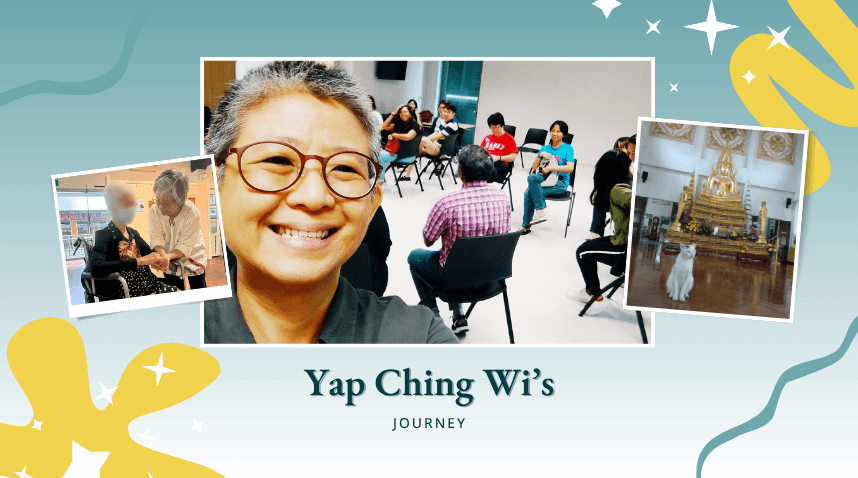
Dharma in the City: Social worker-cum-Activist Yap Ching Wi
Dharma in the City is a series featuring ordinary Buddhists who have spent decades in the practice, and also in service to their communities and beyond.
Most lay Buddhists are multi-hyphenates – wearing the hats of a family member, a professional, a volunteer, a friend, and more. How do we go about the practice in a way that integrates all these different roles that we take up?
The journeys of our interviewees shed light on how Buddhist teachings have influenced and supported their diverse aspirations, roles and occupations, all while cultivating the same path of peace.
The following interview features Yap Ching Wi, a professional in the social services, as well as an activist and advocate in areas such as women’s rights in Singapore, gender equality in Buddhism, and the welfare of community-dwelling sangha in Singapore.
The interview proper
Question:
You’ve worn many hats in your 30+ years career, including those of a social worker, a feminist activist with AWARE, a community builder for Buddhist youth through various organisers, a theatre practitioner with The Necessary Stage, and more which I’m sure I’m missing out.
How have these experiences shaped or transformed your understanding of community work and social justice, and their place in a largely pragmatic and results-oriented city like Singapore?
Answer:
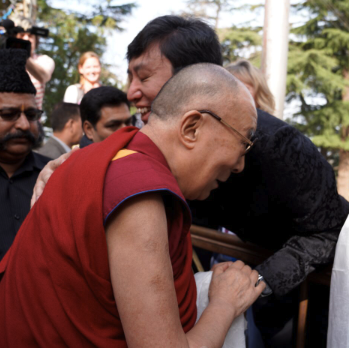
I was brought up by leftist parents so compassion and social justice are like air and water in my family. When I was young, I felt like an outsider in Singapore’s pragmatism. I found myself standing with society’s underdogs and became angry with all the social injustices. Imagine my perplexity when I came across the Dalai Lama’s teaching that anger is never the solution.
“Anger and hatred are our real enemies. These are the forces we most need to confront and defeat, not the temporary enemies who appear intermittently throughout life.”
I have now learned to acknowledge the feeling of anger arising as a motivation but not to grow or hold onto the anger. It is incredibly tough not to get angry as an activist in Singapore. When I became increasingly angry at people who are apathetic, I realised that empowering people is just as important as pushing for policy changes.
Self-awareness engenders courage for honesty and self-growth. Growth requires risk-taking in order to be realised. For this, self-compassion is a crucial grounding. Kindness to self ripples out to kindness to loved ones and to everyone in society. This is how I began to understand the saying that is inspired by Shantideva’s teaching: If you cannot cover the world with leather, cover your feet.
The Turning Point
Question:
In your Outstanding Women in Buddhism award statement, you described seeing the ‘limits of social work and social policy’ along this path.
Could you describe that turning point, if there was one? How has this realization impacted the choice of work that you do, or the way in which you engage civil society?
Answer:
The turning point was the year I spent studying social policy in London. With time and space away from Singapore, I ended up contemplating Shantideva’s teaching. As I learned about policy-making and social change in different countries, I realised that universally, working on social change is like a salmon perpetually struggling upstream. Human greed is celebrated and entrenched institutionally. I felt so hopeless and helpless, as if the carpet was pulled from my feet.
So I turned to the Dalai Lama and Thich Nhat Hanh for some peace. I was very glad that I did as I was rewarded with a sense of hope. As I continued to study and practice Buddhism, I began to realise the first two lines of what Master Yinshun taught, that 国家治还乱,器界成复毁… (The state turns from order to chaos, the material world is built and then destroyed…) 究竟皈依处,三宝最吉祥.
It took a second turning point to realise the last two lines of Master Yinshun’s teaching: 究竟皈依处,三宝最吉祥 (…The ultimate refuge is the Triple Gem, the most auspicious). After going for annual retreats for a few years, I fell into a depression. I lost all my confidence and was struggling to stay alive. With medication, counselling, mindfulness practice, and love from family and friends, a version 2.0 of Ching Wi evolved.
My journey parallels the spiritual activism movement. The goal is not only to reform external systems but to challenge root causes like greed, violence, or apathy by healing individuals and society. For me, taking refuge in the Triple Gem and growing towards enlightenment is how I can best serve myself and all sentient beings. Along the way, raising awareness of injustices, encouraging conversations and initiating actions are part of my everyday living.
Practice & Social Services
Question:
Many people still have the impression that dharma practice is just “going into the mountains to meditate” or closing your eyes and wanting to escape the world. That does not seem to be what you are doing.
In fact, you seem to keep yourself rather busily engaged with the ‘world’. Is this frowned upon in the Buddhist community? How does your dharma practice in the Amitabha Pure Land tradition intersect with the sphere of social services?
Answer:
There is a common belief in our Buddhist community that we should mind our own matters and not interfere with society. I think this comes from the attachment to practising the Dharma in a certain way, and also the politico-social conditioning of Singapore.
When I first joined the Buddhist community, I felt alone and wondered if I was too much of a trouble-maker or rebel but hey, Buddha was the OG rebel, wasn’t he? So I found inspiration from socially engaged monastics who are most definitely woke, double pun intended 😉
- Venerable Bhikkhu Bodhi co-authored the Buddhist Declaration on Climate Change and emphasizes the importance of addressing both internal changes in values and external changes in systems and practices contributing to ecological crises.
- Thich Nhat Hanh was a renowned peace activist recognized for his concept and practice of Engaged Buddhism.
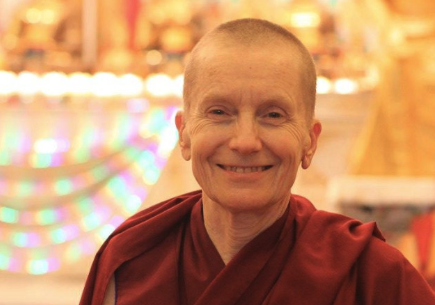
- Shi Chao Hwei, a Bhikkuni in Taiwan proclaimed that “my feminist enlightenment was taught to me by Buddha” and presided over the world’s first Buddhist gay wedding in 2012.
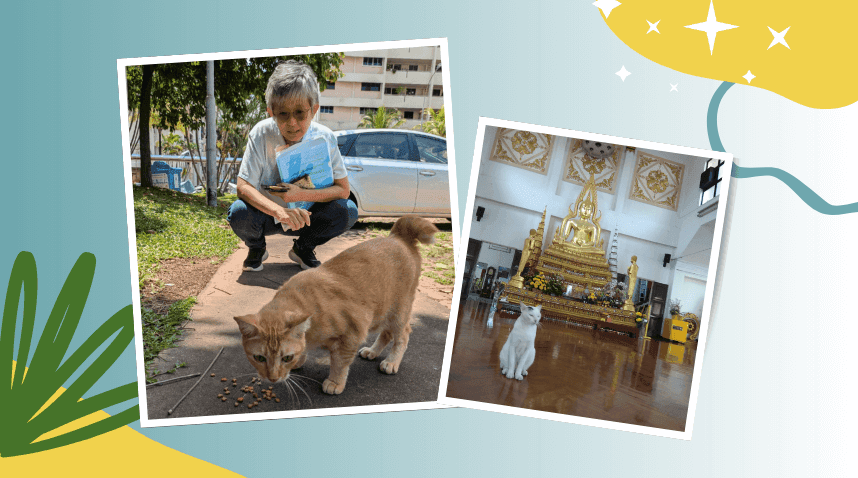
Service to the community is part of my Amitabha Pure Land practice. The goal of going to the Pure Land is not just for self-liberation but to liberate all sentient beings. A monastic who I deeply respect once taught me that if I aspire to liberate sentient beings, I must first 结善缘 (make wholesome karmic connections) with them. If sentient beings do not like me and won’t even talk to me, how can I ever liberate them?
Doing what I do now puts me out there, connecting and empathizing with people from all ages and walks of life, and from different cultures and faiths. I try to form favourable karmic connections with animals too, by radiating metta and reciting “Amituofo” to the insects, birds, cats and dogs. This is an especially joyful ritual on the way to work in the morning and to wind down after a long day’s work. Would you like to try it too?

Death & Dying: The Roles It Plays
Question:
In more recent years, you’ve transitioned to a part-time role with Aranya Sangha Dana Fellowship, in order to spend more time with your parents. You’ve also conducted several Life Story workshops, guiding participants through their life reviews.
Have these caregiver and facilitator roles impacted your reflections on death and dying, and how so? Do these reflections differ from an earlier time, when these topics (ageing, sickness, death) were more contemplative rather than experiential?
Answer:
I am immensely grateful to care for my parents and honoured to listen to people’s life stories in the workshops that I facilitate.
As I learn from them and experience their being, death and dying has shifted from a conversational catch phrase to an intimate practice.
It is very liberating to settle into the clarity that how I die is how I live. The body can be in pain, the heart can be grieving but the mind need not suffer. This has helped me gain a sense of urgency in my practice. The goal is for a calm and clear mind to focus on Amitabha through the dying process and at the moment of death. The condition of the mind at the last breath is crucial for the consciousness to enter Amitabha’s Pure Land.
If we do not work on our attachments and delusions now, they will continue to grow into old age and become much harder to let go.
It is a lot of work and a long process to let go of guilt, regrets and grievances.
It is also super important to work on keeping the mind open and training for it to stay flexible as one ages. In the face of death and dying, we may double down on some mental habits that cause more suffering for self, loved ones and caregivers.
For those of us who take pride in being self-sufficient, we tend to reject help from others. We will get into trouble with this mindset when we become frail. Can you imagine the myriad of negative emotions — embarrassment, shame, guilt, anger? So let’s start to practise now by gracefully accepting help the next time someone offers. Then we can gratefully dedicate merits to them.
For me, examining my oversized ego and working to tame it forms the basis of my practice. Repentance practice is crucial. I have learned to be patient with myself and accept that habits were formed from endless past lives, so I am always a work in progress. I hope that I will have done enough at the moment of death.
Question:
Looking back on your dharma journey and social services journey, one is certain that you must have encountered challenges to your resolve and inspiration. What is one suggestion or teaching that you would offer to someone who is aspiring towards, or starting on similar paths?
Answer:
At the lowest point of my depression, Venerable Sheng Yen’s teaching saved and healed me. 只要還有一口呼吸在,就有無限的希望,就是最大的財富。 Even with a single breath remaining, hope is unlimited, and that is untold wealth. I literally just focussed on taking one breath at a time as it was the only thing I could do. It was immensely useful in calming racing thoughts, staying afloat in the abyss of dread and connecting with the Triple Gem.
When I get overwhelmed, I recite Shantideva’s The Way of the Bodhisattva. It never fails to connect me with the Triple Gem and reignite my Bodhisattva motivation. There are so many moving verses. Two of them from Chapter 10: ‘Dedication’ are:
- …20. May the poor and destitute find wealth, The haggard and the careworn, joy. May those now in despair be whole in mind, Endowed with sterling constancy.
- …22. May those who go in dread have no more fear. May captives be unchained and now set free. And may the weak receive their strength. May living beings help each other in kindness.
Thank you for this opportunity to reflect and learn. May all readers and everyone at HOL continue to grow in wisdom and compassion. May all be well and at ease. May all attain the ultimate liberation. Amituofo.
Wise Steps
1. Call to activists – Deepen the practice of loving-kindness towards your own hearts! Self-compassion is an important first step that is easily missed for those concerned with helping others.
2. Practise in a balanced way; Dharma is not a separate practice from our daily lives and actions. Mindfulness helps us to see more clearly the root causes of suffering wherever it arises, and to address them with great compassion. Liberation cannot be found in either fixing external circumstances alone, or becoming completely absorbed in our own struggles.
3. Embracing the reality of death and dying helps us to understand the spiritual urgency of practice. No single person is immune to aging, sickness and death. Cultivating a firm refuge in the Triple Gem can help us to weather this life journey, and move past the physical and psychological obstacles that could stand in the way of seeing clearly, in order to fulfill our spiritual aspirations.
Credits: Yap Ching Wi’s Facebook