TLDR: Vakkali’s story is about a monk whose devotion becomes a desperate need to see the Buddha – and what happens when that longing is refused. Read alongside Buddhaghosa’s retelling, it becomes a startling account of how being “met” where we are can open the door to liberation.
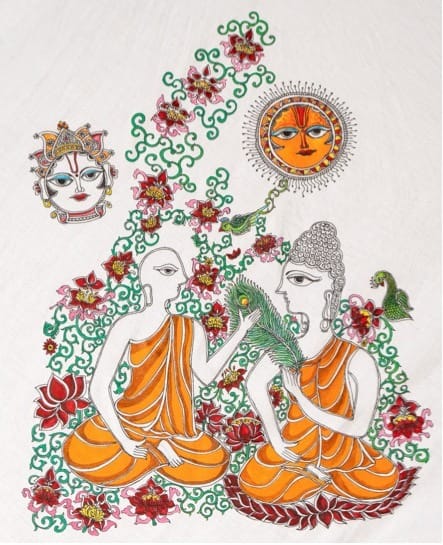
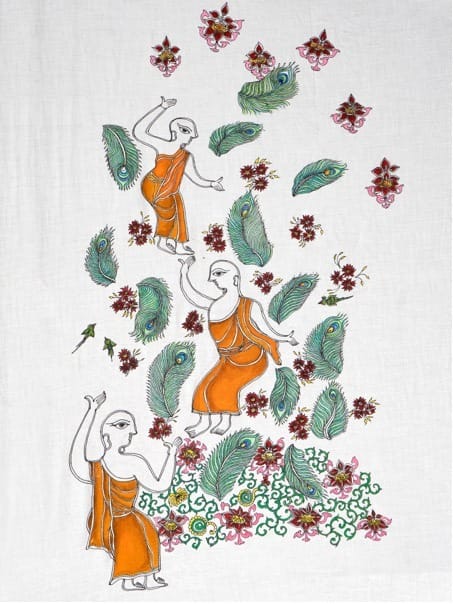
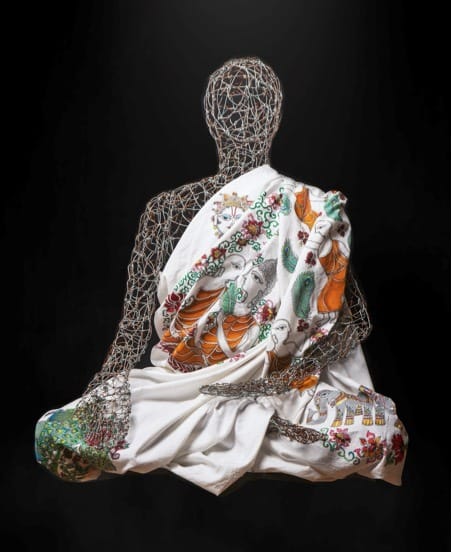
“Visions of Vakkali” (2020), a collaborative artwork between two Nepali artists, Ajit Sah and Bishowmber Basnyat, and a Singaporean student of Buddhist Studies, Dominic Chua.
I cried the first time I read about Vakkali, and the recollection of that still surprises me. I hadn’t expected to feel so close to a monk from the Buddha’s lifetime. I’d expected the usual sort of difficulty that Buddhist stories sometimes present: a doctrinal knot, an ethical puzzle, a footnote that sends you hunting for more footnotes.
Instead, the story got under my skin because it begins with something uncomfortably ordinary: a man who wants to look at another man, and cannot stop looking.
The Pali tradition gives us Vakkali in more than one narrative.[1] One is the Vakkali Sutta in the Saṃyutta Nikāya (SN 22.87), an austere, severe story centred on an ill monk and a deathbed visit. The other comes through the later commentarial tradition, shaped most influentially by the 5th-century CE Pali commentator, Buddhaghosa. In his commentary on the Dhammapada, Buddhagosa draws out Vakkali’s longing more openly and the ending is significantly transformed.[2]
It’s easier to start with that later portrait, because it makes Vakkali’s desire plain.
Vakkali is remembered as a brahmin from Sāvatthī, trained in the Vedas, formed inside a world where you learn how to carry yourself and how to speak correctly. Then he sees the Buddha once and something in him breaks open. He follows the Buddha about, hungry for the sight of him. He ordains as a monk because proximity is the only solution he can imagine.
We’re told that he spends almost all his time — apart from eating and bathing — absorbed in contemplating the Buddha’s external appearance, as though looking were the only way he knew to stay alive. It’s hard to read this as anything other than fixation: Vakkali had become besotted with the Buddha’s form, and he can’t seem to stop himself.
The Buddha responds with a rebuke that has become famous:
“Enough, Vakkali! Why do you want to see this foul body? One who sees the Dhamma sees me; One who sees me sees the Dhamma.”
There’s no gentleness in the phrasing. The Buddha refuses to let his physical body become the refuge Vakkali is trying to build for himself. If Vakkali wants refuge, he will have to find it somewhere other than bodily form.
Now for the sutta version. In SN 22.87, Vakkali appears as a very ill monk. The Buddha comes to visit him and asks him a sequence of questions that feels almost like a careful diagnosis: is the pain easing or worsening; is there restlessness or regret; is there any reason for self-reproach in his virtue? Vakkali says his conduct is blameless. So far so good. But then he reveals that what troubles him is not guilt. What troubles him is that he hasn’t been able to see the Buddha as much as he wanted. The Buddha replies with the famous rebuke and the “seeing Dhamma” line, directly in response to that longing.
In the sutta, the Buddha then leads him through contemplation of the aggregates, pushing Vakkali toward the kind of seeing that loosens clinging at its root.
Then comes the part that makes readers stop short. After the Buddha leaves, Vakkali takes his own life. The Buddha later declares that Māra, the deva who personifies death and temptation, cannot trace his consciousness — this is an old way of saying he has passed into final Nibbāna (often rendered “Nirvana” in English). This is why modern readers talk about the “Vakkali problem.” The first puzzle is ethical: how could self-killing possibly be justified, given the precepts and the tradition’s deep unease around taking life? That puzzle is real. It requires restraint in how we handle and interpret it.
But the second question is the one that gripped me: the Buddha visits Vakkali, teaches him, reassures him — and Vakkali still kills himself. What makes that sequence make sense?
Detail from “Visions of Vakkali” (2020)
Many readers treat the answer as simple: illness, pain, despair. Vakkali’s fixation on seeing the Buddha can look excessive, even embarrassing, and it’s easy to assume Vakkali’s wish to end his life arose solely from physical suffering.
For a gay reader, the emotional logic can feel clearer. I’m not suggesting Vakkali is “secretly gay,” and I’m not trying to sexualise the Buddha’s beauty.
The recognition is simpler: what it feels like when longing is met with refusal, when the wish to look is also the wish to be near, and that nearness is denied.
Many gay people learn early that desire can make you visible. It starts very small: a face you keep turning back to, a look that lingers, and then somebody notices. The correction often arrives as ordinary “help” — don’t stare, don’t be weird, don’t give people the wrong idea, you better be careful — said jokingly, but landing hard. After a while you begin to anticipate the shift in temperature before it happens, and you train your eyes accordingly.
Bring that experience to Vakkali and the sequence makes more sense. His devotion is organised around seeing the Buddha. The Buddha calls the body “foul” and denies Vakkali the comfort of clinging to his physical form.
When that comfort is taken away and nothing has yet taken its place, it can feel like the abrupt ending of a love affair — disorienting, unmooring, and edged with panic.
In Buddhaghosa’s version, the rains retreat is approaching and the Buddha is leaving Sāvatthī for Rājagaha. Vakkali wants to follow him into retreat but the Buddha tells him not to. Devastated, he goes to Vulture Peak intending to throw himself off. His distress centres on not being able to see the Buddha, and on being sent away from him.
Detail from “Visions of Vakkali” (2020), depicting the moment where Vakkali steps off the cliff and floats to the ground.
And then Buddhaghosa resolves the story in a completely unexpected way.
Sensing that Vakkali is about to throw himself off the cliff edge, the Buddha is moved by compassion. The narrative says the Buddha sends forth a radiant image of himself for Vakkali to see. Then,
The moment the monk saw the Teacher, the weight of sorrow that had oppressed him vanished.
Then the Teacher, as though filling the dry bed of a lake with a flood of water, caused great zest and joy to arise in the monk, and pronounced the following stanza:
Full of joy and faith in the Buddha’s teaching, the monk will reach the place of peace, the happiness of the stilling of the formations.
Having pronounced this Stanza, the Teacher stretched forth his hand to the elder Vakkali and said,
Come, Vakkali! Fear not, look at the Tathāgata! I will lift you up like (one lifting) an elephant sunk in the mire.
Come, Vakkali! Fear not, look at the Tathāgata! I will free you just as the (eclipsed) sun is freed from Rāhu’s maw.
Come, Vakkali! Fear not, Vakkali! Look at the Tathāgata! I will free you just as the (eclipsed) moon is freed from Rāhu’s maw.
I’ve quoted the Dhammapada Commentary at some length because the passage has real poetic force. Earlier, Vakkali is told that the Buddha’s body is “foul” and that looking is useless. Here, the Buddha does the opposite: he invites Vakkali to look at him. Vakkali’s sorrow drops away, joy and faith surge, and he leaps; liberation is said to occur before he reaches the ground.
This does not undo the sutta’s point. The body cannot be the final refuge; “seeing the Dhamma” still matters more than seeing a person. What changes is how the story handles the human problem that has been driving Vakkali toward the edge. Buddhaghosa treats the gaze and the pull of the Buddha’s beauty as a force that has to be addressed, not simply dismissed.
The invitation to look becomes the turning point that lets Vakkali move toward liberation — without giving him permission to cling.
For gay Buddhists, that matters. So much of our formation involves learning to mistrust longing, and Buddhist language about craving can either free the mind or quietly reinforce shame, depending on the experiences that we’ve had. Vakkali’s story refuses easy answers. It shows longing in its most inconvenient form — obsessive looking, rebuke, separation, despair — and it also shows, at least in Buddhaghosa’s retelling, a moment where that longing is met without humiliation, long enough for liberation to become possible.
That is why I cried. Buddhaghosa’s retelling offered an ending I didn’t expect: neither indulgence nor a cold demand to “get over it,” but the Buddha compassionately appearing before Vakkali as he stood at the edge. It names a truth which many of us learn the hard way: sometimes you can neither let go nor move forward until you’ve been met. Vakkali is met through the very thing that had once been refused — his looking — and from that foothold the story finally lets him step toward liberation.
Bibliography
Saṃyutta Nikāya 22.87: Vakkali Sutta. Translated by Bhikkhu Bodhi. Accessed January 8,
[1] Piya Tan floats the possibility of “two Vakkalis” to account for differences between the Vakkali Sutta and Buddhaghosa’s later commentarial versions. Here, I treat them as two retellings of one story: later tradition keeps the same core tension (Vakkali’s need to see the Buddha) while reshaping the ending into a more teachable, less ethically jagged resolution.
[2] Buddhaghosa (traditionally dated to the 5th century CE) is arguably the most influential commentator in the Theravāda tradition, best known for systematising doctrine and meditation in works like the Visuddhimagga (The Path of Purification) and for shaping how later generations would read the Pali Canon. For many Theravādin Buddhists, his interpretations have become a standard lens for understanding the suttas. That matters here because the more dramatic Vakkali story comes to us through this commentarial stream, rather than from the early sutta collections alone. Reading Buddhaghosa alongside SN 22.87 shows how a later, highly influential Theravāda interpreter identified the story’s emotional and doctrinal stress points, and then shaped a resolution that he thought could carry the reader through them.
TLDR: This article looks at why we often struggle to say “no” or face uncomfortable conversations, even with loved ones. Drawing from his personal experiences and insights from the suttas, Wei Liang reflects on how people-pleasing can create stress and anxiety, and offers practical ways to meet expectations with greater kindness, wisdom, and ease.
Recognising the Burden of People-Pleasing
Have you found yourself saying “yes” when you really want to say “no”? On the surface, people-pleasing may look like kindness or generosity. But underneath, it can quietly drain our energy and fill our days with anxiety.
When every decision is shaped by how others might respond, we end up living in constant tension—always unsure if we are good enough, always measuring ourselves against shifting expectations.
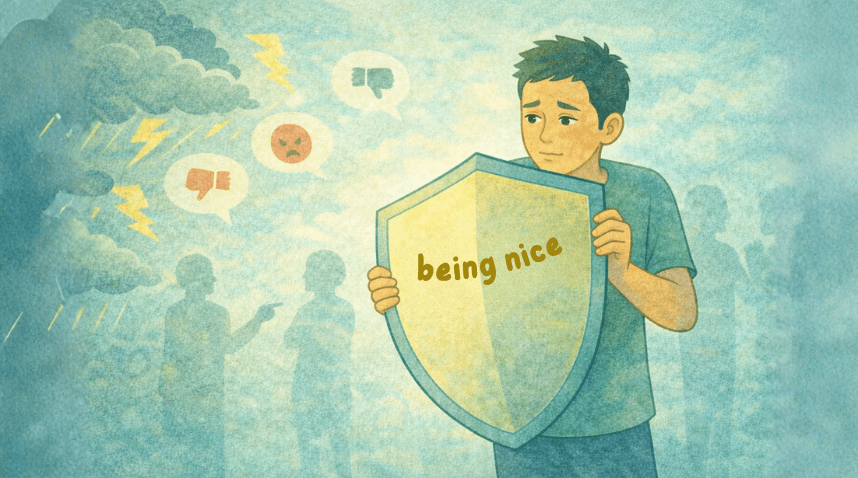
The Buddha’s wisdom helps us see that being nice does not equate to acting in a beneficial way, and to reflect on how our need for approval can be a source of unhappiness when it depends on conditions outside our control.
When Niceness Get Tangled in Delusion
Sometimes, people-pleasing begins with beliefs that don’t line up with reality, what the Buddha calls delusion (moha).
We might think, “If I’m nice enough, I won’t be hurt or rejected.” It feels comforting to believe that kindness is a shield. Or we might assume, “I can control how others treat me.” The truth is, we can’t. Someone’s negative reactions may have nothing to do with us at all.
Seeing this clearly is a relief. It means we can stop carrying the impossible task of managing how everyone feels about us.
When Approval Becomes a Craving
Wanting to be liked is normal, it’s part of being human. But needing to be liked is where things start to hurt. This is craving (lobha), which can manifest as a restless reaching for approval.
In a previous job, I craved being seen as a “good employee.” I would take leave not to rest and recharge, but to block out my calendar from new tasks so I could work on existing ones. Underlying this behaviour was a need to be valued and viewed as competent. In reality, I was letting my work dictate my self-worth, which led to unhealthy work-life boundaries, frustration, and resentment.
Reflecting on that experience, I now see that self-approval, rooted in our principles and values, honesty about one’s limitations, and not being defined by failures, lasts far longer than the fleeting satisfaction of approval from others.
When Avoiding Conflict Closes Doors
Sometimes, people-pleasing takes the form of aversion (dosa). This can mean avoiding situations and conversations that feel uncomfortable.
Conflict avoidance can look like preserving harmony, but often it just postpones a conversation we know we need to have.
I struggle with talking to my family about changes in my life, such as changing jobs. I justify not communicating by telling myself, “They don’t need to know. I’ll just be nagged at, even though I’m being responsible with my choices.” But deep down, I know I am clinging to what I perceive as a comfortable status quo.
Staying quiet feels easier in the moment, but it also means missing opportunities to build trust and communication with those we love.
Reflecting on the Distinction Between “Nice” and Beneficial Conduct
One beautiful example of the Buddha’s wisdom comes from the Abhayarājakumārasutta (MN 58). A prince once asked him, “Sir, may the Realized One ever utter speech that is disliked by others?”
The Buddha didn’t give a categorical yes or no. Instead, he drew a distinction between speech that is pleasing, and speech that is true, correct, and beneficial, with the latter being what matters.
He drew an analogy to removing a stick or stone from a child’s mouth. The child might feel discomfort in the short term, but you would still remove the object, out of compassion.
For me, this shifts the focus. Instead of asking, “Will they like me if I say this?” I can ask, “Will this help?” It becomes a gentler, wiser compass.
Reflecting on Praise and Blame as Unreliable Conditions
These are forces that push and pull us through life. If you’ve ever had your mood lifted by praise, only to see it crash with a single word of criticism, you’ve felt these winds.
Praise and blame can feel important: who doesn’t want to be liked? Words of affirmation, a smile, a pat on the shoulder—all these can feel addictive. But the Buddha’s point is that praise and blame, like all conditions, are always shifting. You can’t control them any more than you can control the weather.
When we remember this, it becomes easier to let praise pass without clinging to it, and to face blame without buckling under its weight.
Finding the Middle Way
Letting go of people-pleasing doesn’t mean we stop caring about others. It means asking ourselves: Why do we care? And how can we care in a way that’s beneficial?
Asking these questions allows us to reflect on the motivations behind our behaviour, empowering us to act with wisdom instead of simply reacting to external forces.
We can still be warm and kind, without being dishonest or ignoring our boundaries. We can speak truthfully and skilfully, even when it’s uncomfortable.
When we pause to check our intentions, and measure our choices against our values instead of someone else’s approval, we feel steadier.
When delusion, craving and aversion lose their grip, praise and blame become just weather—passing overhead. And kindness stops being a survival tactic, returning to what it truly is: a gift, freely given.
Wise Steps
We can begin applying the Buddha’s wisdom by noticing our tendencies to please, and taking small, steady steps to change how we interact with approval and critics.
Take a pause. Before agreeing to something, take a few mindful breaths. Notice whether your “yes” comes from care or from fear of disapproval.
Spot the winds. Each time you receive praise or criticism, silently note, This is just a passing breeze. See if you can let the impulse to hold on or to shrink away pass without reacting.
Speak one gentle truth. Once a day, share something honest that you might normally keep to yourself. You can start by sharing these words with yourself, and later with others if you feel ready. Choose kindness in your tone, but clarity in your words.
TLDR: Ever bought something you had to have, only for the joy to fade right after? Ophelia reflects on her struggles with impulse spending and how Buddhist mindfulness has slowly helped her make more intentional choices. Spoiler: She still wants things, but now she pauses and listens to her wise mind first.
Impulse spending. We’ve all been there, haven’t we? That irresistible urge to buy something on the spot, believing in that moment it’s exactly what we need to plug that blackhole within our hearts.
The Traps of Greed
Remember the last time you scroll mindlessly to a sponsored Instagram post, you notice something novel/cute/pretty/quirky/productive, and feel that little tug? A whisper says you need this <ad product> right now. And you clicked “Shop Now”.
The item that just popped up on your screen promises a better life, a more put-together, more fulfilled version of you. Not just one item, but every item you browse holds endless possibilities. You want that future to happen.
With just a press of “Buy it Now”, Google auto-fills your credit card details and your shipping address because it is such a helpful personal assistant. Within nanoseconds of authorising that transaction, you’ve got mail: Yay! We are preparing your order. Delivery within 3-5 working days. Track your shipment here.
You heaved a sigh of relief. Life can only be better after you receive the parcel. You check the shipment progress in anticipation. Can’t wait for good things to happen.
Or maybe that last time happened within a physical store of a major retailer: you remember seeing “50% off” cards hanging from every other corner.
Everyone else has something in their hands, browsing for more. Unconsciously, you ran your hands through the aisles for something. Anything. You want to be like them. You just got your salary today; you know you can treat yourself for slogging a month at work. You deserve better.
You’d bring that “promise-of-a-better-life” home. Head light, hands full. You feel a flicker of joy.
Within days, sometimes hours, that fickle light fades out like the moment a sparkling wand dies. The exact moment you set the new trophy down, you notice the older purchases still on the coffee table. Shopping bags and cardboard boxes litter the living room. So do your guilt and emptiness.
Then, the next craving would come. You want to experience that joy of waving the sparkly wand of consumerism again. A harmless pen. A sheet of stickers. An inspiring notebook. Another shirt, different in colour than the ones you had. Cleaning supplies. Gradually, the trophy becomes more costly.
That’s the thing with craving, a loose translation of tanha. It never ends. You got some and you want more.
What I’ve described was an older self. She’s still here in her own ways now.
In the Dhammapada (verse 251), the Buddha puts it plainly:
“There is no fire like passion… no river like craving.”
This fire burned through my bank account. This river flooded my apartment with things and left me wondering, why do I keep doing this to myself?
Painting Instead of Possessing
One day, I came across a story on Instagram. A woman who’d paint things she wanted to buy instead of purchasing them. A luxury handbag. A designer couch. A beautiful blouse. She’d record her wants visually, write down why she liked it, and that was it. No checkout. Just observation.
I haven’t tried this hack yet, but something about it stuck with me. It reminded me of what the Buddha often nudged us towards: not rejecting beauty, but seeing their nature clearly. We can appreciate things without clinging. Enjoy presence without owning.
Maybe by capturing beauty on paper, we can acknowledge the desire that arises at that moment and recognise it as distinct from the choice of not acting on greed. We can then let go before the purchase, not just after feeling the regret.
My Online Shopping Cart = My Mirror
Here’s one thing I have been doing. Whenever I see something I want online, I add it to my cart and then I walk away. No checkout. No commitment.
Days pass. A week, sometimes more.
If I return to the cart, I usually find that I may not want those things anymore. The dopamine’s gone. I’ve forgotten why I wanted them in the first place. That pause becomes a mirror. One that shows me the impermanence of my own wanting.
I think of the space as a little mindfulness bell. Every time I feel that surge of “I must have this thing now,* it’s not about saying no. It’s about watching the arising and ceasing of feelings. Letting the wave rise and fall without getting swept up.
Physical Shops = Sensory Overload
Walking into a store? A whole different story. The lights, the smells, the textures of fabric between your fingers, they’re all designed to seduce.
So I came up with a tiny hack. I don’t carry a shopping basket if I’m alone. No trolley either. Just two bare hands.
It might sound silly, but it works to mitigate damage when impulse takes over the steering wheel. If I can’t carry, I can’t buy. This constraint forces me to think, Why do I really want this, or am I just blindly grabbing clutter in another moment of craving?
Choosing with my hands means choosing with my awareness. That’s become a kind of training ground for restraint against the cruising desire.
Bring a Friend, Save Your Wallet
Sometimes, the timeliest wisdom comes from someone beside you. For example, an admirable friend who gently calls out your patterns.
Not long ago, I was eyeing yet another sticker pack. My friend, who’s seen me go through all this before, asked simply, do you really need them, or is it just a passing desire?
She didn’t shame me. Just reminded me to pause. In that moment, the grip of craving loosened. I managed to walk away.
Here’s the thing: the mindfulness practice is not about never buying anything ever again. It’s about asking, Why do I want this? What need is the item trying to fill? And most importantly, will that need be truly satisfied with buying?
Not long ago, after weeks of waiting, I finally bought a set of black fine markers. I’d thought about it. Waited. Reflected. They are inseparable from my sketchbook filled with zentangle patterns doodles.
Now, every time I draw with the fine markers, I feel joy. Not because it’s fancy, but because I chose it with care. It feels earned. Not by money, but by attention. Maybe I’ll start drawing and painting all my desired possessions with these markers.
That’s a shift. I don’t want to live at the mercy of every craving. I want to choose my actions. Live simply. Spend wisely. Cherish what I have. Keep using them, repairing them.
Because in the end, most cravings are just visitors to your mind. And like guests who show up uninvited at your home, if you give them space, attend to their needs with a cup of tea and listen to their musings with presence, they’ll leave you in due time.
Wise Steps:
Delay checkout by at least seven days so desire meets impermanence, as seen when I left items in my online cart and returned to find I no longer wanted most of them.
Shop with empty hands so your body sets a boundary, like skipping baskets and trolleys which forced me to ask if I truly needed what I grabbed.
Invite a mindful friend to be your mirror and agree on a gentle question, as when my friend asked if the sticker pack was a passing desire and the urge eased.
TLDR: With porn so prevalent to all of us, what is the Buddhist take on porn. How can we sustain the practice in a digitally saturated world?
Disclaimer: This article discusses the topic of pornography viewing and may be uncomfortable to some. Please proceed at your discretion.
In the modern world’s frenetic chaos, the Buddha’s teachings on letting go of craving and attachment can seem like ancient whispers easily drowned out by society’s loud siren calls for gratification.
Nowhere is this tension more apparent than the omnipresent pornography that has seeped into our collective consciousness, and at an increasingly young age too. In Singapore, 9 out of 10 boys aged 13 to 15 have watched or read sexually explicit materials.
For Buddhists navigating this dizzying digital era, the issue sparks a moral paradox – to indulge these carnal cravings through pornography’s vivid lens, or to abstain.
The Buddhist Perspective on Sensual Pleasure
On the surface, pornography embodies the very attachments Buddhism cautions against. The Buddha was explicit that sensual pleasures are fundamentally unsatisfying.
The Buddha described sensual pleasures as “a chain of bones” (in the Alagaddupama Sutta) – with little satisfaction, much stress, much despair, and ensnaring us in a perpetual cycle of dissatisfactory craving.
Similarly, in the Avassuta Pariyaya Sutta, the Buddha warns that one being “mastered” by sights, sounds, tastes and sensations leads to the growth of defilements like lust, resulting in future rebirth and suffering. Through this view, pornography, with its fictional displays intended to arouse, represents the apex of delusion, conjuring an artificial reality to satiate base desires.
The Pragmatic Approach
And yet, Buddhism teaches us to meet reality’s circumstances with pragmatism and an open mind, not dogmatic rigidity. Sexual desire is innate to the human experience, not something to be rashly suppressed or shamed.
Some argue that pornography may provide a safe, private way for individuals to explore their sexual curiosities and fantasies without risk of sexually transmitted infections or unwanted pregnancies. It is also asserted that it may offer an accessible avenue for releasing pent-up desires that might otherwise lead to misconduct from desperation.
For those with unconventional desires and orientations, it also allows secure examination of their eroticism behind closed doors.
But is this a skillful means for Buddhists interested in living an ethical life and purifying their minds? Do individuals know when it is enough and when they are addicted to it? The lines are more blurred than some would think.
The Nature of Pornography
Informing this debate is the very nature of pornography itself. Pornography, by design, perpetuates defilements the Buddha cautioned against.
There are 16 defilements (upakilesa) that cloud the mind. The Thai saying, “Kilesa is the engine of sadness,” aptly captures this notion. Pornographic scenes hijack the brain’s dopamine reward system, and according to Gary Wilson (Tedx Glassgow speaker), the dopamine hit can lead to two things: it signals to the brain that it has reached a dopamine peak, and it activates delta FosB, which triggers binge mechanisms and leads to more craving, creating a cycle.
This can cause brain changes similar to those found in all addicts, leading to a numbed pleasure response where only the addict finds porn exciting and everything else becomes boring.
This addictive feedback loop also means increasingly extreme material (more graphic violence, more risque, more illegal or elusive content) is required to feel aroused. Combined with the accessibility to this content, the viewer’s willpower erodes.
What may begin as a “harmless” pleasure or a stress-release activity can increasingly darken the mind.
Ajahn Achalo shares his perspective on pornography here, that by embracing and familiarizing one’s mind with darkness, the mind gets dark, and further darkens as it feeds on more darkness.
The Ethical Concerns
Research has also shown that 88% of the most popular porn scenes contain acts of sexual physical aggression, and 96% of scenes portray women as enjoying violence (Bridges et al., 2010) – and this belief that women subjected to sexual violence is acceptable can become internalised by impressionable viewers.
The coercive underbelly of the industry, rife with exploitation and trafficking of real human beings, the majority being children, also cannot be ignored.
Stories recounted by former performers frequently include instances where they tried to back out of the scene or even the industry altogether and were threatened with legal action.
Other stories include threats from industry agents for performers to do scenes that were not agreed upon beforehand. As Buddhists, are we perpetuating this abuse merely by partaking as consumers?
Undoubtedly, for monastics who have renounced sensual indulgence, engaging in pornography and sexual acts is a clear violation of vows and precepts.
But for the householder still entrenched in worldly life, how can one relate skillfully to the natural urges of sexual desires?
Raga, or lust, is one of the most powerful desires – a finding well supported by neurobiology. Contrary to the modern belief that unbridled expressions of desire are a form of liberation, the Buddha considers desire as a form of slavery: when you have a desire, if you must and are compelled to follow it, these darken and cloud the mind.
Instead, liberation in the Buddhist sense, points to a mind that is free from the deluding and darkening forces of desire, attachment and ignorance. It thus becomes radiant, free and peaceful. Most importantly, all of us have the potential to be awakened to this nature.
Can Watch Or Not Watch?
Thus, the question of whether one can or cannot watch pornography, should be extended to consider how we can cultivate self-compassion amidst these potent forces of desires that cloud the clear, radiant nature of the mind. Furthermore, how we can we journey towards liberation from suffering with ethics, concentration and wisdom.
We can turn to the Handful of Leaves Podcast with Ven Damcho on the topic of sex for some enlightening insights.
One key takeaway is to be brutally honest with where we are at, not shaming ourselves for having these natural urges or even, secretive impulsive habits of pornography and trying to pretend to be a saintly celibate “Buddhist”, whatever that means.
Accepting where we are at in this journey, and acknowledging that the Buddha’s teachings are a gradual path of relinquishing our cravings is the first step towards happiness.
Whether you watch porn or don’t, there is no Godly being that will condemn you, but really, if you feel empty, unhappy and lost as a result, the purpose of the teachings is for us to work out what is realistic or beneficial to our happiness, and taking committed actions towards that.
And to ask ourselves with our own wisdom, what’s realistic, what’s beneficial, what is useful and caring and kind to others.
Start where you’re at
One of the most effective techniques according to psychiatrist Dr K. for resisting the urge to view pornography is called “urge surfing.”
This paradoxical approach recognises that directly fighting pornography cravings is often counterproductive, as the brain learns to intensify the urges when you resist and fail. Instead, urge surfing involves riding out the craving wave for 15-30 minutes without giving in.
During this timeframe, the brain’s homeostatic tolerance mechanisms will kick in, allowing the intensity of the urge to subside on its own. To facilitate urge surfing, avoid fighting any battles you’re likely to lose against intense cravings. This reinforces a sense of powerlessness.
Instead, try to strategically “pick your battles” by scheduling specific windows when pornography viewing is allowed.
This makes it easier to surf through cravings that arise outside of those designated times. With practice, you can strengthen your ability to mindfully experience urges without unconsciously acting on them or creating an irresistible struggle.
From objectification to connection
Cultivating healthy intimate relationships grounded in genuine care, respect and compassionate communication allows sexuality to naturally blossom as an expression of profound human connection – rather than objectification or personal gratification.
Lama Thubten Yeshe has an inspiring quote that always makes me pause, he said, “Often when we say, I love you to someone, what we really mean is I want to use you.”
A key practice to developing real connections with others is to regularly reflect with wisdom and honesty: Am I being wise and kind to myself and others?
Do I want to perpetuate sex as a commodity, viewing others as mere objects, as pieces of flesh to be consumed for fleeting pleasure, like food to satiate a craving?
Is this how I wish to relate to those I care for and to myself? By staying committed to wisdom and kindness, we can be open to intimacy and sex as an acceptance of the wholeness of another, rather than just pursuing personal gratification that inevitably breeds emptiness.
Why are you dissatisfied with your current life?
Similar to people who have an addiction to alcohol and drugs, porn is often used as an unhealthy coping mechanism, especially to get away from their thoughts of loneliness.
It is thus critical to address the root causes driving the behaviour of porn consumption, by building up alternative emotional regulation techniques.
This could include mindfulness practices, exercising, gratitude journaling, seeking counselling, or visiting the Handful of Leaves Directory that promotes wholesome communities providing a sense of purpose and fulfilment.
Establishment of mindfulness
In the podcast, Ven Damcho also suggests referencing the Buddha’s Satipaṭṭhāna Sutta on the establishment of mindfulness. First of all, we learn to identify our own states of mindminds of suffering, such as loneliness, emptiness or even attachment.
Frankly, that’s not easy. When we’re in suffering, we are not identifying it. We are reacting.
When we’re stuck in attachment, our immediate thought is often “I want more. How do I have more of this pleasure?” However, this stance fails to recognize the attachment itself.
By learning to identify the physical manifestations of our thoughts and emotions through meditation, we can cultivate a deeper understanding of their origins and implications.
Adopting this introspective stance allows us to discern the consequences of our thoughts and emotions, guiding us towards wiser choices. Crucially, this process involves refraining from harsh self-criticism, as condemning ourselves for perceived shortcomings only perpetuates negative patterns.
Judging ourselves as “bad and lustful” or “bad and angry” is not the antidote to attachment or anger; it only breeds more negativity.
Contemplating impermanence
The antidote to any kind of attachment is often contemplating impermanence – reflecting on whether the desired object can bring everlasting pleasure or happiness, and considering if engaging with it harms ourselves and others.
Slowing down and taking a long-term perspective can calm attachment. Instead of judging ourselves, we must cultivate wisdom by examining the causes, conditions, and effects our attachments produce.
If we can clearly see that something is not bringing genuine happiness, we won’t settle for it. Venerable Thubten Chodron often says, “Why are you settling for Grade F happiness?” Our minds may protest, “It’s the only thing I know,” but there are sources of happiness outside of our attachments, like having an honest conversation with someone we care about.
The key is moving forward in a way that brings more pleasure than lies or attachments ever could. In summary, choose wisely.
Wise Steps:
Evaluate the facts around pornography, and reflect if it is something that you want to further imprint your mind with. Every action and perception, whether wholesome or unwholesome, that we actively consume leaves an imprint on our mind, and the more we do it, the deeper those grooves will get. So, what are we choosing to stain our minds with?
If you wish to change, take a gradual and multi-pronged approach addressing root causes, and always with kindness and compassion to oneself. Good luck!