
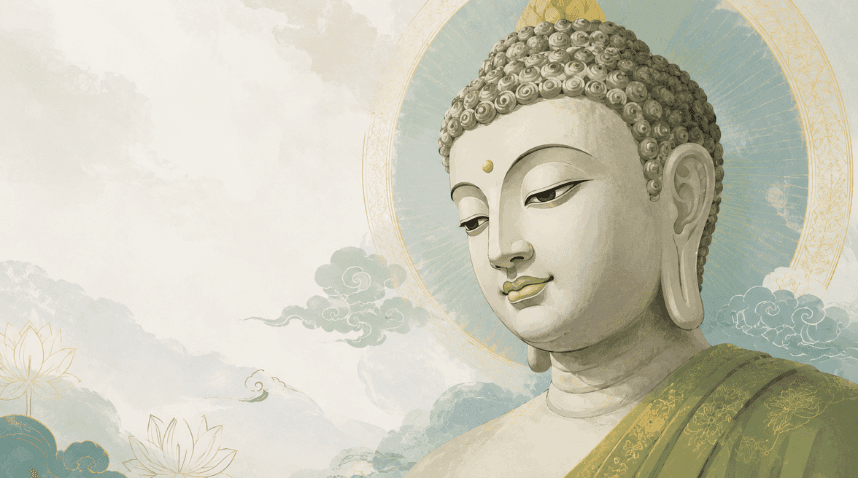
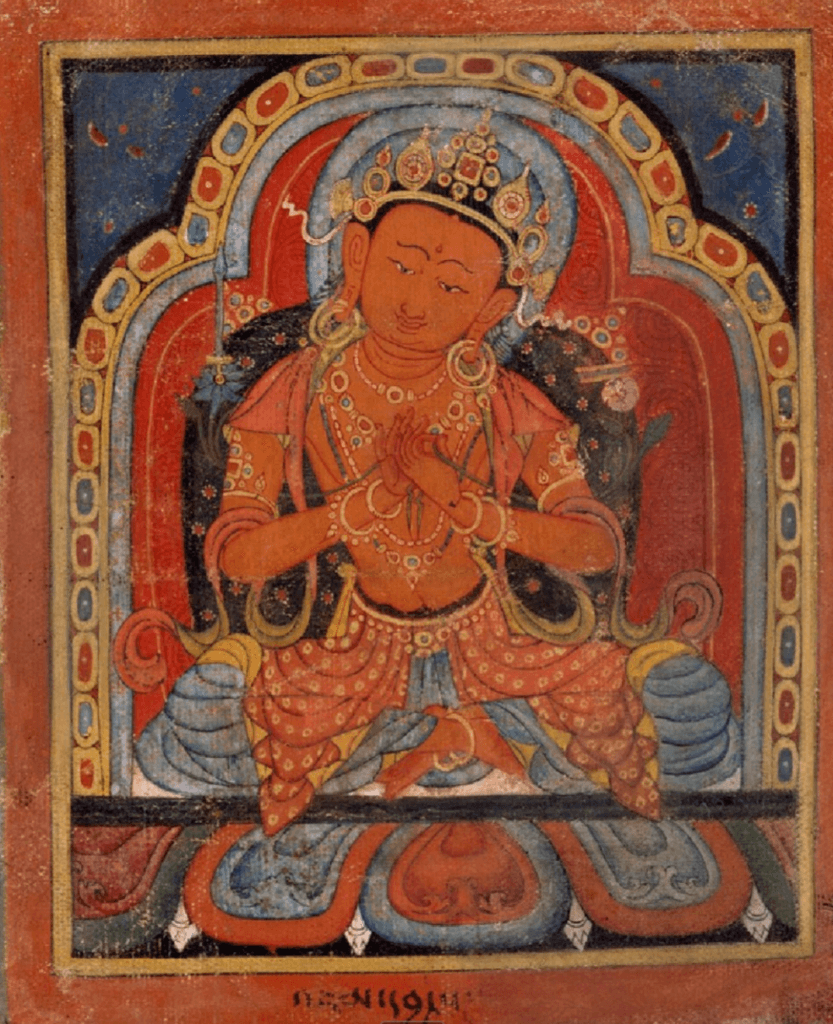
Stand before almost any image of the Buddha, a gilded statue in a Thai temple, a grey schist relief from ancient Gandhara, a painted thangka from Tibet. You will notice the same quality in the face: the eyelids lowered but not shut, the eyes resting on a point somewhere just beyond the tip of the nose, or perhaps on nothing at all.
It is one of the most distinctive and arresting features of Buddhist art.
A Practised Posture
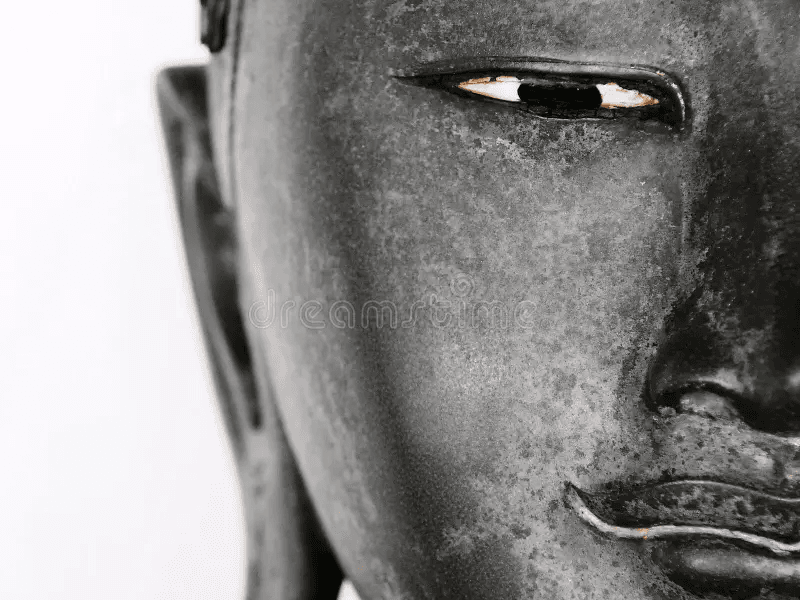
The half-closed eye of the Buddha is, in the first instance, a record of meditation practice. The earliest canonical texts do not specify eye position in great detail, but the living tradition, preserved in commentaries, teachers’ instructions, and practice manuals across every school of Buddhism, is remarkably consistent: eyes neither fully open nor fully closed.
A meditator with eyes wide open is pulled outward, drawn into the sensory world, distracted by movement and light. A meditator with eyes fully closed risks a different kind of failure: dullness, drowsiness, the gentle slide into sleep. The half-open gaze threads between these two dangers, keeping the mind alert without agitation, settled without sinking.
This is still how shamatha is taught today. Instructions given at Rangjung Yeshe Institute direct students counting breaths to rest the gaze on the ground a short distance in front of them — unless they are focusing on a statue of the Buddha, in which case the image itself becomes the object, and the eyes meet the eyes of the figure before them.
What the Tradition Says
Tibetan Buddhist teachers have been especially explicit about what the half-open gaze signifies. Lama Zopa Rinpoche, giving instructions on the painting of Buddha images, put it plainly:
The Buddha’s eye mustn’t be wide, but fine and narrow, half-opened and half-closed. This signifies that Buddha is in equipoise meditation on emptiness, while at the same time working for sentient beings.¹
This is a Mahayana and Vajrayana reading. Only a fully awakened Buddha, free from all obscurations gross and subtle, can hold both simultaneously. The two aspects of the eye — the lowered lid and the remaining aperture — together express the union of wisdom and compassion, or, in Tibetan terms, the inseparability of emptiness and appearance.
Gandhara’s Gift
When the first human images of the Buddha began to appear, around the turn of the first millennium CE, two schools emerged more or less simultaneously: Gandhara in the northwest, drawing on Hellenistic influences carried east by Alexander’s campaigns, and Mathura in the north-central plains, working from an indigenous tradition of yaksha sculpture.
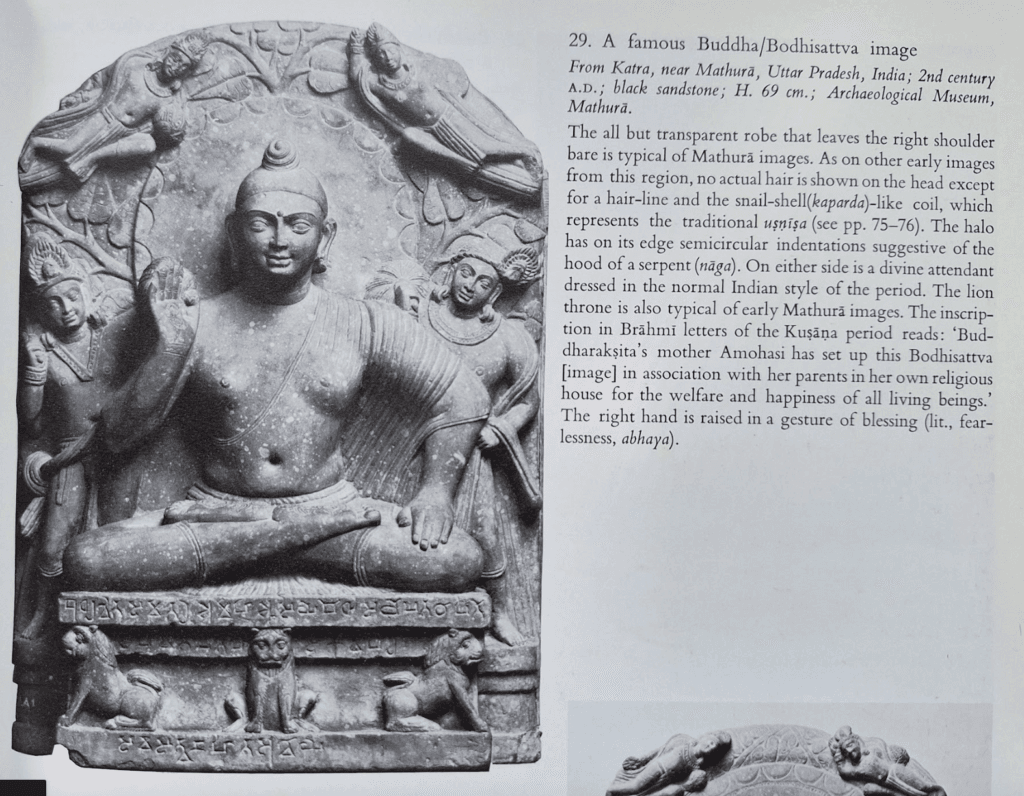
The two schools seem to have made different choices initially. In the early period — up to around the second century — the Mathura Buddhas tend toward wider, more open eyes. The Gandharan Buddhas looked inward from the start: almond-shaped eyes downcast, the gaze directed slightly toward the earth.
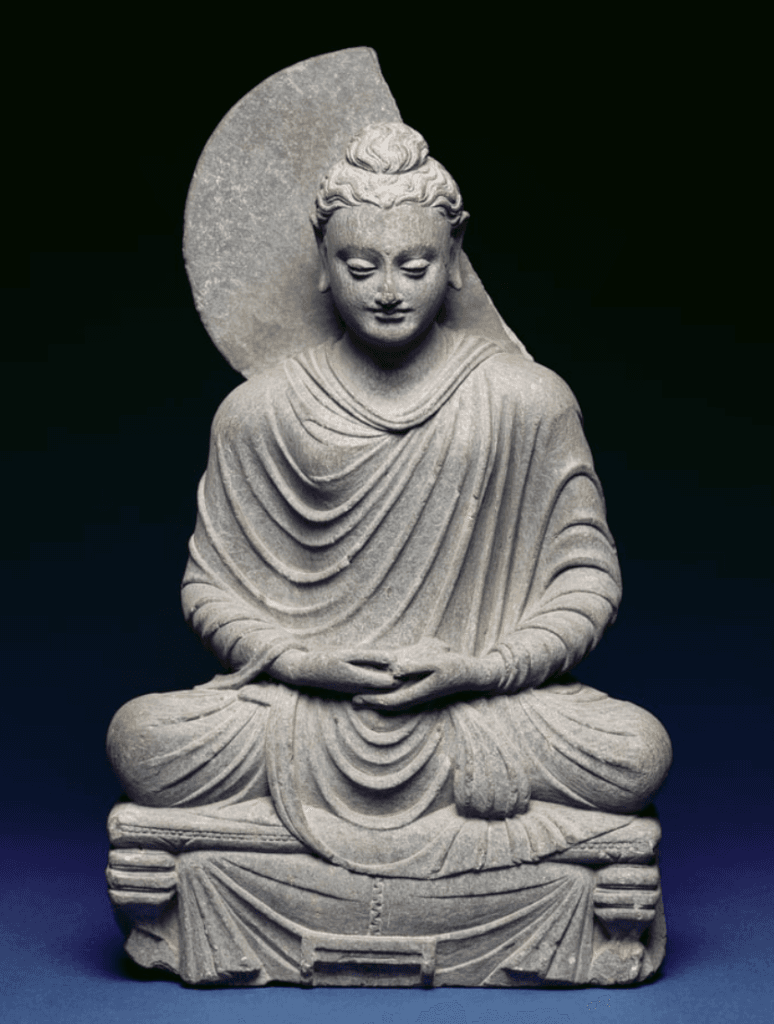
From the third century onward, the Mathura tradition appears to move toward the lidded, downcast gaze, converging, whether through influence or parallel development, on what would become the transnational standard.
A contemporary practitioner sitting with a Theravada teacher in Sri Lanka may be given the same instruction about eye position as a Tibetan practitioner in Kathmandu or a Zen student in Kyoto. The statue they face in meditation, whatever its style or provenance, shows them the same thing.
The Simultaneous Gaze
In most cultural traditions, closed eyes signal interiority: sleep, death, a turning away from the world. Open eyes signal engagement: watchfulness, attention, presence. The half-closed eye of the Buddha refuses to choose. It holds the interior and the exterior in suspension.
Arun Magar, whose family runs a thangka shop in Thamel, Kathmandu, and who is also a student at Rangjung Yeshe Institute, noted that as the convention travelled into Mahayana and Vajrayana imagery, it accumulated further meaning. Manjushri, the bodhisattva of wisdom, and Chenrezig, the bodhisattva of compassion, both have half-closed eyes — though Green Tara, also a bodhisattva of compassion, is wide-eyed, her gaze active and outward. Wrathful deities, Mahakala, Yamantaka, Palden Lhamo, are wider-eyed still. Eye position in this iconographic world tracks a spectrum from fierce outward engagement to the stillness of equipoise.
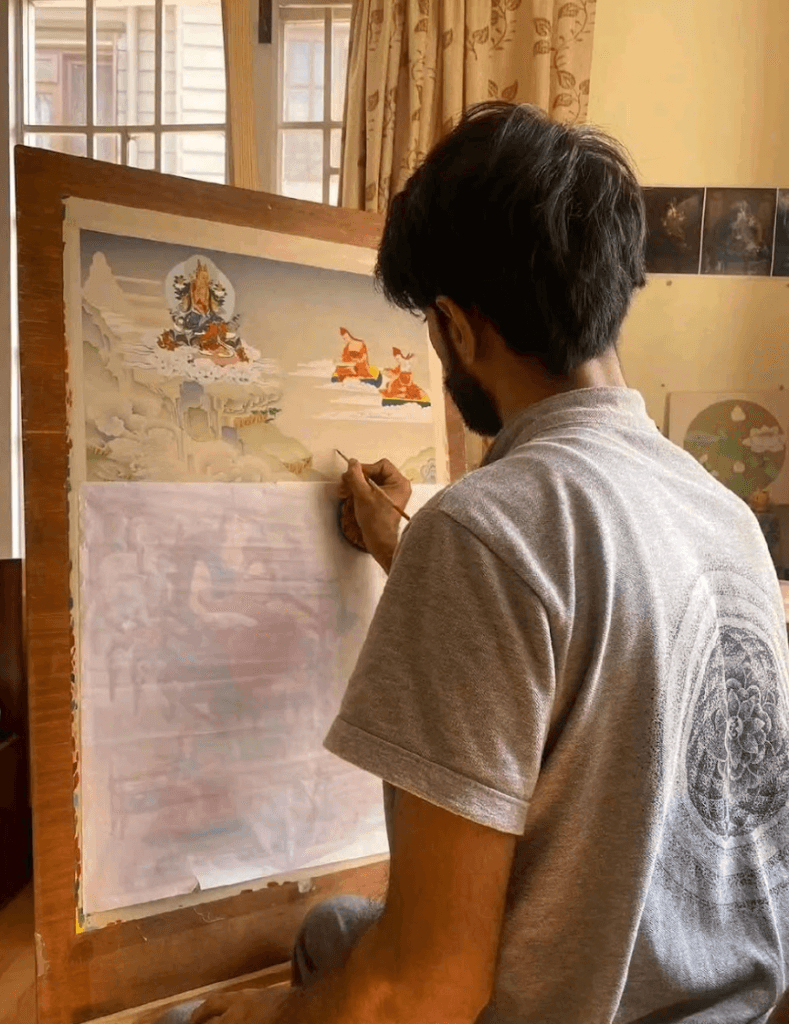
Sahil Bhopal, a thangka painter who lives and works in Kathmandu, came to the same question from a different angle. When he is painting, he said, there are moments when the eye becomes too focused, locked onto a detail, losing the larger form. The remedy, instinctive rather than considered, is to half-close the eyes. “It dissolves the structure of it,” he said, “it dissolves the boundary, so I can just have an overall sense of things.”
Liberation, in Buddhist understanding, means a transformation of one’s relationship to the world, not a withdrawal from it. A Buddha does not disappear into absorption and abandon sentient beings, nor remain caught in the surface of appearances. The half-closed eye holds these together, the visual signature of a mind that sees through phenomena without ceasing to engage with them.
What Sahil does in the studio, anyone can do anywhere. In moments of stress or overwhelm, when the mind narrows and fixes on what is immediately in front of it, the same small adjustment is there for anyone: half-close the eyes, soften the gaze, let the boundaries dissolve a little. The Buddha has been modelling this for more than two thousand years.
Wise Steps
- When your mind feels scattered, lower your gaze slightly and let the eyes rest on one soft point, just as meditation teachers instruct practitioners to avoid being pulled too strongly into movement and light.
- When you stand before a Buddha image, spend a few moments observing the eyes before rushing to pray or take a photo, as the lowered gaze shows how stillness can be present without turning away from life.
Notes:
¹ Lama Zopa Rinpoche, “Painting the Buddha’s Eyes,” Lama Yeshe Wisdom Archive, http://lamayeshe.com/advice/painting-buddha’s-eyes.
² For comparative discussion of the two schools see the MAP Academy entries on the anthropomorphic Buddha (http://mapacademy.io/article/anthropomorphic-buddha) and sculpture at Mathura (http://mapacademy.io/article/sculpture-at-mathura).