

TLDR: Be aware of pride when one shares the Dhamma; Inspire someone’s faith in the Triple Gem rather than personalities.
I still remember the first time someone asked me to share the Dhamma. I panicked a little. I knew the teachings had changed my life, but the idea of speaking about them felt heavy, almost risky. What if I said something wrong? What if I pushed someone away instead of helping them? What if my eagerness came across as pride?
Over the years, through practice, mistakes, and the kindness of my teachers, something changed. I realised that sharing the Dhamma is not about sounding wise or being impressive. It is about meeting another human being with care, clarity, and humility. And it is about remembering that this path has always been meant for the good of the many, not the few.
There’s a line in the Mahāvagga that never fails to inspire me and has been one of my guiding principles. The Buddha told the first 60 monks to go forth “for the good of the many, for the happiness of the many, out of compassion for the world… teach the Dhamma that is beautiful in the beginning, beautiful in the middle, beautiful in the end”.
When I read that for the first time, I felt two things at once. A sense of purpose, because the teachings are meant to be shared. And a sense of responsibility, because how we share them matters just as much as what we share.
I have been reflecting on this a lot, especially when talking to younger practitioners who worry that they are “not good enough” to share anything. So here is my honest account of what I’ve learnt so far, guided by both monastic and lay teachers and blended with the teachings that guided me.
Understanding Why We Share

At the heart of it, I share the Dhamma because of gratitude. Someone took the trouble to teach me when I was seeking answers about life at a young age. Someone planted a seed that later became my refuge. When I remember that, the fear of “not being perfect” softens.
The Dhammapada puts it simply: “The gift of Dhamma excels all gifts”. When someone is suffering, and you offer even a small piece of clarity, it can be life-changing. The taste of Dhamma is the taste of freedom, even if it appears in a single moment of insight now or in the future.
In AN 5.159, the Buddha told Venerable Ānanda that the Dhamma should only be taught when five qualities are present: step-by-step guidance, clear sequence, compassion, no desire for material gain, and no harm to oneself or others. The first 2 qualities are on delivery skills, which we can learn and pick up along the way and which I will cover later, and the next 3 qualities are about intention, which we should constantly be mindful about when we share the Dhamma.
This keeps me grounded and has been my checklist. The moment I feel a bit of pride or a need to be admired, I pause. Teaching becomes unwholesome when it centres around the speaker instead of the Dhamma.
The Buddha says that if someone teaches just to gain followers or praise, the teaching becomes impure. But if they teach because the Dhamma is excellent, and they want others to understand and practise, then the teaching is pure.
It helps to remind myself that I am just a messenger of the Dhamma, for one who is able to share the Dhamma is a blessing and a privilege that we should not take too lightly. The listener should be inspired by the Dhamma, and their faith is to be in the Triple Gem rather than in an individual.
Knowing When to Speak
People sometimes assume that if you know something helpful, you should share it immediately. It is understandable that we are eager to share because of how Dhamma elevates our wisdom and the joy from understanding it. But the suttas offer a more holistic view. In AN 8.78, the Buddha describes the ideal scenario where someone both understands the Dhamma and the practice deeply and can communicate it clearly. They are also able to inspire others in the Dhamma through their own understanding and experience.
Most of us may not fulfil all the criteria yet, but at the very minimum, the Buddha says that someone sharing the Dhamma should be able to speak clearly about the Dhamma and inspire others into the practice.
What this means to me is about sharing what you know honestly. If you know that much, share that much. One can also share from the suttas or teachings from great teachers to inspire others. You can also share your own journey and your own Dhamma experience. I realised that when one shares honestly and sincerely from their own experience and with a heart of compassion, it is often the most beautiful and inspiring.
Delivery skillset – PECS
In one of the suttas (AN8.16), the Buddha talks about 8 qualities that a Bhikkhu should have before going on a mission. These are essentially communication and teachings skills that helps one to share the Dhamma effectively. At the back of my mind, I usually have a rough framework, but the sutta helps me to crystallise the framework properly. I have summarised the 8 qualities into 4 and have come up with the acronym PECS.
P: Preparing the mind
This is the start-point of any Dhamma sharing. We must always check our minds on our intention and motivation to share the Dhamma. It must be a mind filled with kindness and compassion. We need to constantly remind ourselves that we are sharing the Dhamma and not to impose the teachings on other people. We need to learn to listen and respect other people’s points of view, however different they may be.
I often remind myself of the Buddha’s advice in DN 1: If others criticise the Buddha, the Dhamma or the Saṅgha, we shouldn’t react with anger. If they praise, we shouldn’t become overly excited. Both reactions cloud our ability to discern clearly.
One of the guiding principles of Dhamma practice is to unite people and not cause division due to our views. Ajahn Brahm constantly reminds us to be more kind than to be right. I often remind myself that if one goes away feeling negative or angry after the sharing, I would have cut off one avenue for that individual to learn the Dhamma.
E: Encouraging, not pressuring
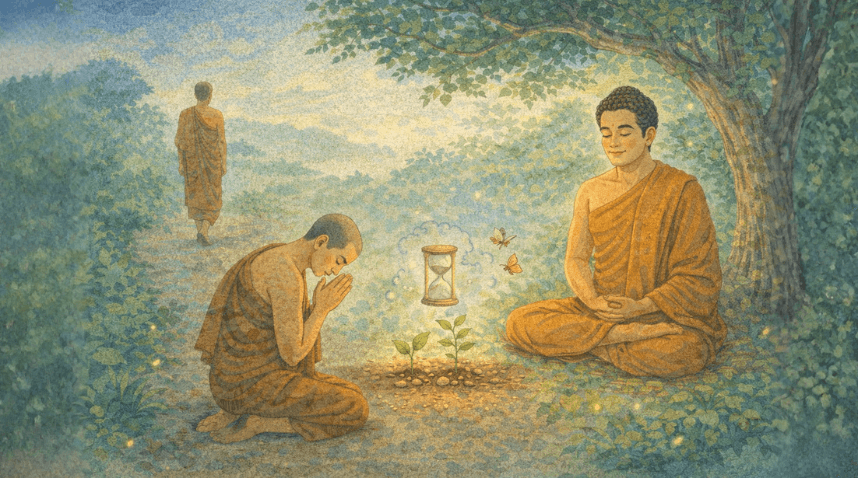
The Buddha never imposed. Even when Venerable Meghiya (AN9.3) insisted on going off alone to meditate against the Buddha’s advice, the Buddha simply said, “Do what you think it is time to do”. And when Meghiya returned disappointed, the Buddha did not scold him. He simply taught him the conditions for spiritual growth.
This story stays with me. It reminds me to respect someone’s conditions. Wisdom grows due to conditions and can’t be forced. Seeds planted today may bloom years later.
So I learn to speak gently and kindly, though sometimes exasperation might arise in me due to my lack of patience. I praise what is wholesome. I try not to use fear or punishment to push someone into belief. Instead, I try to explain to them what is beneficial to them and what is not beneficial to them according to the Buddha. And I never assume that I know what is best for them. If someone disagrees with my view, I let it rest.
Forcing the Dhamma is the quickest way to make someone avoid it.
Most of the time, after a conversation, I thank the person for letting me share. It keeps my own heart soft and grateful.
C: Creating the Right Conditions
Over time, I’ve learnt that conditions matter as much as content. If someone is stressed, distracted, or emotionally charged, they will not absorb even the most profound teaching. The Buddha mentioned that the mind must be soft, malleable and not distracted to hear the teachings
So I pay attention. Is the person relaxed? Are they ready to listen? Are they hungry, tired, or in the middle of something?
I try to keep things light when needed. A little humour goes a long way. Listening well goes even further. And when I notice that someone’s mind is settling, I share a teaching that is appropriate to their conditions.
The Buddha did this beautifully with Bhāradvāja the farmer (Snp1.4). When Bhāradvāja criticised him for not ploughing and planting, the Buddha replied using farming metaphors. Faith as seed, effort as rain, wisdom as the plough, mindfulness as the goad. He relates the teachings to the farmer, exactly how he can understand it in his capacity
This is the kind of skillfulness that I aspire to cultivate. It requires mindfulness and empathy more than knowledge itself.
S: Share Relatable Teachings
I’ve sat through many well-intentioned Dhamma sharings that were full of jargon and complexities. Pāli terms were used excessively without checking the audience’s understanding. Complex ideas delivered rapidly. And the listener was overwhelmed and drowned in the sea of jargon and ideas.
MN 139 makes this very clear: we should not insist on local language or override common lingo. We should speak according to how people normally speak or would understand, without attachment to our preferred terms.
I also try to avoid sharing excessively, which sometimes I admit I fall into the trap because of my overzealous desire to share the Dhamma. I learned that sharing relatable experiences is very useful, and also the gradual path of Dhamma as a guide to see how much I should share is beneficial as well.
The Gradual path:
- Dana – Generosity
- Sila – Morality
- Sagga – Heavenly Rebirth
- Adinava – Danger of Indulgence
- Nekkhamma – Renunciation
- 4 Noble Truths
Let me share with you a funny episode on how I didn’t share relatable teachings. Once, my colleague came up to me and said he wanted to understand more about Kamma. I was so excited that I started to share the concept of Kamma in its most glorious form. After my sharing, I still remember that I was so proud of my sharing. I was so excited that my colleague is so interested in Buddhism, so of course I needed to give my best shot at an explanation. I am so convinced that I had given the most detailed explanation of Kamma that he would have understood.
After the sharing, I asked him for feedback with such esteemed pride. And now here comes the punchline. He apologetically said he actually wanted to know how Gamma works and not how Kamma works. Gamma is a financial term which measures the rate of change. We all had a good laugh. How “relatable” I can be!

There you go! I hope this sharing can help to give some framework on how we can share the Dhamma. I would like to end this by sharing what Ajahn Jayasaro said. He mentioned that we don’t have to be a perfect being to share the Dhamma. If you are ahead of the path, you can help to light up the path for the people who are walking behind you. Share what you know and what works, with honesty and sincerity.
Sabbe sattā sukhitā hontu.
May all beings be well.
Wise Steps
- Prepare your mind by checking for pride or anxiety and softening with three slow breaths, then set the intention “for the good of the many” before you say a word.
- Encourage, not pressure, by asking “Would now be a good time to explore this?” and accept a no with grace, trusting seeds over force.
- Create the right conditions by checking hunger, fatigue, and mood, and if minds are tight, suggest a tea break before any deep sharing.